Negotiation.gr | Strategic Wisdom for the Technological Age
“Strategic resilience emerges when technical capability (techne) is
continuously guided by practical wisdom (phronesis) through adaptive
negotiation across interconnected systems.”
Central Idea (Thesis)
Civilizational competition is increasingly shaped by technological power, cultural identity and geopolitical ambition.
Artificial intelligence introduces a new dimension to this competition, while the possibility of artificial superintelligence raises questions about humanity’s future capacity to control technologies more capable than itself.
Ancient Greek phronesis, particularly as developed by Aristotle, offers a philosophical foundation for evaluating these challenges.
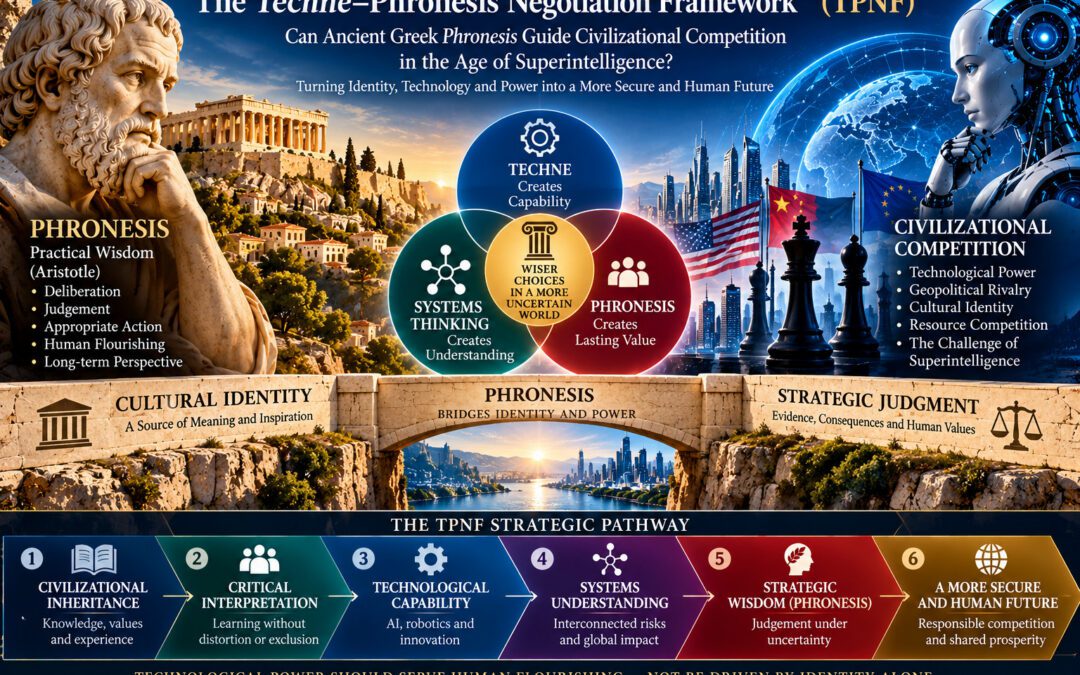
Through the Techne–Phronesis Negotiation Framework™ (TPNF), the central proposition is that civilizational identity can inform strategic purpose, but must never replace evidence, systemic understanding or practical wisdom in determining strategic action.
The challenge is not eliminating cultural identity from decision-making. It is preventing identity from becoming an unquestionable justification for technological competition.
Purpose of the Essay
This TPNF essay examines whether ancient Greek practical wisdom can contribute to managing civilizational competition in the emerging age of advanced artificial intelligence.
It distinguishes cultural inheritance from political rhetoric and explores how technological rivalry can be governed without sacrificing strategic judgement.
Its objective is to develop a TPNF analytical approach connecting civilizational identity, technological capability, Systems Thinking and phronesis.
Abstract
Civilizations draw upon historical achievements, philosophical traditions and cultural identities to define collective purposes.
Political leaders may mobilize these inheritances to justify technological investment, national security policies and geopolitical competition.
However, identity-based narratives can distort strategic assessments when cultural prestige becomes more important than evidence or consequences.
Artificial superintelligence, although hypothetical, intensifies this challenge because competition for technological leadership could encourage excessive risk-taking.
TPNF proposes that responsible civilizational competition requires the integration of technological capability, systemic understanding and practical wisdom.
Phronesis: The Ancient Greek Foundation
In Aristotle’s Nicomachean Ethics, phronesis concerns practical wisdom: the ability to deliberate appropriately about human action and desirable ends.
It differs from technical skill.
A technically competent individual may know how to accomplish an objective without adequately judging whether that objective should be pursued.
Practical wisdom requires attention to circumstances, consequences, experience and human flourishing.
This distinction is essential for contemporary technological governance.
A nation may possess advanced AI capabilities without understanding their full societal implications.
A political leader may invoke civilizational greatness without demonstrating that a proposed policy serves sustainable national interests.
Phronesis therefore provides a discipline of judgement rather than a predetermined political ideology.
Civilizational Identity: Resource or Strategic Constraint?
Civilizational identity can strengthen social cohesion, preserve knowledge and inspire collective achievement.
Ancient Greek philosophy, for example, continues to contribute to education, ethical inquiry and political thought.
However, identity can also become a strategic constraint.
When political actors define technological competition primarily as a struggle between supposedly superior and inferior civilizations, they risk simplifying complex relationships.
Scientific innovation rarely develops within completely isolated cultural systems.
Knowledge advances through research networks, migration, education, investment and international exchange.
A society that treats external knowledge as culturally threatening may weaken its own capacity to innovate.
TPNF therefore distinguishes between identity as a source of strategic meaning and identity as a substitute for strategic analysis.
The first can support progress.
The second can undermine it.
Civilizational Competition and Technological Power
Technological leadership increasingly influences economic productivity, military capabilities and international bargaining power.
Artificial intelligence, advanced semiconductors, robotics, energy infrastructure and computing systems have become important strategic resources.
Governments understandably seek to reduce dangerous dependencies and protect critical technologies.
Yet competition also creates incentives for secrecy, duplication, technological nationalism and accelerated deployment.
These responses may be rational under certain security conditions.
They may also generate collective vulnerabilities.
A country can strengthen its technological position while contributing unintentionally to a less stable international environment.
The relevant strategic question is therefore not simply who develops the most powerful technology first.
It is whether technological advantage can be converted into sustainable security and prosperity.
Techne: Capability Without Guaranteed Control
The first TPNF dimension states:
Technology Creates Capability.
Advanced AI systems already support research, software development, data analysis and increasingly complex automated tasks.
Future systems may become more capable across additional domains.
Artificial superintelligence refers to a hypothetical level of artificial intelligence exceeding human intellectual performance across a broad range of activities.
Its arrival is neither established nor inevitable.
Nevertheless, its possibility raises questions about technical reliability, human oversight and the concentration of power.
A system capable of extraordinary problem-solving would not automatically possess ethical judgement aligned with human purposes.
Technological capability must therefore be distinguished from trustworthy control.
The ability to create a powerful system does not establish the wisdom to deploy it responsibly.
Systems Thinking: Competition Within Interdependent Ecosystems
The second TPNF dimension states:
Systems Thinking Creates Understanding.
Artificial intelligence depends upon interconnected technological and institutional ecosystems.
Semiconductor production, energy supplies, research institutions, cloud infrastructure, skilled personnel and international markets all contribute to its development.
These relationships cross national and cultural boundaries.
A government seeking technological independence must therefore evaluate which dependencies create unacceptable vulnerabilities and which relationships generate valuable cooperation.
Complete isolation may reduce exposure to external pressure but also weaken innovation.
Unrestricted dependence may improve efficiency while creating security risks.
Systems Thinking helps identify these trade-offs.
It also reveals that AI competition can generate consequences beyond individual national strategies.
For example, insufficiently tested systems may create cybersecurity or economic risks that spread internationally.
The strategic environment is therefore simultaneously competitive and interdependent.
The Superintelligence Challenge: A New Strategic Dilemma
The possibility of superintelligence introduces an unusual geopolitical dilemma.
States may believe that achieving technological leadership first could deliver decisive advantages.
This expectation can encourage accelerated development.
However, if development proceeds faster than safety evaluation and institutional preparation, the resulting capabilities may create risks extending beyond national borders.
The dilemma is especially difficult because governments cannot confidently predict future technological breakthroughs.
Strategic planning must therefore distinguish established capabilities from speculative scenarios.
Exaggerating the certainty of superintelligence could distort investment priorities.
Ignoring potentially consequential developments could leave institutions unprepared.
Phronesis requires navigating between these extremes.
It favors neither technological enthusiasm without safeguards nor rejection of innovation through fear.
It demands proportionate decisions under uncertainty.
Cultural Identity and the Danger of Strategic Misjudgment
Civilizational rhetoric can intensify technological competition when leadership is framed as proof of cultural superiority.
Such narratives may mobilize resources.
However, they can also create political pressure to demonstrate technological dominance regardless of readiness.
A government may hesitate to acknowledge technical weaknesses because doing so appears inconsistent with its civilizational ambitions.
Companies may face incentives to announce capabilities before sufficient evaluation.
Public debate may become polarized between technological triumphalism and civilizational anxiety.
These dynamics can widen the TPNF Capability–Wisdom Gap.
The gap emerges when technological power expands faster than the capacity to understand, govern and responsibly employ it.
Strategic wisdom requires institutions capable of correcting mistakes even when correction challenges prestigious political narratives.
Phronesis as a Framework for Responsible Competition
The third TPNF dimension states:
Strategic Wisdom Creates Lasting Value.
Applied to civilizational competition, phronesis suggests several governing principles.
National security concerns should be evaluated through evidence rather than historical symbolism alone.
Technological investment should strengthen productive capabilities and institutional resilience.
International cooperation should remain possible where shared risks exceed the benefits of confrontation.
Human accountability should remain central to consequential decisions.
Political leaders should distinguish legitimate cultural confidence from claims of inherent civilizational superiority.
These principles do not eliminate geopolitical competition.
They help determine how competition can be managed without unnecessarily sacrificing long-term interests.
The Importance of International AI Governance
Existing international initiatives demonstrate that technological competition and shared governance need not be mutually exclusive.
UNESCO’s Recommendation on the Ethics of Artificial Intelligence emphasizes human dignity, transparency, fairness, cultural diversity and human oversight.
Its approach recognizes the importance of different cultural traditions while maintaining universal human-rights protections.
This distinction is relevant to TPNF.
Respect for cultural diversity should not require accepting every identity-based political claim.
Similarly, common governance principles need not eliminate legitimate national differences.
The objective is to establish institutions capable of evaluating technological consequences while accommodating pluralism.
For advanced AI, this may include independent evaluations, incident reporting, research cooperation and mechanisms for addressing cross-border risks.
The TPNF Civilizational Competition–Wisdom Pathway
The preceding analysis suggests a proposed TPNF progression:
Civilizational Inheritance → Critical Interpretation → Technological Capability → Systems Understanding → Strategic Judgement → Responsible Competition → Lasting Value
Civilizational rhetoric may influence this pathway, but should remain subject to critical evaluation.
It is a political instrument, not an independent guarantee of strategic value.
The pathway also emphasizes that strategic wisdom is not merely the final stage of decision-making.
It must continuously inform technological development, institutional design and international negotiation.
Strategic Implications
The implications extend beyond AI governance.
Governments must strengthen technological capabilities without allowing national prestige to override risk assessment.
Research institutions must protect scientific integrity under competitive political pressures.
Companies must recognize that technical performance does not eliminate responsibility for foreseeable consequences.
International organizations must distinguish genuine shared risks from political narratives that exaggerate civilizational divisions.
Above all, societies must preserve the capacity for critical self-examination.
A civilization that cannot question its own strategic assumptions may possess enormous technological resources while remaining vulnerable to avoidable mistakes.
Ancient Greek phronesis cannot provide a complete technical solution to the challenges of artificial superintelligence.
It can, however, contribute a foundational discipline of practical judgement.
Civilizational inheritance offers knowledge and identity.
Technological innovation creates new capabilities.
Systems Thinking clarifies interdependencies and consequences.
Strategic wisdom evaluates how those capabilities should be employed.
TPNF expresses this relationship through its foundational triad:
Technology Creates Capability. Systems Thinking Creates Understanding. Strategic Wisdom Creates Lasting Value.
The future of civilizational competition should not be determined by cultural identity alone, nor by the pursuit of technological superiority at any cost.
It should be shaped by the capacity to exercise power responsibly under conditions of uncertainty.
Key Takeaways
- Ancient Greek phronesis offers a philosophical foundation for responsible strategic judgement.
- Civilizational identity can inspire progress but must not replace evidence-based analysis.
- Artificial superintelligence remains hypothetical, making uncertainty central to strategic planning.
- Technological competition occurs within interconnected international ecosystems.
- The Capability–Wisdom Gap can widen when national prestige overrides safety and institutional accountability.
- Responsible competition requires technological capability, systemic understanding and practical wisdom.
- International cooperation can address shared technological risks without eliminating legitimate national interests.
Author’s Reflection
Ancient Greek philosophy emerged from a civilization that combined extraordinary intellectual achievements with intense political rivalry.
Its enduring contribution was not the elimination of competition, but the development of questions concerning knowledge, justice and responsible human action.
Today, technological civilization confronts an unfamiliar possibility: creating forms of intelligence whose capabilities may eventually exceed our own.
This possibility should encourage neither civilizational arrogance nor strategic paralysis.
It should deepen humanity’s commitment to critical inquiry and practical wisdom.
The challenge is not to abandon cultural identity, but to ensure that identity remains open to evidence, dialogue and responsible judgement.
A civilization demonstrates strategic maturity not when it proves its superiority over others, but when it possesses the wisdom to govern its own power.
Nikolaos Chatzis
Research References
-
Aristotle, Nicomachean Ethics, Book VI — the philosophical distinction between technical skill and practical wisdom.
-
Stanford Encyclopedia of Philosophy — Aristotle’s Ethics — practical judgement, deliberation and human flourishing.
plato.stanford.edu -
Stanford Encyclopedia of Philosophy — Episteme and Techne — distinctions among knowledge, technical skill and practical reasoning.
plato.stanford.edu -
UNESCO — Recommendation on the Ethics of Artificial Intelligence — cultural diversity, human rights, oversight and international cooperation.
Legal Affairs -
Reuters — EU technology chief discusses advanced AI oversight, October 9, 2026 — a contemporary example of the governance challenges associated with increasingly capable AI.
Reuters
Source: Open Sources Analysis, Relative Data Analysis by Nikos Chatzis
© Nikolaos Chatzis. All Rights Reserved.
The Techne–Phronesis Negotiation Framework™
An Integrative Theory of Strategic Negotiation, Complex Adaptive Systems and Practical Wisdom
Technology Creates Capability • Systems Thinking Creates Understanding • Strategic Wisdom Creates Lasting Value.
Negotiation.gr | Strategic Wisdom for the Technological Age