Negotiation.gr | Strategic Wisdom for the Technological Age
“Strategic resilience emerges when technical capability (techne) is
continuously guided by practical wisdom (phronesis) through adaptive
negotiation across interconnected systems.”
Central Idea (Thesis)
The Golden Age of Ancient Athens demonstrated that the strategic value of a city emerges not simply from its buildings, technologies or economic resources, but from the interaction of infrastructure, institutions, knowledge, culture and human participation.
Today, artificial intelligence, robotics, interconnected infrastructure and digital platforms promise to transform major urban centers into smart megacities.
Yet technological sophistication alone cannot guarantee better urban civilization.
Through the Techne–Phronesis Negotiation Framework™ (TPNF), the central proposition is that the city of the future must evolve from technological intelligence toward systemic intelligence and ultimately strategic wisdom.
Ancient Athens offers a historical foundation for examining this transformation—not as a model to reproduce, but as an example of how interconnected urban capabilities can generate extraordinary civilizational value.
Purpose of the Essay
This TPNF essay explores how the institutional, cultural and technological achievements of classical Athens can inform contemporary thinking about smart megacities.
It examines the Acropolis, Ancient Agora and democratic institutions as interconnected elements of an urban ecosystem.
The objective is to identify strategic principles relevant to future cities governed increasingly through artificial intelligence, automated infrastructure and complex technological networks.
Abstract
Ancient Athens achieved remarkable influence through the integration of architecture, commerce, maritime power, education, philosophy and political institutions.
The Acropolis expressed cultural and religious identity. The Ancient Agora supported commercial, administrative and social interaction. Democratic institutions created mechanisms for political participation among eligible citizens.
Modern smart megacities operate at vastly different technological and demographic scales.
Nevertheless, TPNF identifies a common strategic challenge: transforming diverse capabilities into coordinated systems that produce sustainable human value.
The essential distinction is between a technologically connected city and a wisely governed civilization.
Ancient Athens: An Early Integrated Urban Ecosystem
During the fifth century BCE, Athens became a major center of political experimentation, cultural creativity and economic activity.
Its achievements did not emerge from a single technological invention or institution.
They resulted from relationships among maritime trade, public infrastructure, civic institutions, military resources, craftsmanship and intellectual development.
The city’s urban spaces performed complementary functions.
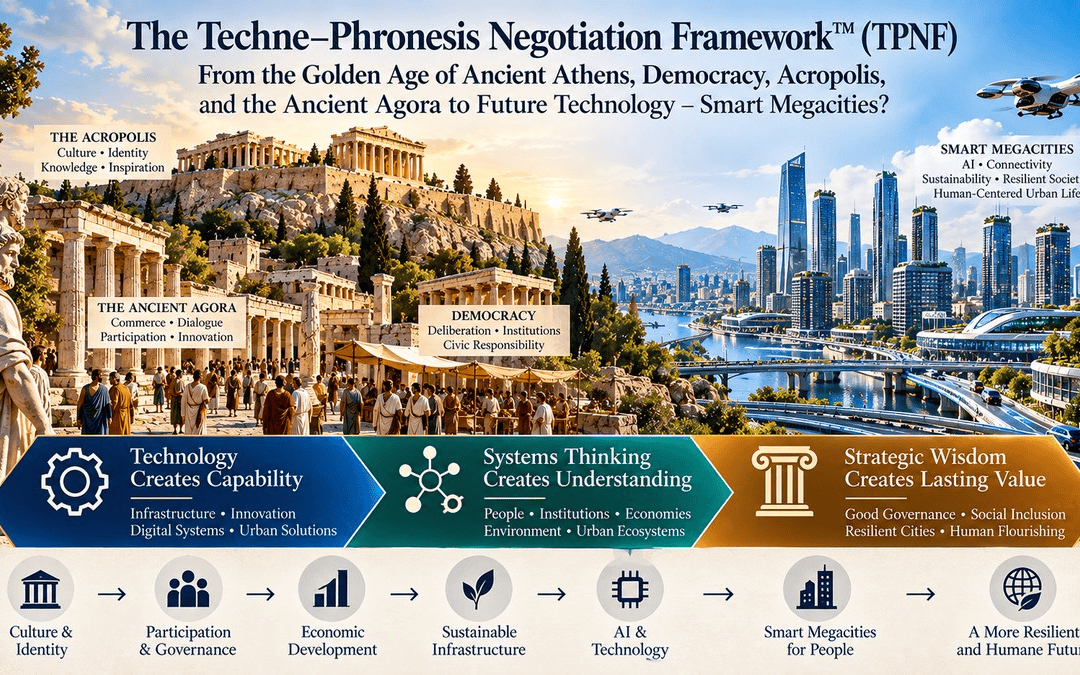
The Acropolis represented sacred identity and monumental architecture.
The Agora connected commerce, administration, justice and everyday interaction.
The Pnyx provided a setting for collective political deliberation.
Together, these spaces supported different dimensions of civic life.
Their significance lies not merely in their physical proximity, but in their complementary institutional functions.
From a TPNF perspective, urban strategic value emerges when distinct capabilities become connected through functioning institutions and shared purposes.
The Acropolis: Technology, Identity and Lasting Value
The Acropolis illustrates how technological capability can acquire meaning beyond its immediate practical function.
Under Pericles, architects, engineers, sculptors and skilled workers transformed an extraordinary architectural vision into enduring monuments.
The Parthenon required sophisticated construction methods, mathematical understanding, logistics and artistic coordination.
Yet its importance cannot be explained by engineering alone.
It represented religious devotion, civic identity, political prestige and cultural ambition.
The Acropolis therefore illustrates a fundamental distinction:
Technology produces an artifact; society determines its meaning and long-term value.
Modern smart megacities face a comparable challenge.
Automated skyscrapers, intelligent transportation systems and digitally managed districts may demonstrate engineering excellence.
But without cultural identity, accessibility and public legitimacy, they risk becoming technologically impressive yet socially disconnected environments.
The Ancient Agora: The Power of Human Connectivity
The Ancient Agora offers a second strategic lesson.
It was a physical environment where commercial exchange, public administration, social interaction and political activity intersected.
Merchants, craftspeople, citizens and visitors participated in different forms of economic and social exchange.
Such interactions helped connect the city’s productive capabilities.
The Agora was not a digital platform, nor should it be described as an ancient smart-city system.
However, it provides a useful analogy for understanding urban connectivity.
Modern cities increasingly rely on digital platforms that coordinate transportation, energy distribution, public services and commercial activity.
These systems can improve efficiency.
Yet efficiency becomes strategically valuable only when people can access, trust and benefit from the services provided.
TPNF therefore distinguishes between technical connectivity and meaningful participation.
A city can be digitally connected while remaining socially fragmented.
Democracy and the Governance of Complexity
Ancient Athens also demonstrates the importance of institutions in managing collective decisions.
Its democracy provided participating citizens with mechanisms for debate, accountability and political choice.
However, Athenian democracy excluded women, enslaved people and resident foreigners from political participation.
This limitation is essential to understanding its historical character.
The lesson for future megacities is therefore not to reproduce Athenian democracy.
It is to recognize that technological systems require legitimate governance.
Artificial intelligence may support urban planning, resource allocation and public administration.
But algorithms cannot independently establish political legitimacy.
Who determines the objectives of an automated transportation system?
Who controls the data collected by intelligent infrastructure?
Who is accountable when algorithmic decisions disadvantage particular communities?
These questions belong to governance, ethics and political judgement.
A smart city becomes a strategically mature city only when technological efficiency operates within accountable institutions.
Techne: The Technological Foundations of Smart Megacities
The first TPNF dimension states:
Technology Creates Capability.
Future megacities may integrate artificial intelligence, robotics, autonomous mobility, smart electricity grids, advanced telecommunications and interconnected environmental monitoring.
Digital twins may allow urban planners to simulate infrastructure performance and evaluate alternative development scenarios.
Intelligent energy systems could help balance electricity demand and supply.
Automated transport networks may improve mobility.
Robotics could support infrastructure maintenance, logistics and emergency response.
These developments offer significant possibilities.
However, each technology introduces dependencies involving cybersecurity, maintenance, energy consumption, investment and human expertise.
A sophisticated technological system can also create new vulnerabilities.
The strategic question is therefore not how many technologies a city possesses, but whether they can operate reliably together.
Systems Thinking: Understanding the Megacity
The second TPNF dimension states:
Systems Thinking Creates Understanding.
A megacity is a complex adaptive system.
Its transportation, housing, energy, water, healthcare, education, economic activity and environmental conditions are interconnected.
An intervention in one sector can produce consequences elsewhere.
For example, expanding autonomous transportation may improve mobility while increasing electricity demand and reshaping employment.
New digital infrastructure may improve public services while creating cybersecurity risks.
Urban redevelopment may stimulate investment while displacing established communities.
These effects cannot be evaluated adequately through isolated technological indicators.
Systems Thinking requires decision-makers to examine interactions, feedback mechanisms and unintended consequences.
The United Nations Human Settlements Programme has emphasized people-centered smart-city development, highlighting digital inclusion, governance, sustainability and resilience.
This reinforces the importance of treating technology as part of a broader urban system rather than as an independent solution.
Phronesis: From Smart Infrastructure to Wise Civilization
The third TPNF dimension states:
Strategic Wisdom Creates Lasting Value.
A technologically intelligent city can collect information and optimize selected operations.
A strategically wise city must also evaluate whether those operations serve legitimate human purposes.
This distinction becomes increasingly important as AI systems influence public administration.
Should urban efficiency take priority over individual privacy?
How should resources be distributed between prosperous and disadvantaged districts?
When should automated recommendations be overridden by accountable human decision-makers?
How should cities balance economic growth, environmental sustainability and social cohesion?
These questions cannot be resolved by computational performance alone.
They require judgement, public deliberation and institutional responsibility.
TPNF therefore proposes that urban intelligence becomes civilizational intelligence only when technological capabilities are guided by systemic understanding and practical wisdom.
The Capability–Wisdom Gap in Future Megacities
Smart megacities may encounter a growing Capability–Wisdom Gap.
This occurs when technological capabilities expand faster than institutions can understand, regulate and responsibly employ them.
A city may possess advanced surveillance technologies without adequate privacy safeguards.
It may deploy automated administrative systems without transparent appeals procedures.
It may attract technological investment without ensuring broad public benefit.
The result can be a city that becomes more technologically capable without becoming more socially resilient.
Closing this gap requires continuous institutional adaptation alongside technological innovation.
Strategic Implications: The TPNF Urban Value Pathway
The comparison between Ancient Athens and future smart megacities suggests a proposed TPNF progression:
Technological Capability → Infrastructure Connectivity → Institutional Coordination → Human Participation → Strategic Wisdom → Lasting Urban Value
This pathway is an analytical proposition rather than a historically proven universal sequence.
Its purpose is to identify the conditions through which urban capabilities may become sustainable societal benefits.
The pathway also suggests that failure in institutional coordination or participation can prevent technological investment from producing lasting value.
Future urban leadership must therefore integrate engineers, planners, policymakers, businesses, researchers and communities.
The Golden Age of Athens demonstrated how architecture, commerce, institutions, culture and human interaction could generate exceptional urban influence.
Its history also reveals the limitations of political exclusion, imperial ambition and strategic miscalculation.
Future smart megacities will possess technological capabilities beyond anything imagined in antiquity.
Nevertheless, their fundamental challenge remains recognizable.
They must transform resources and capabilities into systems that serve human communities.
The TPNF perspective is therefore clear:
Technology Creates Capability. Systems Thinking Creates Understanding. Strategic Wisdom Creates Lasting Value.
The ultimate achievement of future megacities will not be technological sophistication alone, but the creation of resilient, inclusive and wisely governed urban civilizations.
Key Takeaways
- Ancient Athens illustrates the strategic importance of interconnected urban institutions.
- The Acropolis demonstrates how technological achievements can acquire lasting cultural meaning.
- The Agora highlights the difference between connectivity and meaningful participation.
- Democracy provides historical lessons about deliberation, legitimacy and institutional accountability.
- AI, robotics and digital infrastructure create new urban capabilities and dependencies.
- Systems Thinking reveals interactions and unintended consequences across urban networks.
- The Capability–Wisdom Gap threatens technologically advanced but poorly governed cities.
- TPNF proposes an Urban Value Pathway connecting capability with lasting human benefit.
Author’s Reflection
Walking through the Acropolis and the Ancient Agora, one encounters the remains of a civilization whose influence has endured for nearly twenty-five centuries.
Its greatness cannot be reduced to marble monuments or technological craftsmanship.
It also emerged from the relationships between people, institutions, ideas and public spaces.
Today, humanity is preparing to construct urban environments shaped by artificial intelligence, robotics and increasingly autonomous systems.
Yet an essential question remains unanswered.
Will these technologies make cities more efficient, or will they help create better civilizations?
The distinction matters.
The future of urban civilization should not be measured only by the intelligence of its machines, but by the wisdom of the societies that govern them.
Nikolaos Chatzis
Source: Open Sources Analysis, Relative Data Analysis by Nikos Chatzis
© Nikolaos Chatzis. All Rights Reserved.
The Techne–Phronesis Negotiation Framework™
An Integrative Theory of Strategic Negotiation, Complex Adaptive Systems and Practical Wisdom
Technology Creates Capability • Systems Thinking Creates Understanding • Strategic Wisdom Creates Lasting Value.
Negotiation.gr | Strategic Wisdom for the Technological Age