Negotiation.gr | Strategic Wisdom for the Technological Age
“Strategic resilience emerges when technical capability (techne) is
continuously guided by practical wisdom (phronesis) through adaptive
negotiation across interconnected systems.”
Central Idea (Thesis)
More than twenty-three centuries after Plato’s death, humanity confronts a fundamental philosophical question: Can technological intelligence advance civilization without a corresponding development of human wisdom?
Plato (c. 427–347 BCE), influenced by Socrates and later the teacher of Aristotle, helped establish enduring foundations of Western philosophical inquiry.
His investigations into knowledge, truth, justice, education and political responsibility remain relevant to contemporary technological civilization.
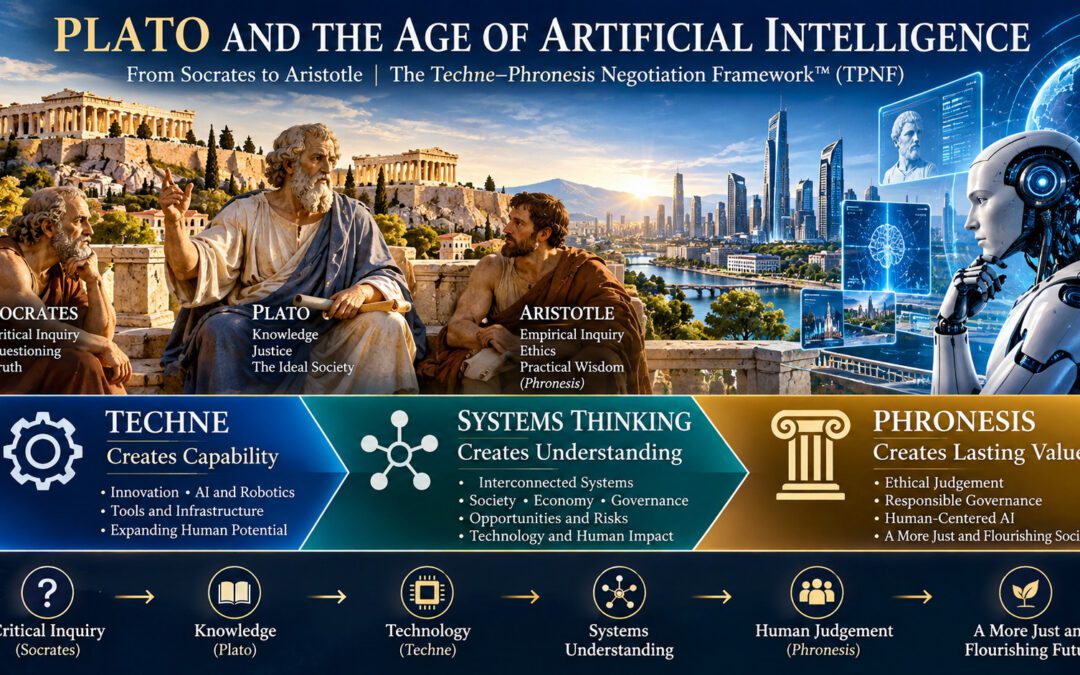
Through the Techne–Phronesis Negotiation Framework™ (TPNF), Plato’s philosophical legacy offers a critical perspective on artificial intelligence, humanoid robotics and the possibility of artificial superintelligence.
The central proposition is that technological progress becomes civilizational progress only when expanding capabilities are accompanied by deeper understanding, responsible institutions and strategic wisdom.
Purpose of the Essay
This TPNF essay examines the intellectual progression from Socrates through Plato to Aristotle and explores its relevance to contemporary technological evolution.
Its purpose is not to suggest that ancient Greek philosophers anticipated artificial intelligence.
Rather, it investigates how their questions about knowledge, human judgement, education and governance can help societies evaluate emerging technological capabilities.
Abstract
Plato’s philosophy emerged from the political, cultural and intellectual environment of classical Athens.
Through his dialogues, he explored the distinction between knowledge and opinion, the nature of justice and the responsibilities of political leadership.
Today, increasingly sophisticated AI systems challenge traditional assumptions about intelligence, expertise, creativity and decision-making.
TPNF connects these developments through three complementary dimensions: Techne, Systems Thinking and Phronesis.
The resulting analytical perspective suggests that the future of technological civilization depends not simply on developing more capable machines, but on strengthening humanity’s ability to understand and govern their consequences.
Socrates, Plato and Aristotle: An Intellectual Continuity
Socrates established a distinctive tradition of philosophical questioning.
Rather than accepting conventional assumptions, he challenged individuals to examine their beliefs, definitions and moral commitments.
Plato developed this intellectual inheritance through philosophical dialogues investigating knowledge, reality, ethics and political organization.
Aristotle, who studied at Plato’s Academy, subsequently developed his own approaches to logic, natural inquiry, ethics and politics.
These thinkers were not interchangeable.
Socrates emphasized critical examination.
Plato investigated the philosophical foundations of knowledge and justice.
Aristotle developed systematic methods for examining nature, human conduct and practical reasoning.
Their intellectual relationship nevertheless demonstrates how philosophical knowledge evolves through questioning, criticism and conceptual refinement.
For TPNF, this progression illustrates an important principle: understanding develops not through accumulating answers alone, but through improving the questions and methods used to evaluate them.
Plato’s Theory of Knowledge and Artificial Intelligence
One of Plato’s enduring contributions concerns the distinction between knowledge and opinion.
In dialogues such as The Republic and Theaetetus, he examined what it means genuinely to know something.
This distinction acquires renewed significance in the age of generative AI.
Modern AI systems can produce sophisticated explanations, analyze large datasets and generate apparently authoritative responses.
However, fluent output does not guarantee factual accuracy, justified conclusions or reliable understanding.
An AI system may generate a persuasive answer containing errors.
It may reproduce biases embedded in its training data.
It may identify statistical relationships without establishing causation.
Plato’s philosophical inquiry therefore suggests a contemporary challenge:
How can societies distinguish the appearance of intelligence from trustworthy knowledge?
The answer requires evidence, verification, critical reasoning and institutional accountability.
The Allegory of the Cave: Information and Reality
Plato’s Allegory of the Cave, presented in The Republic, describes prisoners who mistake shadows for reality.
The allegory explores the difficulty of moving beyond appearances toward deeper understanding.
Its relevance to digital civilization is conceptual rather than literal.
Today, people encounter information through search engines, social platforms, algorithmic recommendations and AI-generated content.
These systems influence what individuals see and how they interpret events.
Yet digitally mediated representations are not necessarily complete or accurate accounts of reality.
The contemporary danger is not simply misinformation.
It is the possibility that technological systems increasingly shape the boundaries of human attention and interpretation.
TPNF identifies the need to move beyond information availability toward critical understanding of the systems producing and distributing information.
The modern equivalent of leaving the cave is not rejecting technology.
It is developing the intellectual capacity to question technologically mediated representations.
Techne: Technology Creates Capability
The first TPNF dimension states:
Technology Creates Capability.
Ancient Greek techne referred broadly to skilled practice, craft and systematic know-how.
Contemporary technological capabilities operate at a scale unimaginable in Plato’s Athens.
Artificial intelligence can support scientific research, medical analysis, engineering design and education.
Robotics increasingly enables machines to perform physical tasks.
Advanced computing expands humanity’s capacity to model complex environments.
Yet technological capability remains different from moral purpose.
A system may optimize a process without determining whether the objective itself is desirable.
An algorithm may improve administrative efficiency while creating unfair outcomes.
A humanoid robot may perform complex activities without possessing human moral responsibility.
The fundamental distinction is between what technology enables and what society should choose to accomplish with it.
Systems Thinking: Understanding Technological Civilization
The second TPNF dimension states:
Systems Thinking Creates Understanding.
Technological evolution does not occur independently of society.
Artificial intelligence depends upon energy infrastructure, semiconductors, research institutions, investment, education and regulatory systems.
Its consequences extend into employment, public administration, security, culture and international relations.
These interconnected relationships create opportunities and vulnerabilities.
For example, AI may improve productivity while altering labor markets.
Automated decision-making may accelerate public services while raising questions about accountability.
Advanced robotics may support healthcare and manufacturing while requiring new safety and workforce arrangements.
Systems Thinking examines these interactions rather than evaluating technologies in isolation.
This complements Plato’s concern with the relationship between individual conduct, education and political institutions, without implying that his philosophy was a modern systems theory.
Plato’s Republic and the Governance of Technology
In The Republic, Plato investigated justice, education and the qualities required for political leadership.
His philosopher-ruler ideal reflected a belief that governing well requires knowledge of the good.
However, Plato’s political proposals also raise serious concerns from modern democratic perspectives, particularly regarding concentrated authority and limited pluralism.
Consequently, his political philosophy should be examined critically rather than adopted as a contemporary governance blueprint.
For AI governance, the relevant question is whether decision-makers possess the understanding necessary to evaluate technologies affecting society.
Technical expertise is essential but insufficient.
Legitimate governance also requires accountability, public participation, rights protection and mechanisms for correcting mistakes.
This distinction becomes particularly important when algorithms influence consequential public decisions.
Expertise can inform legitimate authority, but it cannot independently replace it.
Aristotle, Phronesis and Practical Judgement
Aristotle’s concept of phronesis, developed especially in the Nicomachean Ethics, provides a crucial complement to Plato’s intellectual legacy.
Phronesis concerns practical wisdom: the capacity to deliberate appropriately about human action and the good life.
It differs from technical skill.
A technically competent person may know how to accomplish an objective without adequately judging whether that objective is appropriate.
This distinction is foundational to TPNF.
Technology expands available actions.
Systems Thinking clarifies their interconnections and consequences.
Strategic Wisdom evaluates which actions deserve to be pursued.
In contemporary technological governance, practical judgement becomes especially important when decisions involve uncertainty, competing values and irreversible consequences.
Artificial Superintelligence: Capability Without Guaranteed Wisdom
Artificial superintelligence remains hypothetical.
Nevertheless, its possibility introduces profound questions about future technological civilization.
If artificial systems eventually surpass human performance across broad intellectual domains, their capabilities could transform scientific discovery, economic production and geopolitical competition.
But superior computational capability would not automatically establish moral legitimacy or alignment with human values.
Intelligence and wisdom are not synonymous.
An extremely capable system could pursue objectives whose consequences remain difficult for human institutions to anticipate or control.
TPNF identifies this as a potential Capability–Wisdom Gap.
The gap emerges when technological power expands faster than the capacity to understand, supervise and govern its effects.
Closing it requires technical safeguards, institutional resilience and continuing philosophical inquiry.
Strategic Implications: Human Philosophy as Technological Infrastructure
Modern technological civilization requires more than engineers, programmers and advanced computing systems.
It also requires philosophers, educators, policymakers, scientists and informed citizens capable of evaluating technological consequences.
UNESCO’s Recommendation on the Ethics of Artificial Intelligence emphasizes human dignity, transparency, fairness, accountability and human oversight.
These principles demonstrate that ethical reflection must become part of technological governance rather than an afterthought.
For TPNF, the strategic implication is clear:
Philosophical reasoning should be treated as an essential component of technological civilization’s decision-making infrastructure.
It helps clarify objectives, expose assumptions and evaluate competing visions of human progress.
The TPNF Philosophical–Technological Value Pathway
The relationship between ancient philosophy and contemporary technological evolution suggests a proposed analytical progression:
Critical Inquiry → Knowledge Evaluation → Technological Capability → Systems Understanding → Practical Wisdom → Lasting Civilizational Value
This pathway is not a historical law.
It is a framework for examining how technological societies can integrate intellectual development with expanding capabilities.
Its central requirement is continuous interaction between innovation and critical judgement.
Plato’s enduring importance lies not in providing ready-made answers to modern technological problems, but in demonstrating the necessity of philosophical inquiry.
From Socrates’ questioning to Plato’s investigations of knowledge and justice, and Aristotle’s development of practical wisdom, ancient Greek philosophy established intellectual resources that remain relevant today.
Artificial intelligence and robotics introduce extraordinary new capabilities.
Yet they do not eliminate humanity’s responsibility to determine what constitutes truth, justice and desirable progress.
TPNF expresses this relationship through its foundational triad:
Technology Creates Capability. Systems Thinking Creates Understanding. Strategic Wisdom Creates Lasting Value.
The future of technological civilization will depend not only on the intelligence humanity creates, but on the wisdom it continues to cultivate.
Key Takeaways
- Socrates, Plato and Aristotle established distinct but interconnected traditions of philosophical inquiry.
- Plato’s distinction between knowledge and opinion remains relevant to evaluating AI-generated information.
- The Allegory of the Cave offers a conceptual lens for examining digitally mediated reality.
- Technological capability does not independently determine ethical purpose.
- Systems Thinking connects technological innovation with institutional and societal consequences.
- Aristotle’s phronesis distinguishes practical wisdom from technical expertise.
- Artificial superintelligence raises questions about the relationship between intelligence and responsible governance.
- TPNF identifies philosophical reasoning as essential to sustainable technological civilization.
Author’s Reflection
Plato lived in an Athens shaped by extraordinary intellectual creativity, political conflict and institutional uncertainty.
Today, humanity faces a different transformation, driven by technologies capable of changing how people learn, work, communicate and exercise power.
Yet the philosophical questions remain remarkably familiar.
What constitutes genuine knowledge?
What makes political decisions just?
What responsibilities accompany expanding human capabilities?
The deeper lesson of the Socratic–Platonic–Aristotelian tradition is that progress requires continuous examination of our assumptions.
Technology can expand the boundaries of human possibility.
It cannot relieve humanity of the responsibility to decide which possibilities deserve to become reality.
Perhaps the greatest contribution of ancient Greek philosophy to the technological future is the reminder that civilization must never confuse the power to act with the wisdom to choose.
Nikolaos Chatzis
Research References
-
The Republic — especially Books VI–VII, including the Allegory of the Cave.
-
Theaetetus — Plato’s examination of the nature of knowledge.
-
Nicomachean Ethics — especially Book VI, concerning phronesis.
-
Stanford Encyclopedia of Philosophy — Plato’s Ethics: An Overview.
plato.stanford.edu
Source: Open Sources Analysis, Relative Data Analysis by Nikos Chatzis
© Nikolaos Chatzis. All Rights Reserved.
The Techne–Phronesis Negotiation Framework™
An Integrative Theory of Strategic Negotiation, Complex Adaptive Systems and Practical Wisdom
Technology Creates Capability • Systems Thinking Creates Understanding • Strategic Wisdom Creates Lasting Value.
Negotiation.gr | Strategic Wisdom for the Technological Age