Negotiation.gr | Strategic Wisdom for the Technological Age
“Strategic resilience emerges when technical capability (techne) is
continuously guided by practical wisdom (phronesis) through adaptive
negotiation across interconnected systems.”
Central Idea (Thesis)
Civilizations inherit knowledge, institutions, technologies, philosophical traditions and cultural achievements accumulated across generations.
This inheritance constitutes a strategic resource because societies can draw upon it to develop capabilities, strengthen institutions and shape their futures.
Civilizational rhetoric, however, is different. Political leaders may invoke historical achievements, collective identities and cultural traditions to mobilize societies, legitimize policies or influence international relationships.
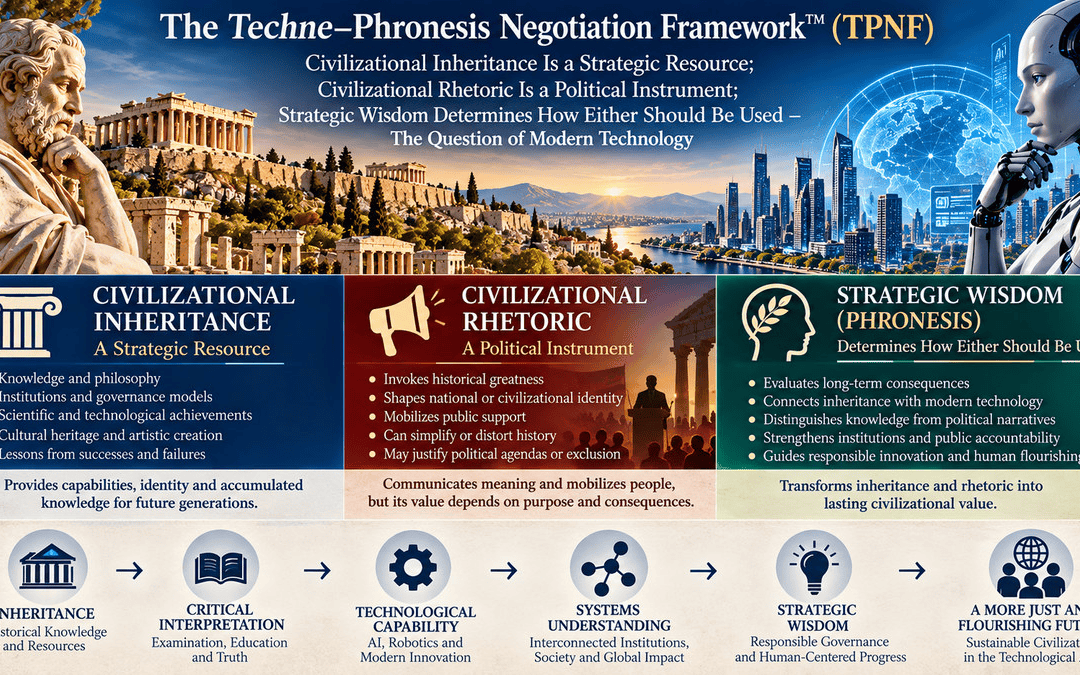
Through the Techne–Phronesis Negotiation Framework™ (TPNF), the central proposition is that civilizational inheritance provides potential value, civilizational rhetoric mobilizes political meaning, and strategic wisdom determines whether either contributes to lasting societal progress.
In the technological age, this distinction becomes essential.
Purpose of the Essay
This TPNF essay examines the relationship between civilizational inheritance, political rhetoric and modern technological evolution.
It investigates how societies can transform historical knowledge into contemporary capabilities while avoiding the instrumentalization of civilization as an unquestionable political justification.
Its purpose is to develop a TPNF analytical distinction between inherited resources, political narratives and the practical wisdom required to govern technological change.
Abstract
Ancient Greek philosophy, Roman law, scientific inquiry, constitutional traditions and successive technological revolutions have contributed to contemporary civilization.
These inheritances are not static possessions. Their value depends upon education, institutional development, critical interpretation and productive application.
Political rhetoric can communicate historical identity and mobilize collective action, but can also simplify history or justify exclusionary policies.
Artificial intelligence, robotics and advanced digital technologies introduce new possibilities for preserving, interpreting and employing civilizational knowledge.
TPNF suggests that technological civilization requires a disciplined relationship among historical inheritance, technological capability, systemic understanding and strategic wisdom.
Civilizational Inheritance: More Than Historical Memory
Civilizational inheritance encompasses accumulated knowledge, institutions, practices, artistic achievements and intellectual traditions.
Ancient Athens provides a powerful example.
Its philosophical inquiries, political experiments, architectural achievements and public spaces influenced subsequent generations.
Yet this inheritance should not be romanticized.
Athenian democracy excluded large sections of its population, while Athens’ imperial ambitions generated conflict and coercion.
Civilizational inheritance therefore includes both achievements and historical failures.
Its strategic value emerges when societies critically examine the past rather than merely celebrate it.
Plato’s investigation of knowledge, Aristotle’s analysis of practical wisdom and the broader Greek tradition of philosophical questioning remain valuable because their ideas can be reconsidered under new circumstances.
Inheritance becomes a strategic resource when historical knowledge is transformed into contemporary understanding and institutional capability.
Civilizational Rhetoric: The Political Construction of Meaning
Civilizational rhetoric operates differently.
Political actors employ references to historical greatness, cultural continuity and collective identity to shape public perceptions.
Such rhetoric can strengthen solidarity, encourage investment in education and reinforce commitments to shared institutions.
It can also selectively present history, exaggerate cultural differences or portray political opponents as threats to civilization itself.
Its strategic effects therefore depend upon purpose, context and institutional safeguards.
Invoking Ancient Greece does not automatically reproduce Greek philosophical reasoning.
Referring to democracy does not necessarily guarantee democratic accountability.
Celebrating scientific achievement does not establish technological competence.
TPNF distinguishes between possessing a historical reference and converting that reference into meaningful contemporary value.
Civilizational rhetoric must therefore be evaluated through its consequences rather than its emotional appeal.
Ancient Greece: Inheritance Without Automatic Superiority
Ancient Greek civilization contributed significantly to philosophy, mathematics, political thought and scientific inquiry.
Its achievements became part of a much broader historical process involving Roman, Byzantine, Islamic, European and other intellectual traditions.
Knowledge developed through preservation, translation, criticism, adaptation and exchange.
This interconnected history challenges the assumption that civilizations evolve through isolated cultural superiority.
Civilizational inheritance is often cumulative and relational.
Its value grows when societies preserve knowledge while remaining open to learning from others.
For TPNF, this illustrates an important principle:
Civilizational strength depends not only on inherited capabilities, but also on the ability to connect inherited knowledge with new ideas and changing environments.
Techne: Transforming Inheritance Into Capability
The first TPNF dimension states:
Technology Creates Capability.
Historical knowledge becomes strategically useful when translated into education, research, engineering, institutions and productive activity.
Modern technologies can expand this process.
Artificial intelligence can assist historical research, analyze digitized archives and support translation.
Digital reconstruction can improve access to archaeological sites and cultural monuments.
Advanced imaging can support the preservation of manuscripts and artworks.
However, technological tools do not independently establish historical truth.
AI-generated interpretations may contain errors, reproduce biases or oversimplify complex cultural traditions.
Human expertise, source criticism and transparent methods remain indispensable.
Technology can expand access to inheritance, but its strategic value depends on the reliability and purposes of its application.
Systems Thinking: Civilization as an Interconnected Ecosystem
The second TPNF dimension states:
Systems Thinking Creates Understanding.
Civilizational inheritance operates through interconnected institutions.
Universities preserve and develop knowledge.
Museums and archives protect historical evidence.
Research institutions generate new understanding.
Governments establish policies affecting education, technology and cultural preservation.
Businesses transform scientific knowledge into products and services.
Citizens participate in interpreting and transmitting cultural traditions.
These relationships create a civilizational knowledge ecosystem.
Technological innovation influences every component.
For example, AI-powered educational systems may expand access to historical knowledge while simultaneously concentrating control over information platforms.
Systems Thinking reveals these interdependencies.
It also demonstrates that preserving heritage without strengthening the institutions capable of interpreting and applying it may produce limited strategic benefit.
Political Rhetoric in the Technological Age
Modern technology dramatically increases the reach of civilizational narratives.
Social media platforms, recommendation algorithms and generative AI can distribute political messages across large audiences.
These systems may improve cultural communication and access to historical knowledge.
They may also amplify selective interpretations, emotional polarization and manipulated representations.
AI-generated images or speeches can make historical narratives appear more authoritative than the underlying evidence justifies.
Consequently, technological capability changes the strategic environment in which civilizational rhetoric operates.
The central question is not whether political leaders should refer to historical traditions.
Historical identity can legitimately inform public debate.
The question is whether technological communication supports informed judgement or substitutes persuasive narratives for critical understanding.
A civilization becomes vulnerable when its historical inheritance is reduced to a political instrument insulated from examination.
Phronesis: Strategic Wisdom as the Governing Principle
The third TPNF dimension states:
Strategic Wisdom Creates Lasting Value.
Phronesis, developed as a concept of practical wisdom in Aristotle’s ethical philosophy, concerns judgement about appropriate action in particular circumstances.
Applied to civilizational inheritance, it requires decision-makers to distinguish between preserving valuable traditions and resisting necessary change.
Applied to political rhetoric, it requires evaluating whether narratives support legitimate objectives, social cohesion and responsible international relations.
Applied to modern technology, it requires assessing consequences beyond immediate performance.
A technologically powerful society may still make poor strategic choices.
It may prioritize prestige over education, surveillance over accountability or political symbolism over institutional resilience.
Strategic wisdom demands that capability remain connected to purpose.
Artificial Intelligence and the Future of Cultural Inheritance
Artificial intelligence creates an important new relationship between civilization and technology.
AI systems can assist in preserving endangered languages, organizing cultural archives and making historical materials more accessible.
Yet the same systems can generate inaccurate historical narratives, marginalize smaller linguistic communities or concentrate cultural influence within dominant platforms.
UNESCO’s 2021 Recommendation on the Ethics of Artificial Intelligence recognizes cultural diversity, human dignity, transparency and human oversight as important governance considerations.
Its provisions also address the use of AI in cultural heritage preservation and the protection of linguistic diversity.
These concerns demonstrate that technological progress must be evaluated within cultural and institutional contexts.
The preservation of civilizational inheritance cannot be separated from the governance of technologies that increasingly mediate access to it.
The Capability–Wisdom Gap
TPNF identifies a recurring danger: the Capability–Wisdom Gap.
This occurs when technological capabilities develop faster than the institutions and judgement required to govern their consequences.
Civilizational rhetoric may widen this gap when historical greatness is presented as sufficient justification for technological or geopolitical ambition.
A society may claim leadership in civilization while neglecting education, scientific integrity or institutional accountability.
Alternatively, strategic wisdom can help narrow the gap by transforming historical inheritance into practical knowledge and responsible innovation.
The decisive issue is not how frequently a civilization invokes its past.
It is how effectively it converts inherited resources into sustainable contemporary achievements.
Strategic Implications: The TPNF Civilizational Value Pathway
The relationship among inheritance, rhetoric and technology suggests a proposed analytical pathway:
Civilizational Inheritance → Critical Interpretation → Technological Capability → Ecosystem Integration → Strategic Wisdom → Lasting Civilizational Value
Political rhetoric can influence this progression by mobilizing resources and public support.
However, rhetoric should not be confused with a necessary stage of value creation.
It is an instrument whose contribution must be assessed independently.
A civilization can preserve and develop its inheritance without relying on grand political narratives.
Conversely, powerful narratives can exist without corresponding institutional achievements.
The distinction is fundamental to responsible strategic analysis.
Civilizational inheritance offers societies a reservoir of knowledge, institutional experience and cultural meaning.
Civilizational rhetoric provides political actors with a means of interpreting and mobilizing that inheritance.
Modern technology expands the possibilities and risks associated with both.
TPNF offers a framework for distinguishing their respective roles.
Technology Creates Capability. Systems Thinking Creates Understanding. Strategic Wisdom Creates Lasting Value.
The future of technological civilization will depend not simply on preserving historical greatness or proclaiming civilizational identity, but on transforming inherited knowledge into responsible institutions, productive capabilities and sustainable human progress.
Key Takeaways
- Civilizational inheritance is a potential strategic resource, not an automatic source of superiority.
- Civilizational rhetoric is a political instrument whose consequences require independent evaluation.
- Ancient Greek achievements offer valuable lessons alongside important historical limitations.
- AI can support cultural preservation while introducing risks of distortion and concentration.
- Systems Thinking reveals the institutions and networks through which inherited knowledge creates value.
- Strategic wisdom distinguishes legitimate historical inspiration from political instrumentalization.
- The Capability–Wisdom Gap can widen when technological ambition exceeds institutional judgement.
- Lasting civilizational value requires critical interpretation, coordination and responsible action.
Author’s Reflection
Civilizations inherit extraordinary achievements from previous generations.
Ancient Greek philosophy remains particularly influential because it encourages inquiry into knowledge, justice, political responsibility and practical wisdom.
Yet inheritance alone cannot determine the future.
Modern societies must decide how to interpret their traditions and employ the technological capabilities now available to them.
Political rhetoric may inspire collective action, but it cannot replace knowledge, institutional competence or responsible judgement.
The central challenge is therefore not whether civilizations should remember their past.
It is whether they possess the wisdom to transform that inheritance into a better future.
A civilization demonstrates its greatness not merely through what it remembers or proclaims, but through what it responsibly creates for generations yet to come.
Nikolaos Chatzis
Research References
The essay’s philosophical distinctions are TPNF analytical propositions. The following sources support its discussion of cultural heritage, technological governance and responsible AI:
-
UNESCO — Recommendation on the Ethics of Artificial Intelligence (2021). Addresses human dignity, cultural diversity, transparency, accountability and AI applications in heritage preservation.
Legal Affairs -
UNESCO — MONDIACULT 2025. Examines cultural rights, digital transformation, AI and culture as a component of sustainable development.
UNESCO -
UNESCO — MONDIACULT 2025 Outcome Document. Establishes a policy context for culture as a global public good and for responsible technological transformation.
UNESCO -
Aristotle, Nicomachean Ethics, Book VI — the classical philosophical treatment of phronesis.
Source: Open Sources Analysis, Relative Data Analysis by Nikos Chatzis
© Nikolaos Chatzis. All Rights Reserved.
The Techne–Phronesis Negotiation Framework™
An Integrative Theory of Strategic Negotiation, Complex Adaptive Systems and Practical Wisdom
Technology Creates Capability • Systems Thinking Creates Understanding • Strategic Wisdom Creates Lasting Value.
Negotiation.gr | Strategic Wisdom for the Technological Age