by Nikos Chatzis | 2 Oct, 2026 | Artificial Intelligence, Strategic Adaptation, Super Intelligence (SI), Technology Ecosystems, The Techne–Phronesis Negotiation Framework™, War, War Robotis
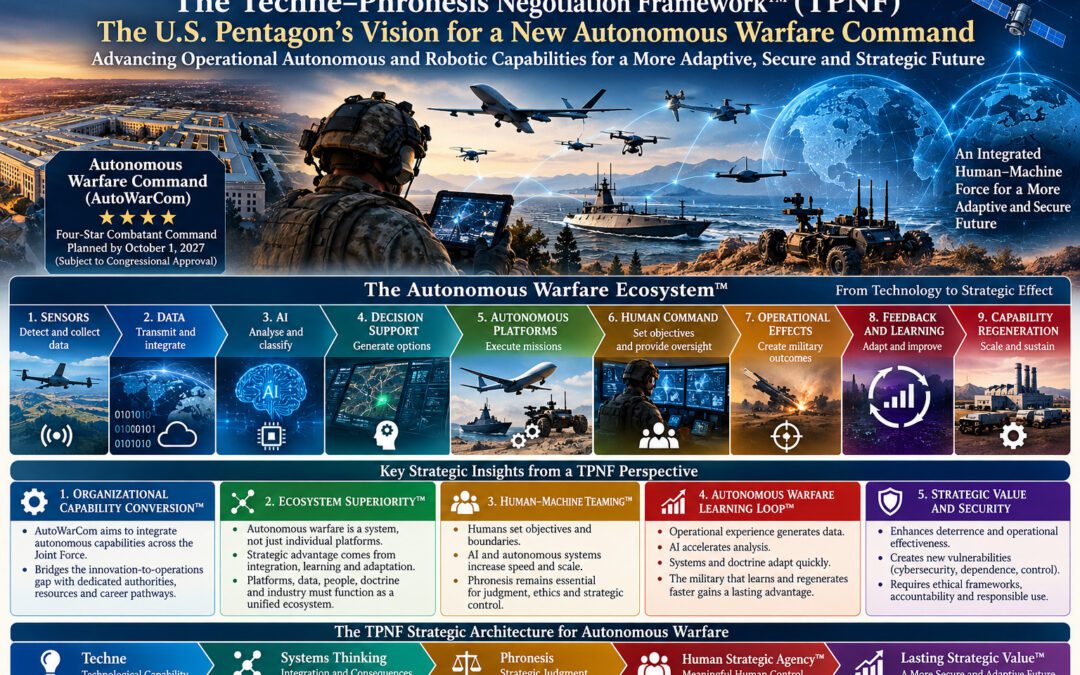
The Pentagon announced plans on September 30, 2026, to establish Autonomous Warfare Command, or AutoWarCom, as a four-star combatant command with service-like authorities. The stated objective is to accelerate and scale autonomous and robotic capabilities across the Joint Force. This essay examines the development through TPNF. The central question is: Does autonomous warfare primarily represent technological evolution, or does it require the emergence of an entirely new military capability ecosystem?

by Nikos Chatzis | 31 Aug, 2026 | Strategic Adaptation, Strategic Analysis, strategic autonomy, Strategic Financial Ecosystems, Strategic Governance, Strategic Leadership, Strategic Management, Sustainability, Sustainable Value Creation, The Techne–Phronesis Negotiation Framework™
This essay examines one of the most fundamental problems of strategy: the conversion of power into sustainable outcomes. Through TPNF, it argues that strategic power must pass through several stages—understanding, orchestration, negotiation, conversion, stabilization and adaptation—before it can generate Lasting Strategic Value™.

by Nikos Chatzis | 14 Aug, 2026 | Platform Ecosystems, Strategic Adaptation, The Techne–Phronesis Negotiation Framework™
The purpose of this essay is to analyze Microsoft’s changing China strategy through the TPNF and explain what it reveals about the future relationship between technology, geopolitics and global business. The essay argues that the emerging U.S.–China technological order should not be interpreted exclusively through the binary concept of decoupling versus globalization. Instead, corporations increasingly need to negotiate where to withdraw, where to remain connected, which dependencies to reduce and which ecosystem relationships continue creating strategic value. Microsoft provides an important contemporary example of this emerging model.
by Nikos Chatzis | 15 Jul, 2026 | Strategic Adaptation, Technological Civilization, The Techne–Phronesis Negotiation Framework™
The purpose of this essay is to present the Techne–Phronesis Negotiation Framework™ (TPNF) as an interdisciplinary conceptual architecture for understanding strategic adaptation in contemporary technological civilization. Rather than offering another sector-specific model, the framework provides an integrative perspective capable of connecting technology, governance, economics, organizational learning, innovation, geopolitics, and human judgment within a coherent theoretical structure. The essay explains the intellectual foundations, conceptual relationships, and practical relevance of the TPNF while positioning it as a framework for analyzing complexity, resilience, and sustainable strategic value creation.