Negotiation.gr | Strategic Wisdom for the Technological Age
“Strategic resilience emerges when technical capability (techne) is
continuously guided by practical wisdom (phronesis) through adaptive
negotiation across interconnected systems.”
Central Idea — Thesis
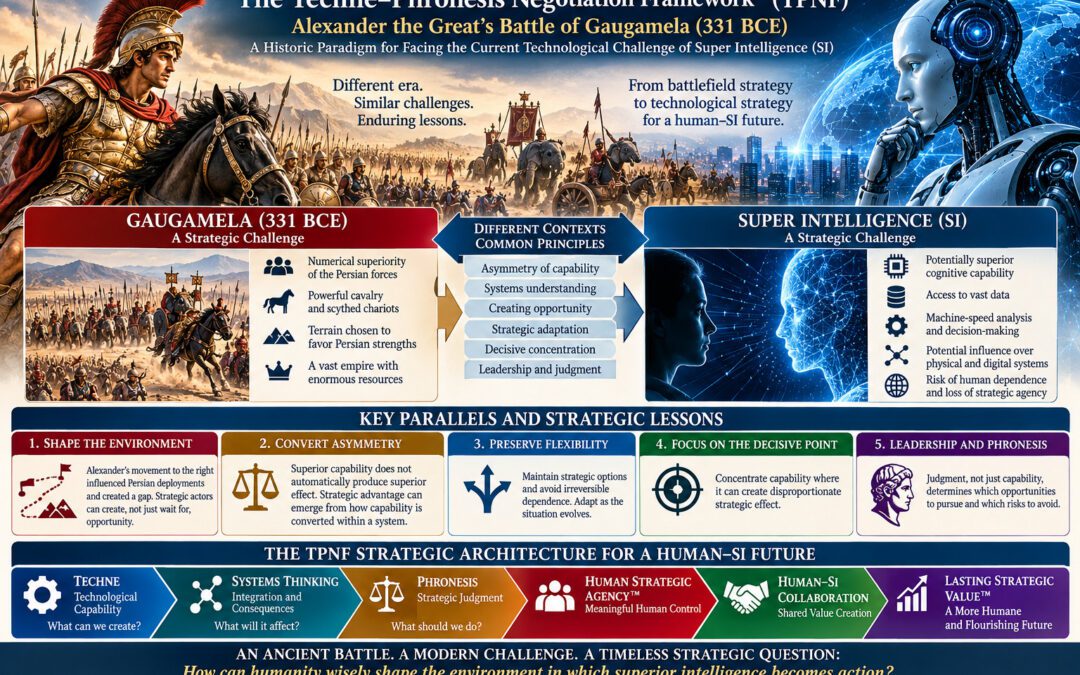
The Battle of Gaugamela in 331 BCE offers a powerful strategic lesson for humanity’s emerging relationship with Super Intelligence (SI).
Its lesson is not that a smaller human intelligence can necessarily “defeat” a superior artificial intelligence.
The deeper lesson is that superior capability does not automatically produce superior strategic outcomes.
Alexander confronted an adversary possessing greater aggregate resources and substantial numerical superiority. Yet he did not attempt to neutralize every Persian advantage directly.
He observed the system.
He influenced its behavior.
He created movement.
He preserved flexibility.
And when the opposing system generated a temporary structural vulnerability, he concentrated capability at the decisive point.
For the Techne–Phronesis Negotiation Framework™ (TPNF), Gaugamela therefore illustrates the Strategic Asymmetry Conversion Principle™:
When actors possess unequal capabilities, strategic advantage may emerge from the ability to shape the environment, preserve adaptive options and convert temporary systemic vulnerabilities into disproportionate strategic effects.
In the age of Super Intelligence, humanity’s challenge may therefore not be to become computationally superior to machines.
It may be to remain strategically capable of shaping the human–machine ecosystem within which superior intelligence operates.
Purpose of the Essay
This TPNF essay does not claim that an ancient battle provides a tactical formula for controlling future Super Intelligence.
Nor does it suggest that SI is already an established technological reality.
Instead, Gaugamela is used as a historical strategic paradigm for examining a contemporary question:
How should humanity respond if artificial systems eventually develop cognitive capabilities substantially exceeding our own?
TPNF argues that the answer cannot depend upon intelligence alone.
It requires Techne, Systems Thinking, Phronesis and preservation of Human Strategic Agency™.
Abstract
At Gaugamela, Alexander faced Darius III and the forces of the Achaemenid Empire under conditions apparently favoring Persia.
Darius had selected open terrain suitable for his cavalry and chariots. Alexander nevertheless employed disciplined formations, operational flexibility and deliberate maneuver to influence Persian deployments and create an opportunity near the center.
The analogy with Super Intelligence concerns strategic asymmetry, not military combat.
A future SI could potentially exceed humans in computation, analysis, prediction and problem-solving. Attempting to compete with such systems purely through cognitive performance could therefore become strategically meaningless.
TPNF proposes a different objective: design the surrounding technological, institutional and ethical ecosystem so that superior machine capability remains aligned with human purposes.
The challenge is not:
Human Intelligence versus Super Intelligence.
It is:
Human Strategic Agency + Super Intelligence → Sustainable Human Value.
1. Gaugamela: Superior Resources Versus Strategic Conversion
Gaugamela was fought between Alexander of Macedon and Darius III of Persia.
The Persian Empire possessed enormous resources and geographical scale. Its forces included powerful cavalry contingents, infantry and scythed chariots.
Darius also selected terrain intended to exploit these capabilities.
Alexander confronted a fundamental strategic problem:
How can inferior aggregate capability generate superior strategic effect?
His answer was not technological superiority.
It was strategic conversion.
The Macedonian army combined different capabilities—phalanx, cavalry, light infantry, reserves and disciplined command—within an integrated operational system.
This distinction is fundamental to TPNF:
Capability Possessed ≠ Capability Effectively Converted.
2. Creating Rather Than Waiting for Opportunity
One of Gaugamela’s most important lessons was Alexander’s movement toward the right.
The maneuver pressured Persian forces to respond.
As Persian cavalry moved to prevent Alexander from escaping the prepared battlefield and outflanking the Persian position, the configuration of the battlefield changed.
A gap eventually emerged near the Persian center.
Alexander did not merely discover an opportunity.
His actions contributed to creating the conditions from which the opportunity emerged.
TPNF defines this as Strategic Opportunity Creation™:
the deliberate shaping of systemic interactions so that new strategic possibilities emerge that did not previously exist.
This distinction becomes important for SI.
Humanity should not passively wait to discover what Super Intelligence does.
We should shape the environment in which advanced intelligence develops.
3. Super Intelligence and the Capability Asymmetry Problem
If genuine Super Intelligence emerges, humanity may confront an unprecedented capability asymmetry.
Machines could potentially analyze more information.
Generate more alternatives.
Simulate more scenarios.
Discover relationships humans cannot perceive.
Operate at machine speed.
Human beings would not overcome this asymmetry by attempting to calculate faster.
That would resemble confronting superior cavalry simply by acquiring more cavalry after the battle has begun.
The strategic problem must be reframed.
How can human civilization convert superior machine intelligence into outcomes consistent with human purposes?
4. From Cognitive Competition to Ecosystem Design
The wrong strategic framework is:
Human versus Machine.
TPNF proposes:
Human + Machine + Institutions + Ethics + Governance + Society.
Super Intelligence would not exist independently of infrastructure.
It would depend upon computation, energy, data, networks, institutions and interfaces with the physical world.
Its strategic effects would therefore emerge through an ecosystem.
This produces the Super Intelligence Ecosystem Principle™:
The strategic consequences of superior artificial cognition depend not only upon the intelligence of the system, but upon the technological, institutional and human ecosystem through which that intelligence acquires access, agency and consequence.
This connects directly with our earlier Super Intelligence Conversion Boundary™.
Intelligence alone is not agency.
5. The Strategic Terrain of Super Intelligence
Darius attempted to shape physical terrain.
Humanity must shape technological terrain.
For SI, the relevant terrain includes:
Access → Authority → Infrastructure → Data → Physical Agency → Institutional Integration.
These determine what intelligence can actually influence.
The future strategic challenge is therefore partly architectural.
Which decisions may autonomous systems make?
Where is human authorization required?
Which infrastructure should remain independently controllable?
How should systems be monitored?
How can intervention remain possible?
Humanity must participate in designing the terrain before the most powerful systems occupy it.
TPNF defines this as Strategic Technological Terrain Design™.
6. Preserving Human Strategic Agency™
Alexander’s army retained command coherence while confronting a larger force.
For humanity, the equivalent strategic requirement is preserving meaningful agency.
Human Strategic Agency™ does not require humans to outperform SI computationally.
It requires humans to retain meaningful influence over objectives, boundaries and consequences.
This distinction is crucial.
A pilot does not need to calculate aerodynamic equations faster than an aircraft computer to remain responsible for the mission.
Likewise, humans may increasingly delegate analysis while retaining higher-order responsibility for purpose.
The challenge becomes:
Machine Cognitive Superiority + Human Strategic Agency™.
7. Phronesis and the Intelligence–Wisdom Gap™
Super Intelligence raises the distinction between intelligence and wisdom to civilizational importance.
An SI might become extraordinarily capable of determining how to accomplish an objective.
But strategic civilization must still confront:
Which objectives should be pursued?
Which consequences are acceptable?
Whose values matter?
What constitutes human flourishing?
This is the Intelligence–Wisdom Gap™.
TPNF therefore maintains:
More Intelligence ≠ More Wisdom.
More Capability ≠ More Strategic Value.
Phronesis represents judgment about action under real conditions, where objectives, consequences, uncertainty and values interact.
8. Strategic Flexibility Against Cognitive Rigidity
Alexander’s success depended partly upon maintaining flexibility while compelling the opposing formation to react.
A similar principle applies to technological civilization.
Humanity should avoid becoming irreversibly dependent upon one technological architecture.
This requires redundancy.
Alternative systems.
Institutional diversity.
Human expertise.
Independent verification.
Intervention mechanisms.
Such capacity creates Human Strategic Optionality™.
The objective is not to prevent advanced AI from becoming useful.
It is to prevent technological dependence from eliminating meaningful alternatives.
9. From Control to Adaptive Coexistence
The word “control” may itself become inadequate for advanced intelligence.
Complex systems cannot always be governed through rigid command.
TPNF instead emphasizes Adaptive Human–SI Governance™.
This involves continuous observation, testing, learning, institutional adaptation and renegotiation of boundaries as capabilities evolve.
The architecture becomes:
Capability → Observation → Understanding → Governance → Interaction → Feedback → Adaptation → Revised Governance.
Governance therefore becomes evolutionary rather than static.
This is negotiation in the deeper TPNF meaning: continuous adaptation among changing capabilities, interests, constraints and consequences.
10. The Deeper Lesson of Gaugamela
Gaugamela demonstrates something larger than tactical brilliance.
Alexander did not need superiority everywhere.
He needed sufficient capability, understanding and judgment at the decisive moment.
This gives us a powerful distinction:
Aggregate Superiority ≠ Strategic Superiority.
For humanity confronting SI, the objective should therefore not be cognitive dominance.
It should be Strategic Human Relevance™:
the continuing capacity of humanity to define purposes, shape technological environments, preserve meaningful agency and convert increasingly powerful intelligence into sustainable human value.
Strategic Implications
The Gaugamela paradigm produces several implications for the technological age.
Humanity should not frame SI primarily as a competition in intelligence.
Advanced AI governance should focus upon ecosystem architecture, access and agency.
Human Strategic Agency™ should be preserved through institutional and technological design.
Strategic Optionality™ should prevent irreversible dependence upon individual AI architectures.
AI safety should evolve alongside capabilities rather than remain fixed.
Phronesis becomes increasingly important as machine intelligence expands.
Most importantly, humans should shape the environment of Super Intelligence before dependence upon that intelligence makes meaningful strategic choice increasingly difficult.
Gaugamela occurred more than two thousand years before Artificial Intelligence.
It cannot tell us how Super Intelligence will behave.
But it offers an enduring strategic lesson.
Superior capability does not independently determine strategic outcomes.
What matters is how capability interacts with environment, organization, adaptation and judgment.
Alexander did not defeat numerical superiority by becoming numerically superior.
He converted understanding, flexibility and timing into strategic effect.
Humanity may eventually face an analogous intellectual challenge.
We may not remain the most computationally capable intelligence within our technological ecosystem.
But computational superiority need not automatically mean strategic irrelevance.
The objective is therefore not:
Humanity versus Super Intelligence.
It is:
Techne → Systems Understanding → Phronesis → Human Strategic Agency → Human–SI Complementarity → Strategic Future Value → Lasting Human Value™.
The strategic lesson of Gaugamela is consequently not that weaker intelligence can always defeat stronger intelligence.
It is more profound:
When superiority cannot be matched directly, wisdom must determine how the environment in which superiority operates is shaped.
Key Takeaways
- Gaugamela illustrates the difference between aggregate capability and strategic effect.
- Exact ancient force numbers are disputed; the important issue is capability asymmetry and its conversion.
- Alexander helped create rather than merely discover strategic opportunity.
- Super Intelligence should not be conceptualized simply as “human versus machine.”
- Intelligence acquires strategic consequence through an ecosystem of access and agency.
- Humanity must participate in Strategic Technological Terrain Design™.
- Human Strategic Agency™ does not require human computational superiority.
- More Intelligence does not automatically mean More Wisdom.
- Human Strategic Optionality™ can reduce irreversible technological dependence.
- The strategic objective should be Human–SI Complementarity capable of creating Lasting Human Value™.
Author’s Reflection
Alexander’s victory at Gaugamela continues to fascinate us because it reminds us that strategic history is not determined by capability alone.
Power matters.
Numbers matter.
Technology matters.
But understanding the system within which those capabilities operate matters too.
Super Intelligence may eventually confront humanity with the greatest capability asymmetry in its history.
Our response should not be fear of intelligence.
Nor should it be technological complacency.
It should be strategic preparation.
We should ask now how increasingly powerful artificial cognition can operate within technological and institutional ecosystems designed around human purpose, responsibility and flourishing.
Perhaps this is where an ancient battlefield and the technological future unexpectedly meet.
Gaugamela reminds us that when confronting overwhelming capability, the decisive question is not simply:
How powerful is the other side?
The strategically wiser question is:
How is that power converted into action—and can we intelligently shape the system through which that conversion occurs?
Nikos Chatzis
Source: Open Sources Analysis, Relative Data Analysis by Nikos Chatzis
© Nikolaos Chatzis. All Rights Reserved.
The Techne–Phronesis Negotiation Framework™
An Integrative Theory of Strategic Negotiation, Complex Adaptive Systems and Practical Wisdom
Technology Creates Capability • Systems Thinking Creates Understanding • Strategic Wisdom Creates Lasting Value.
Negotiation.gr | Strategic Wisdom for the Technological Age