Negotiation.gr | Strategic Wisdom for the Technological Age
“Strategic resilience emerges when technical capability (techne) is
continuously guided by practical wisdom (phronesis) through adaptive
negotiation across interconnected systems.”
Central Idea — Thesis
The greatest challenge of the technological age may ultimately not be technological.
It may be philosophical.
Artificial Intelligence, robotics, biotechnology, quantum computing and increasingly autonomous systems are rapidly expanding what humanity can do.
But technological capability cannot independently determine what humanity should do.
More than two millennia ago, Ancient Greek philosophers examined questions that remain fundamental:
What is a good human life?
What is justice?
What is virtue?
What is knowledge?
What responsibilities do individuals have toward society?
And how should human beings exercise judgment when confronting uncertainty?
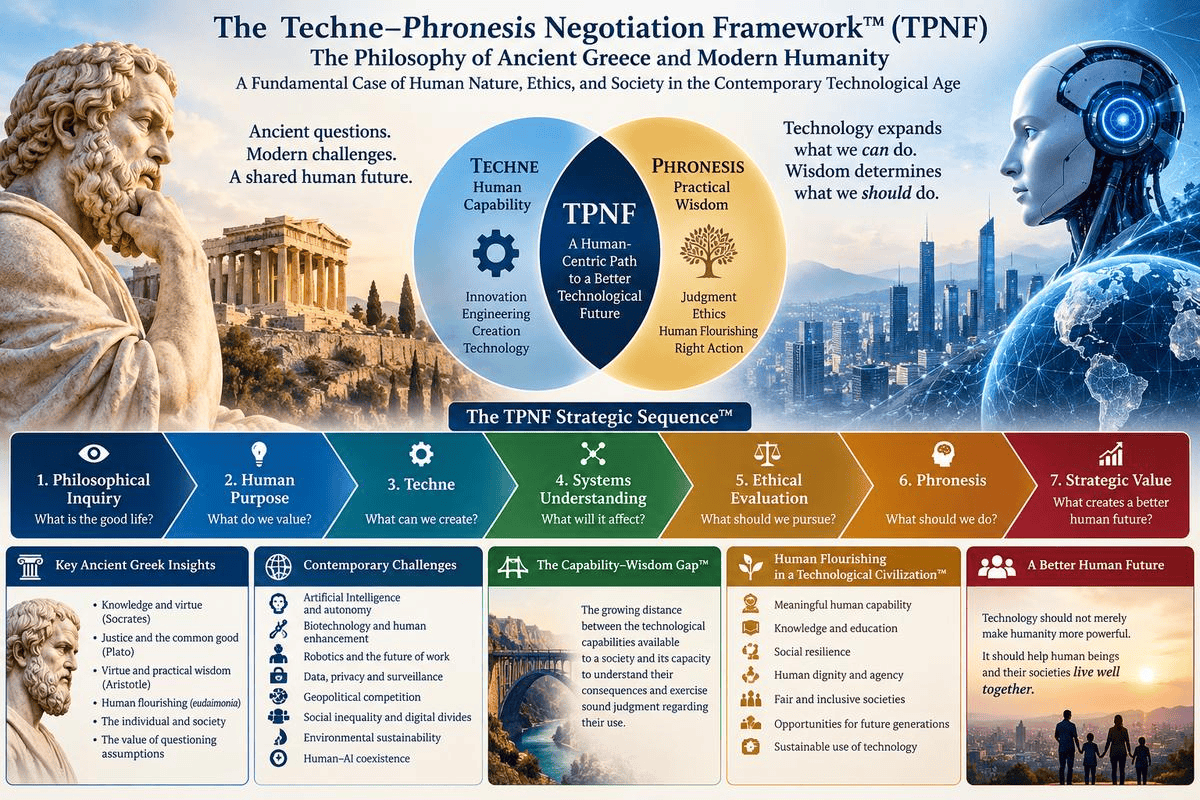
The Techne–Phronesis Negotiation Framework™ (TPNF) argues that these questions acquire renewed strategic importance precisely because modern technology magnifies human capability.
The more powerful our Techne becomes, the greater becomes our need for Phronesis.
Purpose of the Essay
This essay does not claim that Ancient Greek philosophy contains ready-made answers to Artificial Intelligence, robotics or contemporary technological governance.
It proposes something different.
Ancient Greek philosophical inquiry created enduring intellectual methods for examining human nature, ethics, knowledge, society and practical judgment.
TPNF argues that these questions can provide Strategic Intellectual Infrastructure™ for evaluating the purposes and consequences of technological civilization.
The central challenge becomes:
How can humanity ensure that technological evolution contributes not merely to greater capability, but to better human and societal outcomes?
Abstract
Modern technological civilization increasingly confronts a fundamental asymmetry.
Humanity’s capacity to create technological power may be developing faster than its collective capacity to determine how that power should be used.
Ancient Greek philosophy offers no technological blueprint for resolving this challenge.
It offers something potentially more durable: systematic inquiry into knowledge, virtue, justice, human flourishing and practical wisdom.
TPNF defines the growing separation between technological capability and the wisdom required to govern it as the Capability–Wisdom Gap™.
Bridging this gap requires the integration of Techne, Systems Thinking and Phronesis.
Technology creates capability.
Systems Thinking reveals consequences and interdependencies.
Strategic Wisdom evaluates purpose, proportionality and long-term value.
The ultimate objective of technological progress should therefore not simply be increasingly powerful civilization, but Human Flourishing in a Technological Civilization™.
1. Ancient Philosophy and the Question of the Human Being
Ancient Greek philosophy repeatedly returned to the human condition.
Socratic inquiry challenged assumptions about knowledge and virtue.
Plato examined justice, political organization, knowledge and the relationship between the individual and society.
Aristotle investigated virtue, practical wisdom, friendship, politics and eudaimonia—human flourishing.
These philosophers disagreed profoundly.
That disagreement itself matters.
Philosophy was not merely the transmission of answers.
It institutionalized the questioning of answers.
For TPNF, this becomes strategically significant because technological societies must continually question assumptions about progress.
2. Techne: The Expanding Domain of Human Capability
The Greek concept of techne concerned skilled making, craft and practical knowledge.
Modern technological civilization has expanded Techne beyond anything imaginable in antiquity.
Humanity can manipulate atoms.
Edit genes.
Observe distant galaxies.
Build autonomous machines.
Create artificial cognition.
Potentially develop Super Intelligence.
Each development expands the Human Capability Frontier™.
But capability answers only one question:
What can we do?
It does not necessarily answer:
What should we do?
This distinction lies at the heart of TPNF.
3. The Capability–Wisdom Gap™
TPNF defines the Capability–Wisdom Gap™ as:
the distance between the technological capabilities available to a society and its capacity to understand their systemic consequences and exercise sound judgment regarding their use.
The gap becomes increasingly important as technology gains scale, speed and autonomy.
A poorly judged decision involving simple technology may produce limited consequences.
A poorly judged decision involving Artificial Intelligence, autonomous weapons, biotechnology or critical digital infrastructure can generate effects across entire ecosystems.
Technology therefore amplifies not only human capability.
It can amplify the consequences of human judgment.
4. Aristotle and Phronesis
Among the most important ancient concepts for TPNF is Aristotle’s phronesis—practical wisdom.
Phronesis is not simply intelligence.
It is not technical expertise.
It is not possession of information.
It concerns judgment about action within concrete circumstances.
This distinction becomes remarkably important in an age of AI.
A machine may process more information than a human.
It may calculate faster.
It may identify patterns invisible to unaided cognition.
Yet the strategic question remains:
What outcome should be pursued?
This leads to a fundamental TPNF sequence:
Data → Knowledge → Understanding → Judgment → Action → Consequence.
Increasing capacity at the beginning of the chain does not automatically guarantee wisdom at the end.
5. Human Nature in the Technological Age
Technology does not enter an empty world.
It enters human society.
Humans cooperate and compete.
We seek recognition.
We pursue interests.
We form communities.
We experience fear, ambition, hope, loyalty and uncertainty.
Advanced technology interacts with these enduring dimensions of human behavior.
Artificial Intelligence may therefore transform the instruments of human action without automatically transforming human nature.
TPNF calls this the Human Nature–Technology Continuity Paradox™:
technological systems may evolve radically while fundamental human motivations and social tensions evolve far more slowly.
The faster technology changes, the more important understanding human behavior may become.
6. Ethics as Strategic Infrastructure
Ethics is sometimes treated as a restriction imposed after technological innovation.
TPNF proposes a different interpretation.
Ethics can function as Strategic Infrastructure™.
Trust enables adoption.
Fairness strengthens legitimacy.
Accountability supports institutional resilience.
Human dignity provides boundaries around technological optimization.
Ethical reasoning therefore does not necessarily oppose innovation.
It can help determine whether innovation becomes socially sustainable.
A technology rejected by society may possess extraordinary technical capability but limited Lasting Strategic Value™.
7. From Intelligence to Wisdom
Artificial Intelligence makes the ancient distinction between intelligence and wisdom increasingly urgent.
AI can expand analytical capability.
Future systems may exceed humans across broad cognitive domains.
But:
More Data ≠ More Knowledge.
More Intelligence ≠ More Wisdom.
More Capability ≠ More Strategic Value.
These distinctions form an emerging TPNF philosophical architecture.
Technological civilization increasingly needs mechanisms capable of converting expanding intelligence into responsible judgment.
This is the Intelligence–Wisdom Conversion Challenge™.
8. Society as a Human–Technology Ecosystem™
Aristotle connected ethical life with political and social organization; his ethical inquiry into living well leads directly toward questions about the forms of community within which flourishing becomes possible.
Modern societies are vastly different from the ancient polis.
Yet the systemic insight remains relevant:
human flourishing occurs within social structures.
Today those structures increasingly include technological systems.
Platforms influence communication.
Algorithms influence information.
AI influences decisions.
Robotics influences work.
Digital infrastructure influences economic participation.
Society therefore increasingly becomes a Human–Technology Ecosystem™.
The strategic question is no longer simply how humans organize society.
It is how humans and technologies together reshape the conditions under which society operates.
9. Human Flourishing as the Long-Term Criterion
Technological progress is frequently measured through performance.
Faster processors.
Larger models.
Greater productivity.
More automation.
Higher efficiency.
These measures matter.
But they remain incomplete.
TPNF proposes Human Flourishing™ as a higher-order criterion for evaluating Long-Term Strategic Value.
Does technology expand meaningful human capability?
Does it improve knowledge?
Does it strengthen social resilience?
Does it preserve meaningful human agency?
Does it create opportunities for future generations?
Does it contribute to societies capable of adapting without sacrificing human dignity?
These questions move evaluation from technological performance toward civilizational value.
10. A TPNF Architecture for Technological Civilization
Ancient philosophy and contemporary technology can therefore be connected without confusing their historical contexts.
The architecture becomes:
Philosophical Inquiry → Human Purpose → Techne → Capability → Systems Understanding → Ethical Evaluation → Phronesis → Strategic Judgment → Action → Consequences → Learning → Adaptation → Human Flourishing → Lasting Strategic Value™.
Technology remains essential.
But it becomes part of a larger human system.
TPNF therefore rejects both technological pessimism and technological determinism.
Technology does not inevitably destroy human values.
Nor does technological progress automatically create a better civilization.
The outcome depends upon Strategic Conversion™.
Strategic Implications
Several implications follow.
First, technological education should not separate engineering completely from philosophy, ethics and systems thinking.
Second, Artificial Intelligence makes human judgment more—not less—important as analytical capability becomes abundant.
Third, ethics should be incorporated into technological strategy before deployment rather than added after problems emerge.
Fourth, societies should evaluate technology through human and systemic outcomes, not performance alone.
Fifth, preserving Human Strategic Agency™ becomes increasingly important as machines acquire greater cognitive and physical agency.
Finally, technological leadership without philosophical capacity may produce powerful systems without adequate understanding of their purposes.
Ancient Greek philosophy cannot tell us how to program Artificial Intelligence.
It cannot design humanoid robots.
It cannot solve quantum computing.
It cannot provide regulatory rules for technologies that did not exist.
But it can remind technological civilization of something more fundamental.
Before asking what machines can do, humanity must continue asking what human beings should value.
Before optimizing systems, we must determine what purposes deserve optimization.
Before expanding capability, we must consider consequences.
Techne creates capability.
Systems Thinking creates understanding.
Phronesis creates the possibility of wise strategic judgment.
The fundamental challenge of the contemporary technological age is therefore not choosing between philosophy and technology.
It is reconnecting them.
Because the ultimate measure of technological civilization may not be the intelligence of its machines, the speed of its computers or the sophistication of its robots.
It may be whether increasingly extraordinary technological capabilities help human beings and their societies live well.
Key Takeaways
- Ancient Greek philosophy provides questions and methods, not ready-made technological answers.
- Technological civilization faces a growing Capability–Wisdom Gap™.
- Techne concerns capability; Phronesis concerns practical judgment.
- Technology can amplify the consequences of both good and poor human judgment.
- The Human Nature–Technology Continuity Paradox™ explains why technological change does not eliminate enduring human motivations.
- Ethics can operate as Strategic Infrastructure™ rather than merely technological restriction.
- More Intelligence does not automatically produce More Wisdom.
- Modern society increasingly functions as a Human–Technology Ecosystem™.
- Human Flourishing™ provides a higher-order criterion for Long-Term Strategic Value.
- The challenge is to convert technological progress into lasting human and societal value.
Author’s Reflection
Perhaps the most extraordinary feature of Ancient Greek philosophy is not that questions asked more than two thousand years ago still have answers for us.
It is that we still need the questions.
What is knowledge?
What is justice?
What is virtue?
What is a good society?
What does it mean to live well?
Artificial Intelligence may eventually answer questions faster than any human being.
Super Intelligence may discover patterns beyond our cognitive reach.
Robots may perform physical tasks beyond human capabilities.
But technological civilization cannot escape the responsibility of determining what these capabilities are ultimately for.
This may be the enduring strategic contribution of philosophy.
It reminds us that progress is not simply movement toward greater capability.
Progress requires judgment about direction.
The technological age therefore does not make Ancient Greek philosophy obsolete.
Paradoxically, the more powerful our technology becomes, the more strategically important the ancient question may become:
How should human beings live well together?
Nikos Chatzis
Source: Open Sources Analysis, Relative Data Analysis by Nikos Chatzis
© Nikolaos Chatzis. All Rights Reserved.
The Techne–Phronesis Negotiation Framework™
An Integrative Theory of Strategic Negotiation, Complex Adaptive Systems and Practical Wisdom
Technology Creates Capability • Systems Thinking Creates Understanding • Strategic Wisdom Creates Lasting Value.
Negotiation.gr | Strategic Wisdom for the Technological Age