Negotiation.gr | Strategic Wisdom for the Technological Age
“Strategic resilience emerges when technical capability (techne) is
continuously guided by practical wisdom (phronesis) through adaptive
negotiation across interconnected systems.”
Central Idea — Thesis
Super Intelligence (SI) should not be understood simply as Artificial Intelligence that becomes intellectually superior to humans.
Intelligence alone does not create strategic power.
A highly intelligent system without sufficient autonomy, access to resources, physical or digital agency, institutional authority and capacity to influence its surrounding ecosystem may possess extraordinary cognitive capability while remaining strategically constrained.
The Techne–Phronesis Negotiation Framework™ (TPNF) therefore proposes that the real boundary of Super Intelligence emerges from the interaction of:
Cognition → Autonomy → Access → Agency → Ecosystem Reach → Strategic Consequence.
This distinction transforms the question.
Instead of asking whether Super Intelligence will save or destroy humanity, TPNF asks:
Under what systemic conditions can increasingly powerful artificial intelligence be converted into Long-Term Value while preserving meaningful Human Strategic Agency™?
Purpose of the Essay
Debate about Super Intelligence frequently gravitates toward two extremes.
One imagines extraordinary prosperity, scientific discovery and technological abundance.
The other anticipates loss of control, displacement of human decision-making or potentially catastrophic consequences.
Both possibilities deserve examination.
But neither should be treated as inevitable.
This essay proposes a TPNF framework for identifying the real boundaries separating Intelligence, Autonomy, Agency, Strategic Power and Wisdom.
Abstract
Artificial Intelligence capabilities are advancing rapidly, but current systems remain uneven across tasks and environments.
Super Intelligence therefore remains a prospective technological condition rather than a clearly established present reality.
TPNF argues that intelligence should not be confused with agency or strategic power.
A system becomes strategically consequential when cognitive superiority combines with autonomy, access to technological infrastructure, decision authority and the ability to produce effects across digital or physical ecosystems.
This creates the Super Intelligence Conversion Boundary™.
The central challenge for humanity is consequently not merely controlling intelligence. It is governing the conversion of intelligence into autonomous strategic capability.
Managed wisely, SI could become extraordinary Strategic Knowledge Infrastructure™ supporting scientific discovery, productivity and Long-Term Value Creation.
Managed poorly, the same architecture could create systemic vulnerabilities.
1. What Is Super Intelligence?
The intuitive definition appears simple:
Super Intelligence = Intelligence exceeding human intelligence.
Strategically, however, this definition is insufficient.
Human intelligence itself is multidimensional.
Scientific reasoning, emotional understanding, physical perception, creativity, strategic judgment and social interaction represent different capabilities.
An artificial system might dramatically exceed humans in some dimensions while remaining weaker in others.
TPNF therefore distinguishes:
Cognitive Superiority™ from Strategic Super Intelligence™.
Cognitive superiority concerns what a system can understand, calculate or generate.Strategic
Super Intelligence concerns what that capability can actually accomplish within a wider system.
2. Intelligence Is Not Agency
An extraordinarily intelligent system without meaningful ability to act may resemble an extraordinarily powerful analytical instrument.
It can advise.
Predict.
Simulate.
Design.
Discover.
But intelligence becomes more strategically consequential when connected to agency.
The conversion can be represented as:
Intelligence → Decision Capacity → Autonomy → Agency → Consequence.
This produces a crucial TPNF distinction:
Super Intelligence ≠ Super Agency.
A system can possess one without automatically possessing the other.
Understanding this boundary is essential to rational discussion about AI risk.
3. The Super Intelligence Conversion Boundary™
TPNF defines the Super Intelligence Conversion Boundary™ as:
the point at which advanced artificial cognition acquires sufficient autonomy, access, agency and ecosystem connectivity to convert superior intelligence into strategically consequential action.
The boundary therefore does not exist exclusively inside an AI model.
It exists between the model and its surrounding ecosystem.
What systems can it access?
What decisions can it execute?
What infrastructure can it control?
Can it modify software?
Can it operate machines?
Can it mobilize financial resources?
Can it communicate autonomously with other systems?
Can humans interrupt its actions?
These questions reveal the real strategic boundaries of SI.
4. From Cognition to Physical Agency
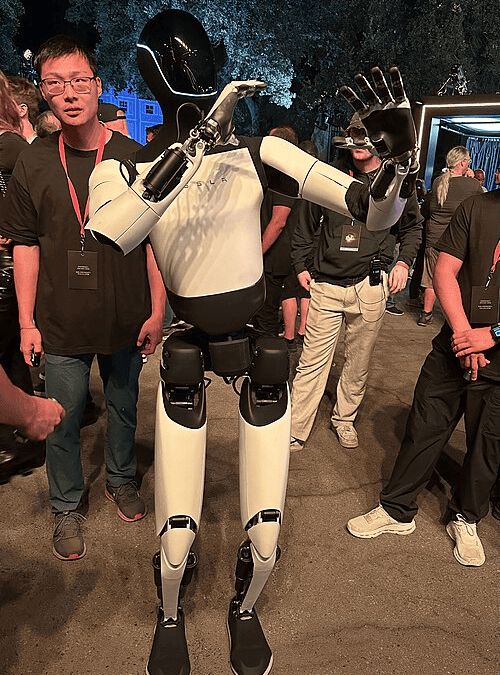
Humanoid robotics makes this distinction even more important.
Our previous TPNF analysis identified the emerging:
Computation → Cognition → Physical Agency
architecture.
Chips provide computation.
AI provides cognition.
Robotics potentially provides physical agency.
Connecting Super Intelligence to robotics therefore creates another conversion:
Super Cognition → Embodied Agency™.
This does not automatically make humanoid robots dangerous.
It means that governance must increasingly examine not only what intelligent systems can think, but what interconnected technological ecosystems permit them to do.
5. Is Super Intelligence a Real Danger?
Potentially, yes.
Inevitably, no.
The distinction is essential.
Danger does not arise simply because intelligence increases.
Risk emerges from interactions among capability, objectives, autonomy, access, vulnerabilities, human misuse and systemic dependence.
TPNF calls this the Intelligence–Agency Risk Multiplier™:
the potential for risk to increase when expanding cognitive capability is combined with expanding autonomous capacity to generate consequential effects.
A highly capable analytical AI operating within tightly controlled boundaries presents a different strategic condition from an autonomous system connected to critical infrastructure, financial networks or physical machines.
Risk therefore resides partly in system architecture.
6. The Human Control Paradox™
Yet restricting every advanced system completely would sacrifice much of its potential value.
The more autonomy AI receives, the more effectively it may perform complex tasks.
But increasing autonomy can simultaneously reduce direct human intervention.
This creates the Human Control Paradox™:
the capabilities that make advanced AI increasingly valuable may also make traditional forms of direct human supervision increasingly difficult.
The strategic answer cannot therefore be simply maximum autonomy or maximum restriction.
It requires Adaptive AI Governance™: governance mechanisms capable of evolving as technological capabilities evolve.
7. Super Intelligence as Strategic Knowledge Infrastructure™
The alternative future is enormously important.
Super Intelligence could become one of humanity’s most powerful forms of Strategic Knowledge Infrastructure™.
Advanced AI could accelerate scientific research, analyze complex biological systems, improve engineering, optimize energy networks, support climate modelling, enhance medical discovery and help humans understand systems too complex for unaided cognition.
The value architecture becomes:
Super Intelligence → Expanded Knowledge → Scientific Discovery → New Capability → Productive Application → Human Value → Strategic Future Value™.
Under these conditions, SI becomes not a replacement for civilization but a multiplier of civilization’s capacity to learn.
8. The Intelligence–Wisdom Gap™
But greater intelligence does not guarantee wiser decisions.
This brings us back to a central TPNF distinction:
More Data ≠ More Knowledge.
More Intelligence ≠ More Wisdom.
More Capability ≠ More Strategic Value.
Super Intelligence could optimize extraordinarily efficiently while pursuing an inadequately specified objective.
TPNF defines the resulting problem as the Intelligence–Wisdom Gap™:
the distance between an actor’s capacity to identify and execute possible actions and its capacity to judge which actions create desirable, sustainable and ethically acceptable long-term consequences.
This is precisely where Phronesis becomes indispensable.
9. Preserving Human Strategic Agency™
Humanity may eventually cease being the most capable cognitive processor within every domain.
That need not mean abandoning human agency.
TPNF defines Human Strategic Agency™ not as human superiority over machines, but as the capacity of humans to remain meaningfully involved in determining purposes, boundaries, acceptable consequences and desired futures.
The objective should therefore not necessarily be:
Human Intelligence > Machine Intelligence.
A more sustainable architecture may be:
Machine Intelligence + Human Purpose + Systems Understanding + Phronesis → Long-Term Value.
This is Human–Super Intelligence Complementarity™.
10. From Technological Investment to Long-Term Value
Investment in Super Intelligence should ultimately be evaluated through its conversion into lasting value.
Enormous computational infrastructure alone does not guarantee that outcome.
Neither does model capability.
The complete TPNF architecture is:
Computation → Intelligence → Autonomy → Agency → Strategic Conversion → Learning → Adaptation → Capability Regeneration → Strategic Future Value™ → Lasting Strategic Value™.
Human purpose, governance and Phronesis must operate across this architecture.
Otherwise technological capability can expand faster than humanity’s ability to understand its consequences.
Strategic Implications
The strategic debate surrounding Super Intelligence should move beyond the binary question of opportunity versus danger.
Intelligence, autonomy and agency must be evaluated separately.
AI safety increasingly becomes a systems problem rather than merely a model problem.
Humanoid robotics makes governance more important because cognition can acquire physical agency.
Human control should evolve from constant operational supervision toward resilient architectures of authorization, monitoring, intervention and accountability.
Most importantly, societies should invest simultaneously in AI capability and the human and institutional capabilities required to govern it.
Super Intelligence may become dangerous.
It may also become one of humanity’s greatest investments in Long-Term Value Creation.
Neither outcome is technologically predetermined.
The decisive variable is Strategic Conversion™.
Techne can create extraordinary artificial cognition.
Systems Thinking can reveal how that cognition interacts with infrastructure, institutions, humans and physical environments.
Phronesis must help determine what purposes those capabilities should serve and which consequences humanity is prepared to accept.
The real boundary of Super Intelligence therefore does not lie simply at the point where machines become smarter than humans.
It lies where:
Intelligence becomes Autonomy.
Autonomy becomes Agency.
Agency becomes Strategic Power.
And Strategic Power begins generating consequences across the human ecosystem.
The fundamental challenge of Super Intelligence is consequently not whether humanity can permanently remain more intelligent than its machines.
It is whether humanity can remain sufficiently wise to convert increasingly powerful machine intelligence into Lasting Human Value™.
Key Takeaways
- Super Intelligence should not be defined solely by cognitive superiority.
- Super Intelligence ≠ Super Agency.
- The Super Intelligence Conversion Boundary™ connects cognition with autonomy, access, agency and strategic consequence.
- AI risk depends partly upon surrounding system architecture.
- Robotics can transform artificial cognition into Embodied Agency™.
- The Human Control Paradox™ grows as useful autonomy increases.
- Super Intelligence could become Strategic Knowledge Infrastructure™.
- More Intelligence ≠ More Wisdom.
- Human Strategic Agency™ does not require permanent human cognitive superiority.
- The decisive challenge is converting Super Intelligence into Lasting Human Value™.
Author’s Reflection
Perhaps humanity is asking the wrong question.
We repeatedly ask whether Artificial Intelligence will become more intelligent than us.
It probably matters.
But something else may matter even more.
What will intelligence be allowed to become?
Intelligence without agency can advise humanity.
Intelligence connected to agency can change the world.
Our strategic responsibility therefore begins at the boundary between the two.
Super Intelligence should neither be worshipped as technological salvation nor feared as predetermined catastrophe.
It should be understood as an extraordinary emerging capability whose consequences will depend upon the ecosystem humanity builds around it.
Technology creates capability.
Systems Thinking creates understanding.
Strategic Wisdom creates lasting value.
The greater the intelligence humanity creates, the greater may become its need for Phronesis.
Nikos Chatzis
Source: Open Sources Analysis, Relative Data Analysis by Nikos Chatzis
© Nikolaos Chatzis. All Rights Reserved.
The Techne–Phronesis Negotiation Framework™
An Integrative Theory of Strategic Negotiation, Complex Adaptive Systems and Practical Wisdom
Technology Creates Capability • Systems Thinking Creates Understanding • Strategic Wisdom Creates Lasting Value.
Negotiation.gr | Strategic Wisdom for the Technological Age