Negotiation.gr | Strategic Wisdom for the Technological Age
“Strategic resilience emerges when technical capability (techne) is
continuously guided by practical wisdom (phronesis) through adaptive
negotiation across interconnected systems.”
Central Idea — Thesis
The Pentagon’s proposed Autonomous Warfare Command represents something potentially more important than the creation of another military organization.
It reflects an emerging transformation in the strategic unit of military capability.
For much of modern military history, capability was organized principally around platforms, formations and military services.
Autonomous warfare increasingly requires something different:
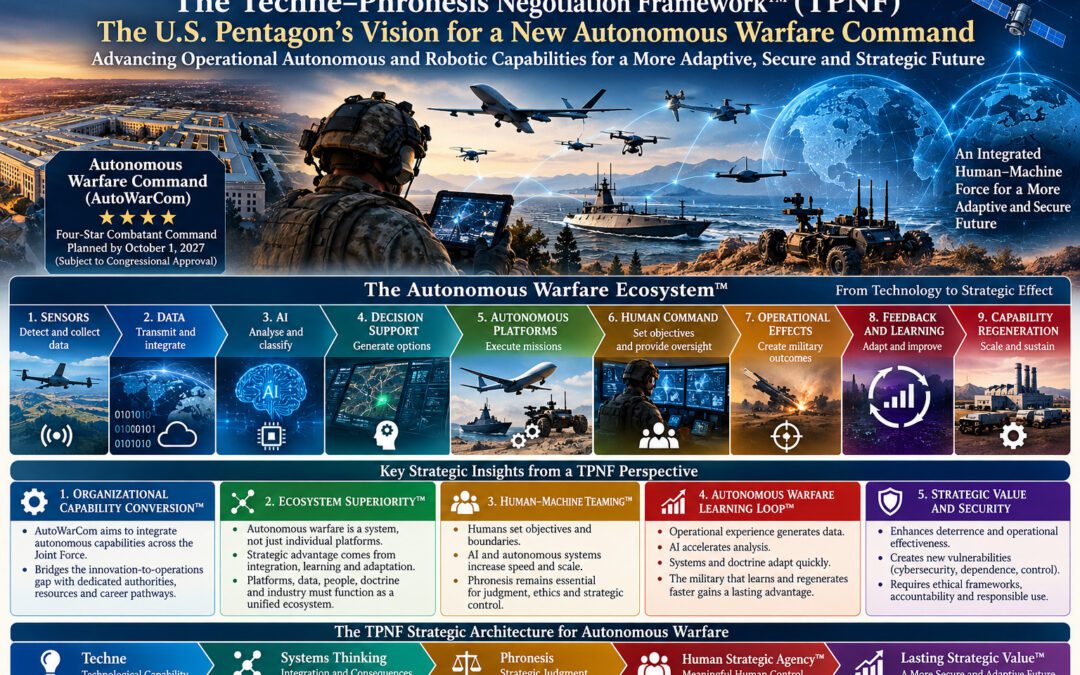
Sensors → Data → Artificial Intelligence → Autonomous Systems → Human Command → Operational Effects → Battlefield Learning → Capability Regeneration.
The Techne–Phronesis Negotiation Framework™ (TPNF) defines this emerging structure as an Autonomous Warfare Ecosystem™.
Its strategic importance lies not simply in deploying more drones or robots, but in developing an organizational system capable of integrating machines, humans, data, software, doctrine, acquisition and operational learning into continuously adaptable military capability.
Purpose of the Essay
The Pentagon announced plans on September 30, 2026, to establish Autonomous Warfare Command, or AutoWarCom, as a four-star combatant command with service-like authorities.
The stated objective is to accelerate and scale autonomous and robotic capabilities across the Joint Force.
This essay examines the development through TPNF.
The central question is:
Does autonomous warfare primarily represent technological evolution, or does it require the emergence of an entirely new military capability ecosystem?
Abstract
Autonomous warfare is frequently understood through visible technologies: drones, unmanned ships, robotic ground vehicles and Artificial Intelligence.
TPNF argues that this interpretation is incomplete.
Autonomy becomes strategically important only when technology is integrated with command structures, operational doctrine, data, communications, acquisition, human expertise and industrial capacity.
AutoWarCom therefore potentially represents Organizational Capability Conversion™: an attempt to transform dispersed autonomous technologies into integrated operational capability.
This transformation creates opportunities for speed, scale, distributed operations and Human–Machine Teaming™, but also creates vulnerabilities involving communications, cybersecurity, dependence, accountability and strategic control.
The ultimate strategic advantage will therefore not necessarily belong to the military possessing the largest number of autonomous platforms.
It may belong to the ecosystem capable of learning, adapting and regenerating autonomous capability faster than its adversary.
1. From Autonomous Platforms to Autonomous Warfare
A drone is not autonomous warfare.
Neither is a robotic ground vehicle.
Nor is an AI model.
These are technological capabilities.
Warfare emerges when capabilities become integrated into an operational system.
The distinction is fundamental:
Autonomous Platform ≠ Autonomous Warfare Capability.
An unmanned aircraft requires sensors.
Sensors generate data.
Data require communications.
AI interprets information.
Command structures establish objectives.
Operators supervise missions.
Logistics sustain platforms.
Industry replaces losses.
Software adapts to adversary countermeasures.
Autonomy is therefore inherently systemic.
2. The Autonomous Warfare Ecosystem™
TPNF defines the Autonomous Warfare Ecosystem™ as:
the interconnected technological, human, organizational, informational and industrial architecture through which autonomous capabilities are transformed into operational military effects.
Its architecture can be represented as:
Sensors → Data → AI → Decision Support → Autonomous Platform → Human Command → Operational Effect → Feedback → Adaptation.
No individual component determines effectiveness.
Strategic value emerges through integration.
This explains why organizational reform may become as important as technological innovation.
3. AutoWarCom as Organizational Capability Conversion™
The proposed command suggests recognition of a persistent military problem.
Technological innovation can move faster than traditional acquisition and organizational systems.
Different services can develop overlapping capabilities.
Promising prototypes can struggle to transition into operational deployment.
TPNF defines the resulting challenge as the Innovation-to-Operations Conversion Gap™:
the distance between demonstrating a technological capability and integrating it at sufficient scale, reliability and organizational maturity to generate sustained operational value.
AutoWarCom appears intended, at least conceptually, to narrow that gap.
The challenge is therefore not simply invention.
It is conversion.
4. Autonomy Changes the Economics of Military Capability
Autonomous systems can alter the relationship between cost, mass and military effect.
Traditional advanced platforms often combine extraordinary capability with extraordinary cost.
Autonomous systems may allow capability to become more distributed.
Instead of concentrating sensors, weapons and decision support within a small number of exquisite platforms, military capability can potentially be dispersed across larger numbers of cheaper systems.
This creates Distributed Autonomous Mass™.
But affordability alone does not create strategic advantage.
Systems must be replaceable, adaptable and sufficiently numerous to sustain operations.
Autonomy therefore connects directly with Strategic Capability Regeneration™.
5. From Human–Machine Teaming to Human–Machine Command
The rise of autonomy does not necessarily eliminate human military decision-making.
It changes its location.
Humans may increasingly move from controlling individual platform movements toward defining objectives, boundaries and mission parameters while machines execute portions of the operational process.
TPNF distinguishes:
Human-in-the-Loop → Human-on-the-Loop → Human-over-the-System.
As machine autonomy expands, human responsibility increasingly shifts toward system-level judgment.
This creates Human–Machine Command Architecture™.
The central strategic challenge becomes preserving meaningful Human Strategic Agency™ while exploiting machine speed and scale.
6. Machine-Speed Warfare
AI and autonomous systems can compress decision cycles.
Sensors can detect.
Algorithms can classify.
Networks can distribute information.
Autonomous platforms can respond.
The result may be increasingly Machine-Speed Operational Cognition™.
But speed creates a paradox.
Faster decision-making may create operational advantage while simultaneously reducing the time available for human interpretation.
TPNF defines this as the Decision-Speed Judgment Paradox™:
the faster technological systems can perceive and respond to operational conditions, the more difficult it may become for human judgment to evaluate every individual action before execution.
Phronesis therefore becomes more important, not less.
7. The Autonomy–Dependency Paradox™
Autonomous warfare also creates new dependencies.
Autonomous systems depend upon software.
Data.
Networks.
Navigation.
Sensors.
Electronic-spectrum access.
Cybersecurity.
Computational infrastructure.
The more distributed military capability becomes, the more important the connective architecture may become.
TPNF defines the Autonomy–Dependency Paradox™:
increasing autonomy at the platform level may simultaneously increase dependence upon the wider technological ecosystem that enables autonomous operation.
An autonomous platform may require less direct human control while becoming more dependent upon software integrity and network resilience.
8. Learning Becomes a Weapon
Perhaps the most important transformation is not autonomy itself.
It is learning.
Recent conflicts demonstrate rapid cycles of technological adaptation.
A successful drone configuration may quickly encounter electronic countermeasures.
Software changes.
Sensors evolve.
Tactics adapt.
Counter-countermeasures emerge.
The strategic competition therefore becomes:
Capability → Deployment → Battlefield Experience → Data → Learning → Software/Hardware Adaptation → Redeployment.
TPNF defines this as the Autonomous Warfare Learning Loop™.
The military that completes this loop faster can regenerate relevance even when individual technologies become obsolete.
9. Industrial Capacity Remains Decisive
Software cannot eliminate industrial reality.
Drones require motors.
Sensors.
Processors.
Batteries.
Communications equipment.
Materials.
Production capacity.
Supply chains.
If autonomous warfare increases platform numbers and attrition, industrial regeneration becomes strategically critical.
This creates a connection between Operational Tempo and Industrial Tempo.
TPNF therefore proposes:
Sustainable Autonomous Capability = Operational Adaptation + Industrial Regeneration.
A technologically sophisticated autonomous force that cannot replace losses may possess temporary capability but limited Long-Term Strategic Value.
10. From Platform Superiority to Ecosystem Superiority
The creation of AutoWarCom therefore points toward a broader transformation.
Future military competition may increasingly move from:
Platform versus Platform
toward:
Ecosystem versus Ecosystem.
One ecosystem may possess better individual drones.
Another may possess better integration.
Another may adapt software faster.
Another may manufacture replacements faster.
Another may achieve superior Human–Machine Teaming.
Strategic superiority emerges from their interaction.
The decisive capability becomes Autonomous Ecosystem Adaptability™:
the capacity of a military ecosystem to integrate, learn, adapt and regenerate autonomous capabilities faster than changing operational conditions degrade their effectiveness.
Strategic Implications
The Pentagon initiative produces several strategic implications.
First, autonomy is becoming an organizational challenge as much as a technological one.
Second, acquisition speed becomes part of combat capability.
Third, Human–Machine Teaming requires new command architectures and professional expertise.
Fourth, distributed autonomous mass can reduce dependence upon individual expensive platforms but creates new dependencies upon data, software, communications and industry.
Fifth, battlefield learning may become a decisive strategic resource.
Sixth, industrial regeneration must accompany technological innovation.
Finally, the long-term strategic advantage of autonomous warfare will depend upon ecosystem adaptability rather than platform performance alone.
The Pentagon’s proposed Autonomous Warfare Command represents an important recognition:
The autonomous revolution cannot be managed simply by buying more drones.
Autonomous warfare requires the integration of technology, organizations, humans, doctrine, data, industry and learning.
From a TPNF perspective:
Techne creates autonomous capability.
Systems Thinking reveals the ecosystem required to make that capability operational.
Phronesis determines how autonomy should be employed under conditions where machine speed, military necessity, uncertainty and human responsibility interact.
The strategic transformation can therefore be expressed as:
Autonomous Technology → Operational Integration → Human–Machine Command → Battlefield Learning → Adaptation → Industrial Regeneration → Sustainable Military Capability.
The ultimate competition may consequently not be over who develops the most autonomous machines.
It may be over who creates the most adaptive autonomous warfare ecosystem.
Because in rapidly evolving technological warfare, possessing advanced capability is temporary.
The deeper strategic advantage belongs to the system capable of learning and regenerating capability continuously.
Key Takeaways
- A drone is not equivalent to autonomous warfare capability.
- AutoWarCom represents potential Organizational Capability Conversion™.
- The Innovation-to-Operations Conversion Gap™ separates prototypes from sustainable military effects.
- Autonomous warfare requires an integrated Autonomous Warfare Ecosystem™.
- Distributed Autonomous Mass™ may alter military cost and force structures.
- Human control may increasingly shift toward Human–Machine Command Architecture™.
- Machine-speed operations create a Decision-Speed Judgment Paradox™.
- Platform autonomy can increase ecosystem dependence.
- The Autonomous Warfare Learning Loop™ can become a major source of advantage.
- Long-term superiority depends upon Autonomous Ecosystem Adaptability™ and capability regeneration.
Author’s Reflection
The most important feature of the Pentagon’s proposed Autonomous Warfare Command may not be the word “autonomous.”
It may be the word “Command.”
Technology becomes strategically significant when institutions learn how to organize it.
A drone can fly.
Artificial Intelligence can analyze.
A robot can act.
But none of these capabilities independently creates sustainable military power.
People must define objectives.
Organizations must integrate capabilities.
Industry must produce them.
Networks must connect them.
Operational experience must generate learning.
And strategy must determine why and when they should be used.
The autonomous revolution therefore does not remove the human dimension of warfare.
It may make human strategic judgment even more consequential.
Machines may increasingly execute.
AI may increasingly analyze.
But the responsibility for converting technological capability into sustainable strategic value remains fundamentally a problem of systems understanding and Phronesis.
Nikos Chatzis
Source: Open Sources Analysis, Relative Data Analysis by Nikos Chatzis
© Nikolaos Chatzis. All Rights Reserved.
The Techne–Phronesis Negotiation Framework™
An Integrative Theory of Strategic Negotiation, Complex Adaptive Systems and Practical Wisdom
Technology Creates Capability • Systems Thinking Creates Understanding • Strategic Wisdom Creates Lasting Value.
Negotiation.gr | Strategic Wisdom for the Technological Age