Negotiation.gr | Strategic Wisdom for the Technological Age
“Strategic resilience emerges when technical capability (techne) is
continuously guided by practical wisdom (phronesis) through adaptive
negotiation across interconnected systems.”
Central Idea — Thesis
The strategic importance of the U.S. Navy’s Blackbeard hypersonic missile may lie not simply in its speed, range or ability to penetrate sophisticated defences.
Its deeper significance lies in the attempt to reconcile three requirements that modern high-intensity warfare increasingly makes difficult to combine:
Advanced Capability + Affordable Cost + Production at Scale.
The U.S.–Iran war has again demonstrated that technologically sophisticated military operations are also industrial competitions. Weapons are launched, inventories decline, production capacity becomes strategically relevant and operational choices increasingly depend upon what the industrial ecosystem can replace.
The Techne–Phronesis Negotiation Framework™ (TPNF) therefore proposes a new concept: Regenerative Firepower™.
Military power is sustainable not merely when a force possesses advanced weapons, but when its technological-industrial ecosystem can produce, expend and regenerate sufficient quantities of effective weapons faster than prolonged operations consume them.
Purpose of the Essay
This essay examines Blackbeard not simply as another hypersonic weapon, but as evidence of a changing philosophy of military capability.
The strategic question is shifting from:
How advanced is the weapon?
toward:
Can an advanced weapon be produced affordably, deployed in sufficient numbers and regenerated during sustained conflict?
Abstract
The U.S. Navy has accelerated development and production of Castelion’s Blackbeard, an air-launched hypersonic strike weapon intended for carrier aviation.
The Navy describes Blackbeard as an affordable and rapidly fieldable weapon capable of striking land and maritime targets while increasing the magazine depth available to naval aviation.
Its development coincides with a broader Pentagon reassessment of expensive precision weapons and industrial production capacity.
TPNF interprets Blackbeard through Regenerative Firepower™, Affordable Strategic Mass™, the Capability–Quantity Balance™, Industrial Tempo–Operational Tempo Alignment™ and Strategic Capability Regeneration™.
The central argument is simple:
A weapon that cannot be replaced at the speed required by prolonged warfare may represent extraordinary technological capability but limited regenerative strategic power.
1. Blackbeard: A Different Hypersonic Logic
Hypersonic weapons are normally associated with exceptional technological sophistication and high cost.
Blackbeard attempts to modify that equation.
The U.S. Navy describes the missile as a long-range, high-speed weapon intended to increase the survivability and reach of carrier-based aircraft against sophisticated defences.
But affordability and manufacturability are central to the program.
This changes the strategic equation:
Performance → Affordability → Quantity → Operational Availability → Regeneration.
The weapon is therefore important not only because of what an individual missile might accomplish.
Its potential strategic importance derives from how many can realistically be produced and sustained.
2. The Capability–Quantity Balance™
Modern defence procurement frequently confronts a dilemma.
Extremely sophisticated weapons can produce extraordinary effects.
But extraordinary sophistication often creates cost, production and supply-chain burdens.
TPNF defines the Capability–Quantity Balance™ as:
the strategic requirement to maintain sufficient technological effectiveness without reducing affordable operational quantity below the level required for sustained conflict.
Too little technological sophistication creates vulnerability.
Too little quantity creates exhaustion.
Strategy requires both.
3. The Iran War and the Economics of Expenditure
The continuing conflict with Iran provides an immediate environment in which this problem becomes visible.
Long-range operations require precision weapons.
Defending ships and bases requires interceptors.
Sustained campaigns consume inventories.
The important strategic variable therefore becomes not simply the number of weapons available at the beginning of a conflict.
It becomes:
Inventory + Production Rate – Expenditure Rate = Sustainable Operational Capacity.
This is an industrial equation hidden inside military strategy.
The battlefield consumes capability.
The industrial ecosystem must regenerate it.
4. Regenerative Firepower™
TPNF defines Regenerative Firepower™ as:
the capacity of a military-industrial ecosystem to continuously restore effective strike capability at a rate sufficient to sustain operational requirements over time.
This concept extends beyond stockpiles.
Large inventories can eventually be exhausted.
Regenerative capability requires factories, skilled workers, supply chains, materials, financing, testing infrastructure and adaptable procurement institutions.
Military sustainability therefore begins far behind the battlefield.
5. Affordable Strategic Mass™
Blackbeard also reflects the renewed importance of mass.
For decades, technological superiority encouraged increasingly sophisticated weapons.
But contemporary conflicts demonstrate that quantity has not disappeared from warfare.
It has returned in technologically transformed form.
TPNF defines Affordable Strategic Mass™ as:
the capacity to deploy technologically sufficient capabilities in quantities large enough to create sustained operational effects without imposing economically or industrially unsustainable replacement costs.
The critical word is sufficient.
Not every mission requires the most expensive available weapon.
Strategic wisdom requires matching capability to mission.
6. The Attrition–Value Paradox™
This connects directly with the TPNF Attrition–Value Paradox™.
An extremely capable weapon may destroy a target successfully while still creating an unfavorable strategic exchange if the weapon is far more difficult or expensive to replace than the capability it destroys.
The relevant question therefore becomes:
What strategic effect was purchased by each unit of consumed capability?
This is Strategic Cost-per-Effect™.
Blackbeard’s lower-cost philosophy suggests an effort to improve this relationship while retaining the advantages of long-range, high-speed attack.
7. Industrial Tempo–Operational Tempo Alignment™
A prolonged conflict creates two clocks.
The first is Operational Tempo: how quickly military forces consume weapons and equipment.
The second is Industrial Tempo: how quickly the supporting ecosystem can manufacture replacements.
TPNF defines Industrial Tempo–Operational Tempo Alignment™ as the condition in which production capacity remains sufficiently synchronized with operational consumption to prevent progressive capability depletion.
When:
Operational Consumption > Industrial Regeneration
strategic readiness declines.
When:
Industrial Regeneration ≥ Sustainable Operational Demand
strategic endurance increases.
This may become one of the defining equations of prolonged technological warfare.
8. Speed of Production Becomes a Military Capability
Blackbeard therefore highlights another transformation.
Manufacturing speed itself becomes part of combat power.
A weapon that requires years to expand production creates different strategic options from one whose production can be rapidly increased.
This means industrial architecture increasingly belongs inside military capability analysis.
Factories become strategic infrastructure.
Supply chains become strategic infrastructure.
Engineering teams become strategic infrastructure.
Manufacturing software becomes strategic infrastructure.
Private capital can even become part of defence readiness.
The weapon and the production system can no longer be evaluated separately.
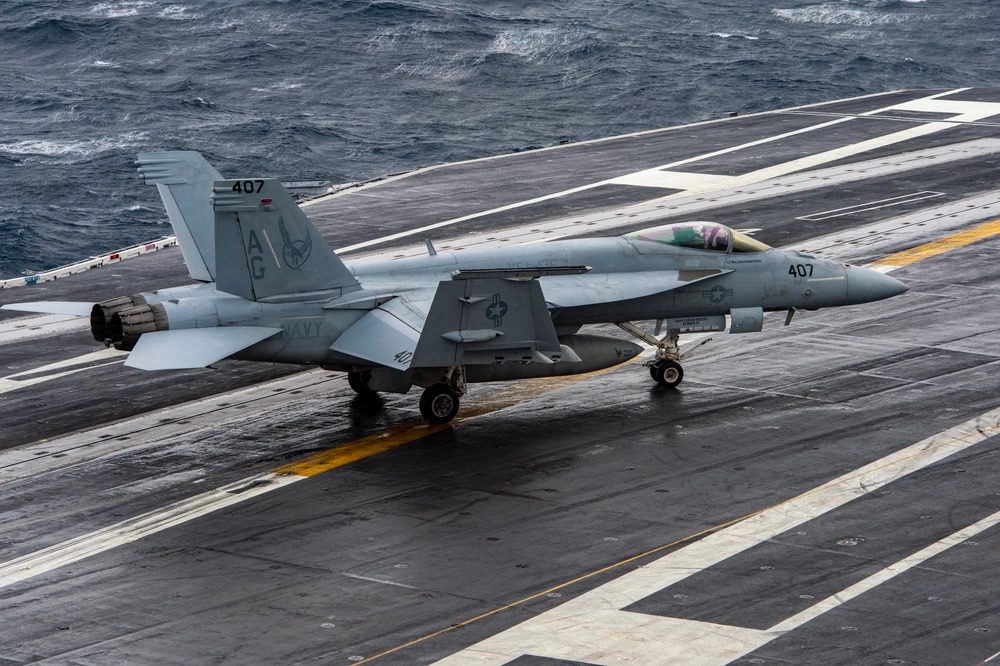
9. The Carrier Air Wing and Distributed Strike
For carrier aviation, a lower-cost long-range weapon could increase the number of targets that can be threatened while allowing aircraft to launch from greater distances.
That potentially changes the relationship between aircraft survivability, carrier positioning and missile inventory.
The strategic unit therefore becomes:
Aircraft + Weapon + Carrier + Sensors + Networks + Logistics + Industrial Regeneration.
TPNF identifies this as a Combat Technology Ecosystem™.
The missile generates value only when integrated into this wider architecture.
10. Keeping Strategic Options Open
The phrase “all options remain open” has a deeper strategic meaning when viewed through TPNF.
Options require capabilities.
Capabilities require inventories.
Inventories require production.
Production requires industrial ecosystems.
Therefore:
Strategic Optionality™ depends partly upon Industrial Optionality™.
A government may theoretically possess many military choices.
But if weapons inventories, production constraints or replacement timelines make particular operations unsustainable, the practical number of available choices becomes smaller.
Industrial capacity therefore influences strategic freedom.
Strategic Implications
Blackbeard suggests several broader lessons.
First, technological superiority without production capacity can become strategically fragile.
Second, affordability is not merely a budgetary consideration; it can determine operational endurance.
Third, mass remains strategically important even in highly technological warfare.
Fourth, industrial production rates should increasingly be considered alongside platform performance.
Fifth, lower-cost standoff weapons can expand magazine depth and potentially preserve more expensive weapons for missions requiring their unique capabilities.
Finally, military power must increasingly be evaluated according to its capacity for regeneration.
Blackbeard represents more than another hypersonic missile.
It represents an attempt to change the relationship between advanced technology, cost, quantity and industrial production.
The Iran war provides an immediate reminder that military campaigns consume technological capability continuously.
The longer operations continue, the more important the industrial ecosystem becomes.
TPNF therefore moves the analysis beyond the missile.
Techne creates the weapon.
Systems Thinking reveals the industrial, logistical and operational ecosystem sustaining it.
Phronesis determines how advanced capabilities should be allocated, consumed and regenerated to create lasting strategic value.
The future of military superiority may consequently depend not only upon who possesses the most advanced weapons.
It may depend upon who can produce effective advanced capability affordably, deploy it at scale, learn from its operational use and regenerate it faster than prolonged conflict consumes it.
That is the strategic promise behind Regenerative Firepower™.
Key Takeaways
- Blackbeard combines hypersonic performance with an explicit emphasis on affordability and scalable production.
- Modern warfare makes production capacity part of operational capability.
- Capability–Quantity Balance™ connects technological quality with sustainable quantity.
- Affordable Strategic Mass™ restores mass to advanced technological warfare.
- Regenerative Firepower™ measures the ability to replenish effective strike capability.
- Industrial Tempo–Operational Tempo Alignment™ determines whether sustained operations progressively strengthen or exhaust a force.
- Strategic Cost-per-Effect™ matters alongside weapon performance.
- Carrier strike capability depends upon a wider Combat Technology Ecosystem™.
- Industrial capacity helps determine Strategic Optionality™.
- Sustainable military superiority ultimately requires Strategic Capability Regeneration™.
Author’s Reflection
Blackbeard raises a question that reaches beyond hypersonic technology.
For decades, technological progress encouraged military systems to become increasingly sophisticated, capable—and expensive.
But warfare eventually tests technology against time.
A weapon may be extraordinary.
A platform may dominate its domain.
A military may possess overwhelming technological superiority.
Yet prolonged conflict asks a different question:
Can the ecosystem regenerate what the battlefield consumes?
This is where technology returns to strategy.
The most important weapon may not always be the most sophisticated one.
It may be the weapon that combines sufficient technological superiority with affordability, availability and the industrial capacity for continuous regeneration.
In the technological age, therefore, sustainable military power may increasingly depend upon mastering not simply the art of creating superior weapons—but the strategic wisdom of creating superior capability that can endure.
Nikos Chatzis
Source: Open Sources Analysis, Relative Data Analysis by Nikos Chatzis
© Nikolaos Chatzis. All Rights Reserved.
The Techne–Phronesis Negotiation Framework™
An Integrative Theory of Strategic Negotiation, Complex Adaptive Systems and Practical Wisdom
Technology Creates Capability • Systems Thinking Creates Understanding • Strategic Wisdom Creates Lasting Value.
Negotiation.gr | Strategic Wisdom for the Technological Age