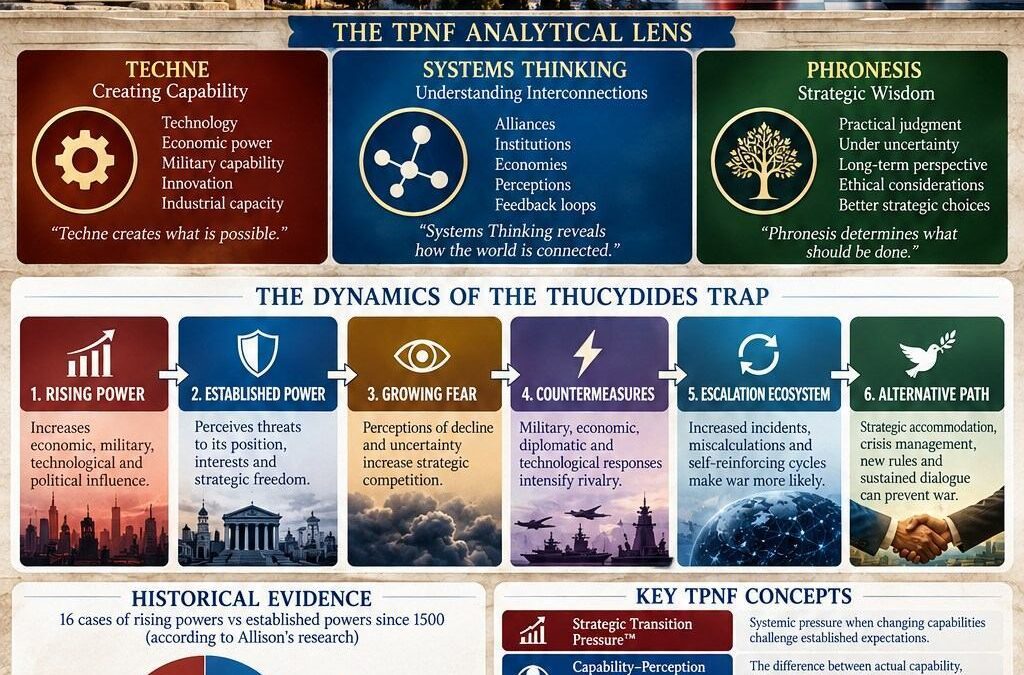
Negotiation.gr | Strategic Wisdom for the Technological Age
“Strategic resilience emerges when technical capability (techne) is
continuously guided by practical wisdom (phronesis) through adaptive
negotiation across interconnected systems.”
Central Idea — Thesis
The strategic significance of the Thucydides Trap lies not in predicting war.
It lies in identifying the systemic conditions under which fear, changing capabilities, perceptions of decline, alliance commitments and strategic miscalculation can transform manageable competition into escalating confrontation.
The Techne–Phronesis Negotiation Framework™ (TPNF) therefore interprets the Thucydides Trap not as historical determinism but as a problem of Strategic Transition Management™.
A rising power creates new capabilities.
An established power interprets their implications.
Both adapt.
Other actors respond.
Strategic interactions accumulate.
The danger emerges when the surrounding geopolitical system becomes increasingly unable to absorb these changes without escalation.
The fundamental question is therefore not:
Does the rise of one power inevitably cause war?
It is:
Can competing powers adapt their strategies and relationships faster than structural change generates fear, mistrust and strategic miscalculation?
Purpose of the Essay
This essay examines the Thucydides Trap through TPNF and asks whether great-power transitions should be understood as predetermined pathways toward war or as complex adaptive processes whose outcomes remain influenced by strategic judgment.
The argument is that structural pressure creates strategic risk—but Phronesis determines how actors respond to that risk.
Abstract
Thucydides famously identified the growth of Athenian power and the fear it generated in Sparta as a fundamental underlying cause of the Peloponnesian War.
More than two millennia later, Graham Allison transformed this observation into the modern concept of the Thucydides Trap.
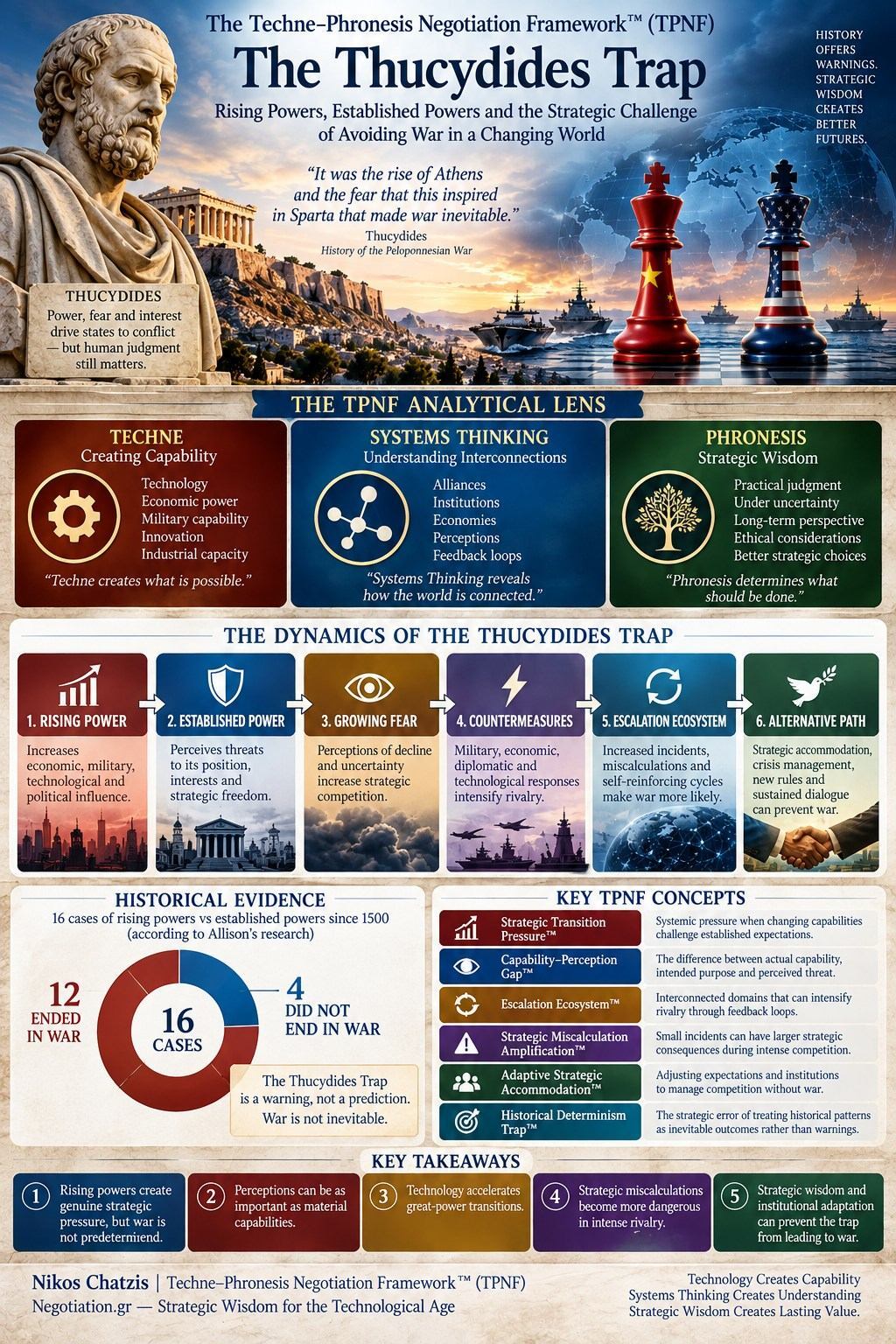
His research examined 16 historical cases in which a rising power challenged an established one; 12 resulted in war, while four did not.
The historical record therefore provides neither certainty nor inevitability.
TPNF interprets this through Strategic Transition Pressure™, the Capability–Perception Gap™, Escalation Ecosystem™, Strategic Miscalculation Amplification™ and Adaptive Strategic Accommodation™.
Together they suggest that power transitions become dangerous not simply because capabilities change, but because political systems may fail to adapt to what those changing capabilities mean.
1. Athens, Sparta and Structural Change
The Peloponnesian War was not produced by a single event.
Athens had accumulated economic, naval and political power.
Its empire expanded.
Its confidence increased.
Sparta remained the dominant land power and leader of the Peloponnesian League.
The balance between them changed.
Thucydides identified the rise of Athens and the resulting Spartan fear as the deepest structural cause of war.
But structural cause should not be confused with automatic causation.
Alliances, political decisions, disputes involving smaller states, perceptions and leadership choices also influenced escalation.
This distinction is fundamental.
2. Strategic Transition Pressure™
TPNF defines Strategic Transition Pressure™ as:
the systemic pressure generated when changing distributions of technological, economic, military or relational capability challenge established expectations concerning power, influence and strategic order.
The rising actor may demand greater influence.
The established actor may fear losing strategic freedom.
Allies begin reconsidering relationships.
Smaller states adjust their alignment.
Institutions experience pressure.
The system itself begins adapting.
Great-power transition is therefore not simply:
Power A rises → Power B declines.
It is an ecosystem transformation.
3. Technology Accelerates the Transition
Technology makes contemporary power transitions particularly complex.
Artificial intelligence, semiconductors, quantum technologies, space infrastructure, advanced manufacturing, biotechnology and autonomous systems increasingly determine national capability.
Technological competition therefore changes economic and military power simultaneously.
TPNF expresses the process as:
Technology → Capability → Economic Power → Military Potential → Strategic Influence → Geopolitical Response.
Techne consequently becomes one of the engines of power transition.
But technological capability alone does not determine what happens next.
Perception matters.
4. The Capability–Perception Gap™
States never possess perfect knowledge of another state’s intentions.
A defensive capability may appear offensive.
Economic expansion may be interpreted strategically.
Military modernization may generate fear.
TPNF defines the Capability–Perception Gap™ as:
the difference between the capability an actor develops, the purpose for which it believes that capability exists and the strategic meaning attributed to it by other actors.
This gap can become dangerous.
The rising power may think:
We are protecting our interests.
The established power may interpret:
They are preparing to displace us.
Each response then reinforces the other’s perception.
5. The Escalation Ecosystem™
The Thucydides Trap becomes more dangerous when competition spreads across interconnected domains.
Military rivalry influences technology.
Technology influences trade.
Trade influences industrial policy.
Industrial policy influences alliances.
Alliances influence military planning.
Military planning reinforces threat perception.
TPNF describes this as an Escalation Ecosystem™.
The danger emerges through feedback:
Competition → Fear → Countermeasure → Counter-Countermeasure → Greater Fear → Escalation.
No actor needs initially to desire war.
The system can progressively make confrontation easier to trigger.
6. Strategic Miscalculation Amplification™
This produces another TPNF concept: Strategic Miscalculation Amplification™.
It describes:
the process through which structural rivalry increases the strategic consequences of mistakes, accidents or incorrect interpretations that would be manageable under less adversarial conditions.
A maritime collision.
A cyberattack.
A disputed island.
A military exercise.
A confrontation involving an ally.
Any could become disproportionately dangerous when embedded inside intense great-power rivalry.
The triggering event may be small.
The ecosystem surrounding it determines its strategic consequence.
7. The United States and China
The modern Thucydides Trap debate is primarily associated with U.S.–China competition.
China’s extraordinary economic and technological development has altered the global distribution of capability.
The United States remains a major military, technological, financial and alliance power.
Their competition extends across semiconductors, artificial intelligence, trade, maritime power, Taiwan, supply chains, space and technological standards.
Yet describing this relationship through the Thucydides Trap should not become prediction.
History provides analogy.
It does not provide destiny.
8. The Historical Determinism Trap™
TPNF therefore introduces the Historical Determinism Trap™:
the strategic error of treating recurring historical patterns as predetermined outcomes rather than as warning structures whose consequences remain dependent upon human decisions, institutional adaptation and changing conditions.
The distinction matters enormously.
If policymakers believe war is inevitable, preparations for conflict may themselves intensify insecurity.
Expectation can influence behavior.
The analytical framework could then contribute to the outcome it was designed to prevent.
Strategic theory should illuminate risk—not manufacture fatalism.
9. Adaptive Strategic Accommodation™
The four peaceful cases in Allison’s historical study are strategically important precisely because they demonstrate that structural rivalry does not automatically produce war.
Avoidance does not require friendship.
Nor does it require surrender.
TPNF defines Adaptive Strategic Accommodation™ as:
the process through which competing actors adjust expectations, institutions, relationships and strategic behavior sufficiently to accommodate changing distributions of power without abandoning essential interests.
Accommodation may involve negotiation.
New rules.
Crisis-management mechanisms.
Institutional reform.
Strategic restraint.
Revised alliance expectations.
The objective is not eliminating competition.
It is preventing competition from becoming uncontrollable.
10. Phronesis and Great-Power Competition
This returns us directly to ancient Greek philosophy.
Techne creates capability.
Systems Thinking reveals how capabilities alter the geopolitical ecosystem.
But Phronesis becomes decisive when leaders must act under uncertainty.
Practical wisdom asks:
Which interests are essential?
Which are negotiable?
Which risks are acceptable?
Which perceptions are wrong?
When should power be demonstrated?
When should restraint be exercised?
Technology may determine what states can do.
Phronesis influences what they choose to do.
Strategic Implications
The Thucydides Trap offers several important strategic lessons.
First, changing power balances create genuine structural pressure.
Second, perceptions of changing power may be as important as material capability itself.
Third, technological competition increasingly accelerates geopolitical transition.
Fourth, alliances and smaller actors can amplify great-power tensions.
Fifth, accidents and miscalculations become more dangerous inside an established Escalation Ecosystem™.
Finally, historical patterns should inform strategic judgment without becoming deterministic predictions.
The objective of strategy should therefore be neither denying competition nor assuming war.
It should be managing strategic transition intelligently.
The enduring importance of Thucydides lies not in proving that rising and established powers must fight.
It lies in showing how changing capability alters fear, expectations, relationships and strategic behavior.
Graham Allison transformed this insight into a powerful contemporary warning.
TPNF takes the analysis one step further.
The Thucydides Trap can be understood as a complex adaptive strategic system:
Rising Capability → Changing Power Distribution → Strategic Perception → Fear → Countermeasures → Feedback → Escalation OR Adaptation.
The final arrow matters most.
Escalation is possible.
Adaptation is also possible.
Techne changes the distribution of capability.
Systems Thinking reveals the consequences of that change.
Phronesis provides the strategic judgment required to navigate it.
The deepest lesson of the Thucydides Trap may therefore not be that history condemns great powers to repeat the past.
It may be exactly the opposite:
Understanding the structural forces that produced past catastrophes creates an opportunity for strategic wisdom to prevent their repetition.
Key Takeaways
- The Thucydides Trap describes structural tension between rising and established powers.
- Structural pressure increases risk but does not make war inevitable.
- Strategic Transition Pressure™ explains how changing capabilities destabilize established expectations.
- Capability–Perception Gap™ can transform defensive behavior into perceived threats.
- Technology accelerates contemporary power transitions.
- Escalation Ecosystems™ can make relatively small incidents strategically dangerous.
- Strategic Miscalculation Amplification™ explains why accidents matter more during intense rivalry.
- Historical Determinism Trap™ warns against converting historical analogy into prediction.
- Adaptive Strategic Accommodation™ provides an alternative pathway to uncontrolled escalation.
- Phronesis becomes increasingly important as the destructive capabilities of competing powers increase.
Author’s Reflection
Thucydides wrote about a war more than 2,400 years ago.
The weapons have changed.
The economies have changed.
Technology has transformed the scale, speed and destructive capacity of geopolitical competition.
Human beings have not eliminated fear, ambition, uncertainty or miscalculation.
That is why Thucydides remains relevant.
But perhaps his greatest strategic value is not that he tells us what will happen.
It is that he forces us to examine why it might happen.
That distinction is fundamental to TPNF.
History provides knowledge.
Technology creates new capability.
Systems Thinking reveals changing relationships.
But strategic wisdom determines how humanity responds.
The Thucydides Trap should therefore be understood not as a prophecy of war, but as a warning demanding Phronesis.
The purpose of understanding the trap is not to accept it. It is to become strategically capable of escaping it.
Nikos Chatzis
Source: Open Sources Analysis, Relative Data Analysis by Nikos Chatzis
© Nikolaos Chatzis. All Rights Reserved.
The Techne–Phronesis Negotiation Framework™
An Integrative Theory of Strategic Negotiation, Complex Adaptive Systems and Practical Wisdom
Technology Creates Capability • Systems Thinking Creates Understanding • Strategic Wisdom Creates Lasting Value.
Negotiation.gr | Strategic Wisdom for the Technological Age