Negotiation.gr | Strategic Wisdom for the Technological Age
“Strategic resilience emerges when technical capability (techne) is
continuously guided by practical wisdom (phronesis) through adaptive
negotiation across interconnected systems.”
Central Idea — Thesis
The strategic importance of RAF Fairford lies not simply in the American bombers operating from British territory.
It lies in what the base represents: a critical node connecting American long-range airpower, British territory, NATO geography, logistics, political authorization and the U.S.–Iran conflict.
The September 27 arrest of five men near RAF Fairford on suspicion of preparing a terrorist act therefore raises a wider strategic question—even though no Iranian responsibility for the suspected plot has been established.
The Techne–Phronesis Negotiation Framework™ (TPNF) argues that modern military superiority can generate a paradox:
The farther a powerful military ecosystem distributes its capabilities, the greater its operational reach—but also the larger the geographic and political ecosystem that must be protected.
TPNF defines this as the Strategic Reach–Exposure Paradox™.
Purpose of the Essay
This TPNF essay examines RAF Fairford as an example of how conventional military superiority can interact with asymmetric vulnerability.
The central question is whether a geographically distant bomber hub can become part of the wider battlespace of a Middle Eastern war—and what this means as U.S. domestic political pressure over the conflict increases ahead of the November midterm elections.
Abstract
RAF Fairford in Gloucestershire is a British military installation and the U.S. Air Force’s preferred European forward operating location for strategic bombers.
During the Iran conflict, American B-1 and B-52 bombers have operated from the base. On September 27, British authorities arrested five men after suspicious vehicles were reported travelling toward Fairford. Counter-terrorism police are investigating.
The event does not establish Iranian involvement.
Its strategic significance nevertheless extends beyond attribution.
TPNF interprets Fairford through the Strategic Reach–Exposure Paradox™, Geographic Battlespace Expansion™, Distributed Capability Vulnerability™, Alliance Infrastructure Interdependence™ and Asymmetric Strategic Conversion™.
Together they reveal how modern conflict can spread geographically without requiring symmetrical military capabilities.
1. RAF Fairford: More Than an Airfield
RAF Fairford is particularly suited to strategic aviation.
Its long runway and supporting infrastructure allow the United States to deploy heavy bombers closer to potential operational theaters while remaining connected to American and NATO logistical systems.
Its strategic function can be represented as:
U.S. Strategic Capability → Forward Deployment → Reduced Operational Distance → Increased Mission Availability → Greater Combat Reach.
Fairford therefore multiplies American capability.
But every capability multiplier can simultaneously become a dependency.
That is where the TPNF problem begins.
2. The Strategic Reach–Exposure Paradox™
TPNF defines the Strategic Reach–Exposure Paradox™ as:
the condition in which geographic expansion of military capability simultaneously increases operational reach and expands the infrastructure, relationships and locations exposed to disruption or retaliation.
Forward deployment creates strategic advantages.
Aircraft operate closer to theaters of conflict.
Logistics become more responsive.
Operational tempo can increase.
But bases, supply networks, personnel and host-country infrastructure acquire greater strategic significance.
Military reach therefore creates an expanding security perimeter.
3. From Middle Eastern War to European Security
This produces Geographic Battlespace Expansion™:
the process through which a conflict’s strategic geography expands as supporting military, logistical, economic and technological networks located outside the original theater become relevant to military operations.
The U.S.–Iran war is geographically centered in the Middle East.
Yet a bomber departing Britain, tanker operating elsewhere, satellite providing intelligence from orbit or logistics facility supplying weapons may all contribute to operations.
The functional geography of war becomes larger than its physical front line.
Modern conflict therefore follows networks.
4. Asymmetry Changes the Meaning of Distance
A state confronting superior conventional military power does not necessarily benefit from confronting that power symmetrically.
Aircraft do not have to be defeated exclusively in air combat.
Operational capability can theoretically be disrupted through attacks on infrastructure, logistics, communications, cyber networks or other supporting systems.
This is Asymmetric Strategic Conversion™:
the ability to use comparatively limited resources against vulnerable nodes in a superior opponent’s ecosystem to generate effects disproportionate to the resources employed.
This does not mean the Fairford incident was such an operation.
The investigation must establish what occurred and who, if anyone beyond those arrested, was involved.
But the strategic mechanism deserves examination independently of attribution.
5. Distributed Capability Vulnerability™
Bombers represent extraordinary technological capability.
Yet bombers require infrastructure.
They require fuel.
Weapons.
Maintenance.
Secure communications.
Personnel.
Airfield protection.
Intelligence.
Political authorization.
TPNF calls the resulting condition Distributed Capability Vulnerability™:
the vulnerability created when advanced operational capability depends upon geographically dispersed supporting nodes whose disruption can reduce the effectiveness of the larger system.
The aircraft is therefore only the visible component.
The ecosystem makes the aircraft strategically useful.
6. Alliance Infrastructure Interdependence™
Fairford adds another dimension because the base is British while American forces operate from it.
This produces Alliance Infrastructure Interdependence™:
the condition in which one ally’s operational capability depends upon infrastructure, political authorization and security provided within another ally’s sovereign territory.
The relationship generates considerable strategic value.
The United States gains forward operating capability.
Britain reinforces interoperability with its principal military ally.
NATO benefits from infrastructure capable of supporting strategic deployments.
But interdependence also distributes risk.
A military operation originating from allied territory can connect the host country more directly to the geopolitical consequences surrounding that operation.
7. Technology Does Not Eliminate Physical Vulnerability
Modern strategic bombers represent advanced aerospace engineering.
But advanced technology does not eliminate geography.
Runways remain physical.
Fuel remains necessary.
Munitions require storage.
Aircraft on the ground cannot exploit all the advantages available to them in flight.
This produces a familiar TPNF distinction:
Technological Superiority ≠ Ecosystem Invulnerability.
The more sophisticated the platform, the more important the systems sustaining it may become.
The protection of advanced capability must therefore extend beyond the platform itself.
8. The Domestic Political Dimension
The approaching U.S. midterm elections introduce another layer.
On September 24, the Senate narrowly rejected a resolution that would have required President Trump to end the Iran war or obtain congressional authorization. The vote occurred amid growing political debate over the conflict and its economic consequences.
Domestic politics should not be treated as determining military strategy.
But prolonged wars operate simultaneously inside military and political systems.
Casualties matter.
Costs matter.
Energy prices matter.
Public opinion matters.
Congressional authorization matters.
Strategic time therefore interacts with Political Time.
TPNF can describe this as Strategic–Political Time Compression™: the increasing pressure on strategic decision-making when military objectives operate against approaching domestic political deadlines.
9. The Asymmetric Value of Political Effects
Asymmetric strategy need not achieve conventional military victory to matter.
Its objective may instead be to increase costs, uncertainty, security requirements or political pressure.
This produces an important distinction:
Military Damage ≠ Strategic Effect.
Limited physical damage can sometimes produce significant political consequences.
Conversely, substantial military action can fail to produce lasting political change.
TPNF therefore evaluates operations according to Strategic Conversion™: whether an action converts available capability into the desired strategic outcome.
The relationship between military action and political effect is rarely linear.
10. Protecting the Ecosystem
The Fairford case therefore points toward a broader concept: Military Ecosystem Protection™.
Protecting airpower means protecting more than aircraft.
It includes:
Platform → Base → Logistics → Personnel → Information → Host-Nation Infrastructure → Alliance Relationships → Political Legitimacy.
A weakness anywhere in this chain can affect the wider system.
Future force protection must consequently combine physical security, intelligence, counter-terrorism, cyber defence, air and missile defence, infrastructure resilience and alliance coordination.
The battlespace becomes systemic.
Strategic Implications
RAF Fairford demonstrates that long-range military capability generates both power and exposure.
First, forward basing increases operational reach while expanding the infrastructure requiring protection.
Second, asymmetric actors may seek vulnerable ecosystem nodes rather than confronting superior platforms directly.
Third, military networks can expand the functional geography of conflict beyond the principal theater.
Fourth, allied infrastructure creates both shared capability and shared strategic exposure.
Fifth, domestic political timelines can interact with prolonged military campaigns without mechanically determining their outcomes.
Finally, protecting modern airpower increasingly means protecting the entire ecosystem that makes airpower possible.
RAF Fairford illustrates a central characteristic of twenty-first-century warfare.
Military power is distributed through networks.
American strategic bombers can project extraordinary capability from British territory toward the Middle East.
But that capability depends upon infrastructure, alliances, logistics, personnel and political decisions extending across several strategic environments.
The suspected September 27 incident should not be attributed to Iran without evidence.
Yet it exposes a broader strategic reality.
Techne creates long-range military capability.
Systems Thinking reveals the networks required to sustain it.
Phronesis determines how capability, vulnerability, alliance obligations and political consequences should be balanced.
The central strategic question therefore extends beyond whether American bombers can strike distant targets.
It becomes:
Can the wider military ecosystem that generates long-range power remain protected, resilient and politically sustainable as the conflict itself becomes increasingly distributed?
The U.S.–Iran war may consequently demonstrate another transformation of modern warfare:
Military superiority expands strategic reach.
Strategic reach expands systemic exposure.
And asymmetric strategy searches for the points where that exposure can be converted into disproportionate strategic effect.
Key Takeaways
- RAF Fairford is a British base and a major forward operating location for U.S. strategic bombers.
- The base has supported U.S. bomber operations during the Iran conflict.
- No Iranian responsibility for the September 27 suspected terrorist incident has been established.
- Strategic Reach–Exposure Paradox™ explains the relationship between forward power projection and expanding vulnerability.
- Geographic Battlespace Expansion™ describes how supporting networks widen the functional geography of war.
- Distributed Capability Vulnerability™ shifts attention from aircraft toward their enabling ecosystem.
- Alliance Infrastructure Interdependence™ creates both shared capability and shared exposure.
- Asymmetric strategy can target ecosystem nodes rather than superior platforms.
- Domestic political timelines can create Strategic–Political Time Compression™.
- Modern force protection increasingly requires Military Ecosystem Protection™.
Author’s Reflection
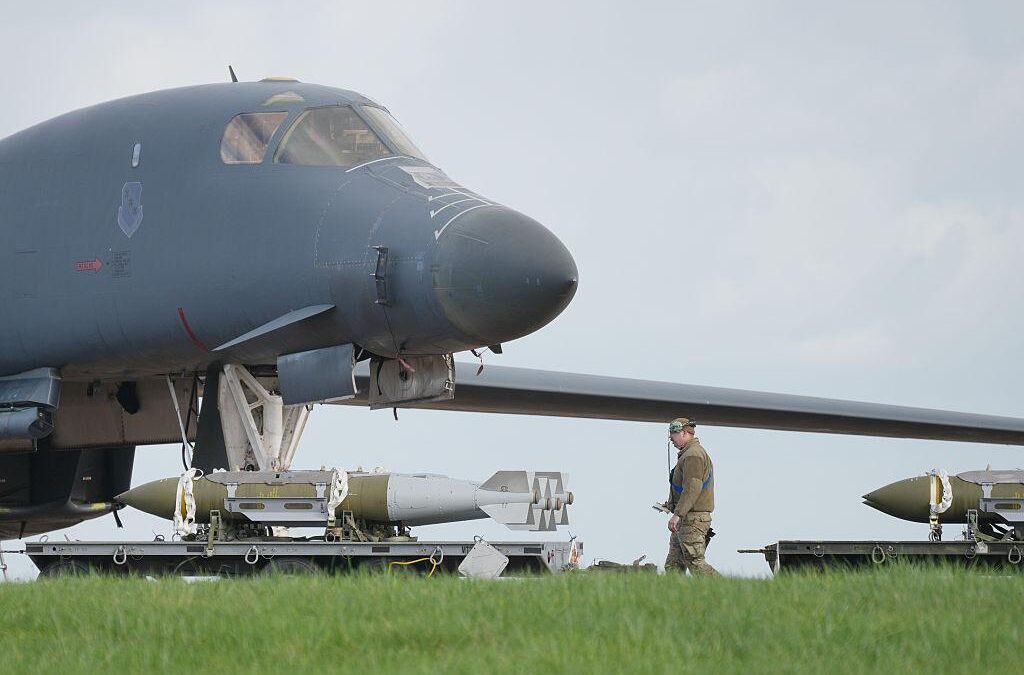
RAF Fairford presents an apparently simple image: American bombers operating from a British airfield.
Systems Thinking reveals something much larger.
Behind each aircraft exists a network of people, infrastructure, fuel, weapons, intelligence, communications, diplomacy and political authorization.
That network creates the capability.
It can also create vulnerability.
This is why modern strategy cannot evaluate military power by counting platforms alone.
The strategic unit increasingly becomes the ecosystem.
And as technological capability extends military reach across continents, strategic wisdom must expand at the same speed—because the geography of power and the geography of vulnerability are increasingly becoming two sides of the same system.
Nikos Chatzis
Source: Open Sources Analysis, Relative Data Analysis by Nikos Chatzis
© Nikolaos Chatzis. All Rights Reserved.
The Techne–Phronesis Negotiation Framework™
An Integrative Theory of Strategic Negotiation, Complex Adaptive Systems and Practical Wisdom
Technology Creates Capability • Systems Thinking Creates Understanding • Strategic Wisdom Creates Lasting Value.
Negotiation.gr | Strategic Wisdom for the Technological Age