Negotiation.gr | Strategic Wisdom for the Technological Age
“Strategic resilience emerges when technical capability (techne) is
continuously guided by practical wisdom (phronesis) through adaptive
negotiation across interconnected systems.”
Central Idea — Thesis
The lasting contribution of ancient Greek philosophy to human civilization was not a collection of ready-made answers for the modern world.
It was something more fundamental: a disciplined way of asking questions about reality, knowledge, power, action, ethics and human purpose.
From this intellectual environment emerged distinctions between knowledge and action, means and ends, capability and judgment, political power and justice.
The Techne–Phronesis Negotiation Framework™ (TPNF) proposes that these intellectual habits remain deeply relevant to contemporary technological and geopolitical strategy.
Modern civilization possesses capabilities the ancient Greeks could never have imagined. Yet artificial intelligence, autonomous systems, biotechnology, space technology and geopolitical competition continually return humanity to an ancient problem:
What can we do, what should we do, and how should we decide between them?
Purpose of the Essay
This TPNF essay examines ancient Greek philosophy not as historical nostalgia but as Strategic Intellectual Infrastructure™: accumulated ways of reasoning that help civilizations understand capability, uncertainty, choice and consequence.
Its central argument is that strategy and tactics become meaningful only when connected to deeper philosophical questions concerning knowledge, judgment, purpose and value.
Abstract
Ancient Greek philosophy developed sustained inquiry into ethics, politics, knowledge, nature, logic and human flourishing. Modern virtue ethics still draws explicitly upon Greek concepts such as aretê, phronesis and eudaimonia.
Greek political thought also examined problems recognizable in contemporary geopolitics: power, justice, political order and relations between communities. Thucydides’ account of the Melian Dialogue remains a prominent example of ancient debate concerning power and justice between political actors.
TPNF argues that the lasting value lies not in mechanically applying ancient answers to modern problems, but in preserving the relationship:
Knowledge → Capability → Deliberation → Judgment → Action → Consequence → Learning.
This creates what TPNF defines as Strategic Intellectual Continuity™.
1. Philosophy as Civilization’s Questioning System
The transformation associated with Greek philosophy involved increasingly systematic attempts to understand phenomena through argument, observation and rational explanation.
Greek thinkers addressed questions ranging from astronomy and mathematics to ethics, politics, metaphysics and logic. Their influence subsequently passed through Roman, Islamic, medieval, Renaissance and Enlightenment intellectual traditions.
Their greatest strategic inheritance may therefore be the question itself.
What is knowledge?
What is justice?
What constitutes good government?
What is the relationship between means and ends?
What makes an action wise rather than merely possible?
Such questions create Strategic Intellectual Infrastructure™ because they improve civilization’s capacity to examine its own decisions.
2. Techne — Creating Capability
Technê occupies the first pillar of TPNF.
For Aristotle, technê concerns productive knowledge: the reasoned capacity to bring something into existence. It differs from theoretical knowledge and from phronesis, which concerns practical action.
Modern technology magnifies this ancient distinction enormously.
Artificial intelligence creates capability.
Robotics creates capability.
Nuclear engineering creates capability.
Biotechnology creates capability.
Space systems create capability.
But capability answers primarily:
What can we create or accomplish?
It does not automatically answer:
Why, when and toward what purpose should that capability be employed?
3. Phronesis — Judging Action
This leads to phronesis.
Aristotle’s practical wisdom cannot be reduced to knowing general rules. It requires deliberative capacity developed through experience and the ability to determine what action circumstances require.
TPNF therefore interprets phronesis as indispensable to strategic decision-making.
Technology expands the field of possible action.
Strategic wisdom evaluates that field.
This produces a fundamental distinction:
Capability without judgment can increase power without increasing wisdom.
The more powerful technology becomes, the more consequential this distinction becomes.
4. Strategy as the Bridge
Strategy connects capability with purpose.
Technology asks:
What is possible?
Strategy asks:
How can capabilities be organized to achieve an objective?
Phronesis asks the deeper question:
Which objective is worth pursuing, under what conditions and with what consequences?
Strategy therefore becomes the bridge between Techne and Phronesis.
TPNF describes this as Capability–Purpose Alignment™:
the process through which available capabilities are organized toward objectives that have been evaluated through systemic understanding and strategic judgment.
5. Tactics Without Strategy
Tactics concern the execution of action.
They answer:
Where?
When?
How?
With which resources?
But tactical success does not guarantee strategic success.
A battle can be won while a war is strategically lost.
A technological product can succeed while its ecosystem fails.
A diplomatic maneuver can produce immediate advantage while destroying long-term trust.
This creates the Tactical Success–Strategic Value Paradox™:
an action may achieve its immediate objective while simultaneously reducing the actor’s capacity to generate lasting strategic value.
Ancient strategic history repeatedly invites examination of precisely this relationship between action, consequence and political purpose.
6. Systems Thinking — The Modern Extension
Ancient Greek philosophy did not possess modern Systems Thinking as a formal discipline.
TPNF should therefore avoid anachronism.
But Greek philosophy repeatedly examined relationships among ethics, politics, knowledge, institutions and human behavior.
Modern Systems Thinking expands this relational approach.
A geopolitical crisis today may simultaneously involve:
Technology → Military Capability → Economics → Energy → Alliances → Information → Society → Political Legitimacy.
No individual variable explains the whole system.
Systems Thinking therefore becomes the modern connective layer between Techne and Phronesis.
7. Philosophy and Technological Evolution
The technological challenge of the twenty-first century is not simply innovation.
It is governing accelerating innovation wisely.
AI can analyze.
Autonomous systems can act.
Algorithms can influence.
Biotechnology can modify life.
Space systems can extend human activity beyond Earth.
The central question consequently evolves from:
Can humanity create it?
toward:
Can humanity understand the systems created by its own capabilities sufficiently to govern their consequences?
TPNF defines this as the Capability–Wisdom Gap™:
the growing distance between humanity’s capacity to create powerful technologies and its capacity to understand, govern and strategically integrate their consequences.
8. Philosophy and Modern Geopolitics
The same problem appears in geopolitics.
Modern states possess missiles, satellites, cyber capabilities, AI, economic sanctions and global information networks.
Yet geopolitical decision-making remains fundamentally human.
Leaders must interpret incomplete information.
They must anticipate adversaries.
They must negotiate.
They must evaluate risk.
They must distinguish tactical advantage from strategic consequence.
Technology changes the instruments.
It does not eliminate the need for judgment.
Indeed:
The expansion of strategic capability increases the value of strategic wisdom.
9. Strategic Intellectual Continuity™
This allows TPNF to introduce Strategic Intellectual Continuity™:
the transmission and adaptation across generations of intellectual methods that improve humanity’s capacity to understand complex situations, evaluate choices and connect action with long-term consequence.
Ancient philosophy should therefore not be copied.
It should be continuously interrogated and adapted.
Socrates teaches the importance of questioning assumptions.
Plato forces examination of justice, knowledge and political order.
Aristotle distinguishes productive capability from practical judgment.
Thucydides exposes tensions among power, fear, interest and justice.
Their enduring value lies in providing intellectual instruments rather than technological instructions.
10. From Ancient Philosophy to TPNF
TPNF can consequently represent the relationship as:
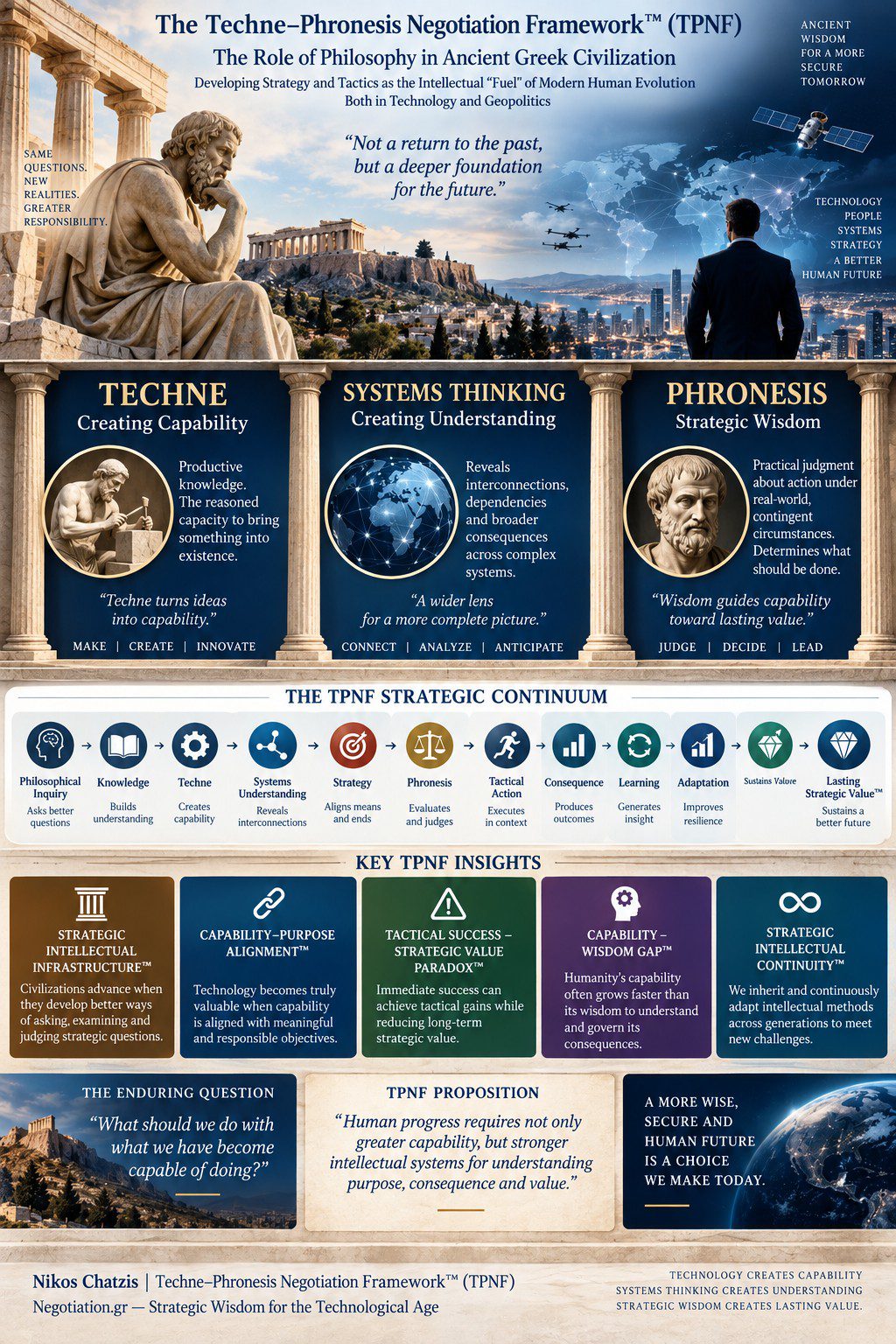
Philosophical Inquiry → Knowledge → Techne → Capability → Systems Understanding → Strategy → Phronesis → Judgment → Tactical Action → Consequence → Learning → Adaptation → Lasting Strategic Value™.
The sequence is not historically linear.
It is an analytical architecture.
Ancient Greek thought provides some of its foundational questions.
Modern technology radically expands its capabilities.
Systems Thinking reveals interdependence.
Strategy organizes action.
Phronesis evaluates purpose and consequence.
Human evolution therefore depends not only upon creating greater capabilities but upon improving the intellectual systems through which those capabilities are governed.
Strategic Implications
The ancient Greek inheritance remains strategically relevant because technological civilization increasingly confronts problems of its own making.
AI governance, autonomous warfare, climate technologies, biotechnology and space expansion cannot be addressed through technical expertise alone.
They require interdisciplinary understanding and practical judgment.
The more powerful Techne becomes, the greater the need for Phronesis.
And the more interconnected civilization becomes, the greater the need for Systems Thinking.
Ancient Greek philosophy did not provide a blueprint for artificial intelligence, modern warfare or contemporary geopolitics.
It provided something more enduring:
the intellectual discipline of examining knowledge, capability, purpose, action and consequence.
Strategy converts capability into organized action.
Tactics execute that action.
But philosophy asks whether the objective, assumptions and consequences have been understood.
This is why philosophy remains part of the intellectual “fuel” of human evolution.
TPNF expresses this relationship through three interconnected principles:
Technology Creates Capability.
Systems Thinking Creates Understanding.
Strategic Wisdom Creates Lasting Value.
The technologies change.
The geopolitical actors change.
The scale of human capability changes.
But the fundamental strategic challenge remains remarkably persistent:
Humanity must continuously learn not only how to create greater power, but how to use that power wisely.
Key Takeaways
- Ancient Greek philosophy contributed enduring methods of rational inquiry and practical judgment.
- Techne concerns productive capability; phronesis concerns practical wisdom.
- Strategy connects capability with purpose, while tactics translate strategy into action.
- Capability–Purpose Alignment™ connects technological possibility with strategic objectives.
- Tactical Success–Strategic Value Paradox™ explains why immediate success may undermine long-term value.
- Systems Thinking provides a modern method for understanding interconnected consequences.
- Capability–Wisdom Gap™ becomes increasingly important as technology accelerates.
- Strategic Intellectual Continuity™ explains how intellectual methods can evolve across civilizations.
- Philosophy remains relevant to both technological development and geopolitics.
- Human progress ultimately requires capability, understanding and wisdom.
Author’s Reflection
Ancient Greece matters to TPNF not because every modern strategic problem can be solved by returning to ancient texts.
It matters because those texts remind us that human progress has always involved something deeper than acquiring capability.
Human beings must decide what capability is for.
Modern technological civilization may increasingly delegate calculation to machines.
It may delegate production to autonomous systems.
It may even delegate elements of tactical decision-making to artificial intelligence.
But the question of purpose remains.
That question connects philosophy with strategy and technology with humanity.
Perhaps the deepest continuity between ancient Greek philosophy and the technological age is therefore not an answer.
It is the enduring human responsibility to ask:
What should we do with what we have become capable of doing?
Nikos Chatzis
Source: Open Sources Analysis, Relative Data Analysis by Nikos Chatzis
© Nikolaos Chatzis. All Rights Reserved.
The Techne–Phronesis Negotiation Framework™
An Integrative Theory of Strategic Negotiation, Complex Adaptive Systems and Practical Wisdom
Technology Creates Capability • Systems Thinking Creates Understanding • Strategic Wisdom Creates Lasting Value.
Negotiation.gr | Strategic Wisdom for the Technological Age