Negotiation.gr | Strategic Wisdom for the Technological Age
“Strategic resilience emerges when technical capability (techne) is
continuously guided by practical wisdom (phronesis) through adaptive
negotiation across interconnected systems.”
Central Idea — Thesis
The Techne–Phronesis Negotiation Framework™ (TPNF) began from negotiation but increasingly encounters strategic problems that cannot be understood through negotiation alone.
Technology, artificial intelligence, geopolitical competition, industrial ecosystems, space exploration, military capability, finance, energy security and institutional resilience involve negotiation, but they also involve technological capability, systemic interaction, strategic decision-making, adaptation, learning and practical wisdom.
TPNF therefore faces an important theoretical transition:
from a framework explaining strategic negotiation toward a potential General Strategic Theory capable of explaining how actors create, understand, mobilize, convert, adapt and regenerate capabilities across multidimensional strategic environments.
The challenge is not simply theoretical expansion.
It is demonstrating that the same underlying architecture can generate useful explanations across fundamentally different practical domains without becoming so broad that it explains everything—and therefore nothing.
Purpose of the Essay
This TPNF essay examines the intellectual path through which TPNF may evolve from negotiation theory toward General Strategic Theory.
It argues that multidimensional practical application should not be treated merely as evidence of versatility. It should become a mechanism of systematic theoretical testing.
The fundamental question is:
Can one coherent strategic architecture explain recurring patterns across technological, economic, geopolitical, organizational, military and societal systems while remaining precise enough to generate testable propositions?
Abstract
Negotiation theory traditionally examines interactions among actors possessing partly conflicting and partly compatible interests.
TPNF retains this foundation but extends the analytical problem.
Contemporary strategic outcomes increasingly emerge from interactions among actors, technologies, institutions, networks, resources and complex adaptive systems.
The relevant strategic question consequently shifts from:
How can actors negotiate effectively?
toward:
How are capabilities transformed through interconnected systems into sustainable strategic outcomes?
TPNF proposes an emerging architecture:
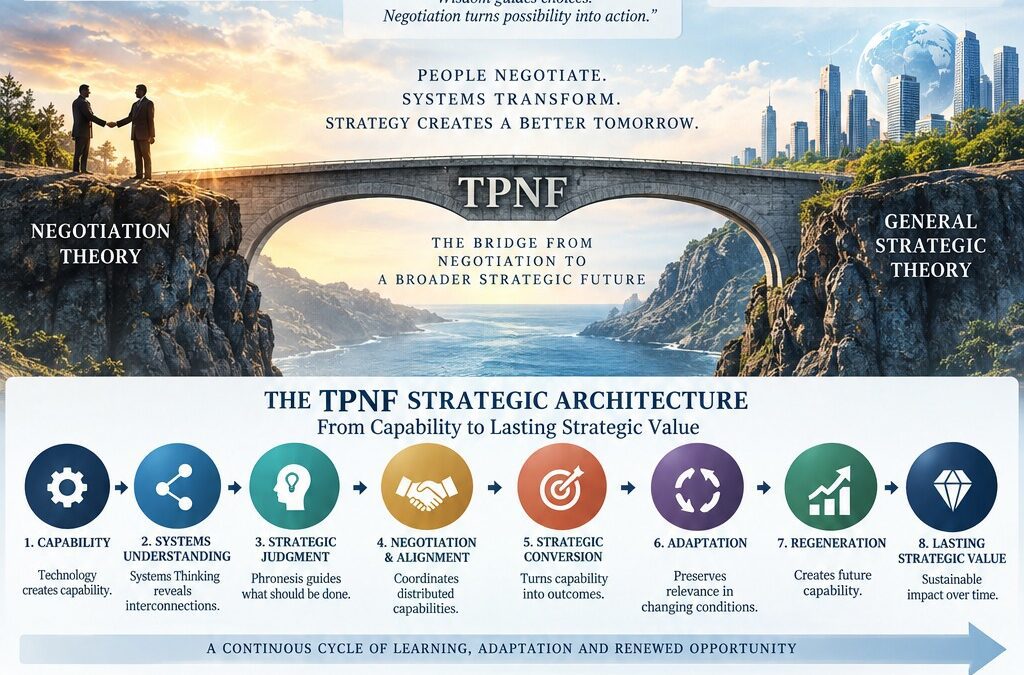
Capability → Systems Understanding → Strategic Judgment → Negotiation and Coordination → Strategic Conversion → Adaptation → Regeneration → Lasting Strategic Value.
If this architecture remains explanatory across multiple independent domains, TPNF may progressively develop toward a General Strategic Theory of Capability Conversion and Lasting Value™.
1. Negotiation as the Intellectual Starting Point
Negotiation remains fundamental.
Individuals negotiate.
Corporations negotiate.
Governments negotiate.
Alliances negotiate.
Technological ecosystems continuously coordinate interests, resources and capabilities.
But negotiation is rarely isolated.
A government negotiating energy security must understand infrastructure, markets, geography, alliances and technology.
A company negotiating an AI partnership must understand data, intellectual property, technological capability, regulation and ecosystem dependencies.
Negotiation therefore occurs inside systems.
TPNF‘s evolution begins with this recognition.
Negotiation remains essential, but it becomes one component of a wider strategic architecture.
2. From Actors to Systems
Traditional negotiation analysis frequently begins with actors, interests, alternatives and possible agreements.
General strategic analysis must go further.
It must examine:
Actors + Technology + Institutions + Resources + Relationships + Geography + Time + Feedback + Adaptation.
The analytical unit consequently expands from the negotiation table toward the strategic ecosystem.
This transition introduces what TPNF can define as Strategic Dimensional Expansion™:
the progressive extension of strategic analysis from direct actor interaction toward the interconnected technological, institutional, economic, relational and temporal systems shaping strategic outcomes.
The negotiation has not disappeared.
Its systemic environment has become visible.
3. Technology Changes What Is Possible
Technology introduces the first foundational TPNF dimension.
Techne creates capability.
Artificial intelligence expands cognition.
Satellites expand observation.
Drones expand operational reach.
Digital networks expand connectivity.
Advanced manufacturing expands productive capability.
Yet capability does not automatically produce strategic advantage.
A technologically sophisticated military can fail strategically.
An innovative company can lose its market.
A resource-rich country can remain economically vulnerable.
This produces a foundational distinction:
Capability ≠ Strategic Value.
Something must convert capability into outcome.
4. Systems Thinking Explains the Connections
That conversion cannot be understood by examining individual capabilities separately.
Systems Thinking reveals relationships.
An aircraft depends upon maintenance, trained personnel, supply chains, sensors, communications and industrial capacity.
An energy corridor depends upon infrastructure, security, insurance, shipping, markets and diplomacy.
An innovation ecosystem depends upon universities, capital, talent, institutions and industry.
TPNF therefore moves from Capability Analysis toward Capability-in-System Analysis™.
Strategic value resides partly in the capability itself and partly in the system’s ability to activate it.
5. Phronesis and the Problem of Judgment
Understanding the system still does not determine what should be done.
Strategic environments contain uncertainty.
Information is incomplete.
Objectives conflict.
Consequences unfold across different time horizons.
Artificial intelligence can improve analysis but cannot eliminate strategic ambiguity.
This is where Phronesis — practical wisdom — becomes central.
Phronesis asks not merely:
What can we do?
but:
What should we do, when, with whom, at what cost and toward what lasting purpose?
Strategic wisdom therefore transforms understanding into judgment.
6. Negotiation Becomes a Strategic Conversion Mechanism
Within this broader architecture, negotiation acquires a more important—not less important—role.
Negotiation coordinates capabilities distributed among different actors.
Governments possess authority.
Companies possess technology.
Universities possess knowledge.
Investors possess capital.
Military organizations possess operational capability.
Communities possess legitimacy and human resources.
No single actor controls the complete system.
Negotiation consequently becomes a mechanism of Strategic Conversion™:
Distributed Capability → Alignment → Mobilization → Coordinated Action → Strategic Outcome.
Negotiation becomes the connective mechanism through which distributed capabilities can be transformed into collective strategic action.
7. From Strategic Outcome to Lasting Strategic Value™
Even successful outcomes may be temporary.
A military victory can create instability.
A technological breakthrough can become obsolete.
An agreement can collapse.
An economic advantage can disappear.
TPNF therefore asks a longer-term question:
Can the system preserve, adapt and regenerate the value it creates?
This introduces the distinction between immediate success and Lasting Strategic Value™.
Strategic success becomes:
Outcome + Adaptability + Learning + Regeneration + Future Capability.
General Strategic Theory must explain not only how advantage is achieved but how strategic systems evolve after it is achieved.
8. The Challenge of Multidimensional Practical Applications
This is where TPNF faces its most important methodological test.
We have applied its concepts to:
technology,
geopolitics,
space,
defence,
energy,
finance,
industrial ecosystems,
supply chains,
artificial intelligence,
political institutions,
and human–technology relationships.
This breadth can strengthen theory—but only if handled carefully.
Finding different terminology for every case does not demonstrate theoretical validity.
The deeper requirement is discovering recurring causal structures beneath apparently different cases.
A tanker in Hormuz, an orbital resupply spacecraft and an advanced combat aircraft appear unrelated.
Yet all can involve:
Capability → Ecosystem → Conversion → Adaptation → Regeneration → Future Value.
If that architecture repeatedly survives testing, theoretical generalization becomes possible.
9. Multidimensional Strategic Validation™
TPNF therefore requires what we can define as Multidimensional Strategic Validation™:
the systematic testing of common theoretical propositions across independent strategic domains to determine whether observed relationships are domain-specific or manifestations of more general strategic principles.
This changes the role of TPNF essays and Strategic Decision Laboratories™.
They are not merely applications of theory.
They can become testing environments for theory.
Each case asks:
Does the proposition hold?
Under what conditions?
Where does it fail?
What variables modify it?
Does another domain reveal the same relationship?
Theory therefore develops recursively:
Concept → Proposition → Application → Observation → Comparison → Testing → Refinement → Generalization.
10. Avoiding the Universal-Theory Trap™
Expansion creates danger.
If TPNF can supposedly explain every strategic phenomenon, its explanatory precision may decline.
We can call this the Universal-Theory Trap™:
the tendency of an expanding theoretical framework to interpret every new phenomenon through its existing concepts until conceptual flexibility becomes mistaken for explanatory validity.
TPNF must therefore remain falsifiable in practical terms.
Cases should sometimes challenge propositions.
Concepts should occasionally be rejected.
Definitions should be refined.
Domain-specific mechanisms should remain domain-specific when evidence does not justify generalization.
A stronger theory is not one that always appears correct.
It is one capable of discovering where it is incomplete.
11. Toward a General Strategic Architecture
The accumulated TPNF research increasingly suggests a common architecture:
Technology creates Capability.
Systems Thinking creates Understanding.
Phronesis creates Strategic Judgment.
Negotiation creates Alignment.
Ecosystems enable Mobilization.
Strategic Conversion transforms Capability into Outcomes.
Adaptation preserves relevance.
Regeneration creates Future Capability.
Lasting Strategic Value™ provides the long-term criterion.
This may represent the conceptual bridge from negotiation theory toward General Strategic Theory.
Strategic Implications
The transition has four major implications.
First, negotiation remains foundational but becomes embedded within wider strategic systems.
Second, practical applications must become systematic theoretical tests rather than illustrations.
Third, recurring concepts across independent domains should gradually form higher-order strategic principles.
Fourth, theoretical expansion must be balanced by conceptual discipline and explicit identification of limitations.
The ultimate objective should not be theoretical size.
It should be explanatory coherence.
TPNF began with a fundamental relationship between Techne and Phronesis.
Technology creates capability.
Practical wisdom guides its use.
Systems Thinking subsequently revealed that capability and wisdom operate inside interconnected ecosystems.
Negotiation demonstrated how distributed actors align their interests and capabilities.
Repeated practical applications then revealed another question:
Perhaps the deeper phenomenon being studied is not negotiation itself.
Perhaps it is how strategic systems transform capability into lasting value under conditions of complexity, uncertainty and continuous change.
If systematic testing across independent domains continues to support that proposition, TPNF may progressively move beyond an integrative negotiation framework.
It may develop toward a General Strategic Theory of Capability Conversion and Lasting Value™.
Key Takeaways
- Negotiation remains foundational to TPNF but may no longer constitute its complete theoretical boundary.
- Strategic Dimensional Expansion™ moves analysis from actors toward interconnected strategic ecosystems.
- Capability alone does not create strategic value.
- Capability-in-System Analysis™ examines how systems activate capabilities.
- Phronesis converts understanding into strategic judgment.
- Negotiation coordinates distributed capabilities.
- Strategic Conversion™ connects capability with outcome.
- Regeneration connects present outcomes with future capability.
- Multidimensional Strategic Validation™ can test propositions across independent domains.
- TPNF must avoid the Universal-Theory Trap™ as it develops toward General Strategic Theory.
Author’s Reflection
The evolution from negotiation theory toward General Strategic Theory should not be declared.
It must be demonstrated.
Hundreds of practical applications would mean little if they merely reproduced the same assumptions.
Their scientific value emerges when different cases challenge the framework, expose weaknesses, identify boundary conditions and reveal recurring strategic relationships.
That is why multidimensional application represents both TPNF’s greatest opportunity and its greatest methodological challenge.
Negotiation provided the starting point.
Technology expanded the domain.
Systems Thinking revealed interconnectedness.
Phronesis introduced judgment.
Strategic applications revealed recurring mechanisms of capability conversion, adaptation and regeneration.
The next stage should therefore be disciplined rather than expansive for its own sake:
develop propositions, test them across domains, identify failures, refine concepts and determine which relationships genuinely deserve to become general strategic principles.
The path from negotiation theory to General Strategic Theory is ultimately not a path toward explaining more phenomena.
It is a path toward discovering whether apparently different strategic phenomena are governed by common underlying relationships.
Technology Creates Capability • Systems Thinking Creates Understanding • Strategic Wisdom Creates Lasting Value.
Nikos Chatzis
Source: Open Sources Analysis, Relative Data Analysis by Nikos Chatzis
© Nikolaos Chatzis. All Rights Reserved.
The Techne–Phronesis Negotiation Framework™
An Integrative Theory of Strategic Negotiation, Complex Adaptive Systems and Practical Wisdom
Technology Creates Capability • Systems Thinking Creates Understanding • Strategic Wisdom Creates Lasting Value.
Negotiation.gr | Strategic Wisdom for the Technological Age