Negotiation.gr | Strategic Wisdom for the Technological Age
“Strategic resilience emerges when technical capability (techne) is
continuously guided by practical wisdom (phronesis) through adaptive
negotiation across interconnected systems.”
Central Idea — Thesis
Aircraft losses in the Iran war should not automatically be interpreted as evidence either of American technological failure or Iranian technological superiority.
They reveal something strategically more important.
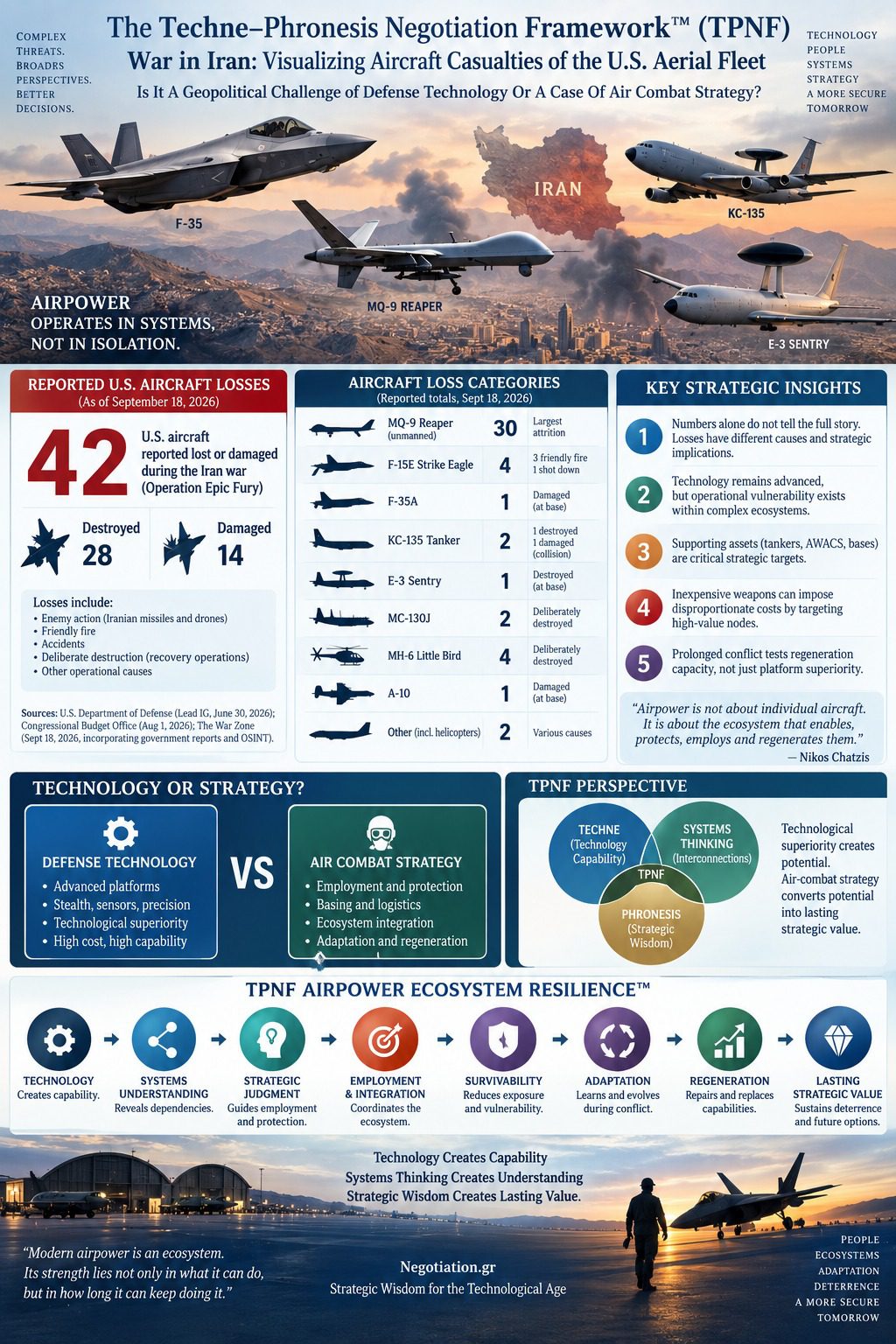
Modern airpower is generated not by aircraft alone but by an interconnected combat ecosystem involving fighters, drones, tankers, airborne command-and-control aircraft, bases, missile defence, logistics, intelligence, maintenance, trained personnel and industrial regeneration.
The Techne–Phronesis Negotiation Framework™ (TPNF) therefore proposes:
The strategic effectiveness of advanced airpower is determined not simply by the technological superiority of individual aircraft, but by the capacity of the entire air-combat ecosystem to protect, integrate, employ and regenerate its distributed capabilities throughout sustained conflict.
This can be described as Airpower Ecosystem Resilience™.
Purpose of the Essay
This TPNF essay examines reported U.S. aircraft casualties during the Iran war through a distinction between Defense Technology and Air Combat Strategy.
The central question is:
When technologically advanced aircraft are lost or damaged, does this indicate technological vulnerability—or the strategic difficulty of sustaining a complex airpower ecosystem during prolonged warfare?
Abstract
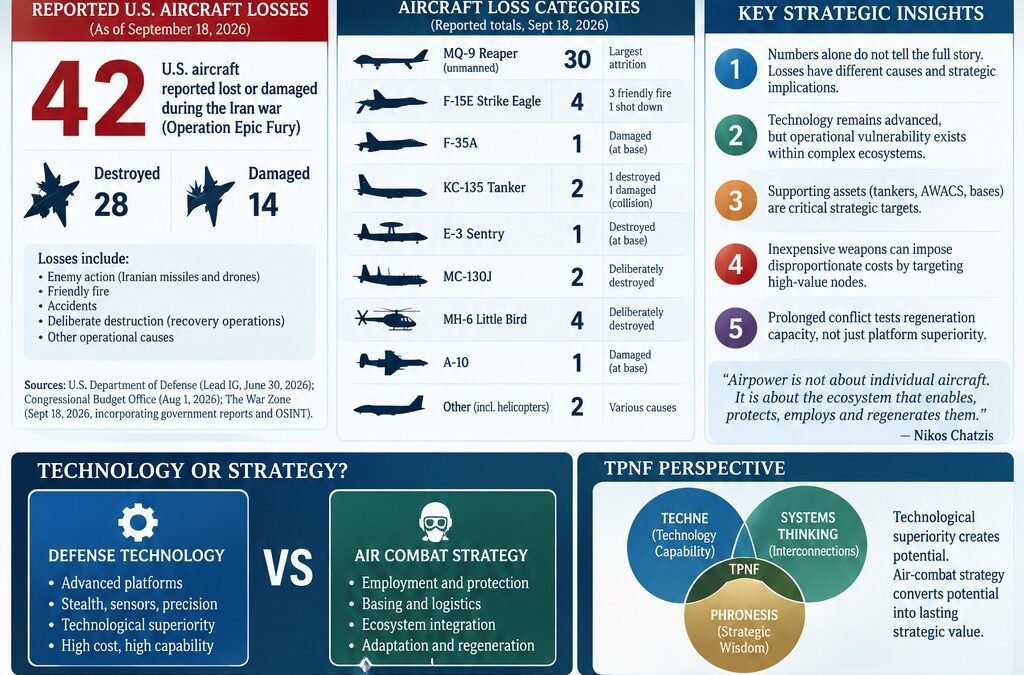
Recent U.S. government assessments have produced the clearest public picture yet of American aviation losses during Operation Epic Fury.
A Congressional Research Service assessment earlier identified 42 aircraft reportedly lost or damaged during the opening phase of the conflict, while subsequent Pentagon Inspector General and Congressional Budget Office assessments expanded the available evidence.
The losses span very different circumstances and aircraft categories: MQ-9 Reapers, F-15Es, KC-135 tankers, an E-3 Sentry, special-operations aircraft and helicopters, an A-10 and damage to an F-35A, among others. Some resulted from enemy action, others from friendly fire, accidents or deliberate destruction during operations.
TPNF argues that these losses should be analyzed systemically through Airpower Ecosystem Resilience™, Combat Capability Exposure™, Airpower Regeneration Capacity™ and the Technological Superiority–Operational Vulnerability Paradox™.
1. Counting Aircraft Is Not Enough
A visual chart of damaged and destroyed aircraft is powerful.
But numbers without causal classification can mislead.
Three F-15Es were destroyed by friendly fire early in the conflict. Another was shot down over Iran. Two MC-130Js and four MH-6 helicopters were deliberately destroyed after becoming stranded during the operation to rescue the F-15E crew. A KC-135 was lost following a collision not attributed to hostile or friendly fire. Other aircraft were directly struck by Iranian weapons.
These are fundamentally different strategic events.
Therefore:
Aircraft Casualty ≠ Enemy Technological Victory.
Understanding airpower requires understanding why capability was lost.
2. Technology Versus Combat Strategy
The F-35, F-15E, MQ-9, KC-135 and E-3 perform radically different functions.
Their vulnerability cannot therefore be judged through a single technological standard.
A tanker does not require fighter-like stealth.
An MQ-9 provides persistent intelligence and strike capability but was not designed primarily to survive sophisticated contested airspace.
An E-3 generates enormous command-and-control value but becomes strategically vulnerable when concentrated at an exposed airbase.
Technology defines capability.
Strategy determines where, when, how and under what protection that capability is employed.
That distinction lies at the heart of TPNF.
3. Combat Capability Exposure™
TPNF can define Combat Capability Exposure™ as:
the degree to which valuable military capabilities become vulnerable through their operational positioning, employment patterns, infrastructure dependencies or concentration within an adversary’s effective strike environment.
An advanced aircraft parked on an exposed airbase temporarily loses much of the protective advantage created by speed, altitude, maneuverability or stealth.
The problem shifts from aircraft survivability toward ecosystem survivability.
4. The Drone Attrition Problem
MQ-9 Reapers have absorbed the largest numerical losses.
The Pentagon Inspector General reported that as many as 30 had been destroyed in various circumstances by June 30, while later reporting citing U.S. officials put the number considerably higher.
This raises an important strategic question.
Should every uncrewed aircraft be designed for maximum survivability?
Or should some capabilities become cheaper, more numerous and deliberately attritable?
A sophisticated $30–50 million drone generates enormous capability.
But prolonged conflict can change the economics of that capability.
TPNF describes this as the Attrition–Value Paradox™:
Increasing technological sophistication can increase operational capability while simultaneously increasing the strategic cost of repeated attrition.
5. The Technological Superiority–Operational Vulnerability Paradox™
The Iran war reveals another apparent contradiction.
The United States possesses extraordinarily advanced aerospace technology.
Yet technologically superior forces remain vulnerable.
There is no contradiction if airpower is understood systemically.
TPNF defines the Technological Superiority–Operational Vulnerability Paradox™:
the condition in which superior individual technologies remain strategically vulnerable because their operational effectiveness depends upon exposed infrastructure, supporting platforms, finite inventories and interconnected enabling systems.
A fifth-generation fighter still requires fuel.
Fuel requires tankers.
Tankers require secure operating locations.
Aircraft require maintenance.
Operations require intelligence.
Bases require missile defence.
Technology exists inside dependency networks.
6. The Tanker Lesson
KC-135 losses and damage demonstrate this particularly clearly.
Air-refuelling aircraft multiply the range and persistence of combat aircraft.
They are therefore not simply support platforms.
They are Capability Multipliers™.
Destroying or disrupting a tanker can influence the operational potential of numerous fighters without directly engaging those fighters.
This creates an important strategic inversion:
The most technologically sophisticated platform may not always be the most strategically valuable target.
Modern air combat therefore increasingly involves attacking the connections sustaining combat power.
7. Airbases Are Part of Airpower
Iranian missile and drone attacks against regional bases further demonstrate that air combat no longer occurs exclusively in the sky.
Recent Iranian strikes damaged multiple American military aircraft at Muwaffaq Salti Air Base in Jordan, according to a U.S. official cited by Reuters.
Aircraft survivability therefore begins before takeoff.
Dispersal, hardened shelters, missile defence, deception, rapid runway repair and distributed logistics become components of air strategy.
The strategic unit is no longer simply:
Aircraft versus Aircraft.
It increasingly becomes:
Combat Ecosystem versus Combat Ecosystem.
8. Technology Still Matters
None of this diminishes technological superiority.
Stealth matters.
Electronic warfare matters.
Sensors matter.
Precision weapons matter.
Autonomy matters.
Missile defence matters.
But technology generates potential capability.
Combat strategy determines how effectively that potential is converted into operational effect.
TPNF therefore distinguishes:
Technological Capability → Potential
from
Integrated Employment → Strategic Effect.
The difference between them is Strategic Conversion™.
9. Airpower Regeneration Capacity™
Prolonged warfare introduces another dimension.
Aircraft are damaged.
Munitions are consumed.
Maintenance requirements increase.
Personnel accumulate fatigue.
Spare parts disappear.
Industrial production must respond.
The CBO estimated losses through August 1 at almost $1.9 billion under its planned-replacement methodology, potentially around $3.3 billion if all lost systems were replaced with currently available equivalents. The same assessments warn of pressure on missile inventories and long production timelines.
TPNF therefore introduces Airpower Regeneration Capacity™:
the ability of a military-industrial ecosystem to repair, replace, replenish and adapt combat capability at a rate sufficient to sustain strategic effectiveness during prolonged warfare.
Winning today’s sortie is insufficient if tomorrow’s capability cannot be regenerated.
10. From Platform Superiority to Ecosystem Superiority
The central lesson is therefore broader than Iran.
Future air warfare may increasingly test competing systems rather than individual aircraft.
One ecosystem attempts to detect.
Another attempts to remain invisible.
One disperses aircraft.
Another attacks bases.
One launches inexpensive drones.
Another expends expensive interceptors.
One destroys capability.
Another repairs and regenerates it.
The strategic competition becomes:
Detection → Protection → Employment → Attrition → Adaptation → Regeneration.
The side capable of sustaining this cycle more effectively develops Combat Ecosystem Adaptability™.
Strategic Implications
The U.S. aircraft casualty picture suggests five important implications.
First, aircraft losses must be classified by cause before conclusions about technological performance are drawn.
Second, supporting aircraft and infrastructure can be strategically as important as frontline fighters.
Third, inexpensive weapons can impose disproportionate costs by attacking expensive ecosystem nodes.
Fourth, distributed basing, protection and logistical resilience increasingly belong to air-combat strategy.
Finally, prolonged warfare shifts the strategic question from who possesses the best technology toward who can regenerate effective combat capability faster than it is consumed.
The aircraft losses of the Iran war do not provide a simple verdict on American defense technology.
They reveal something more important.
Modern airpower is an ecosystem.
Fighters depend upon tankers.
Tankers depend upon bases.
Bases depend upon missile defence.
Aircraft depend upon maintenance.
Operations depend upon intelligence.
All depend upon industrial regeneration.
Techne creates extraordinary aerospace capability.
Systems Thinking reveals the dependencies connecting those capabilities.
Phronesis determines how they should be employed, protected, distributed and regenerated under conditions of sustained conflict.
The fundamental strategic question is therefore not:
Which side possesses the better aircraft?
It is:
Which strategic ecosystem can convert technological capability into sustainable combat effectiveness while learning, adapting and regenerating faster than its opponent can impose attrition?
That is where defense technology becomes air-combat strategy.
Key Takeaways
- Aircraft casualty numbers alone do not measure technological effectiveness.
- U.S. losses have resulted from enemy action, friendly fire, accidents and deliberate destruction.
- Combat Capability Exposure™ explains vulnerability created by operational positioning and dependencies.
- Technological Superiority–Operational Vulnerability Paradox™ separates platform quality from ecosystem vulnerability.
- MQ-9 attrition highlights the economics of sophisticated uncrewed warfare.
- Tankers and command aircraft demonstrate the importance of enabling capabilities.
- Airbase protection and dispersal are integral elements of airpower.
- Airpower Regeneration Capacity™ becomes decisive during prolonged warfare.
- Future air warfare increasingly involves Combat Ecosystem versus Combat Ecosystem.
- Sustainable airpower requires technology, strategy, adaptation and regeneration.
Author’s Reflection
Aircraft casualty charts naturally draw our attention toward what has been destroyed.
Strategic analysis should also examine what each loss reveals about the system surrounding it.
A destroyed fighter can reveal an identification problem.
A damaged tanker can reveal infrastructure exposure.
A lost drone can reveal an unfavorable attrition economy.
An aircraft destroyed on the ground can reveal a basing vulnerability.
A successfully rescued aircrew can reveal extraordinary ecosystem capability even while consuming additional equipment.
The real analytical object is therefore not the aircraft.
It is the system that creates, employs, protects, loses, learns from and regenerates airpower.
The Iran war reinforces a principle increasingly visible across TPNF research:
Technological superiority creates strategic potential. Ecosystem superiority determines whether that potential can be converted into sustainable strategic value.
Nikos Chatzis
Source: Open Sources Analysis, Relative Data Analysis by Nikos Chatzis
© Nikolaos Chatzis. All Rights Reserved.
The Techne–Phronesis Negotiation Framework™
An Integrative Theory of Strategic Negotiation, Complex Adaptive Systems and Practical Wisdom
Technology Creates Capability • Systems Thinking Creates Understanding • Strategic Wisdom Creates Lasting Value.
Negotiation.gr | Strategic Wisdom for the Technological Age