Negotiation.gr | Strategic Wisdom for the Technological Age
“Strategic resilience emerges when technical capability (techne) is
continuously guided by practical wisdom (phronesis) through adaptive
negotiation across interconnected systems.”
Central Idea — Thesis
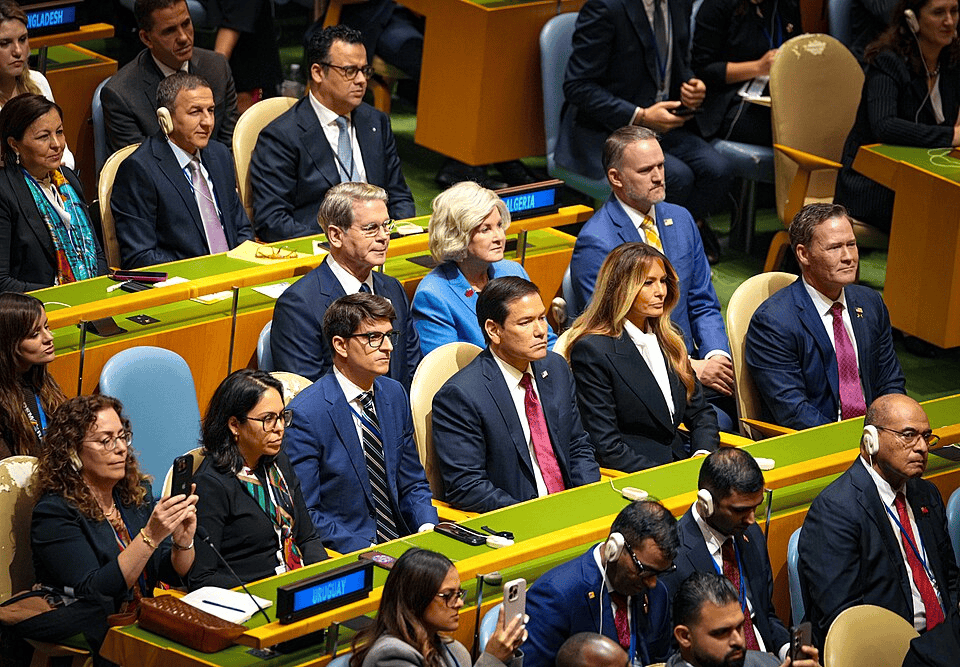
The 2026 United Nations General Assembly exposes a potentially important strategic dilemma for Israel.
President Donald Trump has intensified coercive pressure against Iran, warning that the United States could “annihilate” the Islamic Republic if negotiations fail to produce an agreement ending the conflict. At the same UN gathering, Turkish President Recep Tayyip Erdoğan called for wider recognition of a Palestinian state and increased international pressure on Israel.
For Israel, these developments operate in opposite strategic directions.
American pressure on Iran may reinforce Israeli security against its principal regional adversary. Yet growing international pressure concerning Palestinian statehood could simultaneously constrain Israel diplomatically.
The Techne–Phronesis Negotiation Framework™ (TPNF) describes this condition as Strategic Alignment Asymmetry™:
a situation in which developments within one part of an actor’s geopolitical ecosystem strengthen its strategic position while developments within another simultaneously increase its constraints.
Purpose of the Essay
This TPNF essay examines whether the competing messages emerging from the 2026 UNGA represent a broader strategic dilemma for Israel.
The question is not simply whether Israel possesses military superiority.
It is whether military advantage against Iran can be converted into Lasting Strategic Value™ while Israel faces increasing diplomatic pressure surrounding Palestine.
Abstract
Trump used his September 22 UNGA address to defend the war against Iran, argue that Tehran must not acquire nuclear weapons, encourage greater economic isolation of Iran and threaten further destruction if diplomacy fails. He nevertheless predicted that an agreement could ultimately emerge.
Erdoğan used the same international forum to pursue a different agenda. He criticized the humanitarian situation in Gaza, called for countries that do not recognize Palestine to reconsider and urged greater international pressure on Israel. Israel rejects Turkey’s characterization of its conduct in Gaza as genocide.
These positions illuminate an increasingly multidimensional strategic environment in which military, diplomatic, institutional and relational pressures interact.
TPNF suggests that Israel therefore confronts not one strategic problem but an interconnected Strategic Alignment Asymmetry™.
1. Two Messages From the Same Global Forum
The UNGA is not itself a unified geopolitical actor.
It is an arena in which different strategic ecosystems become visible.
Trump’s message emphasized coercive power.
Erdoğan’s emphasized diplomatic legitimacy and Palestinian statehood.
These approaches operate through different strategic instruments:
Military Capability → Deterrence → Coercive Pressure
and
Diplomatic Mobilization → International Support → Political Pressure.
Israel benefits strongly from the first.
It is challenged by elements of the second.
This demonstrates a central TPNF principle: strategic position cannot be measured through a single dimension.
2. Iran and the Israeli Security Ecosystem
Iran represents a major security challenge for Israel because the confrontation encompasses missiles, drones, nuclear concerns, regional armed groups, maritime routes, cyber capabilities and broader geopolitical relationships.
American military pressure therefore affects Israel’s security environment directly.
If Iranian military capabilities are degraded, Israel may experience greater operational freedom and reduced pressure.
But military degradation does not automatically eliminate geopolitical influence.
States adapt.
Networks reorganize.
Technologies diffuse.
Relationships change.
Consequently:
Military Superiority ≠ Permanent Strategic Resolution.
TPNF distinguishes between defeating capability and transforming the system that regenerates capability.
3. Palestine and the Diplomatic Ecosystem
The Palestinian issue operates differently.
It is increasingly embedded within a broad diplomatic network involving states, international organizations, humanitarian institutions and public opinion.
The UN General Assembly recently voted 152–3, with four abstentions, to permit Palestine to participate virtually in the 81st session after its delegation could not attend physically.
Erdoğan’s speech therefore did not emerge in diplomatic isolation.
Separately, eleven Western governments—including Britain, France, Canada and Spain—reaffirmed this month their commitment to a two-state solution that they said should allow Israel and a sovereign Palestinian state to coexist in peace and security.
The strategic environment surrounding Palestine is therefore increasingly relational.
4. Strategic Alignment Asymmetry™
This produces the central concept.
TPNF defines Strategic Alignment Asymmetry™ as:
the simultaneous strengthening and weakening of an actor’s strategic position across different but interconnected geopolitical relationships.
For Israel:
U.S. Pressure on Iran → Potential Security Advantage
while
Growing Palestinian Diplomatic Mobilization → Potential Political Constraint.
Neither development cancels the other.
They coexist.
This is precisely why multidimensional strategy requires Systems Thinking.
5. The Security–Legitimacy Conversion Gap™
A second concept follows.
Military power can produce security outcomes.
But military success does not automatically generate diplomatic legitimacy.
TPNF describes the difference as the Security–Legitimacy Conversion Gap™:
the distance between an actor’s ability to produce security through coercive capability and its ability to convert those outcomes into durable political acceptance and relational support.
This matters because strategic power ultimately depends upon both capability and relationships.
Israel may possess considerable military capability while still facing diplomatic disagreement over how that capability is employed.
The strategic challenge therefore becomes one of conversion.
6. Erdoğan and Relational Strategic Capital™
Turkey illustrates another dimension.
As a NATO member, regional military power and diplomatic actor with relationships across Europe, the Middle East and the wider Muslim world, Ankara operates across overlapping geopolitical ecosystems.
Erdoğan’s Palestinian advocacy therefore attempts to transform diplomatic relationships into political influence.
TPNF calls this Relational Strategic Capital™: the accumulated strategic value embedded in relationships that can potentially be mobilized during competition, negotiation or crisis.
The significance of Turkey’s position is consequently not determined solely by Erdoğan’s rhetoric.
It depends upon whether Ankara can mobilize wider diplomatic coalitions.
7. Trump and Coercive Strategic Power
Trump’s approach toward Iran represents another strategic mechanism.
His UN address combined military threats, economic isolation and the possibility of negotiation.
This creates what TPNF can describe as Coercion–Negotiation Duality™:
the simultaneous use of coercive capability and negotiated opportunity to alter an adversary’s strategic calculations.
The apparent contradiction is intentional within coercive diplomacy.
Pressure attempts to increase the cost of resistance.
Negotiation provides an alternative pathway.
Whether this succeeds depends upon how Iran evaluates survival, sovereignty, military vulnerability and future strategic options.
8. Israel Between Two Strategic Ecosystems
Israel consequently sits between two evolving environments.
The first is the Security Ecosystem:
United States → Israel → Iran → Regional Military Balance.
The second is the Diplomatic Ecosystem:
Palestine → Turkey → Arab and Muslim States → European Governments → International Institutions.
These ecosystems overlap.
That creates the strategic dilemma.
If Israel concentrates overwhelmingly on military security, it may underestimate diplomatic costs.
If it prioritizes diplomatic accommodation without sufficient security guarantees, it may perceive unacceptable security risks.
Strategic wisdom requires understanding both simultaneously.
9. The Strategic Dilemma Is Not Binary
The choice therefore should not be simplified into:
Security OR Diplomacy.
The deeper strategic question is:
How can security capability be converted into a political environment that remains sustainable after military operations decline?
TPNF calls this Security-to-Stability Conversion™:
the strategic process through which temporary security advantages are transformed into political arrangements, relationships and institutions capable of producing more durable stability.
This represents a harder challenge than battlefield superiority.
Military capability can destroy threats.
It cannot by itself create political settlement.
10. From Military Advantage to Lasting Strategic Value™
The ultimate TPNF criterion is therefore not immediate military advantage.
It is Lasting Strategic Value™.
For Israel, the strategic chain could be understood as:
Military Capability → Security Advantage → Diplomatic Opportunity → Negotiation → Relational Adaptation → Regional Stability → Lasting Strategic Value™.
Failure at any stage creates a Strategic Conversion Gap™.
The central challenge is converting capability into sustainable outcomes.
Strategic Implications
The 2026 UNGA demonstrates several interconnected realities.
American pressure on Iran can strengthen Israel’s security environment without resolving the Palestinian question.
International support for Palestinian statehood can expand without eliminating Israel’s security concerns.
Turkey can challenge Israeli policy diplomatically while remaining embedded within Western security institutions.
And the United States can simultaneously exercise coercive power against Iran while remaining indispensable to broader regional diplomacy.
The strategic environment is therefore not bipolar.
It is a Complex Adaptive Geopolitical Ecosystem™.
Trump and Erdoğan delivered very different strategic messages at the 2026 UN General Assembly.
Trump emphasized coercive power against Iran.
Erdoğan emphasized diplomatic pressure concerning Palestine.
For Israel, the interaction of these two dynamics creates a potential Strategic Alignment Asymmetry™.
One strengthens an important dimension of Israeli security.
The other can increase diplomatic constraints.
TPNF therefore suggests that Israel’s central challenge cannot be measured solely through military superiority.
Techne creates military capability.
Systems Thinking reveals the interacting security and diplomatic ecosystems.
Phronesis requires judging how immediate security advantages can be converted into sustainable political outcomes.
The strategic question is consequently not simply whether Israel can defeat or deter its adversaries.
It is whether Israel can transform military advantage, diplomatic relationships and political negotiation into a regional environment capable of generating Lasting Strategic Value™.
Key Takeaways
- The 2026 UNGA exposes different military and diplomatic pressures affecting Israel.
- U.S. pressure on Iran may strengthen one dimension of Israeli security.
- Erdoğan is attempting to widen international support for Palestinian statehood.
- Strategic Alignment Asymmetry™ explains simultaneous advantage and constraint across different geopolitical relationships.
- Security–Legitimacy Conversion Gap™ distinguishes military effectiveness from diplomatic acceptance.
- Coercion–Negotiation Duality™ explains the simultaneous use of pressure and negotiation toward Iran.
- Security-to-Stability Conversion™ identifies the challenge of transforming temporary security advantage into durable political stability.
- Israel’s strategic environment must be understood as an interconnected geopolitical ecosystem.
- Military capability remains necessary but is insufficient for sustainable political outcomes.
- The ultimate TPNF criterion remains the creation of Lasting Strategic Value™.
Author’s Reflection
The 2026 UNGA illustrates why contemporary geopolitics increasingly requires multidimensional strategic analysis.
Military power, diplomatic legitimacy, alliances, international institutions, public narratives and regional relationships operate simultaneously.
An actor can therefore become stronger militarily while becoming more constrained diplomatically.
This is not necessarily contradiction.
It is the normal condition of strategy inside complex adaptive systems.
For TPNF, the deeper lesson is that power acquires lasting value only when capability can be converted into sustainable relationships and outcomes.
Military superiority can change the strategic environment. Strategic wisdom determines whether that changed environment produces lasting value.
Nikos Chatzis
Source: Open Sources Analysis, Relative Data Analysis by Nikos Chatzis
© Nikolaos Chatzis. All Rights Reserved.
The Techne–Phronesis Negotiation Framework™
An Integrative Theory of Strategic Negotiation, Complex Adaptive Systems and Practical Wisdom
Technology Creates Capability • Systems Thinking Creates Understanding • Strategic Wisdom Creates Lasting Value.
Negotiation.gr | Strategic Wisdom for the Technological Age