Negotiation.gr | Strategic Wisdom for the Technological Age
“Strategic resilience emerges when technical capability (techne) is
continuously guided by practical wisdom (phronesis) through adaptive
negotiation across interconnected systems.”
Central Idea — Thesis
President Donald Trump increasingly confronts a strategic paradox in the prolonged conflict with Iran.
Military pressure can damage Iranian capabilities.
But continuing escalation can simultaneously increase the geopolitical and economic costs imposed upon the United States and its allies.
The latest Houthi advance along Yemen’s Red Sea coast dramatically illustrates this problem.
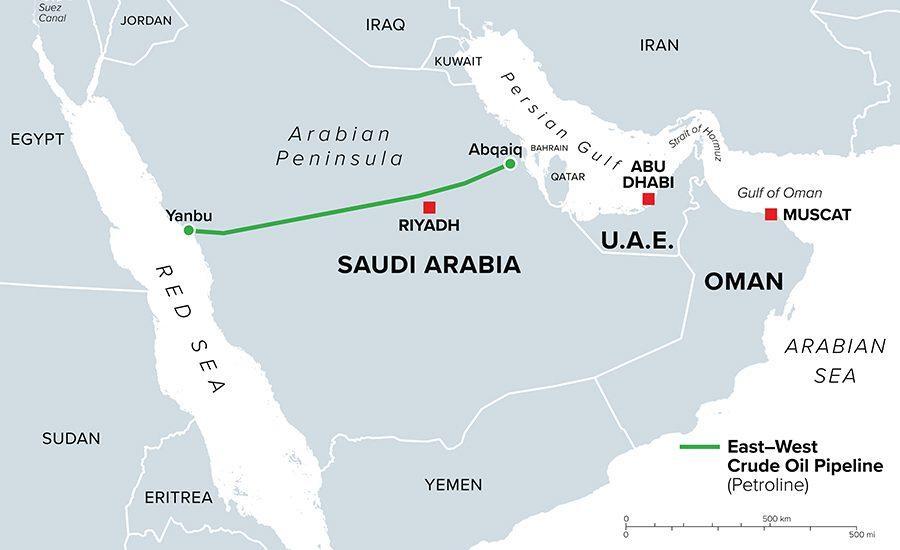
Saudi Arabia’s East–West Pipeline was designed to provide strategic resilience by moving oil from the kingdom’s eastern production regions to Yanbu on the Red Sea, bypassing the Strait of Hormuz.
But if Hormuz is severely disrupted while the Houthis acquire the capability to threaten shipping through Bab el-Mandeb and Saudi Red Sea exports, the strategic bypass itself becomes vulnerable.
The result is what TPNF defines as a Strategic Bypass Vulnerability™:
A system designed to provide resilience against one strategic chokepoint can lose much of its protective value when an adversarial ecosystem develops the capacity to threaten the alternative route.
The emerging chain is therefore:
Military Escalation → Hormuz Disruption → East–West Pipeline Dependence → Red Sea Dependence → Houthi Expansion → Bab el-Mandeb Vulnerability → Oil Supply Risk → Inflation → Higher Interest Rates → Economic Pressure → Political Constraint.
President Trump is consequently confronting more than a military problem.
He is confronting an ecosystem deadlock.
Purpose of the Essay
This TPNF essay examines how the Houthi advance in Yemen, attacks against Saudi energy infrastructure, disruption around Hormuz and increasing inflationary pressures are becoming interconnected components of the same strategic system.
Through the Techne–Phronesis Negotiation Framework™ (TPNF), it asks whether military escalation can become strategically self-constraining when its economic consequences progressively reduce the freedom of action of the power pursuing it.
Abstract
The Houthi advance along Yemen’s Red Sea coastline has changed the strategic geography of the U.S.–Iran conflict.
Houthi forces have captured important territory and islands close to Bab el-Mandeb, increasing their potential ability to threaten one of the world’s most important maritime corridors.
Simultaneously, Saudi Arabia’s East–West Pipeline—its principal alternative to exporting crude through Hormuz—was temporarily shut following attacks on installations inside Saudi Arabia.
These developments expose a potentially dangerous interaction between two strategic corridors.
Meanwhile, oil prices above $100, persistent inflation and rising government-bond yields are increasing pressure on Western central banks.
TPNF describes the resulting situation as an Escalation–Economic Constraint Loop™: military escalation creates economic consequences that progressively constrain the strategic options available to the governments conducting the escalation.
1. The Strategic Importance of the East–West Pipeline
Saudi Arabia’s East–West Pipeline, commonly called Petroline, stretches roughly 1,200 kilometres from Abqaiq in the Eastern Province to Yanbu on the Red Sea.
Its strategic logic is straightforward.
Saudi Arabia’s principal oil-producing regions lie east of the country.
Normally, much of that oil reaches international markets through the Persian Gulf and Strait of Hormuz.
But Hormuz is one of the world’s most strategically vulnerable maritime chokepoints.
The East–West Pipeline therefore provides an alternative:
Eastern Oil Fields → Pipeline → Yanbu → Red Sea → International Markets.
Earlier this year Saudi authorities reported that the system’s full pumping capacity had been restored to approximately seven million barrels per day.
The pipeline is therefore not simply infrastructure.
It is strategic redundancy.
2. But Redundancy Depends on the Alternative Remaining Safe
The current conflict exposes the limitation of redundancy.
If Hormuz becomes unsafe, Saudi Arabia can redirect oil toward Yanbu.
But tankers leaving Yanbu must eventually travel through the Red Sea.
To reach Asian markets, they must pass through Bab el-Mandeb.
And that brings Yemen directly into the global energy equation.
The Houthi advance toward the strait therefore changes the strategic value of territory that might otherwise appear peripheral to the U.S.–Iran confrontation.
A local military advance can create global economic consequences.
This is Strategic Bypass Vulnerability™.
A bypass is strategically valuable only while the alternative route remains operationally credible.
3. The Houthis Change the Geography of Pressure
The Houthis have advanced rapidly along Yemen’s Red Sea coast, capturing Mocha and moving toward strategically important islands and positions around Bab el-Mandeb.
Their position creates potential leverage over maritime traffic.
The significance extends beyond Yemen.
If Iran retains the ability to threaten Hormuz while an Iran-aligned actor can credibly threaten Bab el-Mandeb, pressure can potentially be generated around both sides of the Arabian Peninsula.
This produces a particularly dangerous form of the Double-Chokepoint Risk™ identified previously by TPNF.
Hormuz Risk + Bab el-Mandeb Risk = Systemic Energy Vulnerability.
The important word is systemic.
Neither chokepoint should now be analyzed independently.
4. The Pipeline Attack Adds Another Layer
The strategic picture became still more complicated when Saudi Arabia temporarily shut the East–West Pipeline after attacks struck installations in the Riyadh and Medina regions.
Saudi and Iraqi authorities traced those attacks to Iraqi territory, where Iran-backed militias operate.
This distinction matters.
The Houthis should not be attributed responsibility for an attack for which evidence currently points elsewhere.
But from a systems perspective, the combined effect is significant.
Saudi oil can face pressure:
At Hormuz.
Along the East–West Pipeline.
At Red Sea export infrastructure.
At Bab el-Mandeb.
The vulnerability is therefore no longer concentrated at one geographical point.
It becomes distributed across the energy ecosystem.
5. From Military Geography to the Price of Oil
Energy markets price not only actual shortages but expectations and risk.
When traders perceive increasing probability that future supplies could be disrupted, prices can rise before physical shortages become severe.
This explains why military developments thousands of kilometres from Europe or North America can rapidly affect economic expectations.
The transmission architecture becomes:
Conflict → Infrastructure Risk → Supply Uncertainty → Oil Price → Transportation Costs → Production Costs → Consumer Prices.
This is Geopolitical–Economic Transmission™.
War does not need to physically reach Europe or the United States to enter their economies.
Oil carries the shock.
6. Inflation Returns as a Strategic Variable
This is where President Trump’s military problem becomes an economic problem.
Oil above $100 per barrel increases inflationary pressure across transportation, logistics, manufacturing, agriculture and household energy consumption.
Western economies were already struggling to restore durable price stability.
Now central banks face another externally generated inflationary shock.
The Federal Reserve confronts U.S. inflation around 3.4 percent while oil prices have again moved above $100.
The European Central Bank has already raised rates amid renewed inflation pressure.
Markets are increasingly considering additional monetary tightening in several major economies.
The geopolitical crisis has therefore entered monetary policy.
7. The Interest-Rate Trap
President Trump has repeatedly demanded lower U.S. interest rates.
But the Middle East conflict pushes in the opposite direction.
Higher oil prices can generate inflation.
Higher inflation discourages monetary easing.
Persistent inflation can force central banks to maintain or raise interest rates.
Higher interest rates increase:
Mortgage costs.
Corporate financing costs.
Government debt-service costs.
Consumer credit costs.
Investment hurdles.
The strategic contradiction becomes remarkable:
Trump wants lower interest rates.
Yet the economic consequences of continued geopolitical escalation can contribute to the conditions requiring higher interest rates.
This is an Escalation–Monetary Policy Paradox™.
Military strategy and domestic economic objectives begin moving in opposite directions.
8. Why Trump Is Strategically Deadlocked
The word “deadlocked” should not mean that President Trump possesses no options.
The United States retains enormous military, economic and diplomatic capabilities.
The deadlock is more subtle.
Each major option carries increasing costs.
Escalate militarily?
Iran and aligned actors may intensify pressure on energy infrastructure and maritime routes.
Reduce pressure?
Iran may interpret de-escalation as evidence that energy-market coercion works.
Attack the Houthis?
That could expand another military front without guaranteeing permanent security at Bab el-Mandeb.
Support renewed Saudi intervention in Yemen?
That risks reopening a costly regional war.
Seek negotiations?
Negotiation becomes politically and strategically difficult after months of confrontation.
This is a **Strategic Option Compression™:
the progressive narrowing of politically, economically and operationally acceptable choices as interconnected consequences accumulate around a prolonged confrontation.**
9. Iran Does Not Need Conventional Superiority
This reveals another important strategic reality.
Iran does not need to defeat the United States conventionally to impose strategic costs.
It can exploit geography, infrastructure vulnerability, aligned armed groups, maritime disruption and economic interdependence.
The objective becomes not necessarily military victory.
It can be cost multiplication.
A relatively inexpensive drone attack can threaten infrastructure worth billions.
A militia controlling strategic coastline can influence global shipping expectations.
A threat to maritime traffic can move global oil markets.
Rising oil prices can influence Western inflation.
Inflation can influence central banks.
Central banks can influence households and elections.
The battlefield therefore expands:
Military Domain → Energy Domain → Financial Domain → Economic Domain → Political Domain.
10. The Everyday Citizen Becomes Part of the Strategic System
This is perhaps the most important TPNF observation.
A family in Germany.
A driver in France.
A homeowner in Britain.
A small business in Greece.
A consumer in the United States.
None participates directly in the conflict.
Yet each can experience its consequences.
Fuel becomes more expensive.
Transportation costs rise.
Food prices experience pressure.
Mortgage rates remain elevated.
Businesses face higher financing costs.
Governments spend more servicing debt.
This produces Household Economic Compression™.
Geopolitical escalation eventually reaches the household budget.
And once millions of households experience the consequences, economics becomes politics.
11. The Escalation–Economic Constraint Loop™
The entire strategic system can now be mapped:
Military Escalation
↓
Regional Proxy Activation
↓
Chokepoint Vulnerability
↓
Energy Infrastructure Risk
↓
Oil Supply Uncertainty
↓
Higher Energy Prices
↓
Inflation
↓
Higher Interest Rates
↓
Household Economic Compression™
↓
Political Pressure
↓
Reduced Strategic Freedom
This is the Escalation–Economic Constraint Loop™.
The crucial insight is that the system eventually feeds back upon the actor that initiated or intensified the military strategy.
Power creates consequences.
Consequences reshape power.
Strategic Implications
First, the Houthi advance must be understood within the wider energy geography connecting Hormuz, Saudi Arabia’s East–West Pipeline, Yanbu and Bab el-Mandeb.
Second, strategic redundancy is insufficient when alternative routes become vulnerable simultaneously.
Third, Iranian-aligned actors can generate disproportionate strategic effects without achieving conventional military superiority.
Fourth, energy prices have become part of the strategic battlefield because they transmit regional conflict into Western economies.
Fifth, inflation constrains military strategy by affecting monetary policy, household welfare and domestic political stability.
Sixth, Western governments must evaluate military decisions through their complete geopolitical-economic transmission chains rather than only immediate battlefield outcomes.
Finally, prolonged escalation can create Strategic Option Compression™, progressively reducing the number of politically and economically sustainable choices available to decision-makers.
The Houthi advance in Yemen is not simply another development in a long civil war.
It is becoming part of a much larger strategic system.
Hormuz is vulnerable.
Saudi Arabia consequently depends more heavily upon its East–West Pipeline.
The pipeline directs oil toward the Red Sea.
The Red Sea depends upon secure navigation through Bab el-Mandeb.
And the Houthis increasingly possess geographical positions from which they can influence that security environment.
The strategic chain therefore closes.
Meanwhile, rising oil prices transmit the conflict into Western inflation, interest rates, government finances, businesses and household budgets.
President Trump possesses enormous military power.
But military power does not automatically produce strategic freedom.
Techne provides military capability.
Systems Thinking reveals the second-, third- and fourth-order consequences produced when that capability interacts with energy, finance, alliances and domestic economics.
Phronesis asks the decisive question:
At what point does continuing escalation begin reducing rather than expanding strategic freedom?
That is the emerging dilemma facing Washington.
President Trump is not deadlocked because the United States lacks power.
He is increasingly deadlocked because every application of power changes the ecosystem within which the next decision must be made.
And that may prove to be one of the defining strategic lessons of the conflict.
Key Takeaways
- The Houthi advance threatens the Red Sea side of Saudi Arabia’s strategic oil-export architecture.
- The East–West Pipeline provides a Hormuz bypass, but its value depends upon secure Red Sea access.
- Strategic Bypass Vulnerability™ explains how an alternative route loses resilience when its own operating environment becomes threatened.
- Hormuz and Bab el-Mandeb increasingly create Double-Chokepoint Risk™.
- Strategic Option Compression™ describes the narrowing of sustainable choices as military, economic and political consequences accumulate.
- Escalation–Monetary Policy Paradox™ captures the contradiction between geopolitical escalation that increases inflation and political demands for lower interest rates.
- Escalation–Economic Constraint Loop™ explains how the economic consequences of military escalation eventually constrain the strategic actor itself.
- The ultimate strategic measure is therefore not the amount of power employed, but the sustainable outcome that power creates.
Author’s Reflection
There is something strategically revealing about an oil pipeline.
It appears to be infrastructure.
But in a crisis it becomes geography, economics, military strategy and political power simultaneously.
Saudi Arabia built its East–West Pipeline partly because strategic wisdom required an alternative to Hormuz.
Today we discover another lesson.
Resilience itself must be resilient.
An alternative route provides limited protection if the wider ecosystem upon which that route depends becomes vulnerable.
This is why I believe contemporary strategy cannot be understood through isolated events.
The Houthi advance in Yemen.
The East–West Pipeline.
Bab el-Mandeb.
Hormuz.
Oil above $100.
Western inflation.
Central-bank decisions.
President Trump’s political constraints.
These may appear to belong to different analytical categories.
They do not.
They are interacting components of one strategic system.
And perhaps this is where the real meaning of President Trump’s deadlock can be found.
The United States possesses the ability to destroy targets.
But destroying targets is not identical to controlling consequences.
In an interconnected world, consequences travel.
They travel through shipping routes.
Through pipelines.
Through commodity markets.
Through bond markets.
Through central banks.
And eventually through the front door of the ordinary household.
Military power can initiate an action. Systems determine where its consequences ultimately arrive. Strategic wisdom must understand both before deciding what should happen next.
Nikos Chatzis
Source: Open Sources Analysis, Relative Data Analysis by Nikos Chatzis
© Nikolaos Chatzis. All Rights Reserved.
The Techne–Phronesis Negotiation Framework™
An Integrative Theory of Strategic Negotiation, Complex Adaptive Systems and Practical Wisdom
Technology Creates Capability • Systems Thinking Creates Understanding • Strategic Wisdom Creates Lasting Value.
Negotiation.gr | Strategic Wisdom for the Technological Age