Negotiation.gr | Strategic Wisdom for the Technological Age
“Strategic resilience emerges when technical capability (techne) is
continuously guided by practical wisdom (phronesis) through adaptive
negotiation across interconnected systems.”
Central Idea (Thesis)
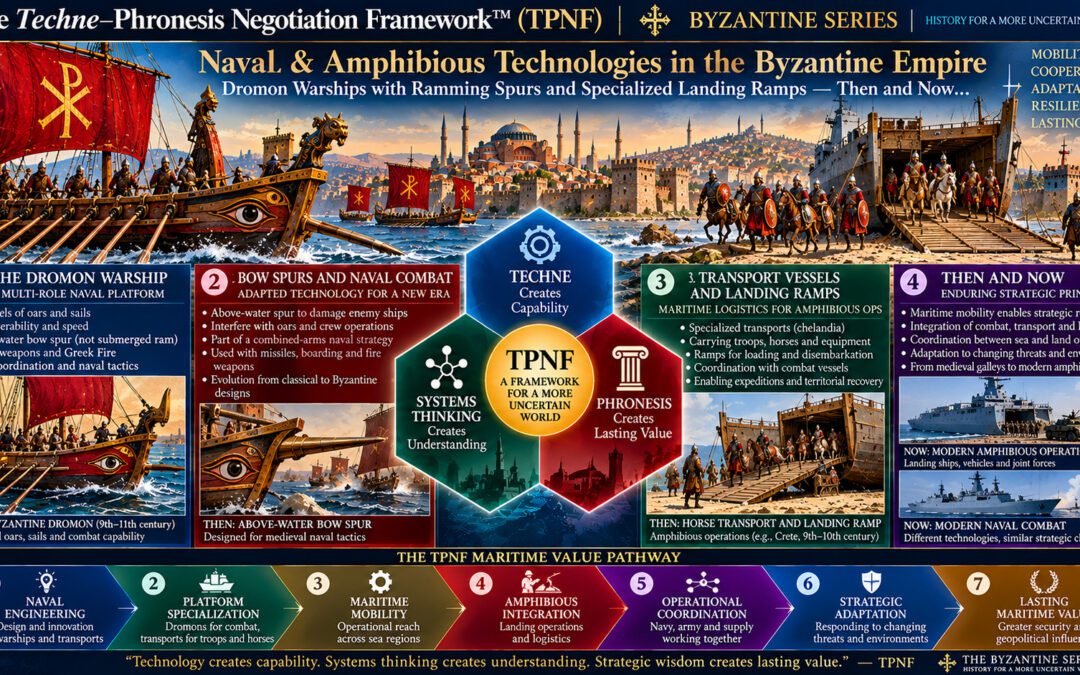
Byzantine naval power depended not simply upon the technological characteristics of its warships, but upon the capacity to integrate maritime combat, transportation, logistics and amphibious operations into a coherent strategic system.
Dromon warships, specialized bow spurs and adapted horse-transport vessels demonstrate how Byzantine maritime technology evolved according to operational requirements.
Through the Techne–Phronesis Negotiation Framework™ (TPNF), this historical experience suggests a fundamental proposition:
Naval technology creates mobility and combat capability; integrated maritime systems transform these capabilities into strategic reach; practical wisdom determines whether maritime power generates lasting geopolitical value.
Purpose of the Essay
This fourth essay in the TPNF Byzantine Series examines the evolution of Byzantine naval and amphibious technologies.
It explores dromon warships, their above-water bow spurs, specialized transport vessels and landing arrangements.
Its purpose is to identify how naval engineering, logistical organization and strategic decision-making contributed to Byzantine military operations, and to examine functional parallels with contemporary maritime defense.
Abstract
The Byzantine Empire developed a sophisticated naval tradition shaped by Mediterranean geography, military competition and changing operational requirements.
The dromon became an important Byzantine warship, combining oared propulsion, sails, specialized weapons and combat personnel.
Its above-water bow spur differed from the submerged rams of classical antiquity.
Meanwhile, specialized transports, including forms of chelandion, supported the movement of troops and horses.
Loading and unloading arrangements helped connect maritime transportation with operations ashore.
TPNF interprets these developments through technological capability, Systems Thinking and strategic wisdom, emphasizing the relationship between naval platforms and institutional coordination.
Introduction: Maritime Power and Geopolitical Survival
The Byzantine Empire occupied a strategic position between Europe and Asia.
Constantinople’s location connected important maritime routes and commercial networks.
Control of surrounding seas influenced trade, military communications and the defense of imperial territories.
However, geographical advantages alone could not guarantee maritime security.
The empire confronted Arab fleets, competing Mediterranean powers and changing political relationships.
Its naval forces therefore required flexibility.
Warships needed to fight, transport vessels needed to sustain campaigns, and commanders needed to coordinate maritime operations with land forces.
The Byzantine experience demonstrates that naval power is not simply the possession of ships.
It is the ability to employ maritime capabilities toward coherent political and strategic objectives.
The Dromon: Evolution of a Byzantine Warship
The dromon, meaning approximately “runner,” developed from earlier Mediterranean galley traditions.
Its design evolved over several centuries.
By the tenth century, important Byzantine dromons employed two levels of oars, sails and specialized combat equipment.
Oared propulsion provided maneuverability, particularly during engagements requiring precise positioning.
Sails supported movement over longer distances when conditions permitted.
Deck arrangements accommodated fighting personnel and equipment.
Some warships carried Greek Fire projection systems.
The dromon’s effectiveness emerged from the combination of these characteristics.
Its technological significance therefore lay not in a single revolutionary invention, but in the progressive adaptation of an integrated naval platform.
Bow Spurs: From Classical Ramming to Medieval Combat
Ancient Mediterranean warships frequently employed submerged rams intended to damage enemy hulls.
Byzantine dromons generally replaced this arrangement with projecting bow spurs positioned above the waterline.
These could interfere with enemy oars and support close-range engagements.
This distinction is historically important.
The medieval spur should not automatically be interpreted as equivalent to the classical underwater ram.
Changes in ship construction, naval tactics and combat requirements influenced the evolution of naval weapons.
Byzantine engagements could involve missiles, incendiary weapons and boarding actions.
The bow spur formed part of this wider combat environment.
For TPNF, its development illustrates how inherited technologies may be redesigned when operational conditions change.
Technological continuity does not require technological imitation. It may instead depend upon adaptation.
Chelandia: Maritime Transportation as Military Capability
Byzantine naval power extended beyond dedicated combat vessels.
Specialized transport ships supported military expeditions across the Mediterranean.
The chelandion was associated with several vessel types, including ships adapted for transporting horses.
Such vessels required arrangements different from those of ordinary fighting galleys.
Transporting animals involved problems of space, stability, ventilation, provisioning and embarkation.
These requirements demonstrate the complexity of amphibious logistics.
A military expedition needed more than soldiers arriving by sea.
It required equipment, animals, food, water and an organized method of transferring resources ashore.
The strategic significance of specialized transports was therefore considerable.
They expanded the operational choices available to Byzantine commanders.
Landing Ramps and Amphibious Operations
Byzantine sources concerning expeditions to Crete describe specialized equipment associated with horse transportation.
Among these arrangements were ramps used for loading and unloading animals.
Their precise configuration varied according to vessel design and operational circumstances.
It would be inaccurate to imagine every Byzantine dromon as a modern landing craft equipped with a standardized bow ramp.
Nevertheless, the historical evidence demonstrates purposeful adaptation of ships for military transportation.
This capability helped connect maritime mobility with operations on land.
Successful amphibious operations required coordination between naval crews and disembarking forces.
Landing locations, local geography, weather and the availability of supplies could determine the success or failure of an expedition.
The ramp itself was therefore only one component of a larger operational system.
Techne: Technology Creates Capability
The first TPNF dimension states:
Technology Creates Capability.
Dromon design created maritime maneuverability and combat options.
Bow spurs supported particular forms of naval engagement.
Specialized transports enabled the movement of personnel, horses and equipment.
Landing arrangements facilitated the transfer of military resources between sea and shore.
Each technological adaptation addressed a different operational requirement.
However, possessing these capabilities did not guarantee military success.
Ships could be lost, expeditions could fail and maritime advantages could disappear.
Technological capability represented potential rather than assured strategic effectiveness.
Systems Thinking: The Maritime Defense Ecosystem
The second TPNF dimension states:
Systems Thinking Creates Understanding.
A Byzantine fleet depended upon numerous interconnected resources.
Shipyards constructed and maintained vessels.
Forests and supply networks provided materials.
Crews required recruitment, training and provisions.
Ports supported repair and resupply.
Transport vessels sustained campaigns.
Commanders coordinated naval operations with land forces and political objectives.
These relationships created a maritime defense ecosystem.
Its effectiveness depended upon the ability to connect specialized capabilities.
A powerful warship could not independently sustain an expedition.
Likewise, a transport fleet without adequate protection could become vulnerable.
The strategic value of Byzantine naval technology therefore emerged from coordination among combat, transportation, logistics and command.
Amphibious Operations: Strategic Mobility and Its Limits
Amphibious capabilities allowed Byzantine authorities to project military forces across maritime spaces.
Such operations could support territorial recovery, reinforcement and offensive campaigns.
However, amphibious warfare presented substantial risks.
Transported troops could become vulnerable during disembarkation.
Adverse weather could disrupt coordination.
Inadequate supplies could undermine operations after landing.
Byzantine expeditions against Crete demonstrate both the possibilities and difficulties of maritime campaigning.
The island’s eventual recovery in 961 under Nikephoros Phokas followed earlier unsuccessful efforts.
This history illustrates the importance of persistence, preparation and operational adaptation.
Maritime mobility creates opportunities, but only effective institutions can convert those opportunities into sustainable military results.
Then and Now: Modern Naval and Amphibious Technologies
Modern naval platforms differ fundamentally from Byzantine warships.
Contemporary fleets employ propulsion systems, sensors, communications, precision weapons and specialized amphibious vessels unimaginable to medieval engineers.
Modern landing ships can transport vehicles, personnel and equipment through purpose-designed systems.
Nevertheless, functional parallels remain.
Both Byzantine and contemporary maritime forces confront the challenge of connecting sea transportation with land operations.
Both require coordination among combat platforms, logistics and command structures.
Both depend upon maintaining operational effectiveness across changing environments.
The comparison is therefore institutional and strategic, not one of direct technological equivalence.
Across different technological eras, maritime power depends upon the integration of mobility, protection, sustainment and coordinated action.
Phronesis: Strategic Wisdom and Maritime Power
The third TPNF dimension states:
Strategic Wisdom Creates Lasting Value.
Naval power expands strategic possibilities, but also creates significant financial and organizational demands.
Maintaining fleets requires continuous investment.
Maritime expeditions involve uncertainty.
Commanders must assess whether the potential political benefits justify operational risks.
The Byzantine experience demonstrates that technological capabilities cannot substitute for sound strategic judgement.
A successful landing may achieve limited value if territory cannot subsequently be defended.
A powerful fleet may become unsustainable if economic resources deteriorate.
Practical wisdom requires matching maritime ambitions with institutional capacities.
The TPNF Byzantine Maritime Value Pathway
The historical experience suggests the following analytical progression:
Naval Engineering → Platform Specialization → Maritime Mobility → Amphibious Integration → Operational Coordination → Strategic Adaptation → Lasting Maritime Value
Each stage adds a new dimension.
Engineering produces vessels.
Specialization adapts them to particular missions.
Mobility creates operational reach.
Amphibious integration connects maritime and land capabilities.
Coordination transforms individual actions into collective operations.
Strategic adaptation responds to changing geopolitical conditions.
Lasting value depends upon whether these capabilities support sustainable security and political objectives.
This pathway is a contemporary TPNF analytical interpretation, not a historical Byzantine doctrine.
Strategic Implications
Byzantine naval experience suggests several lessons for contemporary defense planning.
First, platform specialization should reflect clearly defined operational requirements.
Second, transportation and logistics are strategic capabilities rather than secondary support functions.
Third, maritime and land operations require institutional coordination.
Fourth, technological adaptation must respond to changing threats and geographical conditions.
Finally, sustainable maritime power depends upon economic resources, organizational resilience and strategic judgement.
Byzantine dromons, bow spurs and specialized transport vessels demonstrate the evolution of naval technology within a demanding geopolitical environment.
Their importance cannot be understood through engineering alone.
Maritime effectiveness depended upon logistics, institutional coordination and strategic decision-making.
TPNF captures this relationship:
Technology Creates Capability. Systems Thinking Creates Understanding. Strategic Wisdom Creates Lasting Value.
The enduring lesson is that naval power becomes strategically meaningful when institutions can transform maritime capabilities into coordinated, adaptable and sustainable action.
Key Takeaways
- Byzantine dromons evolved through continuous technological adaptation.
- Above-water bow spurs differed from classical submerged rams.
- Specialized transports supported troops, horses and amphibious operations.
- Landing arrangements connected maritime mobility with military activity ashore.
- Logistics and institutional coordination determined operational effectiveness.
- Modern naval forces confront comparable integration challenges.
- Strategic wisdom determines whether maritime capability creates lasting value.
Author’s Reflection
Byzantine naval history demonstrates that military innovation involves more than developing increasingly sophisticated weapons.
The dromon was important because it combined engineering with operational requirements.
Specialized transports were important because they expanded the possibilities of military movement.
Amphibious capabilities were important because they connected different operational environments.
Together, these developments reveal a fundamental relationship between technology, institutions and strategy.
Contemporary naval forces operate with radically different equipment.
Yet the challenge of integrating combat power, mobility, logistics and political objectives remains recognizable.
Maritime superiority does not emerge simply from possessing advanced vessels. It emerges when technological capability, institutional coordination and strategic wisdom operate as an integrated system.
Nikolaos Chatzis
Research References
The following references provide the historical foundation for Essay IV.
1. Pryor, John H., and Elizabeth M. Jeffreys (2006). The Age of the Dromōn: The Byzantine Navy ca. 500–1204. Leiden: Brill. The principal scholarly reference for dromon design, bow spurs, propulsion, transport vessels, naval logistics and Byzantine operational practices. Publisher’s edition.
2. Sullivan, Denis F. (2012). “Ships, Shipping, Byzantine.” The Encyclopedia of Ancient History. Wiley-Blackwell. Explains the evolution of the dromon from earlier Roman naval traditions and the replacement of submerged rams with above-water spurs. Scholarly reference.
3. Constantine VII Porphyrogenitus. De Ceremoniis (Book of Ceremonies). Primary Byzantine source containing inventories associated with the Cretan expeditions of 911 and 949, relevant to naval equipment, transport and expeditionary logistics. Discussed extensively by Pryor and Jeffreys.
4. Leo VI, Emperor of Byzantium. The Taktika of Leo VI. Edited and translated by George T. Dennis. Washington, DC: Dumbarton Oaks, 2010. Primary military treatise addressing Byzantine warfare, including naval tactical principles.
5. Haldon, John (1999). Warfare, State and Society in the Byzantine World, 565–1204. London: UCL Press. Provides the wider institutional, economic and logistical context of Byzantine military organization.
Historical clarification: Byzantine dromons should not be presented as universally equipped with classical-style ramming prows or specialized landing ramps. The historical evidence supports above-water bow spurs on combat vessels and loading arrangements associated with adapted transport ships.
Source: Open Sources Analysis, Relative Data Analysis by Nikos Chatzis
© Nikolaos Chatzis. All Rights Reserved.
The Techne–Phronesis Negotiation Framework™
An Integrative Theory of Strategic Negotiation, Complex Adaptive Systems and Practical Wisdom
Technology Creates Capability • Systems Thinking Creates Understanding • Strategic Wisdom Creates Lasting Value.
Negotiation.gr | Strategic Wisdom for the Technological Age