Negotiation.gr | Strategic Wisdom for the Technological Age
“Strategic resilience emerges when technical capability (techne) is
continuously guided by practical wisdom (phronesis) through adaptive
negotiation across interconnected systems.”
Central Idea (Thesis)
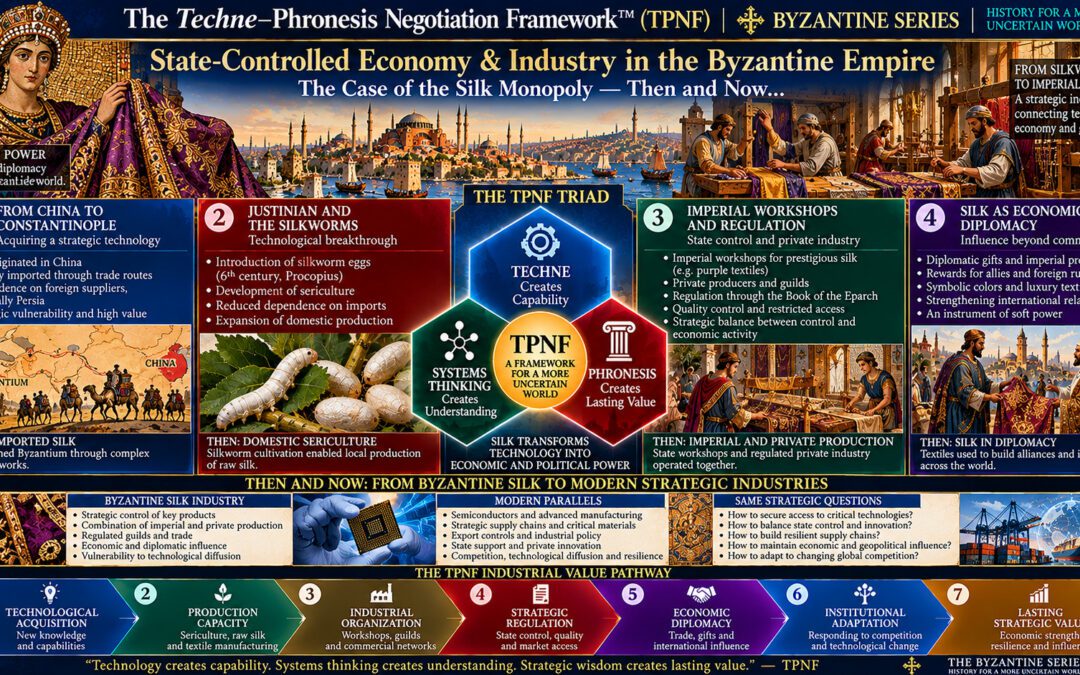
The Byzantine silk industry demonstrates how technological knowledge, industrial organization, state regulation and economic diplomacy can combine to create strategic power.
Silk was more than a luxury textile. It represented wealth, imperial legitimacy, specialized craftsmanship and international influence.
The Byzantine state sought to control particularly valuable silk products while regulating a wider network of private producers and merchants.
Through the Techne–Phronesis Negotiation Framework™ (TPNF), this experience suggests a fundamental proposition:
Technology creates productive capability; Systems Thinking transforms industrial resources into economic and political influence; strategic wisdom determines whether state intervention produces lasting national value.
Purpose of the Essay
This seventh essay in the TPNF Byzantine Series examines silk as a case of strategic industrial organization.
It explores technological acquisition, imperial workshops, regulated guilds, international trade and diplomatic applications.
The essay also investigates functional parallels with contemporary industrial policy, technological sovereignty and strategic supply chains.
Abstract
Silk became one of Byzantium’s most prestigious manufactured products.
Initially dependent upon imported raw materials, Byzantine production expanded following the introduction of silkworm cultivation during Justinian I’s reign.
Imperial workshops manufactured highly valued textiles, while private producers participated in a tightly regulated industry.
The Book of the Eparch provides evidence of government supervision over silk-related commercial activities.
Silk also functioned as a diplomatic instrument, communicating imperial prestige and rewarding political relationships.
TPNF interprets this historical experience through productive capability, economic ecosystems and strategic judgement.
Introduction: When Industry Becomes Geopolitics
Modern governments increasingly treat advanced technologies and industrial supply chains as matters of national security.
Semiconductors, critical minerals, aerospace systems and advanced manufacturing illustrate the relationship between economic production and geopolitical influence.
The Byzantine Empire confronted a comparable strategic problem in a radically different technological environment.
Silk was highly desirable, technically demanding and internationally traded.
Its production involved specialized knowledge, valuable materials and skilled workers.
Control over prestigious textiles also reinforced the political symbolism of imperial authority.
The central question was therefore not simply how to manufacture silk.
It was how to transform industrial capability into economic independence, political legitimacy and diplomatic influence.
Silk Before Byzantine Sericulture
Silk production originated in China and gradually became integrated into extensive Eurasian trading networks.
Byzantine consumers initially depended upon imported silk, frequently obtained through commercial intermediaries.
Persian influence over important trade routes created economic and strategic complications.
The Byzantine Empire could weave imported silk into valuable textiles, but dependence upon external suppliers limited its autonomy.
This distinction between processing imported materials and controlling their production remains important.
An economy may possess advanced manufacturing capabilities while remaining vulnerable to disruptions in essential inputs.
Justinian and the Acquisition of Silkworm Technology
During the sixth century, Byzantine sources describe the introduction of silkworm eggs into the empire.
Procopius recounts how monks familiar with sericulture offered Emperor Justinian a means of producing silk without relying upon traditional foreign suppliers.
According to the narrative, silkworm eggs were transported to Byzantine territory and successfully cultivated.
The account is historically significant, although its precise details cannot be independently verified in full.
The introduction of sericulture expanded Byzantine access to raw silk production.
However, technological acquisition did not immediately eliminate imports or guarantee complete economic independence.
Developing a domestic industry required agricultural resources, specialized labor and continuing institutional support.
For TPNF, this episode illustrates the strategic significance of acquiring knowledge that changes an economy’s productive possibilities.
Imperial Workshops and the Limits of Monopoly
Byzantine authorities maintained imperial workshops associated with prestigious silk production.
Particularly valuable purple textiles carried strong political symbolism.
Certain garments, colors and manufacturing privileges were closely connected with imperial authority.
Yet the Byzantine silk economy was not a uniform state monopoly across all products and periods.
Private workshops, merchants and specialized guilds participated in production and distribution.
The relationship between public control and private activity changed over time.
The state therefore exercised selective control rather than necessarily owning every stage of the industry.
This distinction matters for contemporary analysis.
Strategic industrial control can operate through ownership, regulation, restricted access and market privileges rather than through complete nationalization.
The Book of the Eparch: Industrial Regulation
The Book of the Eparch, associated with early tenth-century Constantinople, provides valuable evidence of urban economic regulation.
It describes professional groups involved in silk trading, processing and manufacturing.
Different activities were subject to rules governing commercial behavior, occupational responsibilities and access to particular products.
Such regulations sought to supervise markets and protect established institutional arrangements.
They also constrained entrepreneurial freedom.
The system reveals a tension familiar to modern economic policy.
Regulation may protect strategic interests and product quality.
Excessive restrictions may also discourage competition, flexibility and innovation.
The historical evidence does not permit a simple conclusion that Byzantine regulation was either economically optimal or uniformly harmful.
Its effects depended upon changing political and commercial circumstances.
Silk as Economic Diplomacy
Byzantine silk possessed significance beyond commercial exchange.
Luxury textiles were distributed as diplomatic gifts, rewards and symbols of imperial favor.
Their colors, designs and associations with court ceremony communicated status and political authority.
Silk could therefore help establish relationships with foreign rulers and influential elites.
Its relatively high value and portability made it particularly suitable for diplomatic exchange.
This illustrates an important strategic distinction.
The economic value of a product is not identical to its political value.
A textile could simultaneously function as merchandise, compensation, prestige and diplomatic communication.
The Byzantine state transformed selected industrial products into instruments of international influence.
Techne: Technology Creates Capability
The first TPNF dimension states:
Technology Creates Capability.
Sericulture expanded access to silk-producing resources.
Weaving and dyeing transformed raw materials into valuable textiles.
Specialized craftsmanship enabled complex designs and prestigious garments.
These capabilities strengthened the empire’s productive possibilities.
Nevertheless, technical knowledge alone did not determine economic outcomes.
Production required workers, materials, commercial networks and reliable demand.
Technological capability was therefore necessary but insufficient for lasting industrial success.
Systems Thinking: The Byzantine Silk Ecosystem
The second TPNF dimension states:
Systems Thinking Creates Understanding.
The silk industry depended upon interconnected activities.
Silkworm cultivation supplied raw materials.
Merchants organized transactions.
Artisans processed fibers, dyed textiles and operated looms.
Workshops coordinated production.
Guild regulations shaped commercial relationships.
Imperial institutions influenced demand and distribution.
Diplomatic networks extended the political significance of finished products.
These components formed an industrial ecosystem.
Weakness in one component could undermine others.
Domestic silkworm production would have limited value without skilled weavers.
Prestigious imperial workshops depended upon access to materials and specialized labor.
The industry’s strategic importance emerged from the relationships connecting production, governance and international influence.
Monopoly, Competition and Institutional Trade-Offs
State control may preserve access to strategically important products.
It can also restrict competition and concentrate economic decisions.
The Byzantine silk industry illustrates both possibilities.
Imperial privileges protected symbolic authority and access to selected luxury goods.
Private producers contributed commercial activity and productive flexibility.
Over time, technological knowledge spread beyond Byzantium, and competing silk industries developed elsewhere.
Political control could not permanently prevent technological diffusion.
For TPNF, the historical lesson is not that monopoly guarantees strategic advantage.
It is that governments must evaluate the balance between protecting critical capabilities and sustaining innovation.
Then and Now: Strategic Industries and Technological Sovereignty
Modern governments face related challenges in advanced manufacturing.
Semiconductor production depends upon specialized equipment, skilled workers, materials and international supply chains.
Aerospace and defense industries require technological knowledge, industrial coordination and sustained investment.
Critical technologies may be subject to export controls, public procurement and security restrictions.
These arrangements differ fundamentally from Byzantine silk regulation.
Nevertheless, functional parallels exist.
Governments seek to protect valuable knowledge.
Industries depend upon interconnected supply networks.
International competition encourages technological diffusion and adaptation.
The enduring strategic question concerns how economic capability can support national objectives without undermining productive dynamism.
Phronesis: Strategic Wisdom in Industrial Policy
The third TPNF dimension states:
Strategic Wisdom Creates Lasting Value.
Industrial policy requires choices among competing objectives.
Governments may seek economic autonomy, technological leadership, employment, security and international influence.
These goals do not always reinforce one another.
Protecting a domestic industry may increase resilience but also raise costs.
Restricting technological access may preserve advantages while limiting commercial opportunities.
Excessive concentration may weaken innovation.
Strategic wisdom therefore requires evaluating the wider consequences of intervention.
The objective should not be state control for its own sake.
It should be the creation of sustainable economic and strategic value.
The TPNF Byzantine Silk Strategic Value Pathway
The historical experience suggests the following analytical progression:
Technological Acquisition → Domestic Production → Industrial Organization → Strategic Regulation → Economic Diplomacy → Institutional Adaptation → Lasting Strategic Value
Technological acquisition expands productive possibilities.
Domestic production reduces selected external dependencies.
Industrial organization connects specialized capabilities.
Regulation shapes access and commercial incentives.
Economic diplomacy converts selected products into political influence.
Institutional adaptation responds to changing technologies and markets.
Lasting value depends upon sustainable economic performance and strategic effectiveness.
This pathway is a contemporary TPNF interpretation, not a historical Byzantine doctrine.
Strategic Implications
The Byzantine silk experience offers several lessons for contemporary governments.
First, industrial autonomy depends upon controlling critical knowledge and capabilities, not merely finished products.
Second, strategic industries require functioning ecosystems of suppliers, workers and institutions.
Third, state intervention should be evaluated through its effects on resilience and innovation.
Fourth, technological advantages are vulnerable to international diffusion.
Finally, industrial policy becomes strategically meaningful when economic capability supports achievable public and geopolitical objectives.
The Byzantine silk industry illustrates the relationship between technology, economic organization and political power.
Its importance extended beyond manufacturing.
Silk supported commerce, imperial legitimacy and diplomatic influence.
Yet its history also demonstrates the limits of monopoly and the importance of institutional adaptation.
TPNF captures the enduring relationship:
Technology Creates Capability. Systems Thinking Creates Understanding. Strategic Wisdom Creates Lasting Value.
The lasting lesson is that industrial strength depends not simply upon controlling production, but upon governing technological and economic ecosystems wisely.
Key Takeaways
- Byzantine silk combined economic, technological and diplomatic value.
- Sericulture expanded domestic productive capability.
- Imperial workshops controlled especially prestigious products.
- Private producers operated within regulated commercial structures.
- Silk functioned as an instrument of imperial diplomacy.
- Strategic monopolies involved trade-offs between protection and innovation.
- Modern industrial policy confronts comparable ecosystem challenges.
Author’s Reflection
The Byzantine silk industry demonstrates how an apparently ordinary manufactured product can acquire extraordinary strategic significance.
Silk connected technological knowledge with production, commerce, political authority and international relations.
Its history also reveals that economic control is not equivalent to economic strength.
A state may regulate an industry extensively without ensuring its permanent competitiveness.
Modern governments face similar challenges as they seek to secure advanced technologies and strategic supply chains.
The enduring lesson is that technological sovereignty cannot be sustained through control alone. It requires productive capability, interconnected institutions, continuous adaptation and strategic wisdom.
Nikolaos Chatzis
Research References
1. Procopius of Caesarea. History of the Wars, Book VIII, Chapter 17. A sixth-century primary account of the introduction of silkworm cultivation into the Byzantine Empire. Read the historical source.
2. Muthesius, Anna Maria (1992). “Silk, Power and Diplomacy in Byzantium.” Textile Society of America Symposium Proceedings. Explores imperial silk privileges, political symbolism and diplomatic functions. Read the scholarly paper.
3. Maniatis, George C. (1999). “Organization, Market Structure, and Modus Operandi of the Private Silk Industry in Tenth-Century Byzantium.” Dumbarton Oaks Papers, 53, 263–332. A detailed study of private silk production, market organization and regulation. Read the research.
4. Maniatis, George C. (2001). “The Domain of Private Guilds in the Byzantine Economy, Tenth to Fifteenth Centuries.” Dumbarton Oaks Papers, 55, 339–369. Examines private guild activity and its relationship with Byzantine economic institutions. Read the study.
5. Shepard, Jonathan (1997). “Silks, Skills and Opportunities in Byzantium: Some Reflexions.” Byzantine and Modern Greek Studies, 21(1), 246–257. Analyzes silk’s relationship with imperial authority, political rewards and economic opportunities. Read the article.
6. The Book of the Eparch, early tenth century. Primary Byzantine regulatory text documenting professional guilds, commercial restrictions and state supervision of silk-related activities. See also the University of Bologna’s academic overview. Academic reference.
7. The Metropolitan Museum of Art (2012). “Woven Silk.” Discusses Byzantine textile production, imperial workshops, private manufacturing and the changing market for luxury textiles. Read the museum article.
Source: Open Sources Analysis, Relative Data Analysis by Nikos Chatzis
© Nikolaos Chatzis. All Rights Reserved.
The Techne–Phronesis Negotiation Framework™
An Integrative Theory of Strategic Negotiation, Complex Adaptive Systems and Practical Wisdom
Technology Creates Capability • Systems Thinking Creates Understanding • Strategic Wisdom Creates Lasting Value.
Negotiation.gr | Strategic Wisdom for the Technological Age