Negotiation.gr | Strategic Wisdom for the Technological Age
“Strategic resilience emerges when technical capability (techne) is
continuously guided by practical wisdom (phronesis) through adaptive
negotiation across interconnected systems.”
Central Idea (Thesis)
Byzantine military resilience depended not simply upon superior weapons or formidable fortifications, but upon the integration of engineering, communications, logistics, intelligence and institutional coordination.
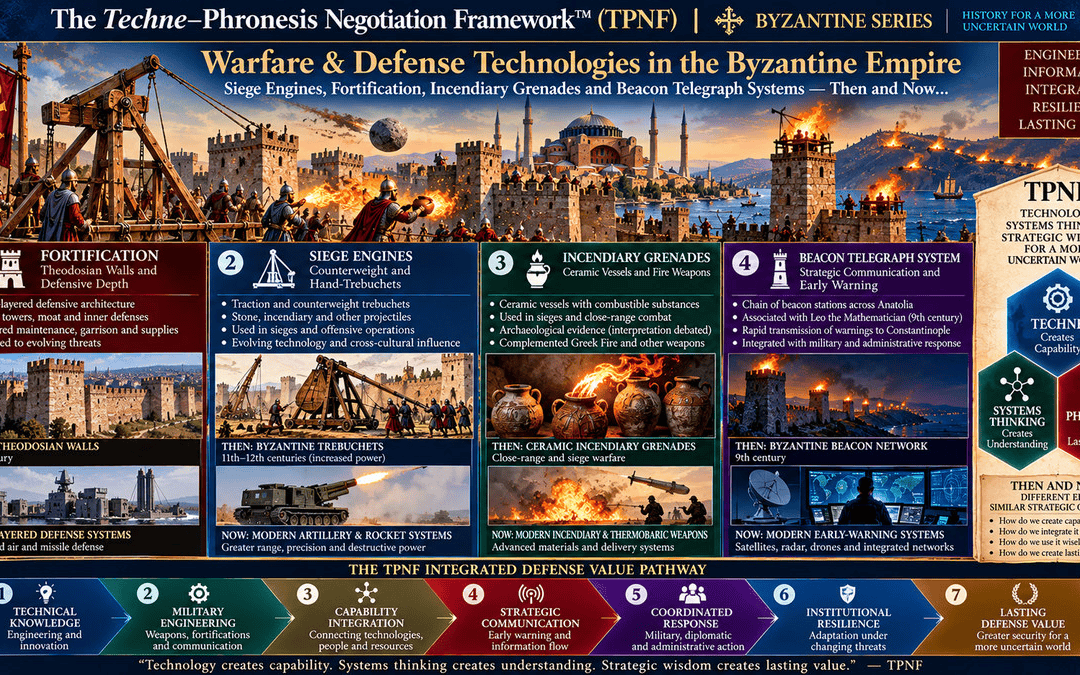
Siege engines, defensive walls, incendiary devices and beacon telegraph systems illustrate different dimensions of this technological ecosystem.
Through the Techne–Phronesis Negotiation Framework™ (TPNF), their historical significance suggests a fundamental proposition:
Military technology creates defensive and offensive capabilities; interconnected systems transform those capabilities into coordinated action; strategic wisdom determines their contribution to lasting security.
The Byzantine experience offers important lessons for contemporary integrated defense.
Purpose of the Essay
This third essay in the TPNF Byzantine Series examines the relationship between military engineering, fortification and strategic communication.
It explores mechanical artillery, including traction and counterweight trebuchets, portable incendiary weapons and the Byzantine beacon network.
Its objective is to identify the institutional and strategic principles connecting these historical technologies with modern defense ecosystems.
Abstract
The Byzantine Empire developed and adapted military technologies across centuries of geopolitical competition.
Its defensive systems combined fortified cities, siege machinery, specialized weapons and long-distance communication.
The Theodosian Walls protected Constantinople through layered defensive architecture.
Mechanical artillery evolved through interaction among Byzantine, Islamic and Western military traditions.
Ceramic vessels have been associated with incendiary warfare, although their precise functions remain debated.
The ninth-century beacon network provided an early example of organized strategic warning.
TPNF interprets these developments through technological capability, Systems Thinking and strategic wisdom.
Introduction: Beyond Individual Weapons
Byzantine military history is often associated with Greek Fire and Constantinople’s defensive walls.
Yet the empire’s military capabilities were considerably more diverse.
Its commanders confronted sieges, frontier raids, maritime attacks and shifting political alliances.
Responding to these challenges required more than possessing advanced equipment.
Military organizations needed information, supplies, trained personnel and coordination.
The Byzantine experience therefore raises a question relevant to contemporary security:
How can different technologies become components of an integrated defense system capable of responding to complex threats?
Fortification: Theodosian Walls and Defensive Depth
Constantinople’s Theodosian land walls, constructed during the fifth century, became one of the most important defensive complexes of the medieval world.
Their architecture combined multiple defensive lines, towers and a moat.
The system complicated enemy approaches and created successive obstacles.
Its effectiveness depended upon more than masonry.
Maintenance, garrison strength, supplies and political stability were essential.
Defensive infrastructure required continuing institutional investment.
The walls also demonstrate that engineering value changes over time.
Weapons, tactics and siege techniques evolved, eventually challenging earlier defensive advantages.
For TPNF, fortification illustrates a central principle:
Defensive infrastructure creates lasting value only when institutions maintain and adapt it to changing threats.
Mechanical Artillery: From Traction to Counterweight Trebuchets
Byzantine armies employed various stone-throwing machines during siege operations.
Earlier traction trebuchets relied upon human power applied through ropes.
Their effectiveness depended upon mechanical design, coordinated crews and operational positioning.
Counterweight trebuchets subsequently introduced a different means of storing and releasing mechanical energy.
Their development increased the potential of medieval artillery, although their actual destructive capabilities varied.
Byzantine accounts from the twelfth century describe powerful siege engines.
Niketas Choniates recounts artillery employed during operations at Zevgminon in 1165.
Some scholars interpret the described mechanisms as evidence of counterweight trebuchets.
Others emphasize uncertainties surrounding terminology, chronology and technological identification.
The historical evidence therefore supports Byzantine involvement in advanced medieval siege artillery without establishing an uncontested Byzantine invention of the counterweight trebuchet.
Hand-Trebuchets and Technological Adaptation
Smaller traction-powered artillery devices, sometimes described as hand-trebuchets, represent another dimension of medieval mechanical warfare.
They required fewer resources than the largest siege engines and could offer greater tactical flexibility.
However, the precise classification of machines across Byzantine and neighboring military traditions remains difficult.
Medieval terminology was not always standardized.
Illustrations and narrative descriptions may also represent different technological arrangements.
Their strategic importance lies in the broader principle of adaptation.
Military organizations required weapons suited to different operational environments.
A machine appropriate for prolonged siege operations was not necessarily suitable for mobile warfare.
Technological diversity expanded commanders’ options, but also increased logistical and organizational demands.
Ceramic Incendiary Grenades: The Limits of Historical Certainty
Archaeological discoveries across the medieval eastern Mediterranean include small ceramic vessels sometimes interpreted as incendiary grenades.
Some may have contained combustible substances.
Others served domestic, commercial or different military purposes.
Their interpretation depends upon archaeological context, surviving residues and comparative evidence.
It would therefore be misleading to classify every such vessel as a Byzantine incendiary grenade.
Nevertheless, portable incendiary containers illustrate a plausible technological response to close-range combat and siege warfare.
Unlike ship-mounted Greek Fire systems, portable weapons could potentially support different tactical applications.
The TPNF significance concerns the relationship between miniaturization, mobility and operational adaptation.
A smaller weapon may offer flexibility while sacrificing other capabilities.
Technological innovation must therefore be evaluated according to operational requirements rather than novelty alone.
The Byzantine Beacon Telegraph: Strategic Communication
One of the most remarkable Byzantine achievements was its long-distance beacon warning system.
Associated with the ninth century and Leo the Mathematician, the network connected frontier regions of Anatolia with Constantinople.
Signal stations transmitted information through visible fires.
Historical descriptions also associate the system with synchronized water clocks, enabling predefined messages to be communicated according to the timing of signals.
The exact operation and reliability of the network cannot be reconstructed with complete certainty.
Nevertheless, its strategic purpose is clear.
Frontier intelligence could reach the imperial capital more rapidly than conventional messengers.
The system represented an important relationship between observation, communication and political decision-making.
Its significance was not simply the transmission of information.
It was the potential to shorten the interval between recognizing a threat and organizing a response.
Techne: Technology Creates Capability
The first TPNF dimension states:
Technology Creates Capability.
Byzantine military engineering created multiple capabilities.
Fortifications protected strategic locations.
Trebuchets supported offensive and defensive siege operations.
Incendiary weapons offered specialized tactical possibilities.
Beacon networks transmitted warnings across considerable distances.
Yet these technologies performed different functions.
Their effectiveness depended upon their suitability for specific military problems.
No individual technology could independently secure the empire.
The critical issue was how technological capabilities contributed to broader operational objectives.
Systems Thinking: Creating an Integrated Defense Ecosystem
The second TPNF dimension states:
Systems Thinking Creates Understanding.
A fortress requires supplies and defenders.
Artillery requires materials, trained crews and maintenance.
Warning networks require functioning stations and reliable procedures.
Military commanders require information to coordinate responses.
These elements form an interconnected defense ecosystem.
Failure in one component can reduce the effectiveness of others.
A warning system provides limited benefit if military forces cannot respond.
Powerful fortifications may become vulnerable when supply routes collapse.
Advanced siege machinery offers little strategic advantage without operational coordination.
The Byzantine experience therefore demonstrates that military effectiveness is a systemic achievement.
The strategic value of a defense ecosystem depends upon the relationships among its capabilities, not merely their individual sophistication.
Then and Now: From Beacon Networks to Integrated Defense
Modern defense systems operate through technologies fundamentally different from Byzantine engineering.
Satellites, radar networks, unmanned aircraft, digital communications and integrated air-defense systems possess capabilities unavailable to medieval societies.
Nevertheless, functional parallels remain.
The Byzantine beacon network connected detection with strategic warning.
Modern early-warning systems perform related organizational functions using entirely different technologies.
Fortified walls created defensive depth.
Contemporary layered defense combines sensors, interceptors, electronic warfare and command networks.
Medieval artillery required coordinated engineering and logistics.
Modern precision weapons similarly depend upon supporting operational ecosystems.
These comparisons concern strategic functions, not direct technological descent.
Phronesis: Strategic Wisdom and Defense Priorities
The third TPNF dimension states:
Strategic Wisdom Creates Lasting Value.
Military resources are always limited.
Byzantine rulers faced difficult choices among fortification, offensive campaigns, naval power and frontier defense.
Investment in one capability could restrict investment elsewhere.
Strategic judgement therefore required balancing immediate threats against long-term institutional needs.
The existence of sophisticated technology did not guarantee sound political decisions.
The Fourth Crusade’s capture of Constantinople in 1204 and the Ottoman conquest in 1453 demonstrate the limits of technological and architectural advantages.
For TPNF, the fundamental distinction is between possessing defensive capabilities and governing them wisely.
The TPNF Byzantine Integrated Defense Value Pathway
The historical experience suggests the following analytical sequence:
Technical Knowledge → Military Engineering → Capability Integration → Strategic Communication → Coordinated Response → Institutional Resilience → Lasting Defense Value
This pathway connects technological development with operational and institutional performance.
Engineering creates specialized capabilities.
Integration connects them with supporting systems.
Communication improves situational awareness.
Coordination enables collective action.
Institutional resilience supports adaptation under pressure.
Lasting defense value emerges when these relationships contribute to sustainable security.
The pathway is a contemporary TPNF interpretation, not a Byzantine military doctrine.
Strategic Implications
The Byzantine experience suggests that modern defense planners should assess technologies through their relationships with wider institutions.
Technological procurement alone does not guarantee operational effectiveness.
Communications and intelligence must support decision-making.
Infrastructure must be maintained and modernized.
Logistical systems must sustain military operations.
Organizational adaptability must accompany technological change.
Most importantly, strategic priorities should determine technological investment rather than technological prestige determining strategic priorities.
Byzantine siege engines, fortifications, incendiary devices and beacon telegraph systems illustrate different dimensions of military innovation.
Their historical significance emerges most clearly when examined together.
They demonstrate the importance of engineering, information, coordination and institutional adaptability.
Through TPNF, their enduring lesson becomes:
Technology Creates Capability. Systems Thinking Creates Understanding. Strategic Wisdom Creates Lasting Value.
The strategic strength of a defense system lies not simply in the weapons it possesses, but in its capacity to connect knowledge, technology and institutions toward sustainable security.
Key Takeaways
- Byzantine defense combined engineering, fortification, artillery and communication.
- Counterweight trebuchet origins and early chronology remain debated.
- Ceramic incendiary vessels require careful archaeological interpretation.
- Beacon networks linked frontier observation with strategic warning.
- Military capabilities depended upon logistical and institutional coordination.
- Technological superiority could not guarantee imperial survival.
- Modern integrated defense confronts comparable systemic challenges.
Author’s Reflection
The Byzantine Empire demonstrates that military innovation cannot be understood through individual weapons alone.
Its fortifications, artillery and communication systems reflected the continuous interaction between technical knowledge and strategic necessity.
Their greatest significance lies in the organizational questions they reveal.
How should institutions connect different capabilities?
How can information become timely action?
How should limited resources be distributed among competing security priorities?
These questions remain central to contemporary technological civilization.
Modern defense systems possess extraordinary technological sophistication.
Yet their lasting strategic value still depends upon integration, institutional resilience and responsible judgement.
The enduring Byzantine lesson is that superior technology strengthens defense only when institutions possess the understanding and wisdom to employ it effectively.
Nikolaos Chatzis
Research References
The following research provides the historical foundation for the essay.
1. Chevedden, Paul E. (2000). “The Invention of the Counterweight Trebuchet: A Study in Cultural Diffusion.” Dumbarton Oaks Papers, 54, 71–116. Examines the emergence of counterweight artillery, including Byzantine evidence from twelfth-century sieges.
2. Dennis, George T. (1998). “Byzantine Heavy Artillery: The Helepolis.” Greek, Roman, and Byzantine Studies, 39(1), 99–115. Examines Byzantine siege engines and textual evidence for increasingly powerful artillery.
3. Fulton, Michael S. (2023). “Trebuchets Were Not Siege Guns, So Why Use Them?” ‘Atiqot, 111, 259–276. Reassesses the destructive effectiveness of counterweight trebuchets and challenges exaggerated interpretations. Read the scholarly article.
4. Komnene, Anna. The Alexiad. A primary Byzantine historical account describing military campaigns and siege machinery during the reign of Alexios I Komnenos.
5. Choniates, Niketas. O City of Byzantium: Annals of Niketas Choniates. Translated by Harry J. Magoulias. Detroit: Wayne State University Press, 1984. A major narrative source for twelfth-century Byzantine warfare and siege operations.
6. Haldon, John (1999). Warfare, State and Society in the Byzantine World, 565–1204. London: UCL Press. Provides institutional and military context for Byzantine defense systems.
7. Constantine VII Porphyrogenitus. De Ceremoniis. A primary source relevant to Byzantine court institutions, communications and imperial administration, including accounts associated with the beacon system.
Research qualification: The historical identification of early counterweight trebuchets, ceramic incendiary grenades and the precise technical operation of the beacon network remains subject to scholarly debate. The TPNF analytical pathway is an original contemporary interpretation.
Source: Open Sources Analysis, Relative Data Analysis by Nikos Chatzis
© Nikolaos Chatzis. All Rights Reserved.
The Techne–Phronesis Negotiation Framework™
An Integrative Theory of Strategic Negotiation, Complex Adaptive Systems and Practical Wisdom
Technology Creates Capability • Systems Thinking Creates Understanding • Strategic Wisdom Creates Lasting Value.
Negotiation.gr | Strategic Wisdom for the Technological Age