Negotiation.gr | Strategic Wisdom for the Technological Age
“Strategic resilience emerges when technical capability (techne) is
continuously guided by practical wisdom (phronesis) through adaptive
negotiation across interconnected systems.”
Central Idea (Thesis)
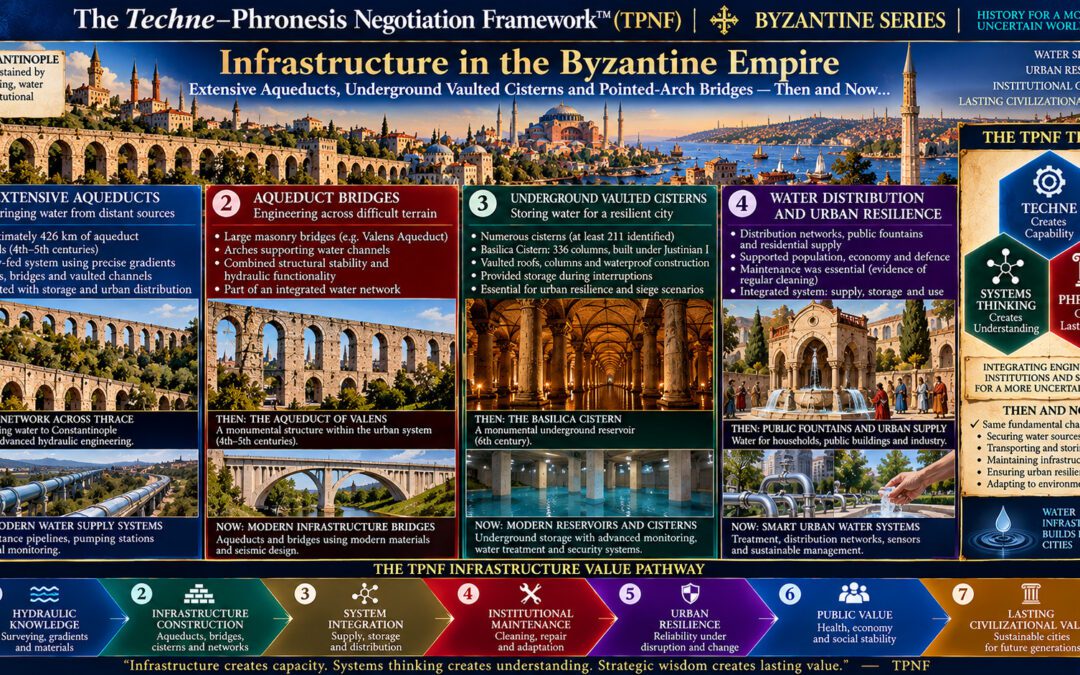
The Byzantine water infrastructure of Constantinople represents one of the most remarkable achievements of ancient and medieval civil engineering.
Its strategic importance extended beyond the construction of aqueducts, bridges and underground reservoirs.
It depended upon connecting distant water sources, hydraulic engineering, storage facilities, urban distribution and institutional maintenance into a functioning infrastructure ecosystem.
Through the Techne–Phronesis Negotiation Framework™ (TPNF), this historical achievement suggests a fundamental proposition:
Infrastructure technology creates capacity; Systems Thinking transforms interconnected facilities into reliable public services; strategic wisdom determines whether those services generate lasting civilizational value.
Purpose of the Essay
This sixth essay in the TPNF Byzantine Series examines Constantinople’s water infrastructure as an example of technological integration and institutional resilience.
It explores extensive aqueduct networks, masonry bridges, underground vaulted cisterns and water-storage strategies.
It also investigates how these historical systems illuminate contemporary challenges involving water security, infrastructure governance and sustainable urban development.
Abstract
Constantinople depended upon an extensive water supply system developed primarily during the fourth and fifth centuries.
Gravity-fed aqueducts transported water from distant sources across Thrace.
Bridges, tunnels and vaulted channels enabled the network to negotiate difficult terrain.
Within the city, numerous cisterns provided storage capacity, including the monumental Basilica Cistern.
Archaeological and hydraulic research demonstrates the exceptional scale and complexity of this infrastructure.
TPNF interprets these achievements through technological capability, Systems Thinking and strategic wisdom, emphasizing the relationship between engineering and institutional continuity.
Introduction: Water as a Strategic Resource
Water is essential to urban survival.
For Constantinople, reliable supplies supported households, public facilities, economic activity and imperial administration.
The city’s geographical position offered exceptional maritime advantages but imposed important freshwater constraints.
Local resources alone could not reliably satisfy the demands of a major imperial capital.
Byzantine authorities therefore inherited, expanded and maintained an extensive water infrastructure.
The historical question is not simply how water reached Constantinople.
It is how engineering systems transformed distant natural resources into an organized urban capability.
The Long Aqueducts: Engineering Across Thrace
Constantinople’s long-distance water network developed substantially during the fourth and fifth centuries.
Its construction built upon Roman hydraulic engineering traditions.
The system used carefully graded masonry channels to transport water through gravity rather than mechanical pumping.
Modern research reconstructs approximately 426 kilometers of fourth- and fifth-century aqueduct channels, although the precise configuration remains debated.
Some reconstructions suggest an even greater combined length if parallel sections continued independently toward Constantinople.
This scale required exceptional surveying, construction and administrative coordination.
Engineers had to manage gradients, geological conditions and variations in water availability.
The achievement was not merely geographical distance.
It was the creation of an infrastructure network capable of linking distant watersheds with an expanding imperial capital.
Aqueduct Bridges: Overcoming Geography
The network crossed valleys and uneven terrain through substantial masonry bridges.
The surviving Aqueduct of Valens remains its most recognizable urban monument.
Such structures supported water channels while preserving the gradients required for gravity-fed flow.
Their engineering significance lay in combining structural stability with hydraulic functionality.
Arches distributed loads through supporting piers and foundations.
Vaulted conduits protected water channels along extensive portions of the network.
Pointed arches also appeared in the broader development of medieval bridge architecture.
However, they should not be presented as a defining or exclusively Byzantine invention.
The essential Byzantine achievement was the integration of bridge engineering into a geographically extensive hydraulic system.
Underground Vaulted Cisterns: Strategic Storage
Transporting water represented only one component of Constantinople’s infrastructure.
Storage was equally important.
The city developed numerous cisterns, including monumental underground reservoirs supported by columns, arches and brick vaults.
The Basilica Cistern, associated with Justinian I’s sixth-century building program, remains the most celebrated example.
Its interior contains 336 columns supporting a vaulted roof.
Other cisterns varied considerably in size and architectural arrangement.
Scholarly research has identified at least 211 cisterns attributable to Byzantine Constantinople.
Their distribution demonstrates that water storage was an urban system rather than an isolated architectural achievement.
Reservoirs could help manage variations in supply and provide reserves during interruptions.
Water Security and Siege Resilience
Constantinople repeatedly confronted military threats.
Its walls provided formidable protection, but fortifications alone could not sustain a large population.
Food, water and administrative coordination remained essential.
Cisterns potentially reduced dependence upon uninterrupted delivery from distant aqueducts.
This was particularly important because infrastructure outside defensive walls could be damaged or disrupted.
However, storage did not guarantee indefinite security.
Reservoirs required replenishment, maintenance and protection against contamination.
Water resilience therefore depended upon the relationship between supply networks and stored reserves.
The strategic value of water infrastructure emerged from combining transportation capacity with continuity under disruption.
Techne: Technology Creates Capability
The first TPNF dimension states:
Technology Creates Capability.
Aqueducts enabled water transportation across long distances.
Bridges overcame geographical obstacles.
Vaulted channels protected hydraulic routes.
Cisterns created storage capacity.
Waterproof construction materials helped preserve reservoirs.
Each innovation expanded the city’s technical possibilities.
Nevertheless, engineering capability alone did not ensure reliable service.
Channels could become obstructed.
Structures could deteriorate.
Water availability could fluctuate.
Technical achievement represented a necessary foundation, not a complete solution.
Systems Thinking: The Byzantine Water Ecosystem
The second TPNF dimension states:
Systems Thinking Creates Understanding.
Constantinople’s water supply depended upon interconnected components.
Distant springs provided resources.
Aqueduct channels transported water.
Bridges and tunnels maintained routes across difficult terrain.
Reservoirs stored supplies.
Distribution systems connected infrastructure with urban demand.
Maintenance personnel preserved functionality.
Imperial and local institutions organized resources.
A failure in one component could affect the performance of others.
A large reservoir was of limited value without replenishment.
An extensive aqueduct offered reduced security without adequate storage.
The entire system therefore required coordination.
Infrastructure effectiveness depends upon the relationships among its components, not merely the capacity of individual structures.
Maintenance: The Invisible Engineering Achievement
Recent scientific studies of carbonate deposits inside Byzantine aqueduct channels provide important evidence of water management.
Mineral accumulation could gradually restrict flow.
Research suggests that parts of the network underwent repeated cleaning.
Such maintenance required technical knowledge, labor and institutional organization.
This introduces a fundamental distinction.
Constructing infrastructure creates initial capacity.
Maintaining infrastructure preserves operational value.
The most impressive aqueduct becomes strategically ineffective if its channels are neglected.
For TPNF, maintenance represents the institutional bridge between engineering achievement and infrastructure resilience.
Then and Now: Smart Water Infrastructure
Modern cities employ technologies fundamentally different from those available to Byzantine engineers.
Digital sensors, automated monitoring, hydraulic modeling and advanced treatment facilities support contemporary water networks.
Geographic information systems help planners assess infrastructure and environmental conditions.
Smart meters and predictive maintenance can improve operational efficiency.
Nevertheless, the underlying strategic challenges remain recognizable.
Cities must secure water sources.
Networks must transport and distribute supplies.
Reservoirs must manage variations in demand and availability.
Infrastructure must withstand environmental and operational disruption.
The historical comparison is functional rather than technological.
Both Byzantine and modern water systems require the integration of physical infrastructure, information and institutional management.
Phronesis: Strategic Wisdom and Urban Sustainability
The third TPNF dimension states:
Strategic Wisdom Creates Lasting Value.
Water infrastructure requires decisions extending beyond technical feasibility.
Authorities must consider costs, maintenance, accessibility, security and long-term environmental conditions.
Large engineering projects can create impressive capabilities while generating continuing financial obligations.
Strategic wisdom therefore requires balancing construction ambitions with sustainable operation.
Constantinople’s experience illustrates the importance of institutional continuity.
Infrastructure may survive political transitions, but its functionality depends upon ongoing human decisions.
Modern governments confront comparable questions involving aging networks, climate pressures and urban growth.
The decisive challenge is not simply constructing more infrastructure.
It is governing existing and future infrastructure responsibly.
The TPNF Byzantine Water Infrastructure Value Pathway
The historical case suggests the following analytical progression:
Hydraulic Knowledge → Infrastructure Construction → Network Integration → Water Storage → Institutional Maintenance → Urban Resilience → Lasting Civilizational Value
Hydraulic knowledge enables engineering solutions.
Construction transforms designs into physical capacity.
Integration connects sources, channels and distribution.
Storage provides flexibility during interruptions.
Maintenance preserves operational functionality.
Resilience emerges through adaptation to changing conditions.
Lasting value depends upon sustained public benefit.
This pathway represents a contemporary TPNF interpretation, not an explicitly formulated Byzantine doctrine.
Strategic Implications
The Byzantine experience suggests several lessons for contemporary infrastructure planning.
First, water security requires coordinated networks rather than isolated engineering projects.
Second, storage capacity provides strategic flexibility but cannot replace reliable supply.
Third, maintenance must be treated as a long-term investment.
Fourth, infrastructure governance should account for disruption, environmental uncertainty and changing urban needs.
Finally, technological modernization should strengthen public resilience rather than merely increase engineering complexity.
Constantinople’s aqueducts, bridges and underground cisterns demonstrate the exceptional scale of Byzantine infrastructure engineering.
Their importance extended beyond construction.
They formed an interconnected system linking natural resources, technological capabilities and institutional responsibilities.
TPNF captures the enduring relationship:
Technology Creates Capability. Systems Thinking Creates Understanding. Strategic Wisdom Creates Lasting Value.
The Byzantine experience demonstrates that infrastructure becomes a lasting civilizational achievement when societies can integrate, maintain and adapt it across generations.
Key Takeaways
- Constantinople developed an exceptionally extensive gravity-fed aqueduct network.
- Bridges and vaulted channels connected distant sources with the city.
- Underground cisterns provided substantial water-storage capacity.
- Water security depended upon supply, storage and distribution working together.
- Maintenance was essential to long-term infrastructure performance.
- Modern water systems face comparable integration and resilience challenges.
- Strategic wisdom connects engineering investment with sustainable public value.
Author’s Reflection
The Byzantine water infrastructure of Constantinople reveals a dimension of technological civilization that is often less visible than monumental architecture or military innovation.
Aqueducts and cisterns did not merely demonstrate engineering sophistication.
They supported the everyday functioning of an imperial capital.
Their strategic significance emerged from the ability to connect distant resources with human needs.
Modern societies possess vastly more advanced technologies.
Yet they remain dependent upon infrastructure systems whose failure can rapidly disrupt economic and social life.
The lasting lesson is that civilization depends not only upon the infrastructure it builds, but upon the institutional wisdom required to keep that infrastructure functioning.
Nikolaos Chatzis
Research References
1. Crapper, Martin, and colleagues (2020). “The Valens Aqueduct of Constantinople: Hydrology and Hydraulics.” Water History, 12, 427–448. Hydraulic modeling of the fourth- and fifth-century network, including water availability, gradients and possible configurations. Read the research.
2. Ruggeri, Francesca (2018). Engineering the Byzantine Water Supply of Constantinople: Mapping, Hydrology and Hydraulics of the Long Aqueducts Outside the City. University of Edinburgh. Doctoral research examining the long-distance system and its engineering characteristics. University research archive.
3. Sürmelihindi and colleagues (2021). “Carbonates from the Ancient World’s Longest Aqueduct: A Testament of Byzantine Water Management.” Geoarchaeology, 36(4), 643–659. Evidence concerning mineral deposits, maintenance and the operation of Constantinople’s water network. Read the article.
4. Crow, James, and colleagues (2017). “The Byzantine Cisterns of Constantinople.” Water Supply, 17(6), 1499–1506. A systematic study identifying at least 211 Byzantine cisterns and examining their distribution. Read the research.
5. Crow, James (2024). “Water and the Urban Environment of Constantinople and Thessaloniki.” In A Companion to the Environmental History of Byzantium, pp. 203–226. Brill. Examines hydraulic infrastructure, urban development and institutional continuity. Read the chapter.
6. Ruggeri, Francesca, Martin Crapper, Riley Snyder and Jim Crow (2017). “A GIS-Based Assessment of the Byzantine Water Supply System of Constantinople.” Research using satellite elevation data and archaeological evidence to reconstruct the network.
7. Basilica Cistern — Historical and Architectural Resources. Background on the sixth-century underground reservoir, its 336 columns and vaulted construction. Architecture and water infrastructure.
Historical qualification: The fourth- and fifth-century aqueduct system continued Roman engineering traditions within the emerging Byzantine capital. Its exact length and configuration remain subjects of research. Pointed arches should not be treated as an exclusively Byzantine invention or as a defining feature of Constantinople’s aqueduct network.
Source: Open Sources Analysis, Relative Data Analysis by Nikos Chatzis
© Nikolaos Chatzis. All Rights Reserved.
The Techne–Phronesis Negotiation Framework™
An Integrative Theory of Strategic Negotiation, Complex Adaptive Systems and Practical Wisdom
Technology Creates Capability • Systems Thinking Creates Understanding • Strategic Wisdom Creates Lasting Value.
Negotiation.gr | Strategic Wisdom for the Technological Age