Negotiation.gr | Strategic Wisdom for the Technological Age
“Strategic resilience emerges when technical capability (techne) is
continuously guided by practical wisdom (phronesis) through adaptive
negotiation across interconnected systems.”
Central Idea (Thesis)
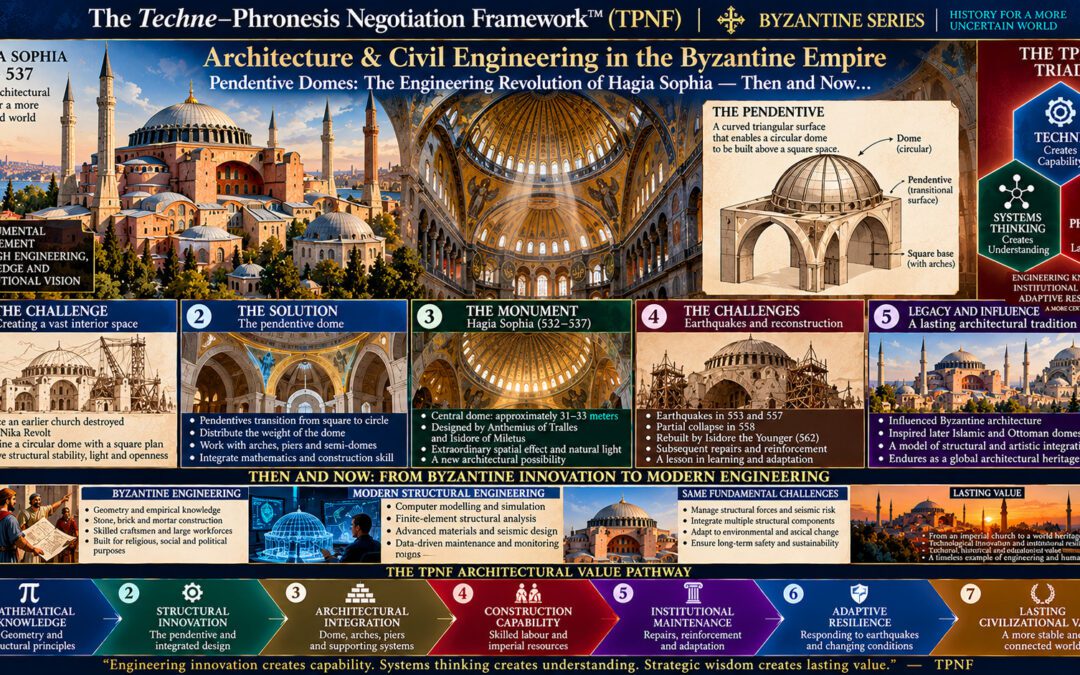
The monumental pendentive dome of Hagia Sophia represents one of the most influential achievements of Byzantine architectural engineering.
Its importance extends beyond the geometric solution of placing a circular dome above a square architectural space.
Hagia Sophia demonstrates how mathematics, materials, structural engineering, artistic ambition and institutional organization can be integrated into a coherent architectural system.
Through the Techne–Phronesis Negotiation Framework™ (TPNF), this achievement illustrates a fundamental proposition:
Engineering innovation creates structural capability; Systems Thinking transforms individual components into functional architecture; strategic wisdom determines whether technological achievements produce lasting civilizational value.
Purpose of the Essay
This fifth essay in the TPNF Byzantine Series examines the pendentive dome as an architectural and engineering achievement.
It focuses on Hagia Sophia, its construction under Emperor Justinian I, the structural challenges encountered by its designers and the subsequent adaptations that contributed to its survival.
The essay also explores conceptual parallels with contemporary civil engineering, seismic resilience and sustainable infrastructure.
Abstract
Constructed between 532 and 537, Hagia Sophia became a defining achievement of Byzantine architecture.
Designed under the direction of Anthemius of Tralles and Isidore of Miletus, its monumental dome combined sophisticated geometry with an ambitious structural system.
Pendentives enabled the transition from a square supporting arrangement to a circular dome.
However, the building’s structural history included earthquakes, partial collapse, reconstruction and repeated reinforcement.
Its enduring significance therefore concerns not only architectural invention but also institutional maintenance and technological adaptation.
TPNF interprets Hagia Sophia through technological capability, Systems Thinking and strategic wisdom.
Introduction: The Engineering Challenge of Monumental Space
The Byzantine Empire inherited architectural traditions from the Greek and Roman worlds.
Roman engineers had developed impressive arches, vaults and domes.
Yet constructing an enormous dome above a predominantly square central space presented demanding geometric and structural challenges.
Hagia Sophia represented an ambitious response.
Commissioned by Justinian I following the destruction of an earlier church during the Nika Revolt, the new building was completed in approximately five years.
Its architectural significance emerged from the integration of engineering, imperial resources and religious symbolism.
The challenge was not simply to construct a large roof.
It was to create a monumental interior that combined structural stability with an extraordinary perception of openness and light.
The Pendentive: Connecting Square and Circle
A pendentive is a curved, approximately triangular architectural surface that helps support a dome above a square arrangement of arches and piers.
Four pendentives create the geometric transition between the square below and the circular base above.
This solution allows the weight and thrust of the dome to be transferred through supporting arches and massive structural piers.
Earlier Roman architecture had experimented with related geometric arrangements.
Consequently, attributing the absolute invention of the pendentive exclusively to Hagia Sophia would oversimplify architectural history.
Its Byzantine achievement was the monumental development and integration of this structural principle.
The innovation transformed an architectural challenge into a new spatial possibility.
A geometric solution became a structural capability capable of reshaping architectural design.
Hagia Sophia: Engineering on an Extraordinary Scale
Hagia Sophia’s central dome spans approximately 31–33 meters, depending upon the measurement convention.
Its original construction involved a complex arrangement of arches, pendentives, semi-domes, piers and supporting masonry.
Anthemius and Isidore combined mathematical knowledge with practical construction experience.
The design created an immense interior space in which the dome appeared remarkably elevated above the supporting structure.
Windows around its base contributed to the visual impression of a suspended roof.
However, the apparent lightness concealed substantial engineering demands.
The structure needed to manage gravitational loads, lateral thrust and the behavior of interconnected masonry elements.
Hagia Sophia therefore demonstrates the difference between architectural appearance and structural reality.
Its beauty depended upon engineering relationships largely invisible to the observer.
The Collapse of 558: Innovation Meets Structural Reality
Hagia Sophia’s original dome did not survive unchanged.
Following earthquakes in 553 and 557, part of the dome and supporting structure collapsed in 558.
The failure revealed vulnerabilities within the ambitious original design.
Reconstruction proceeded under Isidore the Younger.
The replacement dome, completed in 562, adopted a higher profile and incorporated structural modifications intended to improve stability.
Subsequent centuries brought additional earthquake damage, repairs and reinforcement.
These events should not diminish the original achievement.
They demonstrate that engineering innovation develops through experience, structural observation and corrective action.
For TPNF, the collapse represents an essential lesson:
Technological achievement becomes lasting value only when institutions can recognize weaknesses, learn from failure and adapt their systems.
Techne: Technology Creates Capability
The first TPNF dimension states:
Technology Creates Capability.
The pendentive enabled Byzantine builders to combine different geometric forms within a monumental architectural structure.
It expanded the possibilities of interior space.
The dome could dominate the building without requiring a continuous circular supporting wall.
This capability influenced later Byzantine architecture and architectural traditions beyond the empire.
Nevertheless, engineering innovation remained constrained by materials, construction methods and structural forces.
The existence of an elegant geometric solution did not eliminate the need for sound execution.
Technical knowledge created possibilities, not guarantees.
Systems Thinking: Hagia Sophia as an Architectural Ecosystem
The second TPNF dimension states:
Systems Thinking Creates Understanding.
Hagia Sophia cannot be understood through its dome alone.
Its structural performance depended upon the relationships among multiple components.
The dome transferred forces toward pendentives and arches.
The arches interacted with piers and supporting structures.
Semi-domes and additional architectural elements helped organize the overall system.
Materials and construction techniques influenced structural behavior.
Skilled workers transformed mathematical and architectural concepts into physical reality.
Imperial resources supported construction and subsequent maintenance.
These relationships formed an architectural ecosystem.
A weakness in one element could affect the stability of others.
The significance of Hagia Sophia lies not merely in its components, but in the engineering relationships that made them function together.
Architecture, Institutions and Civilizational Ambition
Hagia Sophia was also an institutional achievement.
Its construction required substantial financial resources, skilled labor, administrative coordination and political commitment.
Justinian’s ambition transformed architectural engineering into an expression of imperial authority and religious identity.
The building subsequently experienced profound political, religious and cultural transformations.
Its continuing existence reflects not uninterrupted stability, but repeated adaptation.
This distinction matters.
Architectural monuments survive through changing institutions, changing uses and continuing human intervention.
Their lasting value therefore extends beyond their original political purposes.
They become repositories of technical knowledge, artistic achievement and collective historical memory.
Then and Now: Structural Engineering and Digital Technologies
Contemporary civil engineering employs technologies unavailable to Byzantine builders.
Computer-aided design, finite-element analysis, advanced materials and structural monitoring allow engineers to investigate stresses, deformation and seismic performance.
Modern engineers can simulate alternative structural configurations before construction.
Researchers have applied computational methods to understand Hagia Sophia’s historical behavior.
Yet the fundamental challenge remains recognizable.
A structure must distribute forces, withstand environmental pressures and remain functional throughout its intended life.
Modern digital technologies increase analytical capability.
They do not eliminate uncertainty.
The conceptual parallel between Byzantine and contemporary engineering concerns the relationship between design, structural integration and adaptation.
Phronesis: Strategic Wisdom and Sustainable Infrastructure
The third TPNF dimension states:
Strategic Wisdom Creates Lasting Value.
Monumental architecture requires decisions extending beyond engineering feasibility.
Leaders must consider resources, social purposes, safety, maintenance and long-term consequences.
A technologically impressive building may become an institutional burden if its upkeep exceeds available capacities.
Conversely, responsible maintenance can preserve architectural achievements across generations.
Hagia Sophia demonstrates both the ambition and the obligations associated with monumental infrastructure.
Its survival has depended upon successive interventions rather than the perfection of its original construction.
Strategic wisdom therefore requires recognizing that infrastructure is not a completed object but a continuing responsibility.
The TPNF Byzantine Architectural Value Pathway
The historical experience suggests the following analytical progression:
Mathematical Knowledge → Structural Innovation → Architectural Integration → Construction Capability → Institutional Maintenance → Adaptive Resilience → Lasting Civilizational Value
Mathematics enables new design possibilities.
Structural innovation transforms concepts into engineering solutions.
Architectural integration connects components.
Construction capabilities translate designs into physical structures.
Institutional maintenance protects their functionality.
Adaptive resilience responds to deterioration and changing conditions.
Lasting civilizational value emerges when these achievements remain meaningful across generations.
This pathway is a contemporary TPNF interpretation, not a doctrine formulated by Byzantine architects.
Strategic Implications for Contemporary Civil Engineering
Hagia Sophia suggests several lessons for modern infrastructure planning.
First, technological innovation should be evaluated within complete structural systems.
Second, ambitious designs require careful consideration of environmental risks.
Third, engineering failures should generate institutional learning.
Fourth, maintenance and adaptation deserve strategic attention throughout an infrastructure asset’s life.
Finally, architectural value should be assessed through public usefulness, safety, cultural significance and long-term sustainability.
These principles apply to contemporary bridges, public buildings, transportation infrastructure and technologically advanced urban environments.
The pendentive dome of Hagia Sophia represents a landmark in the development of monumental architecture.
Its significance emerges from the integration of geometry, engineering, materials, institutional resources and architectural ambition.
Its history of collapse, reconstruction and continuing adaptation also reveals the limits of technological achievement without institutional resilience.
TPNF expresses the enduring relationship:
Technology Creates Capability. Systems Thinking Creates Understanding. Strategic Wisdom Creates Lasting Value.
Hagia Sophia demonstrates that engineering greatness is measured not only by what societies can construct, but also by what they can understand, maintain and preserve.
Key Takeaways
- Pendentives enable the geometric transition from square supports to circular domes.
- Hagia Sophia represents a monumental development of earlier architectural knowledge.
- Its dome spans approximately 31–33 meters.
- Structural integration was essential to its architectural achievement.
- The collapse of 558 demonstrated the limits of ambitious engineering.
- Reconstruction and maintenance contributed to long-term survival.
- Modern civil engineering faces comparable challenges of integration, resilience and sustainability.
Author’s Reflection
Hagia Sophia reveals a profound relationship between technological ambition and civilizational responsibility.
Its architects transformed mathematical understanding into a monumental physical achievement.
Yet its history demonstrates that innovation does not end when construction is completed.
Structures must confront time, environmental pressures and institutional change.
The Byzantine experience therefore offers a lesson extending beyond architecture.
Modern societies possess increasingly sophisticated engineering technologies, but they must still decide how those capabilities should serve people and future generations.
The ultimate measure of engineering wisdom is not simply the ability to build extraordinary structures, but the capacity to sustain their value across time.
Nikolaos Chatzis
Research References
1. The Metropolitan Museum of Art. Hagia Sophia, 532–37. An authoritative introduction to the building’s architecture, construction and central dome, including its dimensions and structural history.
2. Mainstone, Rowland J. “Justinian’s Church of St Sophia, Istanbul: Recent Studies of Its Construction and First Partial Reconstruction.” Architectural History. A scholarly examination of Hagia Sophia’s original construction, engineering innovations and reconstruction.
3. Taylor, Rabun (1996). “A Literary and Structural Analysis of the First Dome on Justinian’s Hagia Sophia, Constantinople.” Journal of the Society of Architectural Historians, 55(1), 66–78. Scholarly article. Examines competing interpretations of the original dome’s geometry.
4. “The Structural Configuration of the First Dome of Justinian’s Hagia Sophia (A.D. 537–558): An Investigation Based on Structural and Literary Analysis” (2009). Soil Dynamics and Earthquake Engineering, 29(4), 693–698. Research article. Combines computational structural analysis with Byzantine historical sources.
5. “Structural Characteristics of Hagia Sophia: I—A Finite Element Formulation for Static Analysis” (2007). Building and Environment, 42(3), 1212–1218. Engineering study. Investigates the structural behavior and load-bearing system of Hagia Sophia.
6. Procopius of Caesarea. On Buildings, Book I. A contemporary sixth-century account of Justinian’s construction projects and Hagia Sophia’s architectural achievement. Historical source excerpt.
7. Agathias of Myrina and other Byzantine chroniclers. Accounts of the collapse and reconstruction of Hagia Sophia’s first dome, reproduced in Columbia University’s medieval architecture resources. Primary historical accounts.
Source: Open Sources Analysis, Relative Data Analysis by Nikos Chatzis
© Nikolaos Chatzis. All Rights Reserved.
The Techne–Phronesis Negotiation Framework™
An Integrative Theory of Strategic Negotiation, Complex Adaptive Systems and Practical Wisdom
Technology Creates Capability • Systems Thinking Creates Understanding • Strategic Wisdom Creates Lasting Value.
Negotiation.gr | Strategic Wisdom for the Technological Age