Negotiation.gr | Strategic Wisdom for the Technological Age
“Strategic resilience emerges when technical capability (techne) is
continuously guided by practical wisdom (phronesis) through adaptive
negotiation across interconnected systems.”
Central Idea — Thesis
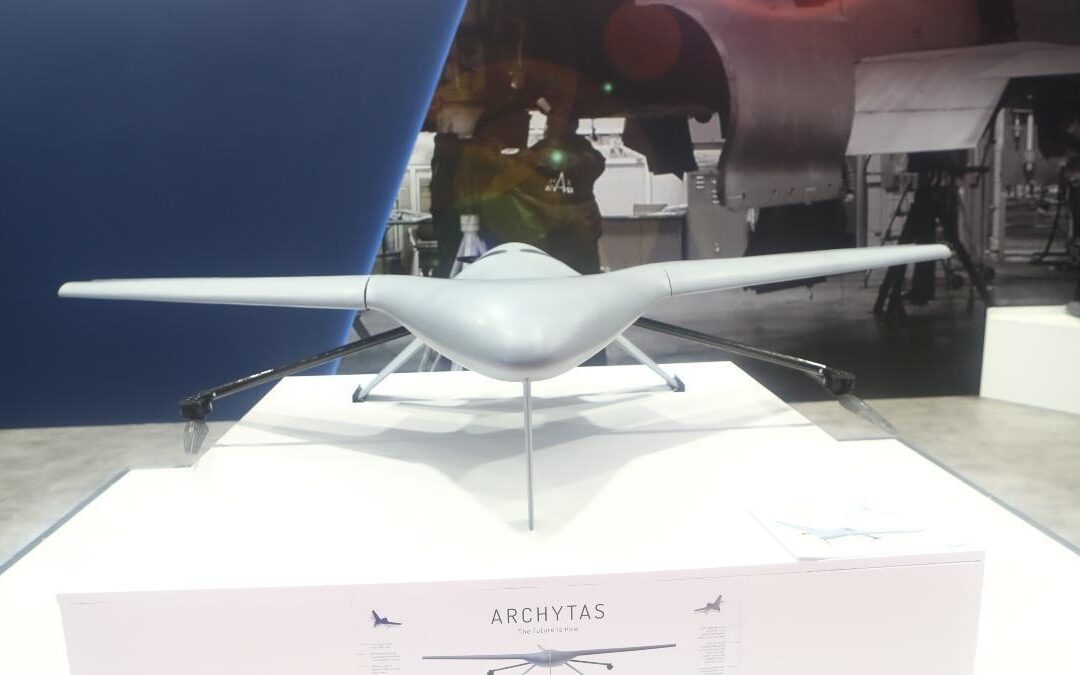
ARCHYTAS should not be evaluated merely as another unmanned aircraft entering an increasingly crowded international UAV market.
Its deeper strategic importance lies in what it can potentially represent: a technological building block around which Greece can accumulate knowledge, industrial capability, operational experience and eventually a wider family of interoperable unmanned systems.
The strategic objective should therefore not be:
Build a Greek drone.
It should become:
Build the national capability to continuously design, integrate, operate, improve and regenerate unmanned systems across multiple operational domains.
From the perspective of the Techne–Phronesis Negotiation Framework™ (TPNF), the architecture becomes:
Indigenous Technology → Operational Capability → Systems Integration → Multi-Domain Interoperability → Industrial Learning → Ecosystem Development → Strategic Autonomy → Strategic Future Value™ → Lasting Strategic Value™.
ARCHYTAS can therefore be strategically important not because one platform transforms Greek defence, but because developing it can contribute to the creation of something considerably larger:
an Integrated Multi-Domain Unmanned Defence Ecosystem™.
Purpose of the Essay
This essay examines how Greece can convert indigenous unmanned technology from individual platforms into sustainable national strategic capability.
Using ARCHYTAS as the starting point, it argues that the greatest long-term value would emerge by connecting domestic UAVs, unmanned maritime systems, counter-UAS technologies, artificial intelligence, sensors, communications, command-and-control, universities, defence companies and operational users within a common learning ecosystem.
The central TPNF question is therefore:
How can Greece convert technological achievement into lasting strategic value?
Abstract
Greece’s ARCHYTAS programme represents an important step in rebuilding indigenous capability in unmanned aviation.
Developed by the Hellenic Aerospace Industry with knowledge generated through cooperation involving Greek universities, ARCHYTAS is a Class II multi-role VTOL UAS intended for missions including surveillance, intelligence gathering and operational support.
But possession of an indigenous UAV is not equivalent to possessing an indigenous unmanned warfare capability.
Modern warfare increasingly connects unmanned aircraft, surface and subsurface systems, sensors, electronic warfare, artificial intelligence and command networks.
Greece’s strategic opportunity is consequently to move from platform development toward Integrated Unmanned Capability™: the capacity to combine multiple domestically supported unmanned technologies within an interoperable operational architecture capable of continuous learning and adaptation.
The real strategic product would therefore not be ARCHYTAS alone.
It would be the ecosystem created around it.
1. ARCHYTAS as a Beginning
ARCHYTAS represents something Greece has lacked for years: the reconstruction of domestic design and industrial knowledge around a relatively substantial unmanned aircraft.
The programme began in 2021 through cooperation involving HAI and Greek universities.
Its significance lies partly in its technological characteristics—fixed-wing flight combined with vertical take-off and landing, autonomous flight-control capabilities and a multi-role architecture.
But the more important strategic asset may be invisible.
Knowledge.
Designing an aircraft creates engineering knowledge.
Building it creates manufacturing knowledge.
Testing it creates operational knowledge.
Failures create diagnostic knowledge.
Modifying it creates adaptive knowledge.
Industrializing it creates production knowledge.
ARCHYTAS therefore generates more than an airframe.
It can generate Cumulative Technological Capability™.
2. The Platform Trap
Countries attempting to develop domestic defence technology can fall into what TPNF might describe as the Platform Trap™.
A national programme successfully produces a platform.
The platform is celebrated.
Limited numbers are manufactured.
But the knowledge, supply chains, software, engineers and institutional relationships surrounding the programme fail to evolve into the next generation.
The technological achievement consequently remains isolated.
Strategic value requires a different progression:
Prototype → Testing → Operational Adoption → Production → Feedback → Improvement → Derivative Systems → New Technologies.
The objective is not simply successful completion.
It is technological continuity.
ARCHYTAS should therefore become a beginning rather than an endpoint.
3. From Platform to System
Modern unmanned warfare is increasingly networked.
A UAV can observe an area.
But its value increases when information can be transferred securely to other platforms.
A sensor detects.
A command system interprets.
AI assists classification.
Another unmanned platform investigates.
An electronic-warfare system disrupts.
A crewed aircraft, naval vessel or ground unit responds.
The architecture evolves:
Platform → Sensor Network → Data Fusion → C2 → Decision → Coordinated Effect.
This is the transition from possessing drones to possessing an unmanned operational system.
ARCHYTAS therefore becomes strategically more valuable when it can communicate and cooperate with other Greek and allied capabilities.
4. Why Multi-Domain Matters for Greece
Greek geography makes multi-domain integration particularly important.
Defence requirements involve mainland territory, islands, extensive maritime spaces and air approaches.
An unmanned architecture designed for such geography should therefore not remain exclusively aerial.
Future capability could connect:
UAVs + USVs + UUVs + Ground Systems + Counter-UAS + Sensors + Space-Based Information + AI + C2.
A UAV can provide surveillance.
An unmanned surface vessel can extend maritime sensing.
An underwater system can monitor the subsurface environment.
Ground sensors can observe critical areas.
Counter-UAS systems can protect infrastructure.
AI can assist in combining the resulting data.
A common command architecture can transform distributed platforms into coordinated capability.
This is the foundation of an Integrated Multi-Domain Unmanned Defence Ecosystem™.
5. Greece Is Already Producing Pieces of the Architecture
The importance of this concept is that Greece does not begin from zero.
ARCHYTAS is one component.
Centaurus provides a domestically developed counter-UAS/electronic-warfare capability already operationally tested in the Red Sea.
Telemachus addresses smaller drone threats.
Hyperion is being developed toward detecting, identifying and suppressing drone swarms.
Greek companies are developing aerial, surface and underwater unmanned systems.
During the 2026 Doureios Ippos exercise, Greek companies demonstrated an integrated network-centric architecture connecting UAVs, a USV, a mini-UUV, sensors, counter-UAS systems, command-and-control and AI applications.
The pieces therefore increasingly exist.
The strategic challenge is orchestration.
6. The Integration–Value Principle™
This leads to an important TPNF proposition:
Integration–Value Principle™
The strategic value of multiple technological capabilities increases when they can exchange information, coordinate action and adapt collectively as parts of an integrated operational ecosystem.
Ten disconnected unmanned platforms may provide ten separate capabilities.
Ten interoperable systems can potentially create something qualitatively different:
distributed sensing, coordinated action and shared situational understanding.
The strategic multiplier therefore comes not only from the number of platforms.
It comes from the relationships among them.
7. AI as the Connecting Intelligence
Multi-domain unmanned operations can generate enormous quantities of data.
Radar.
Electro-optical imagery.
Infrared imagery.
Electronic emissions.
Maritime tracking.
Acoustic information.
Satellite information.
Platform telemetry.
Human operators cannot efficiently process every data stream simultaneously.
Artificial intelligence can therefore become part of the integration layer.
Its role should not necessarily be autonomous decision-making without human responsibility.
Rather, AI can assist:
Detection → Classification → Correlation → Prioritization → Decision Support → Coordinated Response.
This extends TPNF‘s concept of Machine-Speed Threat Understanding™.
The strategic objective is not simply faster machines.
It is faster conversion of distributed information into meaningful operational understanding.
8. The Human Remains Inside the Ecosystem
Increasing autonomy does not eliminate the human dimension.
It changes it.
Operators increasingly move from directly controlling individual vehicles toward supervising systems, interpreting AI-supported information and making higher-level decisions.
This requires different skills.
Drone pilots.
Mission commanders.
Data analysts.
AI specialists.
Electronic-warfare operators.
Systems engineers.
Cybersecurity specialists.
Maintenance technicians.
The unmanned ecosystem therefore requires a corresponding Human Capability Ecosystem™.
Without trained people, advanced technology becomes underutilized capital.
Greece must therefore develop machines and human expertise simultaneously.
9. ELKAK and the Institutional Layer
Technology ecosystems also require institutions capable of connecting military needs with researchers and industry.
The Hellenic Centre for Defence Innovation (ELKAK) can become strategically important in this process.
Its current model emphasizes connecting Armed Forces requirements with domestic technological capability, financing research and development and enabling operational experimentation.
That creates a potentially powerful cycle:
Operational Problem → Innovation Challenge → Research → Prototype → Field Testing → Military Feedback → Improvement → Procurement.
This cycle is more important than any single procurement decision.
It creates institutional learning capacity.
10. From Import Dependency to Selective Strategic Autonomy
No realistic Greek strategy should attempt to manufacture every component domestically.
Modern defence systems depend upon international technology ecosystems.
Processors.
Sensors.
Satellite communications.
Semiconductors.
Engines.
Software.
Weapons.
Attempting complete technological independence could become economically inefficient and strategically unrealistic.
The objective should instead be Selective Strategic Autonomy™:
Greece should identify which technological capabilities are sufficiently important that domestic knowledge, integration authority, maintenance capability and upgrade capacity must be preserved.
The strategic question becomes:
Which technologies must Greece understand and control sufficiently to remain operationally adaptable even when external conditions change?
Unmanned systems should rank high in that calculation.
11. Dual-Use Value
ARCHYTAS also demonstrates why defence innovation can generate value beyond defence.
HAI has identified possible applications involving border surveillance, maritime monitoring, forest surveillance, early fire warning and natural-disaster assessment.
This creates opportunities for dual-use technological development.
Sensors developed for defence may support civil protection.
Autonomous navigation may support commercial applications.
AI developed for surveillance may contribute to infrastructure monitoring.
Manufacturing knowledge can support aerospace exports.
Engineering expertise can migrate into other technology sectors.
Defence investment can therefore generate Strategic Technology Spillover™ when knowledge created for military requirements produces wider economic and technological capability.
12. Industrial Scale Is the Difficult Part
Developing a prototype and creating an industrial capability are different achievements.
A sustainable ecosystem requires suppliers.
Manufacturing capacity.
Quality control.
Certification.
Maintenance.
Software upgrades.
Spare parts.
Investment.
Export opportunities.
Continuous orders.
Without sufficient production volume, engineering teams disperse and accumulated knowledge can disappear.
The transition therefore becomes:
Innovation → Prototype → Procurement → Production → Export → Reinvestment → Next Generation.
This is where technological policy becomes industrial strategy.
13. Strategic Capability Regeneration™
Unmanned technology evolves extremely rapidly.
A UAV designed today may face a radically different electronic-warfare environment several years from now.
Sensors improve.
AI evolves.
Communications change.
Countermeasures adapt.
Weapons change.
A national unmanned ecosystem therefore cannot be static.
It must continuously regenerate capability.
TPNF describes this through Strategic Capability Regeneration™:
Operational Experience → Data → Learning → Redesign → Software/Hardware Upgrade → Improved Capability → New Operational Experience.
The country possessing the best platform today does not automatically possess the advantage tomorrow.
The greater advantage may belong to the country capable of adapting faster.
14. From ARCHYTAS to Strategic Value
ARCHYTAS can now be positioned within a much larger architecture:
ARCHYTAS
↓
Indigenous UAV Knowledge
↓
Sensors + AI + Communications + C2
↓
UAV + USV + UUV + Ground Systems
↓
Counter-UAS + Electronic Warfare
↓
Human–Machine Teaming
↓
Multi-Domain Integration
↓
Operational Learning
↓
Industrial Regeneration
↓
Integrated Multi-Domain Unmanned Defence Ecosystem™
↓
Strategic Future Value™
↓
Lasting Strategic Value™
This is how one technological programme can become strategically significant.
Not by remaining one platform.
But by becoming part of an expanding national capability architecture.
Strategic Implications
First, Greece should evaluate ARCHYTAS through the technological knowledge and industrial capability it generates, not merely through platform performance.
Second, future unmanned procurement should prioritize interoperability and modularity so individual systems can become components of a wider architecture.
Third, Greece’s geography makes integration across air, surface, subsurface and ground domains particularly valuable.
Fourth, ELKAK, universities, military users and private companies should form a continuous experimentation and learning cycle rather than cooperate only around individual projects.
Fifth, AI and secure C2 should become connecting layers across the national unmanned ecosystem.
Sixth, Greece should pursue Selective Strategic Autonomy™ rather than unrealistic technological autarky.
Finally, successful domestic systems should create an industrial cycle of production, export, reinvestment and next-generation development.
ARCHYTAS matters.
But what comes after ARCHYTAS may matter considerably more.
If it becomes only one Greek UAV, its strategic contribution will remain bounded by the capabilities of one platform.
If the knowledge generated through its development feeds future aircraft, sensors, autonomous systems, software, universities, suppliers and operational doctrine, its value multiplies.
And if those capabilities eventually connect with unmanned maritime systems, counter-UAS technologies, AI, electronic warfare and command networks, Greece begins moving from indigenous products toward indigenous system-level capability.
The strategic progression is therefore:
Build → Integrate → Operate → Learn → Adapt → Regenerate.
Techne creates ARCHYTAS and the technologies surrounding it.
Systems Thinking connects those technologies across domains, organizations and operational requirements.
Phronesis determines which capabilities Greece should develop, which international technologies it should integrate, where domestic control is strategically necessary and how limited national resources can produce sustainable advantage.
The central challenge is therefore no longer:
Can Greece build a drone?
ARCHYTAS helps demonstrate that it can develop increasingly sophisticated indigenous unmanned capability.
The more consequential question is:
Can Greece transform its emerging unmanned technologies into a continuously learning national defence ecosystem capable of creating strategic value across decades?
If the answer becomes yes, ARCHYTAS will have achieved something considerably more important than flight.
It will have helped Greece build the capability to create what comes next.
Key Takeaways
- ARCHYTAS should be understood as a potential foundation for cumulative indigenous unmanned capability rather than an isolated UAV programme.
- The Platform Trap™ occurs when a successful domestic platform fails to generate continuing technological and industrial development.
- The Integration–Value Principle™ proposes that strategic value increases when separate technologies become interoperable components of a coordinated ecosystem.
- Greece already possesses emerging building blocks across UAVs, USVs, UUVs, counter-UAS, electronic warfare, AI and C2.
- Selective Strategic Autonomy™ is more realistic than technological self-sufficiency.
- Operational experimentation must continuously connect military users, ELKAK, industry and universities.
- The ultimate objective should be an Integrated Multi-Domain Unmanned Defence Ecosystem™ capable of learning, adapting and regenerating capability.
Author’s Reflection
ARCHYTAS attracted my attention not simply because it is Greek technology.
Its greater importance is the question it creates.
What do we do with the knowledge generated by building it?
A country can purchase advanced technology and immediately acquire capability.
But developing technology domestically creates something different.
Engineers encounter problems.
Universities generate knowledge.
Companies develop components.
Military operators discover new requirements.
Failures generate lessons.
Solutions create expertise.
And expertise can become the foundation for technologies that did not exist when the original programme began.
This is the difference between buying capability and learning how to create capability.
For a country such as Greece, this distinction is strategically important.
Greece cannot compete with major powers through industrial scale alone. Nor does it need to reproduce every technology domestically.
Its potential advantage lies in intelligently combining domestic knowledge, geographic understanding, operational experience, universities, specialized companies and international partnerships.
The objective should therefore not be technological isolation.
It should be strategic technological competence.
Greece should know what it must design.
What it can integrate.
What it can purchase.
What it must be able to modify.
And, above all, what capabilities it cannot afford to lose the ability to understand.
ARCHYTAS can become part of that process.
But the decisive transition will occur when we stop seeing ARCHYTAS, Centaurus, autonomous vessels, AI systems and future Greek unmanned platforms as separate technological achievements and begin understanding them as potential components of one adaptive strategic ecosystem.
Techne gives Greece the ability to create the technology.
Systems Thinking allows Greece to connect technologies into operational capability.
Phronesis must determine how that capability should be developed and sustained to serve national strategy over time.
The lasting strategic value of ARCHYTAS may therefore not ultimately be measured by how many aircraft are produced.
It may be measured by how many new capabilities Greece becomes able to create because ARCHYTAS was developed in the first place.
Nikos Chatzis
Source: Open Sources Analysis, Relative Data Analysis by Nikos Chatzis
© Nikolaos Chatzis. All Rights Reserved.
The Techne–Phronesis Negotiation Framework™
An Integrative Theory of Strategic Negotiation, Complex Adaptive Systems and Practical Wisdom
Technology Creates Capability • Systems Thinking Creates Understanding • Strategic Wisdom Creates Lasting Value.
Negotiation.gr | Strategic Wisdom for the Technological Age