Negotiation.gr | Strategic Wisdom for the Technological Age
“Strategic resilience emerges when technical capability (techne) is
continuously guided by practical wisdom (phronesis) through adaptive
negotiation across interconnected systems.”
Central Idea — Thesis
The spectacular performances of humanoid robots in sporting competitions may appear to be technological entertainment. In reality, such events can function as experimental environments for developing robots that become more reliable, adaptable, safe and economically useful in everyday life.
Running, football, boxing and other competitive tasks test balance, perception, locomotion, coordination and autonomous decision-making under demanding physical conditions. Practical competitions involving logistics, manufacturing, household activities and service tasks extend this experimentation toward real-world usefulness.
From the perspective of the Techne–Phronesis Negotiation Framework™ (TPNF), sports are therefore not necessarily the destination of humanoid robotics. They can become a testing environment for embodied artificial intelligence capable of operating eventually in factories, logistics centers, hospitals, homes and other complex human environments.
The strategic evolution is:
Physical Capability → Reliability → Everyday Utility → AI and Big Data Learning → Human–Robot Ecosystems → Strategic Future Value™ → Lasting Strategic Value™.
The important question is no longer whether humanoid robots can run impressively.
It is whether they can become sufficiently reliable to work safely and productively alongside humans.
Purpose of the Essay
This essay examines why humanoid robot competitions should be interpreted not merely as sporting spectacles but also as technological experimentation.
It explores how artificial intelligence, Big Data, sensors, robotics engineering and repeated physical testing interact to improve humanoid reliability and prepare robots for everyday applications.
The deeper TPNF question is:
Are humanoid robot competitions primarily creating better robotic athletes—or helping create trustworthy robotic partners for society?
Abstract
Humanoid robot competitions increasingly combine athletic performance with practical scenarios requiring robots to navigate environments, manipulate objects, coordinate movements and complete increasingly complex tasks.
Their importance extends beyond the competition itself.
Every movement generates data. Every failure reveals technological limitations. Every successful recovery provides information about control, perception and adaptation. Engineers can use these observations to improve hardware, software and AI models.
TPNF interprets this development through Embodied Reliability Evolution™: the continuous improvement of humanoid robotic capability through repeated interaction among physical experimentation, AI learning, operational feedback and data analysis.
The greatest strategic value of humanoid sports may therefore lie not in the records robots achieve but in the knowledge generated while attempting to achieve them.
1. Why Organize Sports Competitions for Robots?
Robot athletics naturally attract public attention.
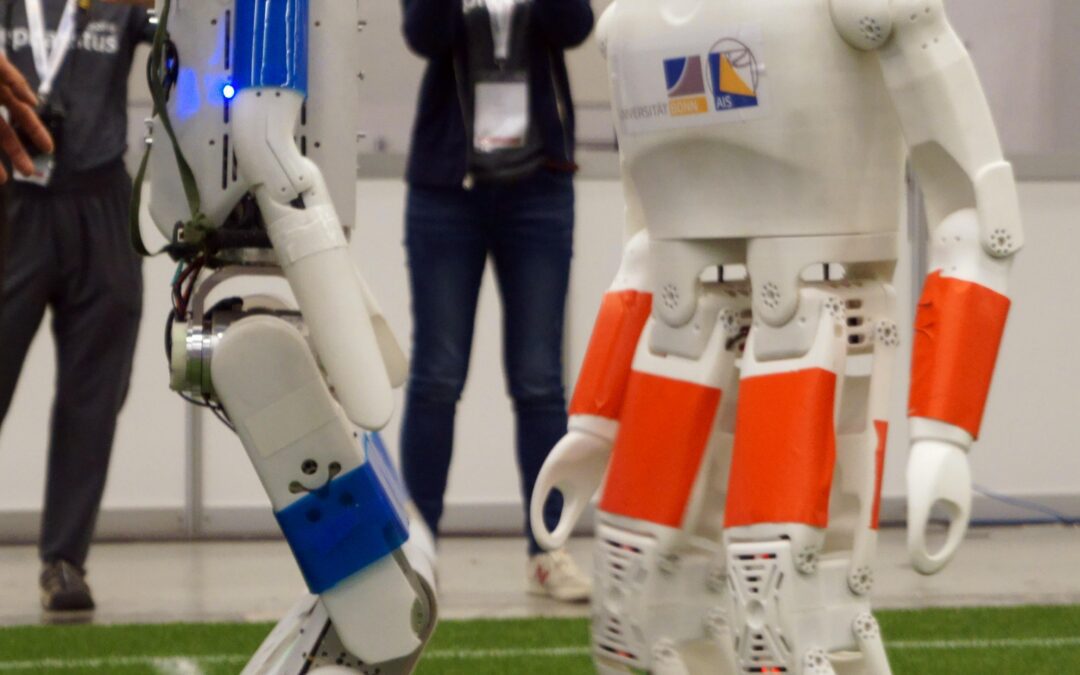
Humanoids race, play football, box, dance and perform increasingly sophisticated physical movements.
Yet behind the spectacle lies serious engineering.
Running tests dynamic balance.
Football combines perception, locomotion, coordination and decision-making.
Boxing requires rapid reaction and physical control.
Gymnastics tests stability and complex motion.
Every activity places the machine under conditions in which weaknesses become visible.
Sports can therefore function as accelerated experimental environments.
The objective is not merely to demonstrate what the robot can accomplish when everything works correctly.
The greater engineering value may come from discovering why it fails when conditions become difficult.
2. From Performance to Reliability
A spectacular demonstration proves capability.
Repeated successful performance demonstrates something more valuable:
reliability.
This distinction becomes fundamental as humanoid robotics moves toward practical applications.
A robot that successfully performs a difficult movement once may demonstrate technological progress.
A robot working in a warehouse, hospital or home must perform ordinary tasks repeatedly and predictably.
TPNF can describe this transition through Embodied Reliability Evolution™:
the systematic improvement of humanoid robotic capability through repeated cycles of physical experimentation, operational feedback, AI learning and technological adaptation.
The architecture becomes:
Physical Test → Sensor Data → Analysis → AI Improvement → Modified Behaviour → New Physical Test → Learning.
Failure becomes information.
3. Big Data Becomes the Memory of Embodied AI
Humanoid robots generate enormous quantities of data.
Cameras observe environments.
Depth sensors estimate distance.
Inertial sensors measure movement and orientation.
Joint sensors monitor position and force.
Tactile sensors measure physical interaction.
Software records decisions and responses.
Each action therefore creates information about the relationship between the robot and its environment.
When thousands or millions of these observations are accumulated, engineers can identify patterns that would be difficult to discover through isolated experiments.
Big Data consequently becomes part of the robot’s learning infrastructure.
The architecture is:
Movement Data + Environmental Data + Interaction Data + Failure Data → AI Learning → Improved Behaviour.
In this sense, Big Data becomes the accumulated memory of embodied artificial intelligence.
4. The Everyday Intelligence Gap™
Humanoid robotics also reveals an apparent paradox.
Robots may perform visually spectacular actions while struggling with tasks humans consider ordinary.
Running quickly may be achievable under controlled conditions.
Folding irregular clothing requires continuous perception and manipulation.
Picking up an unfamiliar object requires estimating shape, weight and grip.
Opening a cupboard requires understanding physical geometry.
Moving through a crowded room requires predicting human movement.
Everyday life is extraordinarily complex.
TPNF can describe this as the Everyday Intelligence Gap™:
the difference between exceptional robotic performance in structured tasks and reliable robotic performance in the unpredictable environments of ordinary human life.
Closing this gap may prove more strategically important than achieving another sporting record.
5. AI Needs Physical Experience
Artificial intelligence has developed rapidly in language, image recognition, prediction and information processing.
Humanoid robotics introduces another dimension:
physical interaction with reality.
A language model processes symbols.
A humanoid robot must understand physical consequences.
If it moves incorrectly, it falls.
If it grips too strongly, it can damage an object.
If it miscalculates distance, it can collide with something—or someone.
Embodied AI therefore connects digital intelligence with physical reality.
TPNF can describe an Embodied AI Ecosystem™ as the integration of artificial intelligence with sensing, movement, manipulation, communication and continuous interaction with real environments.
Intelligence becomes not merely the ability to process information.
It becomes the ability to convert information into appropriate physical action.
6. Reliability Becomes a Safety Requirement
A robot entering everyday human environments cannot simply be capable.
It must become trustworthy.
Reliability therefore includes predictable behaviour, obstacle avoidance, physical stability, cybersecurity, operational continuity and the ability to respond safely when something unexpected happens.
This becomes especially important in hospitals, homes and workplaces where robots may operate close to vulnerable people.
TPNF can define Human-Compatible Reliability™ as:
the capacity of an intelligent machine to perform useful tasks consistently while maintaining acceptable levels of safety, predictability and operational control within human environments.
The transition from laboratory robot to everyday robot will depend heavily upon achieving this condition.
7. Cloud Computing and Collective Learning
Humanoid robots do not necessarily need to learn independently.
Connected robotic systems can potentially share information.
A robot performing a task may generate useful operational data.
That data can contribute to improved AI models.
Updated models can then be distributed to other machines.
The architecture becomes:
Individual Experience → Shared Data → AI Learning → Improved Model → Fleet Deployment → New Experience.
This creates the possibility of Collective Embodied Intelligence™.
One robot’s experience can contribute to improvements across many robots.
The strategic significance is substantial.
Learning becomes scalable.
8. Human–Robot Collaboration
The future of humanoid robotics should not automatically be interpreted through the simplistic question:
Will robots replace humans?
Many future applications may involve collaboration.
Humans possess contextual understanding, judgment, creativity, social intelligence and ethical responsibility.
Robots may provide precision, repetition, physical endurance, continuous monitoring and operation in dangerous environments.
The strategic opportunity therefore lies in combining complementary capabilities.
TPNF can describe this as Human–Robot Cooperative Capability™:
the productive capacity created when human judgment and robotic physical capability are intelligently combined within a shared operational environment.
This extends our wider TPNF principle of Human–AI Complementarity™ from cognitive systems into physical environments.
9. Reliability Is Also an Economic Variable
Technical capability alone will not determine the adoption of humanoid robots.
Economics will.
Companies will evaluate acquisition cost, maintenance, energy consumption, software requirements, downtime, useful working hours and productivity.
A robot requiring constant technical intervention may be technologically impressive but economically unattractive.
Reliability therefore becomes an economic multiplier.
The more consistently a robot performs useful work, the greater the potential return on the technological investment.
This creates an important relationship:
Capability × Reliability × Useful Operating Time → Economic Utility.
The cheapest robot may not generate the greatest value.
The most technologically sophisticated robot may not generate it either.
Strategic value emerges from the appropriate relationship among capability, reliability, cost and useful application.
10. From Demonstration to Everyday Utility
The commercialization challenge can therefore be understood as a sequence:
Technological Demonstration → Repeated Performance → Reliability → Safety → Economic Utility → Adoption.
Many technologies fail to cross this transition.
A successful demonstration attracts attention.
A reliable product creates value.
Humanoid robotics is increasingly approaching this boundary.
The decisive question will not be whether robots can perform extraordinary actions.
It will be whether they can perform ordinary actions extraordinarily reliably.
11. The Big Data Management Challenge
As humanoid robots become more widely deployed, data management itself becomes strategically important.
Robots operating around humans may collect visual, spatial, behavioural and operational information.
This creates opportunities for learning—but also questions involving privacy, cybersecurity, ownership, access and governance.
Who owns the data produced by a household robot?
Which information should be transmitted to cloud systems?
How should sensitive environments be protected?
Who is responsible when an AI-driven physical decision produces harm?
Big Data therefore creates capability and responsibility simultaneously.
The TPNF challenge becomes:
How much data should be collected, for what purpose, under whose control, and toward what lasting human value?
12. From Robot Sports to Strategic Future Value™
The complete development architecture can now be expressed:
Competition → Physical Experimentation → Data Generation → AI Learning → Reliability → Human-Compatible Operation → Everyday Utility → Economic Productivity → Strategic Future Value™ → Lasting Strategic Value™.
Sports therefore become valuable not because society needs humanoid athletes.
They become valuable because demanding physical competitions can expose weaknesses quickly and generate information required to improve robotic systems.
The competition becomes a laboratory.
The robot becomes the experiment.
Data becomes accumulated knowledge.
AI converts that knowledge into improved capability.
And society ultimately decides how that capability should be used.
Strategic Implications
First, humanoid robot competitions should increasingly be evaluated as experimental environments rather than entertainment alone.
Second, reliability may become more strategically important than spectacular performance as robotics moves toward commercialization.
Third, Big Data provides an essential learning infrastructure for embodied AI, but its collection requires appropriate governance.
Fourth, Human-Compatible Reliability™ will become essential before humanoids can operate extensively in homes, hospitals and public environments.
Fifth, cloud-connected robotics may accelerate learning through Collective Embodied Intelligence™.
Finally, the greatest long-term value may emerge from Human–Robot Cooperative Capability™ rather than technological substitution of humans.
Humanoid robot sports represent something more important than machines imitating human athletic performance.
They provide environments where robotic systems can be tested, challenged and improved.
The central progression is therefore not:
Sports → Entertainment.
It is:
Sports → Experimentation → Data → Learning → Reliability → Everyday Utility.
From the perspective of the Techne–Phronesis Negotiation Framework™, this evolution illustrates how technological civilization develops through interaction among physical machines, artificial intelligence, Big Data, human judgment and economic requirements.
Techne creates the robot.
Systems Thinking reveals how sensors, AI, data, cloud computing, energy, infrastructure and human environments interact.
Phronesis asks how increasingly capable machines should be integrated into human life responsibly.
The future of humanoid robotics will ultimately not be determined by which robot wins the fastest race.
It will be determined by which systems become reliable enough, safe enough, useful enough and trustworthy enough to become part of everyday human life.
Key Takeaways
- Humanoid sports can function as demanding laboratories for robotics development.
- Embodied Reliability Evolution™ connects physical testing, data generation, AI learning and improved robotic behaviour.
- The Everyday Intelligence Gap™ explains why apparently simple human activities remain difficult for robots.
- Human-Compatible Reliability™ may become a prerequisite for widespread social adoption.
- Big Data can accelerate embodied AI learning but creates corresponding governance, privacy and cybersecurity challenges.
- The strategic destination is not necessarily human replacement but Human–Robot Cooperative Capability™.
Author’s Reflection
The most important achievement in humanoid robotics may eventually appear surprisingly ordinary.
It may not be the first robot to win a race, perform an extraordinary athletic manoeuvre or demonstrate spectacular physical strength. It may be the moment when a humanoid robot can repeatedly perform an ordinary task—carrying an object, assisting an elderly person, working safely beside a human, navigating an unfamiliar room or responding intelligently when something unexpected occurs.
That distinction is strategically important.
Technological demonstrations show us what may be possible. Reliability determines what becomes useful. Human trust ultimately influences what becomes socially acceptable.
Humanoid robot competitions should therefore be understood as part of a much longer process of technological learning. Every race, fall, failed manipulation and successful recovery can generate knowledge. Sensors transform physical experience into data. AI systems use data to improve behaviour. Engineers transform failures into design changes. Repeated experimentation gradually converts technological possibility into practical capability.
The progression becomes:
Experimentation → Data → Learning → Reliability → Trust → Everyday Utility → Human Value.
This is where the relationship between AI and Big Data becomes particularly important.
Artificial intelligence gives the humanoid robot an increasing capacity to perceive, interpret, learn and decide. Big Data provides accumulated experience from which those capabilities can improve. But neither intelligence nor data alone determines whether humanoid robotics will create lasting value.
The decisive factor remains how technological capability is integrated into human life.
A robot capable of performing extraordinary movements but unable to operate safely beside people has limited everyday value. A system capable of collecting enormous quantities of data but incapable of protecting privacy may create new vulnerabilities. A humanoid that increases productivity while unnecessarily weakening human capability may create economic value while simultaneously producing social costs.
The strategic challenge is therefore not simply to make robots more intelligent.
It is to make the relationship between humans, robots, AI and data more intelligent.
This distinction lies at the heart of the Techne–Phronesis Negotiation Framework™.
Techne asks what humanoid robotics can technologically achieve.
Systems Thinking examines how robots interact with AI, Big Data, cloud infrastructure, workplaces, households, institutions and human behaviour.
Phronesis asks the more difficult questions: Which capabilities should we develop? Where should humanoids be deployed? What responsibilities should remain human? How should the data they generate be governed? And toward what lasting human purpose should this technology ultimately be directed?
The future of humanoid robotics should therefore not be measured primarily by how closely machines can imitate humans.
Its deeper measure should be whether machines can complement human capability while preserving human agency, responsibility and dignity.
The sporting arena may be where some of these technologies learn to run.
The factory, hospital, workplace and home will be where society discovers whether they have learned to become genuinely useful.
And this may be the fundamental TPNF lesson:
Technology demonstrates capability. Reliability converts capability into utility. Strategic wisdom determines whether utility becomes lasting human value.
Nikos Chatzis
Source: Open Sources Analysis, Relative Data Analysis by Nikos Chatzis
© Nikolaos Chatzis. All Rights Reserved.
The Techne–Phronesis Negotiation Framework™
An Integrative Theory of Strategic Negotiation, Complex Adaptive Systems and Practical Wisdom
Technology Creates Capability • Systems Thinking Creates Understanding • Strategic Wisdom Creates Lasting Value.
Negotiation.gr | Strategic Wisdom for the Technological Age