Negotiation.gr | Strategic Wisdom for the Technological Age
“Strategic resilience emerges when technical capability (techne) is
continuously guided by practical wisdom (phronesis) through adaptive
negotiation across interconnected systems.”
Central Idea — Thesis
General Atomics’ proposed Wildfire unmanned aircraft represents more than another stage in the technological evolution of the Medium-Altitude Long-Endurance (MALE) drone.
It reflects a potentially deeper transformation in the economics of modern air warfare.
For decades, technological progress encouraged militaries to pursue increasingly sophisticated platforms offering greater endurance, better sensors, precision weapons and advanced communications. The MQ-9 Reaper became one of the clearest expressions of this model.
But contemporary high-intensity warfare is challenging its underlying economics.
When expensive unmanned aircraft operate inside increasingly lethal environments populated by surface-to-air missiles, electronic warfare, long-range weapons and inexpensive interceptors, technological sophistication alone may no longer guarantee strategic efficiency.
The emerging requirement is therefore not simply:
How capable is the aircraft?
It is increasingly:
How much combat capability can be generated, sustained, lost, replaced and regenerated at an economically acceptable cost?
From the Techne–Phronesis Negotiation Framework™ (TPNF) perspective:
Technological Capability → Operational Flexibility → Affordable Mass → Attrition Tolerance → Capability Regeneration → Sustainable Combat Power.
Wildfire therefore represents a strategic challenge involving both tactical innovation and economic cost evaluation.
Purpose of the Essay
This TPNF essay examines General Atomics’ Wildfire concept within the Pentagon’s search for a new generation of lower-cost, modular MALE unmanned aircraft.
It asks whether the evolution beyond the MQ-9 represents primarily technological innovation or something more fundamental: a reassessment of the relationship between capability, cost, survivability, quantity and operational sustainability.
Abstract
General Atomics Aeronautical Systems has disclosed Wildfire, its proposal for the Pentagon’s Massed Modular Aircraft initiative. The U.S. Air Force and Defense Innovation Unit are examining a future class of unmanned aircraft designed around affordability, modularity, long range, scalable production and greater tolerance for combat losses.
The requirement reflects lessons emerging from modern warfare: sophisticated unmanned aircraft can themselves become economically difficult to expose repeatedly to increasingly contested environments.
TPNF identifies this transformation through Combat Economic Sustainability™: the capacity to generate and regenerate sufficient combat effects over time without allowing the economic cost of individual platforms or their losses to undermine operational endurance.
The future MALE may therefore be evaluated not by maximum platform sophistication alone, but by the relationship between Capability × Quantity × Adaptability × Regeneration / Cost and Vulnerability.
1. The MQ-9 Reaper Changed Modern Warfare
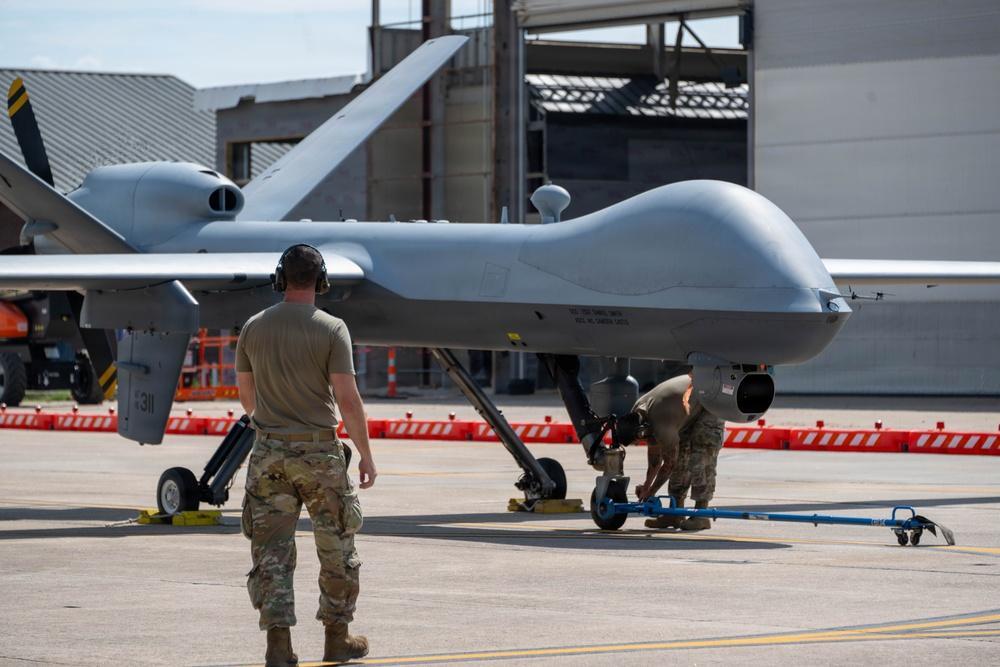
The MQ-9 Reaper became one of the defining unmanned aircraft of the post-9/11 era.
General Atomics states that the MQ-9A can remain airborne for more than 27 hours, operate up to 50,000 feet and carry a payload of 3,850 pounds.
Its combination of persistence, intelligence collection and precision strike created enormous operational value.
But the Reaper emerged during an era in which U.S. forces frequently operated in relatively permissive airspace.
The contemporary battlefield is changing.
Integrated air defences, electronic warfare, drones, long-range missiles and increasingly sophisticated sensors make persistent operations more dangerous.
The strategic question consequently changes from whether an unmanned aircraft can perform the mission to whether sufficient aircraft can continue performing that mission after losses begin accumulating.
2. Wildfire and the Changing Requirement
Wildfire has been proposed by General Atomics for the Pentagon’s Massed Modular Aircraft initiative.
The concept remains under development, and detailed specifications and pricing have not yet been publicly disclosed.
General Atomics nevertheless says its design aims beyond the minimum requirements and has discussed ambitions including approximately 10,000 nautical miles of ferry range, substantial weapons carriage and semi-autonomous operation of large numbers of aircraft.
The Pentagon’s requirement is revealing.
The desired aircraft should be relatively inexpensive, modular, long-range, capable of carrying different sensors and weapons, easier to manufacture at scale and sufficiently affordable that commanders can accept operational losses that would be strategically painful with scarce high-value aircraft.
That is not merely a new aircraft requirement.
It represents a different philosophy of airpower.
3. The Mathematics of Attrition
Modern warfare is forcing military planners to rediscover an old reality:
Platforms are consumed by war.
The Defense Innovation Unit has explicitly argued that reliance upon low-density, high-value aircraft costing more than $30 million becomes difficult to sustain in high-end conflict and that force design must account for inevitable attrition.
This creates what TPNF can define as the Attrition–Value Paradox™:
The greater the technological and financial value concentrated within an individual combat platform, the more capable that platform may become—but the more strategically consequential its loss can also become.
A $30-million aircraft and a $10-million aircraft may accomplish similar missions differently.
But the relevant calculation extends beyond purchase price.
It includes availability, sensors, weapons, maintenance, personnel, communications, mission effectiveness, survivability and replacement rate.
Cost therefore cannot be separated from capability.
4. From Exquisite Capability to Affordable Mass
The emerging model does not necessarily reject sophisticated aircraft.
Instead, it changes how sophistication is distributed.
High-end platforms may perform missions requiring exceptional stealth, sensors or survivability.
Lower-cost unmanned aircraft can provide mass, persistence and distributed effects.
The result is an increasingly heterogeneous combat ecosystem:
Exquisite Platforms + Affordable UAS + Autonomous Systems + Long-Range Weapons + Distributed Sensors + Networks.
The strategic objective is no longer to make every platform maximally capable.
It is to make the combat ecosystem collectively capable.
This connects directly with the TPNF concept of Combat Ecosystem Amplification™.
5. Modularity Changes the Economic Equation
The Pentagon also emphasizes modular open-system architecture.
This matters economically as much as technologically.
A tightly integrated aircraft may become difficult and expensive to upgrade.
A modular aircraft can potentially accept new sensors, communications equipment, software and weapons without redesigning the entire platform.
The U.S. Air Force explicitly identifies open architectures and modular design as foundational requirements for the future force because they allow payloads and software to be integrated more rapidly.
TPNF can define this as Modular Capability Economics™:
the creation of long-term economic and operational value by separating the evolution of the platform from the evolution of the capabilities it carries.
The aircraft becomes an adaptable carrier of changing effects.
6. Operational Flexibility Becomes Economic Value
Flexibility is frequently described as an operational characteristic.
But flexibility also possesses economic value.
If one aircraft architecture can conduct ISR, communications relay, maritime surveillance, strike and other missions through changing payloads, fewer specialized fleets may be required.
The value therefore comes not simply from lower acquisition cost.
It emerges from:
Platform Commonality → Mission Adaptability → Reduced Specialization → Faster Reconfiguration → Greater Fleet Utility.
This is a different form of affordability.
The cheapest aircraft is not necessarily the aircraft with the lowest purchase price.
It may be the aircraft generating the greatest useful operational effect across its lifecycle.
7. Autonomy Changes the Cost Structure
Another important requirement concerns autonomy.
The future system is expected to reduce the traditional relationship between aircraft numbers and human operators.
If one operator can supervise multiple aircraft, increasing mass does not necessarily require proportional increases in manpower.
This creates Human–Machine Force Multiplication™.
Autonomy can potentially reduce workload, coordinate formations, fuse information and allow commanders to operate larger unmanned forces.
But autonomy does not eliminate humans.
Human judgment remains essential for mission planning, rules of engagement, escalation management and consequential decisions.
The objective should therefore be:
Machine Scalability + Human Strategic Judgment.
8. The Reaper Is Not Simply Obsolete
It would nevertheless be analytically wrong to conclude that Wildfire demonstrates the irrelevance of the MQ-9 family.
General Atomics continues developing MQ-9B capabilities, including long-range weapons and airborne early warning. In May 2026, the company flew an MQ-9B equipped with Saab AEW radar pods, demonstrating how the platform family itself continues evolving.
This reveals an important TPNF principle.
New technology does not always replace mature technology.
Sometimes it reorganizes the missions surrounding it.
MQ-9B may continue providing high-value persistence and specialized capabilities while cheaper aircraft absorb missions where attrition risk is greater.
Future airpower may therefore become layered rather than sequential.
9. Combat Economic Sustainability™
This leads to the central TPNF concept of the essay:
Combat Economic Sustainability™
The capacity of a military system to continuously generate required combat effects without allowing the financial cost of platforms, operations, losses and replacement to make the force operationally unsustainable over time.
This changes procurement analysis.
Instead of asking:
Which aircraft is best?
strategists should ask:
Which force architecture can continue producing sufficient combat effects after months or years of losses, expenditure and technological adaptation?
The difference is fundamental.
War is not a demonstration.
It is a competitive process of capability consumption and regeneration.
10. Cost Per Effect Becomes More Important Than Cost Per Platform
Purchase price can therefore become misleading.
Imagine two unmanned systems.
One costs substantially more but survives longer and produces more effective missions.
Another is cheaper but suffers higher losses.
Which is more economical?
There is no answer without operational context.
TPNF therefore suggests Strategic Cost-per-Effect™:
the total resources required to generate a desired strategic or operational effect while accounting for acquisition, operation, survivability, losses, replacement and mission effectiveness.
This is more meaningful than comparing unit prices alone.
A cheap drone repeatedly failing its mission is expensive.
An expensive drone unnecessarily exposed to missions that cheaper systems could perform is also economically inefficient.
Phronesis lies in matching capability to mission risk.
11. Regeneration Becomes Part of Combat Power
The second major transformation concerns replacement.
A military possessing 100 sophisticated aircraft but able to replace only five annually may face greater long-war vulnerability than one possessing less capable aircraft that can be produced rapidly.
Production therefore becomes operational capability.
This connects directly with TPNF’s existing concept of Strategic Capability Regeneration™.
The architecture becomes:
Combat Capability → Operational Employment → Attrition → Replacement → Adaptation → Regenerated Combat Capability.
The cycle matters as much as the initial inventory.
The future balance of military power may increasingly depend upon regeneration velocity.
12. Wildfire as a Different Strategic Philosophy
Wildfire therefore matters even before we know whether it ultimately wins the Pentagon competition.
It represents a changing design philosophy.
The future MALE is being asked to combine:
long range;
payload capacity;
modularity;
autonomy;
network connectivity;
affordability;
scalable manufacturing;
and greater tolerance for operational risk.
These requirements show that technological sophistication is being renegotiated against economic sustainability.
The question is no longer:
How much technology can we place inside one aircraft?
It becomes:
How should technology be distributed across the force to create the greatest sustainable combat value?
Strategic Implications
First, modern warfare increasingly requires militaries to evaluate capability and affordability simultaneously.
Second, attrition must become a design assumption rather than an exceptional event.
Third, modularity can generate long-term economic value by allowing capability to evolve without continuously replacing entire platforms.
Fourth, autonomy can make larger unmanned formations economically and organizationally feasible.
Fifth, industrial production capacity increasingly becomes part of military capability.
Finally, procurement should increasingly evaluate Strategic Cost-per-Effect™ rather than unit cost alone.
Wildfire represents more than a possible successor architecture to the MQ-9 Reaper.
It symbolizes a wider transformation in the economics of combat aviation.
The MQ-9 demonstrated the extraordinary strategic value of persistent unmanned airpower.
The next generation must answer a harder question:
Can persistent unmanned airpower remain sustainable when the battlefield can destroy it repeatedly?
The answer will not come from technology alone.
It requires integration of engineering, economics, industrial capacity, autonomy, operational doctrine and strategic judgment.
From the TPNF perspective:
Technology → Capability
but
Capability + Affordability + Modularity + Mass + Regeneration → Sustainable Combat Power.
The strategic competition of the future may therefore be determined not simply by which military possesses the most sophisticated unmanned aircraft.
It may increasingly depend upon which military can generate, adapt, lose, replace and regenerate effective unmanned combat capability faster and more economically than its opponent.
Key Takeaways
- Wildfire is General Atomics’ proposed platform for the Pentagon’s emerging Massed Modular Aircraft requirement, not yet an officially selected MQ-9 successor.
- Modern high-intensity warfare is shifting UAS design toward affordability, modularity, mass and tolerance of attrition.
- Attrition–Value Paradox™ explains the vulnerability created when excessive economic and technological value is concentrated in individual platforms.
- Combat Economic Sustainability™ evaluates whether combat capability can remain economically sustainable throughout prolonged operations.
- Strategic Cost-per-Effect™ provides a more meaningful measure than purchase price alone.
- Strategic Capability Regeneration™ connects industrial production directly with sustained combat power.
Author’s Reflection
Wildfire raises a deceptively simple question.
How expensive should an aircraft designed to go to war actually be?
Technological development naturally pushes military systems toward greater capability.
Better sensors.
Greater range.
More sophisticated communications.
More powerful weapons.
More computing.
But every additional capability carries economic consequences.
Modern warfare is demonstrating that technological superiority cannot be separated from the ability to sustain technological capability under conditions of attrition.
This is where Techne and Phronesis meet.
Techne asks what kind of unmanned aircraft can be built.
Systems Thinking asks how aircraft, operators, weapons, networks, industrial production, logistics and adversary capabilities interact.
Phronesis asks whether concentrating another increment of capability—and cost—inside the aircraft actually creates greater strategic value.
Wildfire may therefore represent something larger than the successor to a famous unmanned aircraft.
It may represent the transition from an era focused primarily upon platform superiority toward an era increasingly concerned with sustainable ecosystem superiority.
The modern battlefield may not reward the side that possesses the most expensive technology.
It may reward the side that understands how much technology is enough, where it should be placed, what risks it should accept, and how rapidly lost capability can be regenerated.
That is simultaneously a technological, economic and strategic problem.
Nikos Chatzis
Source: Open Sources Analysis, Relative Data Analysis by Nikos Chatzis
© Nikolaos Chatzis. All Rights Reserved.
The Techne–Phronesis Negotiation Framework™
An Integrative Theory of Strategic Negotiation, Complex Adaptive Systems and Practical Wisdom
Technology Creates Capability • Systems Thinking Creates Understanding • Strategic Wisdom Creates Lasting Value.
Negotiation.gr | Strategic Wisdom for the Technological Age