Negotiation.gr | Strategic Wisdom for the Technological Age
“Strategic resilience emerges when technical capability (techne) is
continuously guided by practical wisdom (phronesis) through adaptive
negotiation across interconnected systems.”
Central Idea — Thesis
The widening confrontation between the United States and Iran is transforming the strategic environment surrounding the Eastern Mediterranean and Middle East.
As Tehran demonstrates its capacity and willingness to retaliate against U.S. military interests and regional partners, security can no longer be understood solely through bilateral relationships or geographically isolated conflicts.
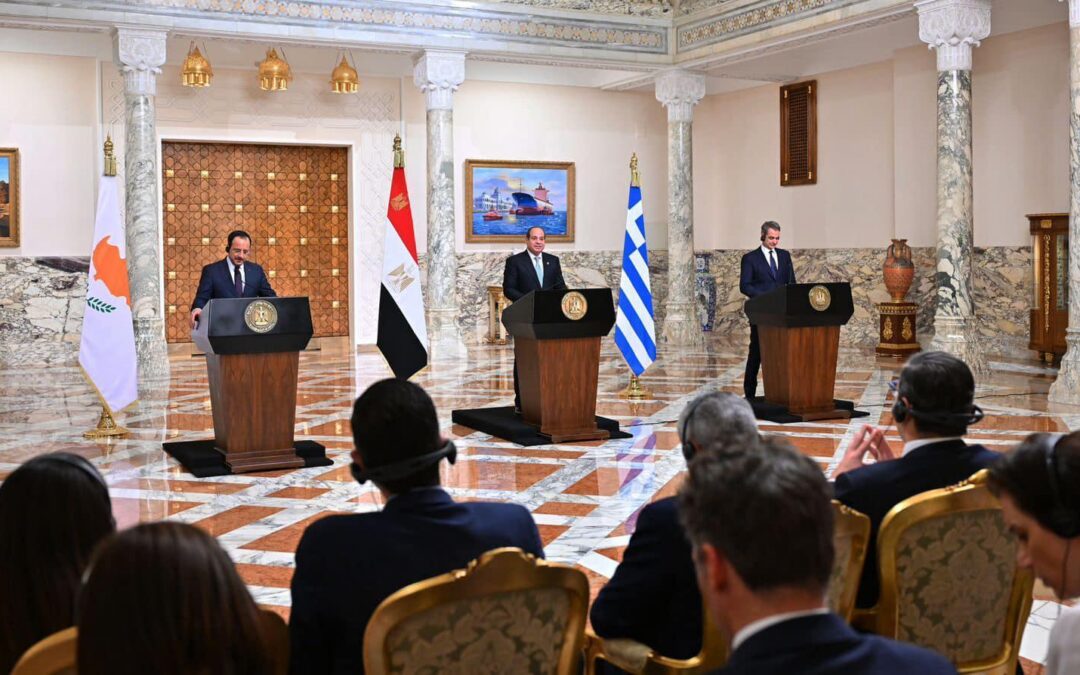
The September 8 meeting between Greece, Cyprus and Egypt at El Alamein therefore acquires broader strategic significance.
The trilateral mechanism is not an anti-Iran alliance, nor should it be interpreted as one. Its importance lies elsewhere: twelve years of institutionalized cooperation have created a regional network connecting diplomacy, energy, security, infrastructure and political coordination.
From the perspective of the Techne–Phronesis Negotiation Framework™ (TPNF), the emerging architecture is:
Regional Escalation → Conflict Spillover → Shared Vulnerability → Strategic Coordination → Ecosystem Resilience → Regional Stabilization.
The geopolitical value of the Greece–Cyprus–Egypt partnership may increasingly depend not on confronting a specific adversary, but on its capacity to preserve stability as instability spreads across interconnected regional systems.
Purpose of the Essay
This TPNF essay examines the geopolitical significance of Greece–Cyprus–Egypt cooperation as the U.S.–Iran confrontation expands geographically.
It asks how an established regional partnership can contribute to security, energy resilience, diplomatic coordination and crisis management without becoming another mechanism of escalation.
The deeper question is:
Can regional cooperation create strategic stability precisely because it is designed to connect rather than divide?
Abstract
On September 8, Greek Prime Minister Kyriakos Mitsotakis, Cypriot President Nikos Christodoulides and Egyptian President Abdel Fattah el-Sisi met at El Alamein amid rapidly deteriorating regional security.
Their joint declaration reaffirmed cooperation on regional stability, energy, defence, maritime security, connectivity, migration and economic development.
Meanwhile, the U.S.–Iran conflict intensified. U.S. forces destroyed five Iranian oil tankers following attempted Iranian attacks on an American warship; Iran retaliated against a U.S. base in Jordan, while Iranian-backed Houthis struck Saudi cities and energy installations.
TPNF interprets these simultaneous developments through Regional Stabilization Capacity™: the ability of cooperating states to use established political, economic, security and infrastructural relationships to absorb external geopolitical shocks and preserve regional functionality.
The strategic importance of the trilateral relationship may therefore grow as the surrounding environment becomes less predictable.
1. A Trilateral Mechanism Twelve Years in the Making
Greece, Cyprus and Egypt did not construct their relationship in response to the current Iran crisis.
That distinction matters.
Their trilateral cooperation began in 2014 at summit level and developed progressively through repeated meetings, agreements and sectoral cooperation.
At El Alamein, Mitsotakis described the mechanism as a positive model for stability and prosperity and emphasized that it is not directed against another country.
This gives the partnership strategic depth.
Repeated interaction creates familiarity.
Familiarity creates communication.
Communication facilitates coordination.
Coordination can become strategically valuable when crises emerge.
The architecture is:
Dialogue → Institutionalization → Cooperation → Trust → Strategic Coordination.
The current crisis therefore tests accumulated cooperative capability rather than creating it from zero.
2. Tehran’s Retaliation Is Expanding the Strategic Geography
The U.S.–Iran confrontation increasingly demonstrates a central characteristic of contemporary conflict:
geographical expansion through interconnected alliances and infrastructures.
Iran has attacked or threatened U.S. interests and regional partners across several countries.
Jordan intercepted most of 20 Iranian ballistic missiles directed toward a U.S. base on September 8.
Iranian-backed Houthis simultaneously attacked four Saudi cities, wounding 73 people and damaging energy infrastructure.
Tehran has also threatened tankers in Kuwaiti and Bahraini ports.
The strategic geography therefore extends beyond Iran itself.
Military bases, ports, shipping routes, energy infrastructure and partner states become interconnected components of the confrontation.
TPNF has already identified this phenomenon as Strategic Conflict Spillover™.
Conflict migrates through the networks surrounding the original belligerents.
3. The Eastern Mediterranean Cannot Remain Strategically Separate
Greece, Cyprus and Egypt are geographically outside the immediate Persian Gulf battlefield.
But geography alone does not provide insulation.
The Eastern Mediterranean connects Europe, the Middle East, North Africa and the Red Sea.
Energy flows cross it.
Shipping passes through it.
Military forces operate around it.
Digital infrastructure crosses it.
Migration flows respond to instability surrounding it.
Consequently:
Gulf Instability → Energy Disruption → Maritime Disruption → Economic Pressure → Eastern Mediterranean Consequences.
Regional security has become increasingly systemic.
A missile strike hundreds of kilometres away can influence energy prices, insurance costs, shipping decisions and European economic conditions.
Distance no longer guarantees strategic separation.
4. Egypt Is the Geographic Bridge
Egypt occupies an especially important position within this architecture.
It connects the Mediterranean with the Red Sea through the Suez Canal.
It borders Israel, Gaza, Libya and Sudan.
It is simultaneously an Arab state, Mediterranean power and major partner of Europe.
For Greece and Cyprus, cooperation with Egypt therefore extends their strategic connectivity deeper into the Middle East and North Africa.
For Egypt, cooperation with Greece and Cyprus strengthens its relationship with two EU member states.
The trilateral mechanism consequently creates a geopolitical bridge:
European Union ↔ Eastern Mediterranean ↔ Egypt ↔ Middle East and Africa.
That connectivity becomes increasingly valuable during periods of regional fragmentation.
5. Energy Security Moves Toward the Center
Energy is another major component.
Greece, Cyprus and Egypt reaffirmed cooperation involving natural gas, electricity and renewable energy at El Alamein.
Among the important projects is the GREGY electricity interconnector linking Egypt and Greece, while plans also involve transporting Cypriot natural gas to Egyptian infrastructure for processing and export toward Europe.
These projects acquire additional strategic significance when Gulf energy routes face disruption.
The Strait of Hormuz remains critical to global oil flows.
Iran’s threats against shipping therefore generate consequences far beyond the Gulf.
Eastern Mediterranean energy infrastructure can contribute to:
Diversification → Optionality → Resilience.
It cannot replace Gulf energy flows.
But diversification reduces concentration risk.
6. From Energy Cooperation to Strategic Infrastructure
The deeper lesson is that infrastructure itself becomes geopolitical.
Electricity interconnectors are not merely cables.
Gas infrastructure is not merely commercial.
Ports are not merely logistical facilities.
Under conditions of geopolitical stress, infrastructure creates strategic options.
TPNF can describe this as Stabilizing Infrastructure™:
physical and institutional connectivity that increases the capacity of interconnected states to maintain essential economic and societal functions during external disruption.
The value of infrastructure therefore increases when the surrounding environment becomes less predictable.
7. Cooperation Without Bloc Formation
Perhaps the most important characteristic of the trilateral mechanism is what it explicitly claims not to be.
It is not directed against another state.
This distinction should not be dismissed as diplomatic language.
Regional systems become dangerous when every cooperative relationship is interpreted exclusively through opposing blocs.
The Eastern Mediterranean already contains overlapping partnerships involving Greece, Cyprus, Egypt, Israel, Türkey, Gulf states, the European Union and the United States.
The strategic objective should not necessarily be to transform these relationships into rigid camps.
It should be to create overlapping areas of cooperation capable of surviving political disagreement.
This can be described as Non-Adversarial Strategic Alignment™:
structured cooperation among states designed to advance shared interests and regional resilience without requiring the identification of a common enemy.
8. The Escalation Ecosystem™
Iran’s retaliation also demonstrates another TPNF concept already emerging from our analysis:
Escalation Ecosystem™.
The conflict is no longer simply:
United States ↔ Iran.
It increasingly involves:
U.S. forces;
Iranian forces;
Jordan;
Saudi Arabia;
Gulf states;
Houthis;
shipping companies;
energy markets;
military bases;
maritime corridors.
Every additional connection creates potential escalation pathways.
An attack on a tanker produces retaliation.
Retaliation generates missile strikes.
Missile strikes influence oil markets.
Proxy attacks expand geographical exposure.
The system becomes capable of generating escalation through interaction.
That is why stabilizing networks become strategically important.
9. Greece and Cyprus Face Alliance Activation Risk™
Greece and Cyprus also occupy sensitive positions.
Both maintain close strategic relationships with the United States.
Both have expanding relationships with Israel.
Both cooperate closely with Egypt.
Both are EU members.
Greece is additionally a NATO member and hosts facilities used by U.S. forces.
This creates what TPNF has previously defined as Alliance Activation Risk™:
the possibility that expanding conflict progressively increases pressure upon partners and allies to provide political, logistical, military or infrastructural support.
This does not mean Greece or Cyprus will enter the conflict.
It means widening confrontation increases the strategic importance of decisions regarding access, logistics, diplomacy, force protection and regional coordination.
10. Egypt’s Strategic Value Also Increases
Egypt faces a different challenge.
Cairo traditionally seeks regional stability while maintaining relationships across competing political environments.
Escalation threatens Egyptian interests directly.
Disruption around the Red Sea affects Suez Canal traffic.
Instability influences tourism.
Energy-market volatility affects economic conditions.
Conflict can generate migration.
Regional fragmentation complicates diplomacy.
Egypt therefore has strong incentives to prevent further geographical expansion of confrontation.
Its participation in the trilateral mechanism can strengthen diplomatic connectivity between European and Arab political environments.
11. From Alliance Networks to Stabilization Networks™
This suggests a useful conceptual distinction.
Traditional security thinking emphasizes alliance networks.
Alliances deter adversaries and coordinate defence.
But complex geopolitical environments also require Stabilization Networks™:
interconnected relationships among states that preserve communication, infrastructure, economic functionality and diplomatic coordination during periods of regional disruption.
Greece–Cyprus–Egypt increasingly exhibits characteristics of such a network.
Its value does not derive solely from military capability.
It derives from combining:
diplomacy;
energy;
infrastructure;
defence cooperation;
maritime security;
economic relationships;
EU connectivity;
regional political access.
That combination creates resilience.
12. The Geopolitical Impact
The geopolitical significance of the trilateral mechanism therefore extends beyond the three participating countries.
For the European Union, it creates stronger connectivity with Egypt and the Eastern Mediterranean.
For regional energy security, it creates additional infrastructure and diversification options.
For maritime security, it connects three states positioned around critical Mediterranean approaches.
For crisis diplomacy, it creates an established consultation mechanism.
And for the broader Middle East, it demonstrates that regional cooperation does not necessarily require constructing another adversarial bloc.
The architecture becomes:
Cooperation → Connectivity → Strategic Options → Crisis Coordination → Resilience → Regional Stabilization Capacity™.
Strategic Implications
First, continued U.S.–Iran escalation increases the strategic importance of Eastern Mediterranean cooperation even without directly involving Greece, Cyprus or Egypt in the conflict.
Second, energy and infrastructure cooperation should increasingly be understood as components of security policy.
Third, Egypt’s position connecting the Mediterranean, Red Sea, Arab world and Africa makes it especially important to European regional strategy.
Fourth, Greece and Cyprus must manage Alliance Activation Risk™ carefully as conflict expands around U.S. partners.
Finally, the trilateral mechanism may create its greatest value by remaining a stabilization framework rather than evolving into another rigid geopolitical bloc.
The September 8 El Alamein meeting occurred at an unusually consequential moment.
As Greece, Cyprus and Egypt reaffirmed their commitment to regional stability, events farther east demonstrated how rapidly conflict can spread through alliances, military infrastructure, energy networks and proxy relationships.
This juxtaposition reveals two competing regional dynamics:
Escalation Ecosystem™
versus
Stabilization Network™.
Iran’s widening retaliation demonstrates the first.
Greece–Cyprus–Egypt cooperation potentially strengthens the second.
From a Techne–Phronesis Negotiation Framework™ perspective, strategic success should therefore not be measured solely by military deterrence.
It should also be measured by the capacity to preserve functioning relationships, energy flows, infrastructure, communication and diplomatic options when the surrounding environment deteriorates.
The deeper strategic architecture becomes:
Conflict Spillover → Shared Vulnerability → Cooperation → Connectivity → Resilience → Stabilization → Lasting Strategic Value™.
In an increasingly interconnected geopolitical system, the states that contribute most effectively to stability may not always be those possessing the greatest individual power.
They may be those most capable of connecting capabilities, institutions and relationships before the next crisis requires them.
Key Takeaways
- The Greece–Cyprus–Egypt trilateral mechanism predates the Iran crisis and should not be characterized as an anti-Iran alliance.
- Iran’s expanding retaliation demonstrates Strategic Conflict Spillover™ across military, alliance, energy and maritime networks.
- Energy interconnections and regional infrastructure can become Stabilizing Infrastructure™ during geopolitical disruption.
- Greece and Cyprus face increasing Alliance Activation Risk™ as the confrontation extends toward U.S. regional partners.
- The trilateral mechanism can evolve as a Stabilization Network™, creating resilience through diplomacy, infrastructure, energy and strategic coordination.
Author’s Reflection
The current crisis demonstrates why contemporary geopolitics cannot be understood through bilateral confrontation alone.
A missile launched in one region can influence energy markets elsewhere.
A strike against infrastructure can affect global shipping.
An attack against an ally can alter calculations across an entire network.
Power therefore travels through ecosystems.
But so can stability.
Greece, Cyprus and Egypt cannot determine the outcome of the U.S.–Iran confrontation.
They can, however, strengthen the environment surrounding it.
Techne provides energy infrastructure, defence capabilities, communications and physical connectivity.
Systems Thinking reveals how the Eastern Mediterranean, Gulf, Red Sea, Europe and Middle East interact.
Phronesis asks how those capabilities and relationships should be employed without unnecessarily expanding confrontation.
This may be the deeper strategic importance of the trilateral mechanism.
In an Escalation Ecosystem™, the creation of Stabilization Networks™ can itself become an instrument of strategic power.
Nikos Chatzis
Source: Open Sources Analysis, Relative Data Analysis by Nikos Chatzis
© Nikolaos Chatzis. All Rights Reserved.
The Techne–Phronesis Negotiation Framework™
An Integrative Theory of Strategic Negotiation, Complex Adaptive Systems and Practical Wisdom
Technology Creates Capability • Systems Thinking Creates Understanding • Strategic Wisdom Creates Lasting Value.
Negotiation.gr | Strategic Wisdom for the Technological Age