Negotiation.gr | Strategic Wisdom for the Technological Age
“Strategic resilience emerges when technical capability (techne) is
continuously guided by practical wisdom (phronesis) through adaptive
negotiation across interconnected systems.”
Central Idea — Thesis
China’s industrial transformation is increasingly driven not by the isolated adoption of individual digital technologies, but by their integration into interconnected production systems.
Blockchain, Big Data, cloud computing and Artificial Intelligence perform different functions. Yet when combined with industrial networks, sensors, robotics, digital twins and advanced manufacturing equipment, they can create something strategically more important than technological modernization:
an industrial system capable of sensing, learning, coordinating and increasingly adapting.
From the perspective of the Techne–Phronesis Negotiation Framework™ (TPNF), the fundamental transformation can therefore be represented as:
Industrial Data → Connectivity → Computing → Intelligence → Coordination → Adaptive Production → Ecosystem Capability → Strategic Industrial Value.
China’s experience suggests that the future competitive advantage of manufacturing may increasingly depend not merely on possessing factories, machines or even AI, but on the ability to integrate technological capabilities into intelligent industrial ecosystems.
Purpose of the Essay
This TPNF essay examines how blockchain, Big Data, cloud computing and AI contribute to China’s industrial production and why their convergence matters strategically.
Its purpose is not to portray technology as automatically creating industrial superiority.
Rather, it asks a more important TPNF question:
How can multiple digital technologies be converted into productive capability, adaptive industrial ecosystems and long-term strategic value?
Abstract
China is accelerating the digital and intelligent transformation of its enormous manufacturing base.
Its 2026 policy agenda calls for expanded “AI Plus,” public cloud development, high-quality datasets, hyper-scale intelligent-computing clusters, an upgraded “5G + Industrial Internet,” smart factories and smart supply chains. China’s 15th Five-Year Plan also explicitly links AI, cloud computing, blockchain, data infrastructure and intelligent manufacturing with deeper integration between the digital and real economies.
TPNF interprets this transformation as the emergence of Industrial Digital Convergence™: the integration of complementary digital technologies into a production architecture in which data can be collected, processed, trusted, analyzed and converted into industrial decisions.
The strategic unit of competition consequently begins moving from the individual factory toward the Intelligent Industrial Ecosystem™.
1. China Is Digitizing Industrial Production at Scale
China possesses an unusual strategic advantage: the scale and diversity of its manufacturing system.
Digital technologies can therefore be deployed across automobiles, electronics, machinery, chemicals, energy equipment, telecommunications and numerous other industrial sectors.
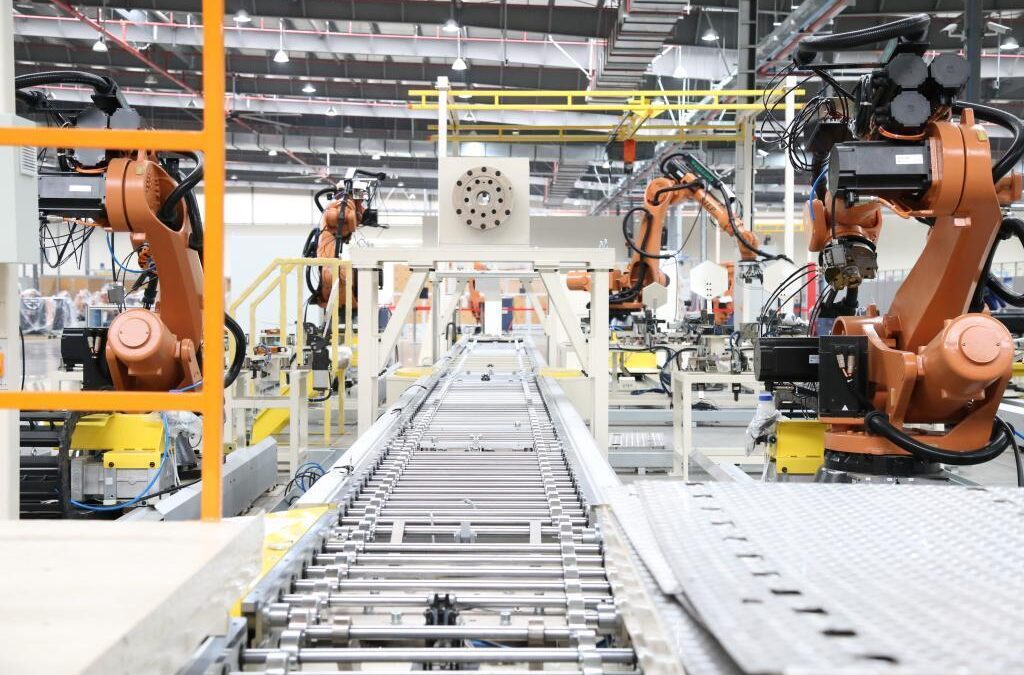
By the end of 2025, China had built more than 35,000 basic-level smart factories, more than 8,200 advanced-level factories, more than 500 excellent-level factories and 15 leading smart factories.
According to China’s Ministry of Industry and Information Technology, some leading factories achieved flexible mixed production of multiple vehicle models, while others used digital twins to support autonomous operation. Across leading factories, production efficiency reportedly increased by an average of 29%, while product defect rates fell 47%.
These figures illustrate an important distinction.
China is not simply digitizing information.
It is increasingly attempting to digitize industrial processes themselves.
2. Big Data: Making the Factory Observable
Modern industrial facilities continuously generate data.
Machines generate operational information.
Sensors measure temperature, pressure, vibration and energy consumption.
Production lines generate quality data.
Warehouses generate inventory data.
Suppliers generate logistics information.
Customers generate demand signals.
Individually, these data streams have limited strategic value.
Their importance emerges when they can be integrated and interpreted.
Big Data therefore creates what we might call Industrial Observability™:
the capacity to develop an increasingly comprehensive and continuously updated understanding of the condition and behaviour of an industrial system.
A factory that can observe itself becomes easier to optimize.
A supply chain that can observe itself becomes easier to coordinate.
But observation alone is insufficient.
Data must be processed.
3. Cloud Computing: Creating the Computational Layer
Cloud computing provides part of that processing architecture.
Instead of every factory maintaining isolated computing capabilities, cloud infrastructure allows data storage, applications and computational resources to be accessed across organizational and geographic boundaries.
China’s 2026 Government Work Report explicitly calls for supporting public cloud development, hyper-scale intelligent-computing clusters and better nationwide coordination of computing resources.
For industrial production, this creates an important transition:
Factory Computing → Networked Computing → Ecosystem Computing.
Factories, suppliers, engineering teams and service providers can increasingly operate through shared digital infrastructures.
Cloud computing therefore becomes more than an IT service.
It becomes part of the industrial capability layer.
4. Artificial Intelligence: Converting Data into Decisions
If Big Data helps an industrial system observe and cloud computing helps it process, AI increasingly helps it interpret and act.
AI can support:
predictive maintenance;
quality inspection;
production scheduling;
energy optimization;
robotic control;
demand forecasting;
supply-chain management;
process optimization;
industrial design.
The important development is the movement from automation toward greater degrees of autonomy.
MIIT reported that AI has already entered more than 70% of business scenarios in China’s leading smart factories, where more than 6,000 vertical-domain models have been accumulated. Industrial AI agents with perception, decision and execution capabilities are also emerging.
The evolution can therefore be conceptualized as:
Mechanization → Automation → Digitalization → Intelligence → Adaptive Production.
AI is not merely replacing individual tasks.
It can increasingly become part of the decision architecture of production.
5. Blockchain: The Trust and Verification Layer
Blockchain occupies a different position.
It should not be exaggerated.
Blockchain does not manufacture automobiles, operate industrial robots or automatically make supply chains efficient.
Its potential industrial value lies primarily in environments where multiple actors need trusted records, traceability or verifiable transactions.
Applications can include:
component provenance;
supply-chain traceability;
quality certification;
maintenance histories;
industrial data exchange;
contract execution.
China’s 15th Five-Year Plan explicitly identifies blockchain alongside cloud computing and next-generation communications as digital industries to be developed while simultaneously promoting industrial data infrastructure and intelligent manufacturing.
Within the broader architecture, blockchain can therefore function selectively as a Digital Trust Layer™.
Its value depends on the problem being solved.
This distinction is essential.
Not every industrial process requires blockchain.
Strategic technology adoption means selecting technologies because they create value—not because they are technologically fashionable.
6. The Real Transformation Is Convergence
The deeper transformation becomes visible when the four technologies interact.
Consider a manufacturing system.
Sensors generate enormous quantities of operational data.
Big Data organizes those information flows.
Cloud computing provides scalable computational infrastructure.
AI analyzes patterns and recommends or executes decisions.
Blockchain, where appropriate, can provide trusted records across organizational boundaries.
The architecture becomes:
Physical Production
↓
Industrial Data
↓
Cloud Infrastructure
↓
Artificial Intelligence
↓
Decision and Optimization
↓
Trusted Ecosystem Coordination
↓
Adaptive Industrial Production
This is Industrial Digital Convergence™.
Its strategic importance lies in the system rather than any single component.
7. From Smart Factory to Intelligent Industrial Ecosystem™
This transformation does not stop at the factory gate.
A manufacturer depends upon suppliers.
Suppliers depend upon logistics networks.
Production depends upon energy.
Equipment depends upon maintenance.
Factories interact with research organizations, software companies, financial institutions and customers.
Digital connectivity allows these relationships to become increasingly integrated.
China’s leading smart factories are already spreading capabilities into their supply chains. MIIT reports that they have helped more than 1,300 upstream and downstream companies upgrade collaboratively.
The strategic unit therefore expands:
Machine → Production Line → Factory → Supply Chain → Industrial Ecosystem.
This supports a concept particularly important to TPNF:
Intelligent Industrial Ecosystem™ — an interconnected production environment in which technological, organizational and human capabilities continuously exchange data, coordinate decisions and adapt across organizational boundaries.
8. Industrial AI Requires Industrial Knowledge
There is nevertheless an important limitation to purely technological explanations.
AI cannot simply be inserted into a factory and expected automatically to generate productivity.
Industrial production contains enormous amounts of tacit knowledge.
Engineers understand materials.
Technicians understand machines.
Operators recognize unusual behaviour.
Managers understand production constraints.
Suppliers understand component limitations.
This creates a critical interaction:
Artificial Intelligence + Industrial Knowledge + Human Experience.
China’s accumulation of thousands of vertical industrial models is strategically interesting precisely because industrial AI requires domain-specific knowledge.
The future factory therefore should not necessarily be imagined as a factory without humans.
It may increasingly become a Human–AI Industrial Collaboration System™.
9. Scale Becomes a Learning Advantage
China’s enormous manufacturing base introduces another strategic dimension.
More factories create more industrial applications.
More applications generate more data.
More data can improve models.
Improved models can be deployed across additional factories.
This potentially creates an:
Industrial Learning Flywheel™
Manufacturing Scale → Data → AI Learning → Process Improvement → Wider Deployment → More Data → Further Learning.
Scale therefore produces more than manufacturing volume.
Under the right conditions, it can produce learning velocity.
This may become one of the most important competitive characteristics of future industrial systems.
10. Technology Does Not Automatically Produce Strategic Value
TPNF must nevertheless resist technological determinism.
Possessing AI does not guarantee productivity.
Possessing data does not guarantee understanding.
Possessing cloud infrastructure does not guarantee coordination.
Possessing blockchain does not guarantee trust.
The critical process remains Strategic Conversion™.
Technological capability must be integrated with:
human expertise;
organizational adaptation;
industrial standards;
cybersecurity;
energy infrastructure;
capital;
skills;
regulation;
supply-chain resilience.
The strategic equation is therefore not:
Technology = Industrial Advantage.
It is:
Technology + Integration + Human Capability + Ecosystem Coordination + Strategic Conversion™ = Potential Industrial Advantage.
That distinction is fundamental.
11. The China Manufacturing Technology Stack™
China’s industrial transformation can therefore be understood as a layered architecture.
At the physical level are factories, machines, robots and logistics systems.
Above them sit sensors, industrial networks and connectivity.
Above connectivity sit data infrastructures.
Cloud and computing infrastructure provide processing capability.
AI provides increasingly sophisticated analytical and decision capabilities.
Blockchain can provide trusted coordination where appropriate.
Humans and institutions govern the entire architecture.
This produces a Manufacturing Technology Stack™:
Physical Infrastructure → Connectivity → Data → Computing → Intelligence → Trust → Human Judgment → Ecosystem Coordination.
Competitive advantage increasingly depends upon the integration of the entire stack.
12. From Production Efficiency to Strategic Future Value™
The immediate objective is higher productivity.
But the long-term implications are larger.
Digitally integrated industrial ecosystems can potentially learn faster.
They can reconfigure production.
They can identify problems earlier.
They can coordinate suppliers more effectively.
They can accelerate product development.
They can integrate new technologies more rapidly.
This means digital transformation can create Strategic Future Value™ by increasing the capacity of an industrial system to adapt to technological change.
The deepest competitive advantage may therefore not be today’s production efficiency.
It may be tomorrow’s capacity to continuously improve production capability.
Strategic Implications
China’s industrial transformation suggests that future manufacturing competition will increasingly concern integrated technological ecosystems rather than isolated factories.
Big Data creates Industrial Observability™.
Cloud computing provides scalable computational capability.
AI converts data into increasingly sophisticated industrial intelligence.
Blockchain can selectively create a Digital Trust Layer™.
But their greatest strategic value emerges through convergence.
This makes technological integration, human expertise, industrial standards, cybersecurity and ecosystem coordination increasingly important components of national industrial competitiveness.
Blockchain, Big Data, cloud computing and Artificial Intelligence are often discussed as separate technological revolutions.
Industrial production reveals a different reality.
They are becoming interconnected layers of a broader digital architecture.
China provides an important contemporary laboratory for observing this transition at scale.
The evolution can be represented as:
Data → Connectivity → Computing → Intelligence → Coordination → Adaptive Production → Ecosystem Learning → Strategic Future Value™.
But technology alone does not determine the outcome.
Factories must adapt.
Workers must develop new skills.
Organizations must change.
Industrial ecosystems must coordinate.
Institutions must establish standards and governance.
From the perspective of the Techne–Phronesis Negotiation Framework™, the central challenge is therefore not simply adopting more technology.
It is intelligently integrating technological capabilities into industrial systems capable of learning, adapting and continuously creating value.
Key Takeaways
- China’s manufacturing transformation increasingly integrates Big Data, cloud computing, AI and other digital technologies into interconnected production systems.
- Industrial Digital Convergence™ describes the strategic value created when complementary technologies operate as an integrated industrial architecture.
- AI is increasingly moving Chinese smart manufacturing from automation toward greater degrees of autonomous industrial decision-making.
- China’s manufacturing scale may create an Industrial Learning Flywheel™, allowing industrial data and AI learning to reinforce one another.
- Long-term industrial advantage depends not merely on technology adoption but on successful Strategic Conversion™ of technology into adaptive ecosystem capability.
Author’s Reflection
China’s industrial transformation raises a question extending far beyond China:
What is the factory becoming?
For more than two centuries, industrial evolution increased humanity’s capacity to manufacture physical objects.
The emerging transformation may be different.
Factories are beginning to acquire something resembling a continuously developing capacity to observe, analyze, learn and adapt.
This does not make factories intelligent in the human sense.
Nor does it eliminate human judgment.
It changes the relationship between technological capability and industrial decision-making.
Techne creates machines, algorithms, networks and computational capability.
Systems Thinking reveals how they interact across factories, supply chains, energy systems, workers, markets and institutions.
Phronesis determines how these capabilities should be combined, governed and directed toward sustainable purposes.
China therefore demonstrates an increasingly important proposition for TPNF:
The future of industrial competitiveness may belong not simply to those who possess the most advanced technologies, but to those who can most effectively integrate technology, data, human knowledge and ecosystems into a continuously learning productive system.
Nikos Chatzis
Source: Open Sources Analysis, Relative Data Analysis by Nikos Chatzis
© Nikolaos Chatzis. All Rights Reserved.
The Techne–Phronesis Negotiation Framework™
An Integrative Theory of Strategic Negotiation, Complex Adaptive Systems and Practical Wisdom
Technology Creates Capability • Systems Thinking Creates Understanding • Strategic Wisdom Creates Lasting Value.
Negotiation.gr | Strategic Wisdom for the Technological Age