Negotiation.gr | Strategic Wisdom for the Technological Age
“Strategic resilience emerges when technical capability (techne) is
continuously guided by practical wisdom (phronesis) through adaptive
negotiation across interconnected systems.”
Central Idea — Thesis
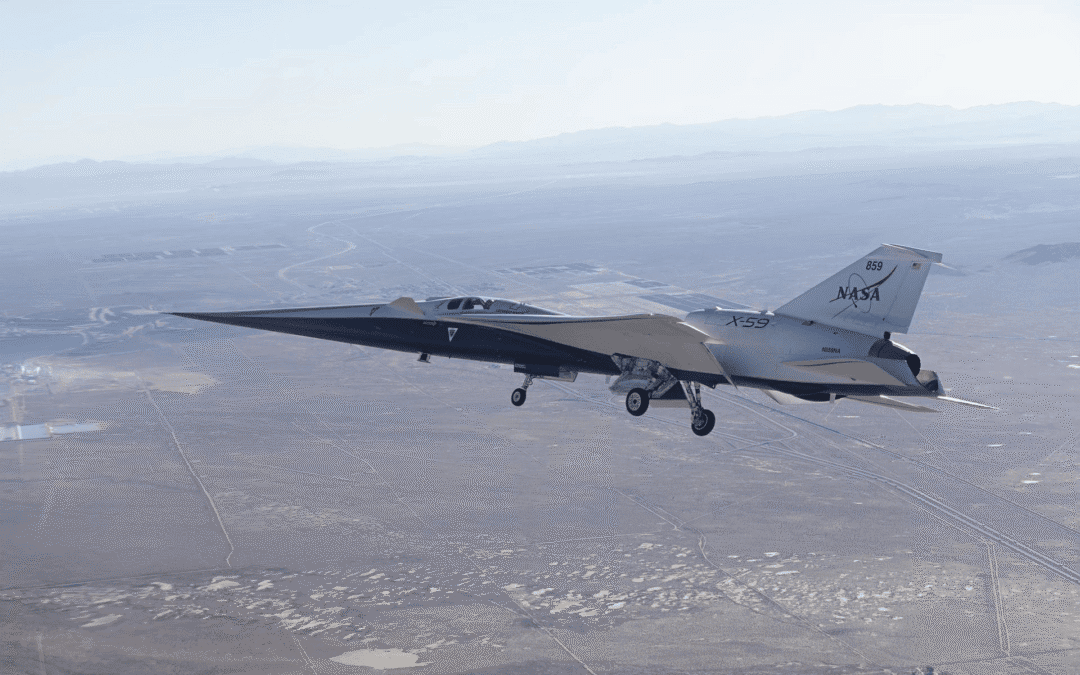
NASA’s X-59 quiet supersonic experimental aircraft has completed 25 test flights, but the strategic significance of this milestone extends beyond the performance of a single aircraft.
The deeper value lies in the process through which experimental aerospace research converts technological uncertainty into validated knowledge.
At NASA’s Armstrong Flight Research Center, computer modeling, wind-tunnel research, aircraft design, flight testing, digital simulation, engineering judgment and operational learning are interacting through repeated experimentation.
The result is not merely an aircraft.
It is cumulative technological knowledge.
Through the Techne–Phronesis Negotiation Framework™ (TPNF), the X-59 therefore illustrates a broader long-term value-creation architecture:
Scientific Knowledge → Technological Design → Experimentation → Real-World Validation → Learning → Regulatory Knowledge → Future Applications → Strategic Future Value™ → Lasting Strategic Value™.
The X-59 may never carry a commercial passenger.
But the knowledge created through it could influence aircraft that eventually do.
Purpose of the Essay
This essay examines NASA’s X-59 milestone not simply as an aviation achievement but as a paradigm of long-term technological value creation.
The central question is:
How can an experimental aircraft that will never become a commercial airliner nevertheless create substantial long-term economic, technological and societal value?
The answer lies in understanding experimentation itself as strategic infrastructure.
Abstract
NASA’s X-59 completed its 25th flight on August 21, 2026, from Armstrong Flight Research Center in Edwards, California.
The aircraft has progressively expanded its flight envelope and has already reached Mach 1.4 and 55,000 feet—the target conditions planned for future community overflights.
The X-59 is the centerpiece of NASA’s Quesst mission, which seeks to demonstrate that an aircraft can fly supersonically while producing a quieter sonic “thump” rather than the disruptive sonic boom traditionally associated with supersonic flight.
But Quesst has a larger objective.
NASA ultimately intends to provide regulators with empirical data that could help inform future acceptable noise thresholds for commercial supersonic flight over land.
TPNF therefore identifies the X-59 as an example of Experimental Value Conversion™: the process through which structured experimentation converts technological uncertainty into validated knowledge capable of enabling future technological, institutional and economic options.
1. Twenty-Five Flights — But What Has Actually Been Created?
Numbers attract attention.
Twenty-five flights.
Mach 1.4.
55,000 feet.
But these numbers describe performance milestones rather than the deepest strategic outcome.
NASA reports that flight data are closely matching predictions developed through computer simulation, wind-tunnel testing and other analytical tools.
Engineers are validating:
flying qualities;
aircraft controllability;
stability margins;
structural loads;
engine-inlet performance;
aerodynamic behaviour.
Between flights, pilots, engineers and maintenance personnel analyze data and make refinements.
This creates a learning loop:
Prediction → Flight → Measurement → Comparison → Refinement → New Flight.
The strategic product of the process is therefore not simply aircraft performance.
It is validated understanding.
2. Armstrong as a Strategic Learning Infrastructure
NASA’s Armstrong Flight Research Center should consequently be understood as more than an airfield where experimental aircraft fly.
It functions as Strategic Learning Infrastructure™.
Its value emerges from the combination of:
specialized facilities;
instrumented aircraft;
test pilots;
engineers;
simulation;
data systems;
maintenance expertise;
flight-test methodology;
institutional memory.
None of these elements alone creates the full capability.
Their interaction does.
This is a central TPNF principle:
advanced technological capability increasingly emerges from ecosystems of complementary capabilities rather than isolated technological assets.
Armstrong represents such an ecosystem.
3. The X-59 Is an Experiment, Not a Future Airliner
Conceptual precision is important here.
NASA explicitly states that X-59 is an experimental research aircraft.
It is not a prototype commercial airliner, and it will never carry passengers.
Its purpose is different.
Its unusual shape is designed to alter how shock waves generated during supersonic flight reach the ground.
Instead of producing the familiar loud sonic boom, the aircraft is intended to create a substantially quieter sonic thump.
The X-59 therefore tests a technological proposition.
If the proposition is validated, knowledge generated through the aircraft could influence future commercial designs.
That distinction explains why experimental technology can create value without itself becoming a commercial product.
4. From Simulation to Reality
One particularly interesting feature of the X-59 program is NASA’s use of a real-time digital twin.
Flight data can be compared with simulated predictions while engineers evaluate whether the physical aircraft behaves as expected.
This creates a continuous interaction between:
Digital Model ↔ Physical Aircraft.
Simulation reduces uncertainty before flight.
Flight reveals realities simulation cannot completely predict.
The resulting data then strengthen future models.
This is Model–Reality Learning™:
the iterative process through which digital predictions and physical experimentation continuously test and improve one another.
The principle extends far beyond aviation.
Advanced manufacturing, robotics, autonomous systems, space technology and complex industrial systems increasingly operate through similar digital-physical learning loops.
5. Failure Is Not the Opposite of Value
Experimental research also changes the meaning of failure.
A test flight does not need to demonstrate perfect performance to create value.
Unexpected results can reveal incorrect assumptions.
A software alert can identify an integration problem.
Unexpected vibration could reveal aerodynamic behaviour.
A mismatch between simulation and flight data can expose weaknesses in a model.
In experimentation:
Unexpected Result → Investigation → Understanding → Improvement.
This connects directly with TPNF’s emerging methodology of Systematic Theoretical Testing™.
The objective is not to protect assumptions.
It is to expose assumptions to reality.
Knowledge becomes stronger when it survives testing—and more useful when testing reveals where it was wrong.
6. The Next Challenge: Measuring the Thump
NASA now approaches the phase that addresses the central technological proposition behind Quesst.
Can the X-59 reliably produce its intended quiet sonic signature under real atmospheric conditions?
NASA will use ground- and air-based instrumentation to characterize the aircraft’s sonic thumps during supersonic flight.
This matters because technological performance must be demonstrated outside the design environment.
A computer model can predict.
A wind tunnel can simulate.
But eventually:
Reality must decide.
Acoustic validation therefore represents the transition from engineering expectation toward empirical evidence.
7. Technology Alone Cannot Change Aviation
Even successful acoustic validation would not automatically create commercial supersonic travel over land.
This is where the Quesst mission becomes particularly interesting from a TPNF perspective.
NASA intends eventually to fly X-59 over selected U.S. communities and collect data on how people perceive its sound.
That data will be provided to U.S. and international regulators.
The architecture therefore expands:
Technology → Performance → Human Perception → Evidence → Regulation → Market Possibility.
Engineering success alone is insufficient.
The technology must interact with society and institutions.
This is a perfect example of the Strategic Conversion Gap™.
A technological capability can exist without automatically becoming economic or societal value.
Complementary institutional conditions must enable its conversion.
8. Regulation Can Become an Innovation Variable
Regulation is often portrayed simply as a constraint on innovation.
Quesst demonstrates a more complex relationship.
Current restrictions on civil supersonic flight over land emerged largely because sonic booms created unacceptable disturbance.
If technology changes the acoustic consequences, regulators require new evidence to determine whether existing rules remain appropriate.
Research therefore creates something strategically important:
Regulatory Knowledge™.
This is evidence sufficiently robust to allow institutions to evaluate whether technological change justifies regulatory adaptation.
The progression becomes:
Technological Innovation → Scientific Evidence → Social Evidence → Regulatory Evaluation → New Strategic Options.
Regulation and innovation are therefore not necessarily opposites.
Evidence can connect them.
9. Experimental Value Conversion™
This leads to a broader TPNF concept.
Experimental Value Conversion™ can be defined as:
the systematic transformation of technological uncertainty into validated knowledge that creates future technological, institutional, economic or strategic options.
The X-59 illustrates the sequence:
Concept
↓
Modeling
↓
Prototype
↓
Flight Testing
↓
Data
↓
Validation
↓
Knowledge
↓
Institutional Learning
↓
Future Applications
The value produced at each stage accumulates.
Even if future commercial supersonic aircraft look very different from X-59, they may benefit from knowledge created through Quesst.
10. From Technological Product to Knowledge Capital
Traditional economic thinking often evaluates technological projects through products.
What was built?
How many units were sold?
What revenue was generated?
Experimental research requires a different metric.
Its output includes Knowledge Capital™.
Knowledge capital includes:
validated models;
engineering methods;
flight-test data;
human expertise;
design principles;
software;
measurement techniques;
regulatory evidence;
institutional experience.
These assets can migrate into future programs.
Consequently:
Experimental Aircraft → Knowledge Capital → Future Technological Capability.
The aircraft is temporary.
The accumulated capability can persist.
11. Strategic Future Value™
This is where the X-59 becomes particularly important to TPNF.
Strategic Future Value™ asks not only:
What does this capability produce today?
but:
What does this capability make possible tomorrow?
X-59 could contribute to future value by expanding knowledge about low-boom aerodynamics, validating digital models, improving experimental methodologies, developing engineering expertise and producing evidence relevant to future regulation.
Some possibilities may become commercial products.
Others may influence technologies that do not yet exist.
The strategic value lies partly in preserving optionality.
Research expands the range of futures that can subsequently be pursued.
12. The Long-Term Value Creation Paradigm
The Armstrong model therefore reveals a deeper architecture:
Infrastructure → Expertise → Experimentation → Evidence → Learning → Knowledge Capital → Strategic Optionality™ → Strategic Future Value™ → Lasting Strategic Value™.
This is fundamentally different from evaluating innovation solely through immediate return on investment.
Some technological ecosystems create value precisely because they allow societies to investigate uncertain possibilities before commercial markets can justify doing so independently.
NASA’s experimental aviation programs historically operate in this territory.
Their strategic function is not necessarily to manufacture tomorrow’s commercial aircraft.
It is to reduce the uncertainty surrounding what tomorrow’s aircraft could become.
Strategic Implications
First, experimental infrastructure should be evaluated as a long-term capability rather than merely a project cost.
Second, technological experimentation creates Knowledge Capital™ that can outlive the individual platform producing it.
Third, digital twins and physical testing increasingly form integrated Model–Reality Learning™ systems.
Fourth, technological innovation creates societal value only when engineering capability can be converted through institutions, regulation and public acceptance.
Finally, governments can create Strategic Future Value™ by supporting experimental environments in which technological possibilities are systematically tested before their full commercial value becomes visible.
NASA’s X-59 has completed 25 flights.
But counting flights alone misses the deeper achievement.
Every flight converts assumptions into evidence.
Every comparison between simulation and reality improves understanding.
Every engineering refinement adds knowledge.
Every validated model strengthens future capability.
And eventually, community-response data may help regulators reconsider the boundaries within which commercial supersonic aviation can operate.
The X-59 therefore represents more than quiet supersonic technology.
It demonstrates a process of long-term value creation:
Experimentation → Learning → Knowledge → Optionality → Future Capability → Strategic Value.
From the perspective of the Techne–Phronesis Negotiation Framework™, Armstrong Flight Research Center illustrates something fundamental about technological civilization.
The greatest long-term value of an experimental technology may not be the machine that is built, but the knowledge, capabilities and future possibilities that humanity retains after the experiment is complete.
Key Takeaways
- X-59’s 25 flights are progressively validating models and expanding understanding of the aircraft’s real-world behaviour.
- Armstrong Flight Research Center functions as Strategic Learning Infrastructure™, combining human expertise, experimental aircraft, simulation and institutional knowledge.
- Experimental Value Conversion™ describes how experimentation transforms uncertainty into validated knowledge and future strategic options.
- Quesst demonstrates that technological capability must interact with human acceptance and regulation before potential commercial value can emerge.
- The X-59 itself will never become a passenger airliner, but the Knowledge Capital™ generated through the program could influence future supersonic aviation.
Author’s Reflection
The X-59 reminds us that technological value should not always be searched for inside the technology itself.
Sometimes the most valuable outcome is what humanity learns while creating it.
An experimental aircraft may eventually stop flying.
Its data remain.
Its engineering knowledge remains.
Its methodologies remain.
Its human expertise migrates.
Its discoveries influence future designs.
And its unanswered questions create new research.
This is how technological civilization accumulates capability.
Techne creates the experimental machine.
Systems Thinking connects the machine with engineering, human perception, institutions and future markets.
Phronesis asks which technological possibilities are worth developing and toward what long-term purpose.
The X-59 therefore offers a powerful lesson for TPNF:
Long-term technological value is not created only when innovation produces a successful product. It is also created when disciplined experimentation leaves humanity more capable of understanding, choosing and creating what comes next.
Nikos Chatzis
Source: Open Sources Analysis, Relative Data Analysis by Nikos Chatzis
© Nikolaos Chatzis. All Rights Reserved.
The Techne–Phronesis Negotiation Framework™
An Integrative Theory of Strategic Negotiation, Complex Adaptive Systems and Practical Wisdom
Technology Creates Capability • Systems Thinking Creates Understanding • Strategic Wisdom Creates Lasting Value.
Negotiation.gr | Strategic Wisdom for the Technological Age