Negotiation.gr | Strategic Wisdom for the Technological Age
“Strategic resilience emerges when technical capability (techne) is
continuously guided by practical wisdom (phronesis) through adaptive
negotiation across interconnected systems.”
Central Idea — Thesis
For most of modern economic history, value creation has been organized primarily across land, sea, traditional aviation and, increasingly, digital space.
A new economic domain is now emerging much closer to us:
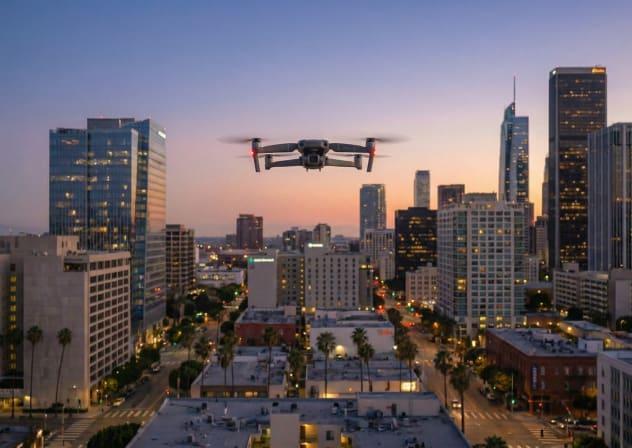
the low-altitude airspace above cities, industries, agricultural areas and transportation networks.
Drones, electric vertical take-off and landing aircraft (eVTOLs), artificial intelligence, autonomous navigation, advanced sensors, communications networks and digital air-traffic-management systems are beginning to transform this previously underutilized space into an economic environment.
Through the Techne–Phronesis Negotiation Framework™ (TPNF), the Low-Altitude Economy should therefore be understood not merely as a new aviation market but as an emerging technological ecosystem for future value creation.
Its evolution can be expressed as:
Airspace → Technological Access → Connectivity → Applications → Ecosystem Formation → Strategic Future Value™ → Lasting Strategic Value™.
Purpose of the Essay
This essay examines the Low-Altitude Economy as an emerging dimension of technological civilization and asks a central strategic question:
How can societies convert access to low-altitude airspace into sustainable economic, technological and societal value?
The answer depends not simply upon producing more drones.
It requires the integration of aircraft, AI, energy, communications, infrastructure, regulation, human skills and public acceptance into a functioning ecosystem.
Abstract
The Low-Altitude Economy is emerging around economic activities conducted by manned and unmanned aircraft operating relatively close to the ground.
Its applications already include logistics, agriculture, infrastructure inspection, emergency response, mapping, surveillance and aerial services, while eVTOL development could eventually expand passenger mobility.
China has moved particularly rapidly in recognizing low-altitude airspace as a new economic domain. Europe is simultaneously developing U-space infrastructure to enable increasingly complex drone operations.
TPNF interprets this transformation through the concept of Low-Altitude Strategic Value™: the cumulative economic, technological and societal value created when low-altitude airspace is transformed from an underutilized geographical space into an integrated environment for mobility, services, data and innovation.
1. Airspace Becomes an Economic Resource
Land creates economic value because societies build roads, factories, cities and infrastructure upon it.
The sea creates value through shipping, fisheries, energy and communications.
Digital space creates value through information, platforms, networks and data.
Low-altitude airspace may increasingly develop similar economic characteristics.
The crucial transformation is conceptual:
Airspace is becoming infrastructure.
Once aircraft can operate safely, repeatedly and economically at low altitude, the space above existing infrastructure becomes another layer through which services can be delivered.
That creates what TPNF can define as Vertical Economic Expansion™:
the extension of economic activity from predominantly surface-based infrastructure into technologically accessible low-altitude airspace.
2. Drones Created the First Economic Layer
Drones have already demonstrated the economic potential of this domain.
They perform agricultural monitoring and spraying.
They inspect power lines, pipelines, bridges and industrial facilities.
They support mapping, construction and environmental monitoring.
They deliver medical supplies.
They assist firefighters and emergency responders.
They capture data that previously required helicopters, aircraft or human inspection teams.
The economic importance of drones therefore extends beyond drone manufacturing.
Their deeper value lies in their ability to make existing economic activities:
faster, safer, cheaper, more precise or previously impossible.
This represents Capability-Based Value Creation™.
Technology creates value by expanding what organizations and societies are capable of doing.
3. AI Changes the Low-Altitude Economy
Artificial intelligence may accelerate this transformation.
Early drones depended heavily upon direct human control.
Future systems will increasingly incorporate:
autonomous navigation;
computer vision;
object recognition;
route optimization;
predictive maintenance;
collision avoidance;
environmental understanding;
fleet coordination.
This changes the economic model.
A human controlling one drone creates limited scalability.
A human supervising an intelligent fleet creates something very different.
The progression becomes:
Remote Control → Assisted Autonomy → Supervised Autonomy → Coordinated Fleets → Intelligent Low-Altitude Networks.
AI therefore potentially becomes a scaling technology for the Low-Altitude Economy.
4. eVTOLs Expand the Mobility Frontier
The next layer could involve eVTOL aircraft.
Unlike conventional aviation, eVTOLs are being designed around distributed electric propulsion, vertical operations and increasingly digital flight systems.
Their potential applications include airport transfers, regional connections, tourism, emergency transport and eventually urban mobility.
But technological capability alone does not create an economy.
An eVTOL may fly successfully while the surrounding ecosystem remains commercially unready.
Vertiports are required.
Charging infrastructure is required.
Airspace integration is required.
Certification is required.
Traffic management is required.
Insurance is required.
Maintenance is required.
Public confidence is required.
This illustrates a fundamental TPNF proposition:
Technological Readiness ≠ Ecosystem Readiness™.
5. The Low-Altitude Technology Stack™
The Low-Altitude Economy therefore depends upon multiple technological layers.
At the physical level are drones and eVTOL aircraft.
Around them are propulsion systems, batteries, sensors and avionics.
Above these sit navigation, communications, AI and autonomy.
Another layer provides digital traffic management.
Physical infrastructure provides launch, landing, charging and maintenance.
Finally, institutions provide certification, regulation, security and airspace governance.
Together they form the Low-Altitude Technology Stack™:
Aircraft
↓
Energy and Propulsion
↓
Sensors and Avionics
↓
Communications and Navigation
↓
AI and Autonomy
↓
Digital Traffic Management
↓
Physical Infrastructure
↓
Regulation and Governance
↓
Commercial Applications
No single layer creates the Low-Altitude Economy independently.
Their integration does.
6. China as an Emerging Laboratory
China provides perhaps the largest current experiment.
The country has increasingly incorporated the Low-Altitude Economy into national economic and industrial policy.
This is strategically important because China possesses complementary capabilities across drones, batteries, electric propulsion, telecommunications, AI, manufacturing and digital infrastructure.
The opportunity therefore extends beyond manufacturing aircraft.
It involves connecting technological capabilities into an ecosystem.
China’s experience illustrates another TPNF principle:
The strategic value of a technology increases when complementary technologies surrounding it are already available.
The Low-Altitude Economy is therefore a powerful example of Technology Convergence.
7. Europe and U-Space
Europe is developing a different but equally important part of the architecture.
U-space provides a framework of digital services intended to support safe and scalable drone operations.
This matters because thousands of aircraft cannot simply enter low-altitude airspace without coordination.
Aircraft must know where they can fly.
Authorities must understand what is operating.
Operators require flight information.
Conflicts must be prevented.
Airspace therefore requires a digital coordination layer.
This transforms low-altitude traffic management into something resembling a digital operating system for the sky.
Europe’s challenge is converting regulatory sophistication into commercial scale and innovation.
8. The Ecosystem Orchestration Challenge
The Low-Altitude Economy brings together actors that historically operated separately:
aircraft manufacturers;
drone operators;
telecommunications companies;
AI developers;
battery manufacturers;
airports;
cities;
regulators;
logistics companies;
emergency services;
insurance companies;
digital-platform providers.
No actor controls the entire ecosystem.
This makes Ecosystem Orchestration™ critical.
The central strategic problem becomes:
How can independent organizations coordinate sufficiently to create collective value without eliminating competition or innovation?
This is fundamentally a negotiation problem.
9. Safety Is Economic Infrastructure
Low-altitude aviation also creates risk.
Drones operate close to people, buildings, airports and critical infrastructure.
Communication failures matter.
Navigation errors matter.
Cybersecurity matters.
Weather matters.
AI errors matter.
Public confidence matters.
Safety should therefore not be viewed simply as a regulatory cost.
It is part of the economic infrastructure.
Without sufficient trust:
operations cannot scale;
regulators will restrict activity;
insurance costs increase;
public opposition grows;
investment becomes uncertain.
TPNF therefore introduces Low-Altitude Trust Infrastructure™:
the combination of safety, regulation, cybersecurity, technical reliability and public confidence required for low-altitude economic activity to scale sustainably.
10. The Future Value Is Larger Than Aviation
The most interesting question concerns where future value will emerge.
Some value will clearly come from manufacturing drones and aircraft.
But substantial value may emerge elsewhere:
software;
AI;
fleet management;
data analytics;
maintenance;
energy infrastructure;
communications;
navigation;
cybersecurity;
insurance;
training;
traffic management;
vertiports;
digital platforms.
The Low-Altitude Economy could therefore produce an expanding value constellation around flight itself.
The aircraft may become only one component of the economic system.
11. Low-Altitude Strategic Value™
TPNF can therefore define Low-Altitude Strategic Value™ as:
the cumulative long-term value created by transforming low-altitude airspace into an integrated technological environment for mobility, services, information and economic activity.
Its development follows:
Airspace
↓
Technological Accessibility
↓
Operational Capability
↓
Commercial Applications
↓
Infrastructure
↓
Ecosystem Formation
↓
Strategic Conversion™
↓
Strategic Future Value™
↓
Lasting Strategic Value™
The critical transition occurs at Strategic Conversion™.
Technology must be converted into useful, scalable and economically sustainable applications.
12. Strategic Future Value™
The greatest economic value may not yet be visible.
Today’s inspection drone generates immediate value.
But the infrastructure created to operate thousands of drones can generate future options.
A communications network developed for logistics drones may later support autonomous passenger aircraft.
A vertiport network may create new mobility services.
Drone traffic-management data may create new digital platforms.
AI developed for autonomous navigation may migrate into robotics.
This is precisely Strategic Future Value™:
value created today through capabilities that enable additional value tomorrow.
Strategic Implications
Governments should treat low-altitude airspace as emerging strategic infrastructure rather than merely an aviation-regulation problem.
Companies should look beyond aircraft manufacturing toward the complete Low-Altitude Technology Stack™.
Cities should consider how aerial mobility and services interact with existing transport and digital infrastructure.
Universities and training organizations will need new combinations of aviation, AI, engineering, regulation and operational expertise.
Europe must ensure that safety and regulation enable innovation rather than merely constrain it.
And societies must recognize that public trust will be as important to scalability as technological performance.
The Low-Altitude Economy represents something larger than drones flying above cities.
It represents the opening of another economic dimension.
Human civilization first organized economic activity horizontally across land and sea.
Aviation extended it across distance.
Digital technology created virtual economic space.
Autonomous aerial systems may now enable systematic economic activity within the low-altitude layer immediately above us.
But access to that space does not automatically create value.
Technology must interact with infrastructure.
Infrastructure must interact with regulation.
Regulation must interact with innovation.
Innovation must interact with markets.
And all must maintain sufficient societal trust.
Through TPNF, the strategic architecture becomes:
Technology → Capability → Airspace Access → Applications → Ecosystem Integration → Strategic Conversion™ → Strategic Future Value™ → Lasting Strategic Value™.
The countries and companies that lead the Low-Altitude Economy may therefore not simply be those producing the greatest number of drones.
They may be those capable of building and orchestrating the most adaptive low-altitude ecosystems.
Key Takeaways
- The Low-Altitude Economy transforms underutilized airspace into a new environment for economic activity.
- Drones, eVTOLs, AI, communications, energy and digital traffic management form an emerging Low-Altitude Technology Stack™.
- Technological Readiness ≠ Ecosystem Readiness™: successful aircraft alone cannot create a functioning market.
- Low-Altitude Trust Infrastructure™ will be essential for safe and scalable operations.
- The deepest opportunity lies in converting low-altitude technological capability into Strategic Future Value™ and Lasting Strategic Value™.
Author’s Reflection
Perhaps the most fascinating characteristic of the Low-Altitude Economy is that humanity does not need to discover a new geographical frontier.
The frontier has always been above us.
What has changed is our technological capability to use it.
Drones made low-altitude airspace economically accessible.
AI can make it increasingly autonomous.
Electric propulsion may make new forms of aerial mobility practical.
Digital networks can coordinate them.
The result may eventually be an entirely new technological layer of civilization.
But technology alone will not determine whether that future succeeds.
We will still need judgment.
Regulation.
Negotiation.
Trust.
Strategic imagination.
And the wisdom to determine not merely what can fly, but what should fly, where, under what rules, for whose benefit and toward what lasting purpose.
That is where Techne meets Phronesis.
And that is where the Low-Altitude Economy becomes not merely another technological market, but a new arena for creating Strategic Future Value™.
Nikos Chatzis
Source: Open Sources Analysis, Relative Data Analysis by Nikos Chatzis
© Nikolaos Chatzis. All Rights Reserved.
The Techne–Phronesis Negotiation Framework™
An Integrative Theory of Strategic Negotiation, Complex Adaptive Systems and Practical Wisdom
Technology Creates Capability • Systems Thinking Creates Understanding • Strategic Wisdom Creates Lasting Value.
Negotiation.gr | Strategic Wisdom for the Technological Age