Negotiation.gr | Strategic Wisdom for the Technological Age
“Strategic resilience emerges when technical capability (techne) is
continuously guided by practical wisdom (phronesis) through adaptive
negotiation across interconnected systems.”
Central Idea — Thesis
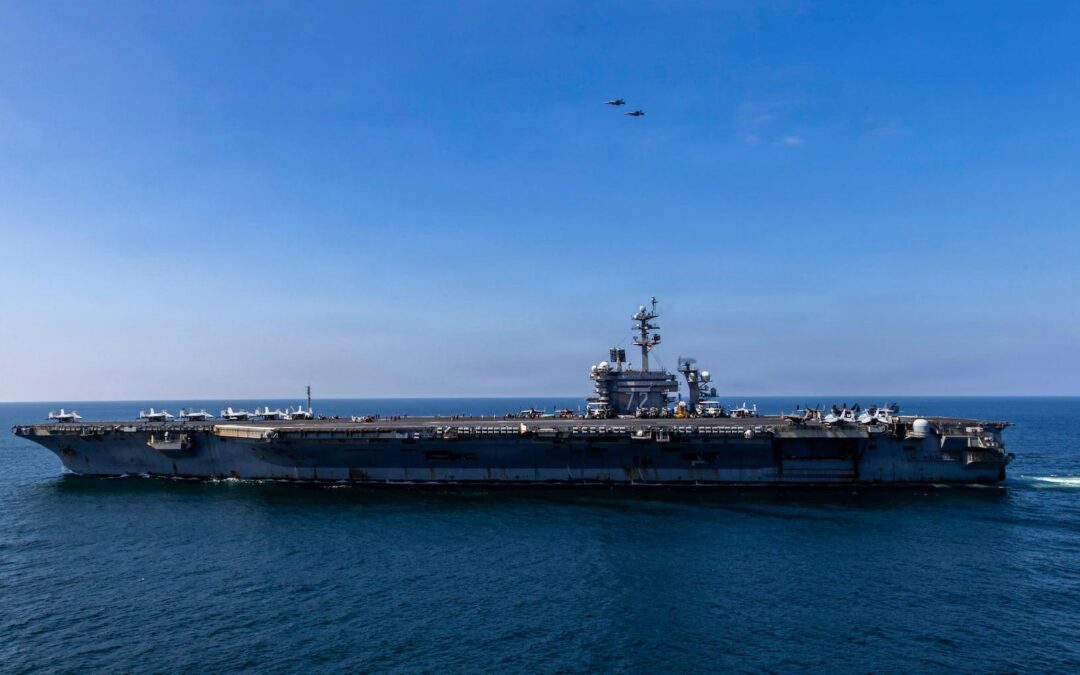
After an extraordinary deployment involving months of sustained combat operations, the USS Abraham Lincoln arrived in Thailand visibly weathered.
Rust stains mark sections of the enormous carrier.
The flight deck shows the visual consequences of intensive operations.
Aircraft, equipment and thousands of sailors have been subjected to an exceptionally demanding operational tempo.
Yet the strategic significance of this image extends far beyond the appearance of one aircraft carrier.
The USS Abraham Lincoln raises a fundamental question for modern military strategy:
When does the intensive use of military capability necessary to accomplish today’s mission begin consuming the readiness required for tomorrow’s mission?
Through the Techne–Phronesis Negotiation Framework™ (TPNF), this becomes a question of Strategic Capability Regeneration™.
Military power cannot be measured exclusively by what a force can deploy, strike or destroy.
It must also be measured by its ability to:
Operate → Sustain → Maintain → Recover → Regenerate → Operate Again.
The central TPNF proposition is therefore:
A military capability is strategically sustainable only when the rate at which it is employed does not persistently exceed the system’s capacity to maintain, replenish and regenerate it.
Purpose of the Essay
This essay examines the extraordinary deployment of the USS Abraham Lincoln as a case study in military operational sustainability.
The purpose is not to question the professionalism or resilience of its sailors, nor to suggest that its visible deterioration represents combat damage.
Instead, it asks whether extremely prolonged high-tempo military operations can create a widening gap between Operational Achievement and Strategic Sustainability.
Through TPNF, the deeper question becomes:
How should military leadership balance immediate mission requirements against the long-term preservation of people, platforms and future combat readiness?
Abstract
The USS Abraham Lincoln has completed one of the most demanding carrier deployments of the contemporary U.S. Navy.
After deploying in November 2025, the carrier spent 286 days at sea and nearly seven months conducting operations associated with the Middle Eastern conflict.
The ship and its air wing generated thousands of sorties while supporting sustained combat operations.
Its sailors endured exceptionally long periods without normal port access.
The carrier nevertheless remained operational.
This demonstrates extraordinary military capability.
But capability demonstrated is also capability consumed.
Aircraft accumulate flight hours.
Engines accumulate cycles.
Flight decks experience repeated launches and recoveries.
Maintenance requirements increase.
Spare parts are consumed.
Sailors accumulate fatigue.
Training and maintenance schedules are disrupted.
TPNF therefore introduces Operational Capability Consumption™:
the cumulative reduction of future readiness produced when sustained operational employment consumes human, mechanical, logistical and organizational capacity faster than those resources can be regenerated.
The issue is not whether the USS Abraham Lincoln succeeded operationally.
It is whether such operational intensity can be repeatedly sustained across the wider force.
1. The Carrier as a System of Systems
An aircraft carrier is frequently perceived as a single weapon.
It is nothing of the kind.
It is an enormous ecosystem.
The carrier integrates:
aircraft;
pilots;
flight-deck crews;
maintenance personnel;
radar;
communications;
weapons;
fuel;
logistics;
nuclear propulsion;
information systems;
medical capability;
command structures;
escort ships;
supply vessels;
thousands of sailors.
Its combat capability emerges from the interaction of these elements.
Systems Thinking therefore immediately changes the analytical question.
The question is not:
Is the carrier still operational?
It is:
What condition is the entire capability-generating system in after months of extraordinary utilization?
2. Visible Wear and Invisible Wear
Rust is visible.
Human fatigue frequently is not.
A worn flight deck can be photographed.
Accumulated maintenance requirements cannot always be seen.
This creates an important distinction.
Visible Operational Wear concerns physical signs produced by intensive environmental and operational exposure.
Invisible Operational Wear™ concerns degradation accumulating within people, equipment, logistics and organizational systems without necessarily becoming immediately observable.
Examples include:
crew fatigue;
deferred maintenance;
aircraft component cycles;
reduced spare-parts inventories;
psychological stress;
training disruption;
maintenance backlogs.
A strategically sophisticated assessment must examine both.
3. Operational Success Can Conceal Strategic Cost
The USS Abraham Lincoln performed its mission.
That matters.
Warships exist to operate.
Military forces cannot remain permanently protected from operational stress simply to preserve readiness.
Readiness exists precisely because forces may need to fight.
But this creates a paradox.
The more successfully a military platform performs intensive operations, the more rapidly it may consume elements of the capability enabling those operations.
TPNF can define this as the Operational Success–Readiness Paradox™:
The successful intensive employment of military capability can simultaneously accomplish immediate strategic objectives while accelerating the consumption of the readiness required for subsequent missions.
Operational success and strategic sustainability are therefore related—but not identical.
4. The Mathematics of Military Sustainability
The underlying strategic logic can be expressed simply.
Let:
O = Operational Demand
and
R = Regeneration Capacity.
When:
O ≤ R
the force can broadly sustain capability.
But when:
O > R
for prolonged periods, readiness debt begins accumulating.
Maintenance is postponed.
Deployments are extended.
Personnel rest decreases.
Training cycles compress.
Equipment ages faster.
Eventually the military must repay this debt.
TPNF can describe the resulting condition as Strategic Readiness Debt™.
Like financial debt, readiness debt may be manageable temporarily.
But persistent accumulation eventually constrains future choices.
5. The Carrier Availability Problem
The challenge extends beyond one carrier.
The United States possesses a finite carrier fleet.
Some carriers undergo maintenance.
Others require training.
Others are preparing for deployment.
Others may already be deployed.
When geopolitical demand increases faster than available forces, commanders face difficult choices.
Deployments can be extended.
Maintenance can be delayed.
Other theaters can temporarily lose assets.
Personnel can remain at sea longer.
Every decision solves one problem while potentially creating another.
This is not necessarily poor military leadership.
It is a structural problem of Demand–Capability Imbalance™.
6. More Missions Than Sustainable Capacity?
For years, American naval analysts have warned about the tension between global commitments and fleet capacity.
The United States simultaneously seeks to maintain deterrence and presence across:
the Middle East;
Indo-Pacific;
Europe;
Mediterranean;
global maritime routes.
Aircraft carriers remain among the most visible instruments of American power.
But they cannot be everywhere.
Nor can individual carriers operate indefinitely.
The strategic question therefore becomes uncomfortable:
Does the United States possess sufficient regenerative military capacity for the geopolitical commitments it expects its forces to sustain?
7. Sailors Are Part of the Weapons System
Military analysis often concentrates on platforms.
But a carrier cannot operate without its people.
Thousands of sailors maintain aircraft.
Load weapons.
Operate reactors.
Manage flight operations.
Repair equipment.
Prepare food.
Provide medical care.
Stand watch.
Operate communications.
Sustained combat therefore consumes human capability as well as mechanical capability.
This allows TPNF to introduce Human Readiness Capital™:
the accumulated physical, psychological, professional and organizational capacity of military personnel to perform demanding missions reliably over time.
Human Readiness Capital™ can be strengthened.
It can also be depleted.
8. Logistics Is Combat Power
The Lincoln experience also illustrates an ancient strategic truth expressed through modern systems.
Combat capability depends upon logistics.
Food.
Fuel.
Ammunition.
Spare parts.
Maintenance equipment.
Medical resources.
Mail.
Replacement components.
A carrier strike group may possess extraordinary offensive capability.
But sustained operations require continuous replenishment.
Logistics therefore should not be understood as supporting combat power.
Logistics is part of combat power.
TPNF would describe this through systems integration:
Platform Capability + Human Capability + Logistics + Maintenance + Information + Regeneration = Sustainable Combat Capability.
Remove one element and the system progressively weakens.
9. Maintenance Is Strategic Regeneration
Maintenance is sometimes perceived as the period when a military platform is unavailable.
Strategically, the opposite interpretation is more useful.
Maintenance is the process through which future capability is created.
Inspection identifies deterioration.
Components are replaced.
Systems are modernized.
Structural problems are repaired.
Software is updated.
Personnel retrain.
Lessons from deployment are incorporated.
Maintenance therefore represents Capability Regeneration.
A military force that continuously delays maintenance to increase immediate availability may paradoxically reduce its future availability.
10. The Operational Tempo Trap™
This creates another TPNF concept:
The Operational Tempo Trap™.
It occurs when immediate strategic demands repeatedly require extending the use of scarce military assets, causing maintenance, personnel recovery and regeneration to be postponed—thereby reducing future force availability and increasing pressure on the remaining assets.
The cycle becomes:
High Demand
↓
Extended Operations
↓
Deferred Regeneration
↓
Reduced Future Availability
↓
Greater Pressure on Remaining Forces
↓
Higher Operational Tempo
↓
Further Readiness Consumption
If persistent, this becomes self-reinforcing.
11. Proper Military Operation Is Not Minimum Wear
The question in the title therefore requires qualification.
A weathered carrier does not automatically indicate improper military operation.
Combat produces wear.
War creates uncertainty.
Equipment exists to be used.
Military personnel accept burdens fundamentally different from normal civilian employment.
Proper military operation therefore cannot mean avoiding stress.
Instead, it requires maintaining a rational relationship between:
Mission Necessity ↔ Operational Risk ↔ Human Endurance ↔ Equipment Sustainability ↔ Future Readiness.
Phronesis becomes decisive precisely because there is no perfect mathematical balance.
12. Techne Without Regeneration Is Temporary Power
The USS Abraham Lincoln represents extraordinary Techne.
Nuclear propulsion.
Carrier aviation.
Precision strike.
Integrated air defence.
Electronic warfare.
Networked command.
Logistics.
But technological sophistication does not eliminate physical constraints.
Aircraft still require maintenance.
Components still wear.
Weapons must be replenished.
People still require sleep and recovery.
Technology expands capability.
It does not abolish sustainability.
Therefore:
Techne without Regeneration eventually becomes exhausted capability.
13. Phronesis and Military Leadership
This is where Phronesis enters the military equation.
Commanders must decide:
How long should a deployment continue?
When does operational necessity justify additional strain?
When must another unit assume the mission?
What maintenance can safely be deferred?
How much personnel fatigue is acceptable?
Which theater receives scarce forces?
What future risk is created by today’s operational decision?
These are not purely technical questions.
They require strategic judgment.
14. From Operational Readiness to Strategic Resilience
Military readiness traditionally asks:
Can the force fight now?
Strategic resilience asks something larger:
Can the force fight, recover, adapt and fight effectively again?
This distinction is crucial.
A military capable of generating extraordinary combat power once is formidable.
A military capable of repeatedly regenerating that power possesses something strategically greater.
TPNF can describe this as Regenerative Military Capability™:
the capacity of a military system to restore, adapt and reproduce combat effectiveness following sustained operational consumption.
15. The TPNF Architecture of Sustainable Military Power
The strategic architecture becomes:
Military Techne
↓
Operational Capability
↓
Combat Employment
↓
Operational Capability Consumption™
↓
Maintenance + Logistics + Personnel Recovery
↓
Strategic Capability Regeneration™
↓
Restored Readiness
↓
Adaptive Learning
↓
Regenerative Military Capability™
↓
Sustainable Strategic Power
The system must remain circular.
If the regeneration stage collapses, the architecture becomes linear:
Capability → Employment → Consumption → Degradation.
That is strategically unsustainable.
Strategic Implications
First, military effectiveness should be evaluated across complete readiness cycles rather than individual deployments.
Second, operational planners should treat maintenance capacity as strategic combat infrastructure.
Third, human endurance must be incorporated directly into assessments of force sustainability.
Fourth, fleet size should be evaluated against realistic global operational demand rather than nominal platform numbers alone.
Fifth, logistics resilience must be considered part of combat capability.
Sixth, extended deployments create costs that may emerge only during subsequent maintenance and readiness cycles.
Finally, strategic leaders must distinguish between maximum operational utilization and optimal strategic utilization.
The two are not necessarily the same.
The weathered USS Abraham Lincoln arriving in Thailand provides a powerful image.
But the most important thing about that image is not rust.
It is what the rust represents.
Time.
Salt.
Heat.
Aircraft launches.
Recoveries.
Combat sorties.
Maintenance.
Logistics.
Human endurance.
Operational necessity.
The carrier’s condition tells the story of a military system that has been intensely used for the purpose for which it was created.
That deserves recognition.
But strategy must ask the next question.
What does today’s extraordinary operational performance cost tomorrow’s readiness?
The answer determines whether military power is merely impressive or genuinely sustainable.
TPNF therefore proposes:
Military capability should not be measured only by the power that can be generated at the beginning of a conflict, but by the capacity of the military ecosystem to regenerate that power throughout the conflict and beyond it.
The USS Abraham Lincoln demonstrates American military capability.
Its extraordinary deployment also reminds us that even the world’s most technologically advanced military operates within constraints.
Ships wear.
Aircraft age.
Weapons are consumed.
Maintenance accumulates.
People become tired.
Strategy begins by acknowledging these realities rather than assuming technology has abolished them.
The objective of proper military operation is therefore not simply:
Fight effectively today.
It must be:
Fight effectively today → Preserve the system → Learn → Regenerate → Remain capable of fighting tomorrow.
That is the difference between operational power and sustainable strategic power.
And it is precisely where military Techne must meet strategic Phronesis.
Key Takeaways
- Visible wear aboard the USS Abraham Lincoln should not be confused with combat damage; it reflects an extraordinarily demanding deployment and sustained operational use.
- Operational Capability Consumption™ describes how intensive military employment consumes human, mechanical, logistical and organizational readiness.
- Strategic Readiness Debt™ accumulates when operational demand persistently exceeds the military system’s capacity to maintain and regenerate capability.
- The Operational Tempo Trap™ can emerge when extended operations defer regeneration, reducing future availability and placing still greater pressure on remaining forces.
- Regenerative Military Capability™ may ultimately be a more important measure of sustainable military power than maximum short-term operational intensity.
Author’s Reflection
The photographs of the USS Abraham Lincoln are striking precisely because they make military strategy physical.
Strategy is often discussed through abstractions.
Power.
Deterrence.
Force projection.
Operational reach.
Military superiority.
But eventually all of these concepts encounter material reality.
Steel encounters saltwater.
Aircraft accumulate flight hours.
Engines accumulate cycles.
Weapons inventories decline.
People become exhausted.
The greatest military machine remains a human-technological system.
And every system has limits.
Perhaps one of the greatest dangers of possessing extraordinary technological capability is beginning to believe that capability itself has abolished those limits.
It has not.
Technology can extend endurance.
Logistics can sustain operations.
Maintenance can regenerate capability.
AI may improve predictive maintenance.
Autonomous systems may reduce certain human burdens.
But no technological system creates infinite readiness.
This is why the USS Abraham Lincoln represents such an interesting TPNF case.
Its deployment demonstrates Techne at extraordinary scale.
But its weathered appearance asks a question of Phronesis:
How much capability should be consumed today in order to achieve today’s objective without compromising the strategic options required tomorrow?
That question applies far beyond aircraft carriers.
It applies to missiles.
Aircraft.
Drones.
Air-defence systems.
Satellites.
Cyber capabilities.
Industrial production.
And ultimately people.
Military superiority therefore cannot depend exclusively upon possessing superior weapons.
It must include the ability to regenerate the ecosystem that makes those weapons strategically useful.
Perhaps the deeper principle is simple:
A military force proves its power by fighting effectively.
A military system proves its strategic resilience by remaining capable of doing so again.
That distinction may become increasingly important in an era of prolonged, high-intensity technological warfare.
Nikos Chatzis
Source: Open Sources Analysis, Relative Data Analysis by Nikos Chatzis
© Nikolaos Chatzis. All Rights Reserved.
The Techne–Phronesis Negotiation Framework™
An Integrative Theory of Strategic Negotiation, Complex Adaptive Systems and Practical Wisdom
Technology Creates Capability • Systems Thinking Creates Understanding • Strategic Wisdom Creates Lasting Value.
Negotiation.gr | Strategic Wisdom for the Technological Age