Negotiation.gr | Strategic Wisdom for the Technological Age
“Strategic resilience emerges when technical capability (techne) is
continuously guided by practical wisdom (phronesis) through adaptive
negotiation across interconnected systems.”
Central Idea
The Blue Economy is evolving from a traditional maritime economic sector into a technology-driven ecosystem where drones, artificial intelligence, autonomous systems, and platform ecosystems redefine competitiveness. Through the Techne–Phronesis Negotiation Framework™ (TPNF), Greece can transform its maritime geography into a strategic innovation ecosystem that generates sustainable economic, technological, environmental, and geopolitical value.
Purpose of the Essay
This essay demonstrates how the Techne–Phronesis Negotiation Framework™ explains the strategic challenges and opportunities emerging from the convergence of the Blue Economy and the global drone industry. Using Greece as a case study, it argues that sustainable competitive advantage will increasingly depend on integrating technological capability, systems thinking, strategic negotiation, platform ecosystems, and strategic wisdom.
Abstract
The Blue Economy is entering a new phase of technological transformation driven by artificial intelligence, autonomous systems, robotics, satellite technologies, digital platforms, and drones. Maritime activities are no longer confined to traditional shipping, fisheries, and tourism. Instead, they increasingly depend upon integrated technological ecosystems capable of collecting, analyzing, and utilizing maritime information in real time. This essay applies the Techne–Phronesis Negotiation Framework™ (TPNF) to explain how Greece can leverage the global drone industry to strengthen its Blue Economy while creating sustainable economic and strategic value.
Introduction
Throughout history, the sea has represented trade, security, prosperity, and cultural exchange. Today, however, oceans have become something more significant: they are emerging as one of the world’s largest technology ecosystems.
The Blue Economy increasingly integrates:
- Artificial Intelligence
- Drones
- Autonomous Surface Vessels (USVs)
- Autonomous Underwater Vehicles (AUVs)
- Maritime robotics
- Satellite observation
- Digital Twins of the Ocean
- Big Data analytics
- Platform ecosystems
These technologies are reshaping maritime governance, environmental monitoring, fisheries, offshore energy, logistics, search and rescue, coastal resilience, and maritime security. The EU identifies maritime infrastructure, robotics, and autonomous systems as rapidly expanding components of the Blue Economy, while ocean observation is becoming a strategic capability supporting environmental management, shipping, defense, and scientific research.
The Blue Economy as a Technology Ecosystem
Traditional definitions of the Blue Economy emphasized economic sectors linked to oceans and coastal regions.
Today, the concept extends much further.
The Blue Economy is increasingly becoming a multidimensional technological ecosystem where value is generated through continuous interaction among digital infrastructure, robotics, sensors, data platforms, and intelligent decision-making systems.
Rather than viewing maritime activities independently, organizations must understand the relationships connecting ports, offshore energy, fisheries, tourism, environmental protection, logistics, defense, and research institutions.
Technology transforms the sea into an intelligent ecosystem.
The Global Drone Industry and Maritime Transformation
The drone industry is becoming one of the principal technological enablers of maritime transformation.
Modern drones support:
- maritime surveillance,
- environmental monitoring,
- offshore infrastructure inspection,
- port security,
- fisheries management,
- search and rescue,
- coastal mapping,
- pollution detection,
- disaster response,
- oceanographic research.
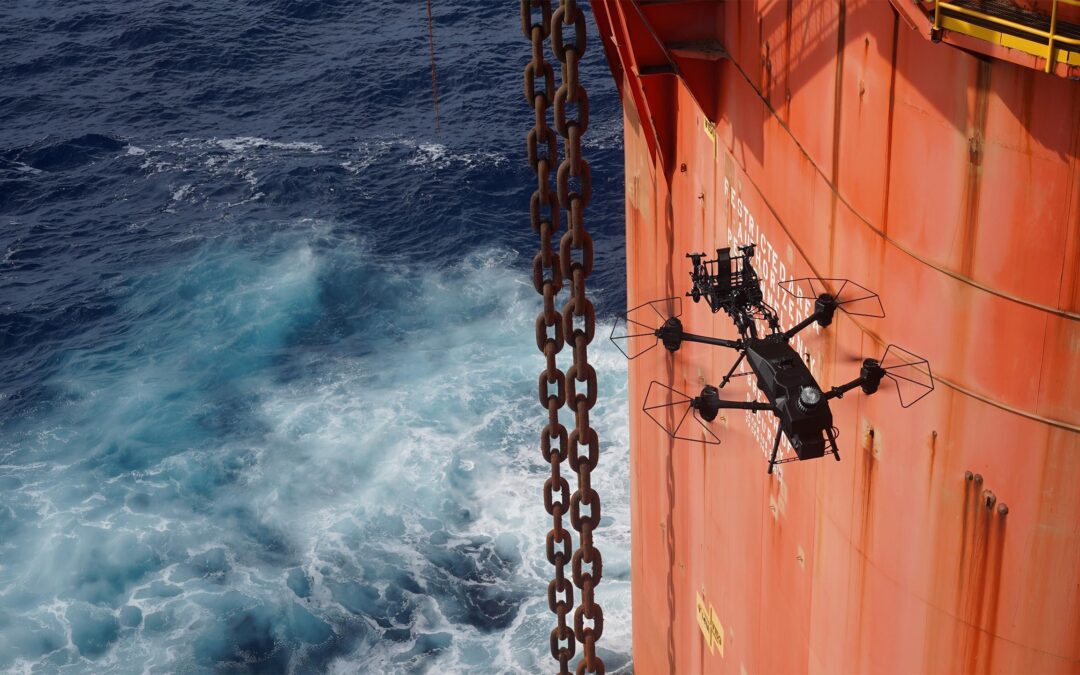
Maritime drones increasingly operate alongside autonomous surface and underwater systems, creating integrated ocean-observation networks. Advances in AI, autonomy, satellite communications, and cloud-based data platforms enable these systems to support shipping, offshore energy, scientific research, maritime safety, and defense as part of broader digital maritime ecosystems.
Applying the Techne–Phronesis Negotiation Framework™
Technology Creates Capability
Drone technologies dramatically expand maritime operational capability.
Sensors, AI-powered image recognition, satellite communications, and autonomous navigation enable continuous observation of marine environments that were previously difficult or expensive to monitor.
Technology becomes the foundation of capability.
Capability alone, however, does not create lasting strategic value.
Systems Thinking Creates Understanding
The Blue Economy functions as a complex adaptive system.
Drones interact with:
- ports,
- shipping,
- offshore wind,
- fisheries,
- coast guards,
- environmental agencies,
- research institutions,
- satellite services,
- telecommunications,
- cloud computing,
- cybersecurity.
Understanding these interactions is essential for effective governance.
Systems thinking enables decision-makers to recognize leverage points where technological investments generate multiplier effects across multiple sectors.
Strategic Negotiation Creates Adaptive Advantage
No single organization can build the future Blue Economy alone.
Success increasingly depends upon strategic negotiation among:
- governments,
- private companies,
- universities,
- defense organizations,
- technology firms,
- investors,
- regulators,
- international organizations.
Negotiation aligns incentives, distributes risks, facilitates knowledge sharing, and supports the creation of innovation ecosystems capable of long-term adaptation.
Platform Ecosystems Create Scalable Innovation
Platform ecosystems fundamentally transform how innovation is organized.
Rather than operating through isolated projects, platform ecosystems connect:
- drone manufacturers,
- AI developers,
- maritime operators,
- software providers,
- universities,
- start-ups,
- investors,
- public authorities.
The platform becomes an innovation accelerator where complementary capabilities continuously reinforce one another.
Strategic Wisdom Creates Lasting Value
Technological capability must ultimately be guided by strategic wisdom.
The objective is not technological sophistication for its own sake.
Instead, technological innovation should contribute to:
- environmental sustainability,
- maritime safety,
- economic competitiveness,
- societal resilience,
- ethical governance,
- intergenerational prosperity.
Strategic wisdom ensures that innovation serves enduring human and societal objectives.
Case Study: Greece
Few countries possess Greece’s strategic advantages.
Its maritime geography includes:
- one of the world’s longest coastlines,
- thousands of islands,
- globally significant commercial shipping,
- strategic ports,
- extensive tourism,
- fisheries,
- offshore renewable energy potential,
- growing digital infrastructure.
According to the EU Blue Economy Observatory, Greece’s Blue Economy employed approximately 610,000 people and generated around €12.9 billion in gross value added in 2023, underscoring its strategic importance for national development.
These characteristics position Greece as an ideal environment for developing:
- maritime drone training,
- AI-powered ocean observation,
- smart ports,
- autonomous maritime logistics,
- coastal resilience systems,
- marine environmental monitoring,
- maritime cybersecurity,
- drone-enabled search and rescue,
- offshore infrastructure inspection,
- Blue Economy innovation clusters.
Rather than competing solely through traditional maritime industries, Greece can compete by becoming a European center for maritime drone ecosystems.
Strategic Implications
From a TPNF perspective, Greece should pursue five strategic priorities:
- Develop a national maritime drone innovation ecosystem.
- Integrate universities, start-ups, industry, and government through platform-based collaboration.
- Invest in AI-enabled ocean observation and maritime data infrastructures.
- Expand education and professional training in maritime robotics, autonomous systems, and drone operations.
- Position itself as a regional hub for Blue Economy innovation serving the Eastern Mediterranean and the European Union.
Such a strategy would strengthen not only economic competitiveness but also environmental stewardship, maritime safety, technological sovereignty, and regional resilience.
The future of the Blue Economy will not be determined solely by ships, ports, or fisheries.
It will increasingly depend on intelligent technological ecosystems where drones, artificial intelligence, autonomous systems, and platform ecosystems continuously generate new capabilities.
The Techne–Phronesis Negotiation Framework™ demonstrates that sustainable competitive advantage emerges from integrating technological capability, systemic understanding, collaborative governance, ecosystem orchestration, and practical wisdom.
For Greece, the challenge is not simply to adopt new technologies but to build an integrated maritime innovation ecosystem capable of creating lasting strategic value. In doing so, Greece can strengthen its role as a European leader in the Blue Economy while contributing to a more resilient, sustainable, and technologically advanced maritime future.
Key Takeaways
- The Blue Economy is evolving into a technology-driven ecosystem centered on AI, robotics, autonomous systems, and drones.
- The global drone industry is becoming a critical enabler of maritime innovation, security, environmental monitoring, and digital ocean governance.
- The Techne–Phronesis Negotiation Framework™ provides an integrative methodology for understanding the interaction between technology, systems thinking, strategic negotiation, platform ecosystems, and strategic wisdom.
- Greece possesses unique geographical, maritime, and institutional advantages for becoming a European hub for maritime drone innovation.
- Sustainable leadership in the Blue Economy will depend on building multidimensional platform ecosystems that transform technological capability into long-term economic, environmental, and strategic value.
Author’s Reflection
The convergence of the Blue Economy and the global drone industry illustrates a broader transformation taking place across technological civilization. Maritime competitiveness is no longer defined solely by access to the sea, but by the capacity to integrate intelligent technologies, collaborative platform ecosystems, and strategic governance into adaptive systems capable of creating sustainable value. The Techne–Phronesis Negotiation Framework™ offers a conceptual architecture for understanding this transition and for guiding nations such as Greece toward leadership in the next generation of maritime innovation.
Source: Open Sources Analysis, Relative Data Analysis by Nikos Chatzis
© Nikolaos Chatzis. All Rights Reserved.
The Techne–Phronesis Negotiation Framework™
An Integrative Theory of Strategic Negotiation, Complex Adaptive Systems & Practical Wisdom
Technology Creates Capability • Systems Thinking Creates Understanding • Strategic Wisdom Creates Lasting Value.
Negotiation.gr | Strategic Wisdom for the Technological Age