Negotiation.gr | Strategic Wisdom for the Technological Age
“Strategic resilience emerges when technical capability (techne) is
continuously guided by practical wisdom (phronesis) through adaptive
negotiation across interconnected systems.”
TPNF Research Essay | Experimental Aviation, Technological Adaptability and Long-Term Value Creation | November 5, 2026
Central Idea (Thesis)
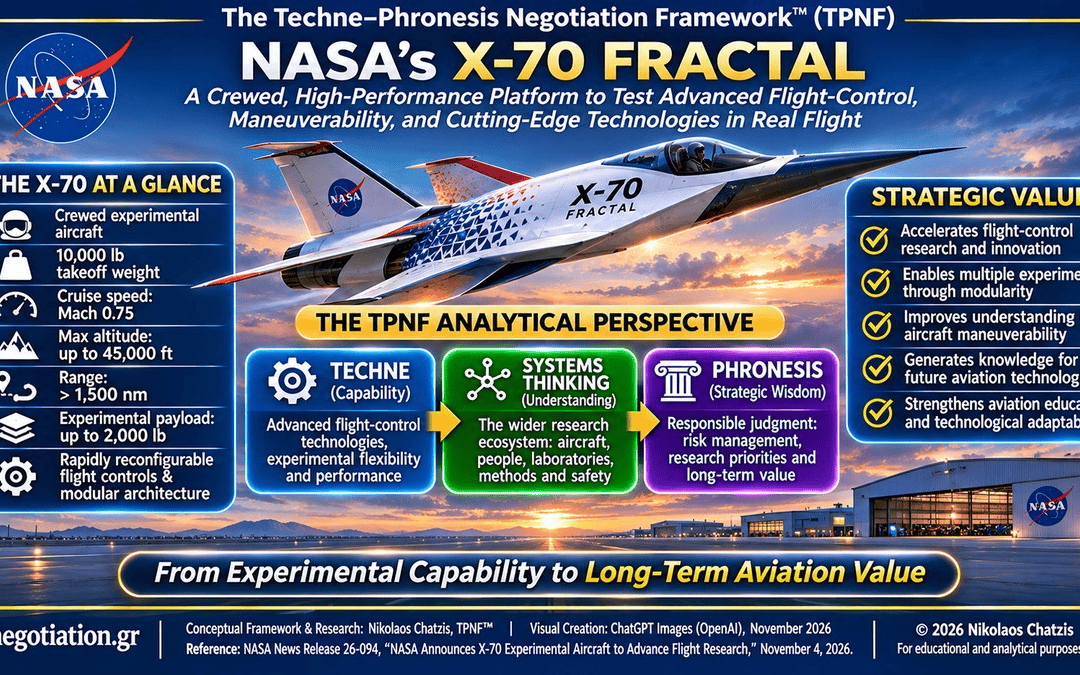
NASA’s X-70 Fractal represents more than another experimental aircraft. Its proposed combination of rapidly reconfigurable flight controls, modular research capabilities, and crewed flight testing offers an opportunity to accelerate technological learning.
Through the Techne–Phronesis Negotiation Framework™ (TPNF), the X-70 can be examined across three interconnected dimensions: Techne (Capability), Systems Thinking (Understanding), and Phronesis (Strategic Wisdom).
The central strategic question is whether experimental flexibility can generate reliable knowledge, strengthen aviation safety, and create sustainable technological value.
Purpose
This TPNF essay evaluates NASA’s newly announced X-70 Fractal through the TPNF analytical perspective.
It explores how modular experimental aircraft may influence flight-control research, technological adaptability, aviation education, and the long-term development of aerospace innovation ecosystems.
Abstract
On November 4, 2026, NASA announced the X-70 Fractal, a crewed experimental aircraft intended to investigate advanced flight-control technologies and aircraft maneuverability.
Its modular architecture is designed to accommodate changing experimental requirements and support repeated research missions.
The aircraft’s importance lies not only in its anticipated performance but also in its potential contribution to faster experimentation and technological understanding.
TPNF provides a complementary analytical framework for evaluating how experimental capabilities may translate into broader institutional, educational, and strategic benefits.
1. NASA’s X-70 Fractal: A New Experimental Platform
NASA unveiled the X-70 Fractal during the UP.Summit at Kennedy Space Center in Florida.
The aircraft is intended to support demanding research into advanced flight-control systems and maneuverability.
NASA has announced the following design characteristics:
| Characteristic | Announced capability |
|---|---|
| Aircraft configuration | Crewed experimental platform |
| Takeoff weight | 10,000 pounds |
| Cruise speed | Mach 0.75 |
| Maximum altitude | Up to 45,000 feet |
| Operational range | More than 1,500 nautical miles |
| Experimental payload | Up to 2,000 pounds |
| Research architecture | Rapidly reconfigurable flight controls and modular payloads |
NASA expects the aircraft to begin flying under its program within approximately two years.
These specifications describe intended capabilities rather than completed flight-test achievements.
2. The Strategic Importance of Reconfigurable Flight Controls
Conventional aircraft development often requires extensive modifications to evaluate new control technologies.
Changes can involve engineering redesign, ground testing, software integration, and certification-related assessments.
The X-70’s proposed reconfigurable architecture could reduce some barriers to experimentation.
Researchers may be able to evaluate different flight-control configurations without developing an entirely new aircraft for every investigation.
This possibility is strategically significant.
A reusable experimental platform can potentially support multiple research programs, encourage comparative testing, and shorten learning cycles.
However, the value of reconfiguration depends upon reliable engineering, effective safety procedures, and the quality of the resulting experimental evidence.
Flexibility alone does not guarantee innovation.
3. Techne: Expanding the Boundaries of Flight Capability
Within TPNF, Techne represents practical knowledge and technological capability.
The X-70 embodies this dimension through its planned flight-control architecture, experimental payload capacity, and high-performance flight envelope.
Advanced flight-control research may investigate how aircraft respond to different control strategies, changing aerodynamic conditions, or new system configurations.
Crewed experimentation introduces additional requirements involving pilot interaction, aircraft handling, and operational safety.
The objective is not simply to demonstrate unusual maneuvers.
It is to acquire reliable knowledge concerning aircraft behavior and control.
TPNF interpretation: Experimental capability becomes strategically valuable when technological performance can be measured, understood, and reproduced.
4. Systems Thinking: The Aircraft as a Research Ecosystem
An experimental aircraft is not an isolated technological product.
It operates within a research ecosystem involving engineers, test pilots, software developers, instrumentation specialists, safety personnel, laboratories, and institutional decision-makers.
Each experiment depends upon interactions among these components.
For example, a modified flight-control configuration may require corresponding changes to instrumentation, simulation models, pilot procedures, and risk assessments.
The success of a flight test therefore depends upon coordinated systems rather than aircraft performance alone.
The X-70’s modular approach could support stronger interaction among research disciplines.
Systems Thinking helps explain how these relationships influence the quality, efficiency, and safety of experimentation.
5. Phronesis: Responsible Judgment in Experimental Flight
Experimental aviation involves uncertainty.
New technologies may behave differently from expectations, especially when tested outside previously demonstrated operating conditions.
Phronesis emphasizes responsible judgment concerning acceptable risks, experimental objectives, and the consequences of technical decisions.
In the X-70 program, this perspective raises important questions.
Which experiments should receive priority?
How should research benefits be balanced against crew safety?
When is sufficient evidence available to expand an experimental flight envelope?
When should testing be delayed or discontinued?
These questions cannot be answered through engineering capability alone.
They require professional judgment supported by evidence, institutional accountability, and disciplined risk management.
6. The Strategic Value of Modular Experimentation
Modularity offers a potentially important advantage in technological research.
A platform capable of accommodating different payloads and experimental configurations may serve successive generations of research programs.
This could reduce duplication and improve the utilization of specialized infrastructure.
However, modularity also creates challenges.
Interfaces must remain compatible, experimental configurations must be controlled, and changes must be thoroughly evaluated.
Researchers must distinguish the benefits of rapid modification from the risks of insufficient validation.
Within TPNF, modularity is therefore best understood as an enabling capability.
Its strategic value emerges through effective integration, disciplined experimentation, and accumulated knowledge.
7. From Experimental Flight to Technological Adaptability
A central challenge in aerospace research is translating experimental results into useful technologies.
Successful demonstrations do not automatically produce operational systems.
New capabilities must undergo further development, validation, integration, and appropriate regulatory evaluation.
The X-70 could contribute by generating evidence about advanced control technologies under real flight conditions.
Such knowledge may inform future aircraft design, simulation, and research methodologies.
The broader objective is technological adaptability: the capacity of aerospace institutions to learn from experimentation and apply validated findings to new challenges.
TPNF considers this capacity essential for long-term value creation.
8. Human–Machine Interaction and Future Aviation
Advanced flight-control systems highlight the evolving relationship between pilots and aircraft automation.
Modern aviation increasingly depends upon software-mediated control, digital interfaces, and sophisticated decision-support technologies.
Experimental platforms can help researchers investigate how human operators interact with unfamiliar technological configurations.
However, NASA’s initial X-70 announcement does not establish that the aircraft will specifically test artificial intelligence or autonomous flight.
These remain possible areas of broader aviation research, not confirmed X-70 missions.
The relevant TPNF question is how future flight-control technologies can preserve effective human understanding, situational awareness, and responsible operational authority.
9. Aviation Education and the Research Pilot
The X-70 also offers an educational perspective.
Experimental flight requires professionals who combine technical proficiency with the ability to understand unfamiliar systems.
Research pilots must communicate effectively with engineers, evaluate aircraft behavior, and recognize unexpected conditions.
Engineers must appreciate the operational consequences of their designs.
These responsibilities illustrate why aviation education should extend beyond the operation of existing aircraft.
Within TPNF, experimental aviation provides a valuable example of the relationship between Techne, Systems Thinking, and Phronesis.
Future aviation professionals should learn not only how technologies function but also how new technologies are investigated, evaluated, and responsibly introduced.
10. The X-70 and NASA’s Experimental Aviation Legacy
NASA’s X-plane history demonstrates the importance of experimental aircraft in advancing aerospace knowledge.
The Bell X-1 established a historic milestone in supersonic flight.
The X-15 contributed substantially to high-speed and high-altitude flight research.
The X-59 investigates technologies intended to reduce the disruptive effects of supersonic flight over communities.
The X-70 enters this tradition with an emphasis on reconfigurable flight controls and flexible experimentation.
Its eventual contribution will depend upon research results rather than announced specifications.
The historical lesson is that experimental aircraft create lasting value when discoveries influence subsequent technological development.
11. The TPNF Long-Term Value Creation Pathway
The X-70 can be examined through a proposed seven-stage pathway:
Experimental Capability → Modular Research → Systems Integration → Flight-Test Evidence → Institutional Learning → Technological Adaptation → Long-Term Aerospace Value
The pathway emphasizes that technological development is a cumulative process.
An experimental aircraft provides capabilities.
Research programs organize these capabilities into investigations.
Flight testing generates evidence.
Institutions interpret and preserve that evidence.
Validated findings may eventually support future technological applications.
The pathway is a TPNF analytical proposal, not a NASA-defined development model.
Strategic Lessons for Aviation Leaders
- Treat experimental aircraft as research platforms rather than isolated technological achievements.
- Evaluate modularity through demonstrated improvements in research effectiveness.
- Preserve rigorous safety governance during rapid experimentation.
- Strengthen cooperation among pilots, engineers, and research institutions.
- Convert flight-test results into transferable technological knowledge.
- Assess long-term value through validated outcomes rather than announced capabilities.
NASA’s X-70 Fractal introduces an ambitious experimental aviation concept centered on reconfigurable flight controls and modular research.
Its potential importance extends beyond aircraft performance.
The platform may contribute to faster experimentation, stronger institutional learning, and new approaches to aerospace technological development.
Through TPNF, its significance can be evaluated by connecting technical capability, systems understanding, and responsible judgment.
Ultimately, the X-70’s strategic contribution will depend upon whether experimental flexibility produces reliable knowledge and lasting improvements in aviation technology.
Key Takeaways
The X-70 is a crewed experimental aircraft announced by NASA in November 2026.
Its proposed strengths include reconfigurable flight controls and modular payload capacity.
Its research results remain prospective.
TPNF connects experimental capability with systems integration, responsible risk management, and long-term technological value.
Author’s Reflection
Experimental aviation represents one of humanity’s most important methods of transforming technological imagination into practical knowledge.
Yet technological progress requires more than increasingly sophisticated aircraft.
It demands institutions capable of learning, professionals capable of adapting, and leaders capable of exercising responsible judgment.
The X-70 Fractal offers an opportunity to examine these relationships.
For TPNF, the most important question is not simply how far an experimental aircraft can extend the boundaries of flight.
It is how the knowledge acquired through experimentation can contribute to safer, more adaptable, and more capable aviation systems.
Nikolaos Chatzis
Primary Source and Research References
NASA — Official X-70 Announcement
November 4, 2026 · Release 26-094
Confirms the aircraft’s research objectives, intended specifications, modular architecture, and projected flight timeline. The accompanying NASA image is explicitly identified as computer-generated.
NASA
The Aviationist — November 5, 2026
Technical reporting on the announcement, the reconfigurable flight-control concept, and NASA’s experimental aircraft program.
The Aviationist
Source: Open Sources Analysis, Relative Data Analysis by Nikos Chatzis
© Nikolaos Chatzis. All Rights Reserved.
The Techne–Phronesis Negotiation Framework™
An Integrative Theory of Strategic Negotiation, Complex Adaptive Systems and Practical Wisdom
Technology Creates Capability • Systems Thinking Creates Understanding • Strategic Wisdom Creates Lasting Value.
Negotiation.gr | Strategic Wisdom for the Technological Age