Negotiation.gr | Strategic Wisdom for the Technological Age
“Strategic resilience emerges when technical capability (techne) is
continuously guided by practical wisdom (phronesis) through adaptive
negotiation across interconnected systems.”
TPNF Research Essay | Aviation Education and Strategic Adaptability | November 4, 2026
Central Idea (Thesis)
Aviation education must prepare professionals not only to operate existing technologies safely but also to understand technological evolution, navigate complex systems, and exercise responsible judgment under uncertainty.
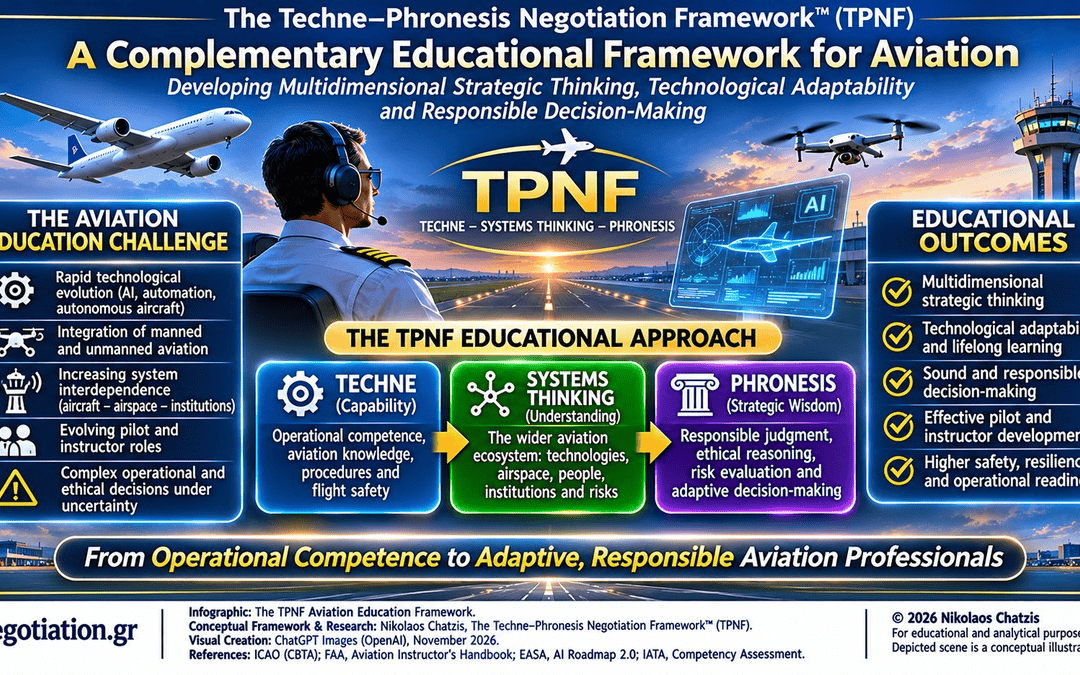
The Techne–Phronesis Negotiation Framework™ (TPNF) proposes a complementary educational approach integrating three interconnected dimensions: Techne (Capability), Systems Thinking (Understanding), and Phronesis (Strategic Wisdom).
Its purpose is not to replace established aviation training standards but to strengthen multidimensional thinking, technological adaptability, and long-term professional competence.
Purpose
This TPNF essay explores how TPNF could complement aviation education by connecting operational expertise with technological awareness, systems-level reasoning, and responsible decision-making.
It also proposes an educational model suitable for further academic examination, particularly within university aviation programs and professional instructor development.
Abstract
Aviation is entering an era characterized by artificial intelligence, advanced automation, autonomous aircraft, unmanned aviation systems, and increasingly interconnected airspace infrastructure.
These developments create educational challenges extending beyond conventional aircraft operation.
Existing competency-based approaches already recognize the importance of decision-making, risk management, communication, and situational awareness.
TPNF builds upon these foundations by proposing a structured relationship between technological capability, systems understanding, and strategic judgment.
The framework’s educational value remains a research proposition requiring systematic evaluation.
1. The Changing Educational Environment
Aviation has historically combined technological innovation with rigorous operational discipline.
Aircraft have evolved from relatively simple mechanical platforms into complex systems integrating digital avionics, automation, advanced navigation, and sophisticated communications.
Emerging technologies introduce additional possibilities.
Artificial intelligence may support operational analysis, while autonomous systems increasingly perform tasks previously requiring direct human control.
Unmanned aircraft are expanding into infrastructure inspection, emergency response, logistics, and environmental monitoring.
These developments create new demands upon pilots, instructors, operators, and aviation institutions.
Professional competence increasingly requires understanding how technological changes influence operational environments, institutional responsibilities, and safety.
The educational challenge is therefore broader than learning to operate individual platforms.
2. Why a Complementary Framework?
Established aviation education already incorporates sophisticated training methodologies.
ICAO promotes competency-based training and assessment, while aviation authorities emphasize aeronautical decision-making, threat and error management, and operational risk assessment.
These approaches provide essential foundations.
TPNF does not suggest that aviation education lacks decision-making or systems-related competencies.
Instead, it proposes an additional conceptual structure for connecting these capabilities with technological evolution and longer-term professional adaptability.
The distinction is important.
A complementary framework should enhance established practices without unnecessarily duplicating them.
Its contribution must ultimately be demonstrated through educational outcomes rather than theoretical claims alone.
3. Techne: The Foundation of Professional Capability
In classical Greek thought, Techne concerns practical knowledge, craftsmanship, and the capacity to accomplish defined tasks.
Within aviation, Techne encompasses aircraft operation, technical knowledge, procedural discipline, navigation, and emergency management.
It also includes understanding aircraft systems and their limitations.
These competencies remain indispensable regardless of technological progress.
A pilot operating an advanced aircraft must maintain the ability to recognize abnormal system behavior.
Similarly, a drone operator must understand aircraft performance, environmental limitations, and operational restrictions.
TPNF therefore treats technical competence as the foundation of aviation professionalism.
However, technical capability alone cannot explain every consequence of technological change.
A broader educational perspective is required.
4. Systems Thinking: Understanding Aviation Interdependence
Aviation operates through interconnected technological, institutional, and human systems.
Aircraft interact with air traffic management, airports, navigation infrastructure, maintenance organizations, regulators, and other airspace users.
Technological innovations may influence multiple components simultaneously.
For example, autonomous drone integration requires more than reliable aircraft automation.
It also involves communications, traffic coordination, cybersecurity, operational authorization, and institutional accountability.
Systems Thinking helps participants examine these interdependencies.
Rather than analyzing an aircraft or technology in isolation, they investigate how its introduction changes the wider aviation environment.
This perspective supports multidimensional reasoning by connecting technical, operational, regulatory, economic, and societal considerations.
5. Phronesis: Responsible Judgment Under Uncertainty
Phronesis, commonly associated with Aristotle’s concept of practical wisdom, concerns sound judgment in circumstances requiring deliberation.
Within TPNF, Phronesis represents the responsible evaluation of available capabilities, competing objectives, risks, and long-term consequences.
Aviation provides particularly demanding conditions for such judgment.
Operational decisions may involve incomplete information, time pressure, environmental uncertainty, and technological limitations.
A technically possible operation may nevertheless be inappropriate because its risks exceed acceptable limits.
Likewise, automation may offer operational advantages without eliminating the need for human oversight.
Phronesis encourages aviation professionals to evaluate not merely whether something can be accomplished, but whether it should be attempted under prevailing circumstances.
6. Multidimensional Strategic Thinking
Multidimensional strategic thinking involves examining problems through several interconnected perspectives.
In aviation education, these may include technical performance, operational safety, regulatory requirements, human factors, economic consequences, and technological evolution.
Consider the introduction of AI-assisted flight planning.
A narrow technical assessment might examine computational accuracy and efficiency.
A multidimensional assessment would additionally consider data reliability, cybersecurity, pilot oversight, organizational responsibilities, and unexpected system behavior.
TPNF encourages participants to connect these perspectives rather than treating them as separate subjects.
This approach does not replace specialized technical expertise.
Instead, it helps aviation professionals recognize when decisions require knowledge extending beyond their immediate specialization.
7. Technological Adaptability as an Educational Objective
Aviation qualifications establish important professional competencies at particular stages of technological development.
However, aviation careers may continue through multiple generations of aircraft and operational systems.
Technological adaptability therefore requires continuous learning.
Professionals must distinguish enduring aviation principles from procedures associated with specific technologies.
They must also recognize when existing knowledge requires updating.
For example, understanding traditional navigation remains valuable even as satellite-based systems become more sophisticated.
Similarly, knowledge of aircraft automation should evolve as increasingly intelligent systems enter operational environments.
TPNF proposes that adaptability should be cultivated deliberately through comparative technological analysis, realistic scenarios, and reflective learning.
8. Artificial Intelligence and Emerging Aviation Technologies
Artificial intelligence represents a significant challenge for aviation education.
Its potential applications include predictive maintenance, operational planning, decision support, and advanced automation.
However, AI systems introduce questions involving explainability, reliability, human oversight, and safety assurance.
EASA’s Artificial Intelligence Roadmap 2.0 adopts a human-centric perspective toward AI integration.
In June 2026, EASA published a proposed third issue of its AI Concept Paper for consultation, extending its exploration toward advanced automation.
These developments reinforce the importance of preparing aviation professionals to evaluate technological capabilities alongside operational limitations.
Within TPNF, AI becomes both a technical subject and an opportunity for systems-level and ethical reasoning.
9. The Aviation Instructor as an Educational Facilitator
Flight instructors transmit technical knowledge, professional standards, and operational judgment.
Their responsibilities extend beyond demonstrating procedures.
Effective instructors encourage participants to recognize risks, explain decisions, and evaluate alternatives.
The FAA’s Aviation Instructor’s Handbook already supports scenario-based training and aeronautical decision-making.
TPNF could complement such practices by introducing structured discussions about technological evolution and systems interdependence.
An instructor might ask participants how autonomous aircraft affect conventional airspace operations or how automation changes pilot responsibilities.
The objective is not to transform every instructor into a specialist in artificial intelligence.
It is to cultivate the capacity to recognize technological developments, identify relevant expertise, and encourage informed professional inquiry.
10. A Proposed TPNF Educational Architecture
The complementary model could operate through three integrated learning stages.
Stage One — Techne:
Participants establish operational competence and demonstrate understanding of relevant aircraft technologies, procedures, and safety requirements.
Stage Two — Systems Thinking:
Participants investigate interactions among aviation technologies, institutions, operational environments, and emerging developments.
Stage Three — Phronesis:
Participants evaluate realistic scenarios involving uncertainty, competing priorities, safety considerations, and technological limitations.
The stages should not be interpreted as rigidly sequential.
In practice, technical competence, systems understanding, and judgment reinforce one another continuously.
Educational exercises can therefore integrate all three dimensions.
11. From Conceptual Framework to Educational Research
TPNF‘s proposed educational contribution should be examined empirically.
Universities and training organizations could compare conventional instructional approaches with equivalent programs incorporating explicit TPNF-based reflection and systems analysis.
Both groups should receive the same required operational training.
Assessment could examine participants’ ability to identify system dependencies, evaluate unfamiliar technologies, justify risk-related decisions, and transfer knowledge between scenarios.
Instructor feedback and repeated assessments could help determine whether improvements persist.
Such research would distinguish conceptual plausibility from demonstrated educational effectiveness.
It would also identify situations where TPNF provides limited additional value.
12. Strategic Implications for Aviation Universities
University aviation programs are well positioned to connect technical education with interdisciplinary research.
Engineering, human factors, aviation management, cybersecurity, and operational training already contribute different perspectives.
TPNF could provide a shared conceptual vocabulary linking these disciplines.
For example, an interdisciplinary workshop might examine the integration of autonomous aircraft into complex civil airspace.
Participants could evaluate technological capabilities, institutional interactions, and responsible operational decisions.
This educational approach may be particularly relevant to universities preparing future pilots, instructors, aviation managers, and technology specialists.
Its implementation should remain compatible with accredited curricula and applicable regulatory requirements.
Strategic Lessons for Aviation Leaders
- Preserve operational competence as the foundation of aviation education.
- Integrate technological literacy with established safety principles.
- Encourage systems-level understanding across aviation disciplines.
- Develop judgment through realistic, evidence-based scenarios.
- Support instructors through continuous professional education.
- Evaluate educational innovations through measurable outcomes.
Aviation’s technological evolution creates educational challenges that cannot be addressed exclusively through familiarity with existing aircraft.
Future professionals will encounter increasingly interconnected systems, advanced automation, and changing operational responsibilities.
Established aviation education already provides essential foundations for technical competence and sound decision-making.
TPNF proposes a complementary approach connecting these foundations with technological adaptability and multidimensional strategic understanding.
Its potential contribution lies in organizing learning around capability, understanding, and wisdom.
The ultimate objective is not technological enthusiasm for its own sake.
It is the development of aviation professionals capable of adapting responsibly while preserving the primacy of safety.
Key Takeaways
TPNF connects Techne, Systems Thinking, and Phronesis within a proposed complementary educational structure.
Its emphasis is on multidimensional understanding, technological adaptability, and responsible decisions.
The framework should support—not replace—existing aviation standards.
Its educational effectiveness requires further research and validation.
Author’s Reflection
Aviation education should prepare individuals for more than the successful completion of examinations or the operation of a particular aircraft.
It should cultivate intellectual curiosity, technological understanding, and the capacity to exercise sound judgment as aviation evolves.
The central challenge is to connect enduring professional principles with technologies that may transform the aviation environment.
For TPNF, this means recognizing that technical capability becomes more valuable when accompanied by systems understanding and practical wisdom.
The proposed framework represents an invitation to educational dialogue and empirical investigation.
Its success should ultimately be judged by whether it helps aviation professionals think more comprehensively, adapt more effectively, and make safer, more responsible decisions.
Nikolaos Chatzis
Primary Research References
The essay’s discussion of established aviation education practices and emerging technologies draws on these official and professional sources:
-
ICAO — Competency-Based Training. Guidance for developing competency-based aviation instruction.
icao.int
-
FAA — Aviation Instructor’s Handbook. Risk management, scenario-based training, teaching methods, and instructor responsibilities.
Federal Aviation Administration+1
-
EASA — Artificial Intelligence Roadmap. Human-centered AI, safety assurance, and technological integration.
EASA+1
-
IATA — Competency Assessment and Evaluation for Pilots, Instructors and Evaluators. Guidance on assessing aviation professional competencies.
iata.org
-
EASA — Aircrew Rules, Instructor Competencies. Regulatory instructor competence and assessment requirements.
EASA
Source: Open Sources Analysis, Relative Data Analysis by Nikos Chatzis
© Nikolaos Chatzis. All Rights Reserved.
The Techne–Phronesis Negotiation Framework™
An Integrative Theory of Strategic Negotiation, Complex Adaptive Systems and Practical Wisdom
Technology Creates Capability • Systems Thinking Creates Understanding • Strategic Wisdom Creates Lasting Value.
Negotiation.gr | Strategic Wisdom for the Technological Age