Negotiation.gr | Strategic Wisdom for the Technological Age
“Strategic resilience emerges when technical capability (techne) is
continuously guided by practical wisdom (phronesis) through adaptive
negotiation across interconnected systems.”
Geopolitics, Defense Technology, Critical Minerals, and Strategic Wisdom | 2 November 2026
Central Idea (Thesis)
The competition between China and the United States over rare earth elements reveals a fundamental paradox of modern technological power: the ability to develop advanced military systems does not guarantee the industrial capacity to manufacture and sustain them independently.
China’s dominance in rare-earth processing provides geopolitical leverage, while American dependence creates vulnerabilities across its defense-industrial ecosystem.
Through the Techne–Phronesis Negotiation Framework™ (TPNF), this confrontation raises a deeper question: can strategic competition produce sustainable technological value, or will the weaponization of supply chains undermine the prosperity and security of both countries?
Purpose
This TPNF essay examines the technological importance of rare earths, China’s industrial dominance, American strategic vulnerabilities, and the implications for modern military production.
It applies Techne, Systems Thinking, and Phronesis to evaluate whether geopolitical competition can be transformed into resilient, sustainable value creation.
Abstract
Rare earth elements are essential inputs for numerous advanced technologies, including high-performance permanent magnets used in defense and civilian systems.
China dominates their processing and associated manufacturing chains, creating substantial dependencies for the United States and its allies.
Export restrictions have demonstrated how concentrated industrial capabilities can become instruments of geopolitical influence.
Yet restricting supplies can also accelerate diversification and weaken long-term commercial relationships.
TPNF suggests that future strategic advantage will depend not simply on controlling resources, but on developing resilient technological ecosystems capable of sustaining innovation, industrial production, and international cooperation.
1. Understanding the Rare Earth Problem
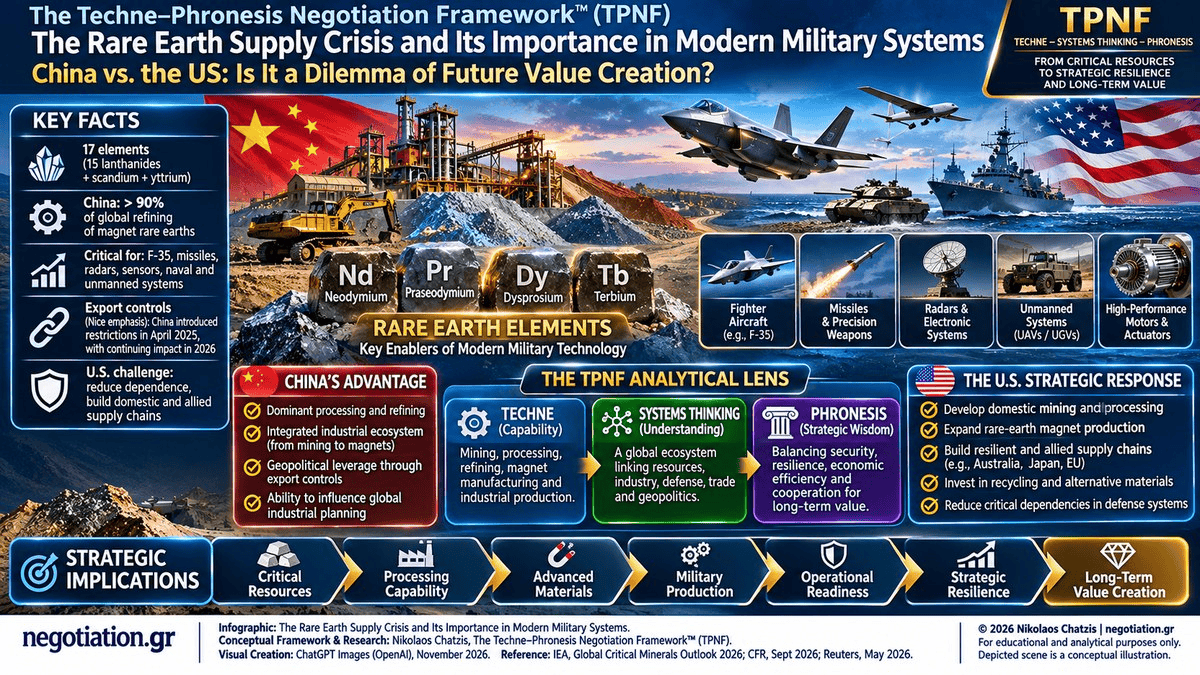
Rare earths comprise 17 chemical elements: the 15 lanthanides, together with scandium and yttrium.
Despite their name, many are not exceptionally scarce in the Earth’s crust.
Their strategic difficulty arises from economically viable extraction, chemical separation, environmental requirements, and the production of specialized industrial materials.
Neodymium and praseodymium are important for powerful permanent magnets.
Dysprosium and terbium can improve magnet performance at elevated temperatures.
These materials enable compact, efficient motors and other technologies requiring demanding performance characteristics.
The strategic challenge therefore extends beyond geological deposits.
A country may possess rare-earth resources without having the industrial infrastructure necessary to transform them into finished components.
Possession of raw materials is not equivalent to technological sovereignty.
2. Why Modern Military Systems Depend on Rare Earths
Modern military capabilities depend upon sophisticated industrial supply chains.
Rare-earth permanent magnets are used in applications such as aircraft systems, electric motors, actuators, sensors, and precision equipment.
Advanced fighter aircraft, guided weapons, naval platforms, and unmanned systems may incorporate components containing these materials.
The F-35 illustrates the complexity of the problem.
Its production depends upon extensive international supplier networks, specialized components, and strict manufacturing requirements.
Rare-earth inputs may represent only a small fraction of the aircraft’s total cost.
Nevertheless, an unavailable certified component can disrupt an entire production process.
This demonstrates an important strategic principle:
The military significance of a material is determined not by its weight or price, but by its indispensability within the production system.
Rare earths are not equally necessary for every military platform, and alternative technologies exist in some applications. However, substitution can involve performance penalties, redesign, qualification, and additional costs.
3. China’s Industrial Advantage
China’s position reflects decades of industrial policy, investment, technological learning, and manufacturing expansion.
Its advantage is particularly strong in separation, refining, and permanent magnet production.
According to the International Energy Agency’s 2026 assessment, China accounts for more than 90% of global refining of magnet rare earths.
This concentration gives Beijing influence over industries extending from electric vehicles and robotics to aerospace and defense.
China’s strategic strength is therefore not simply geological.
It is systemic.
Mining, chemical processing, specialized metallurgy, manufacturing expertise, and commercial networks reinforce one another.
This integrated ecosystem creates substantial barriers for competitors seeking to develop alternative supply chains.
From a TPNF perspective, China has converted industrial capabilities into geopolitical bargaining power.
4. The American Strategic Vulnerability
The United States possesses significant technological capabilities in aerospace, artificial intelligence, defense electronics, and advanced weapons development.
Nevertheless, sophisticated product design does not eliminate dependence upon foreign industrial inputs.
Rare-earth processing represents a particularly important vulnerability.
A disruption may affect component availability, procurement schedules, costs, and the expansion of defense production.
Washington has therefore pursued domestic mining, processing facilities, magnet manufacturing, recycling, and cooperation with allied countries.
However, creating an alternative industrial ecosystem requires considerable time.
New mines need permits and financing.
Processing facilities require specialized expertise.
Manufacturers need dependable customers, commercially viable prices, and qualified production processes.
The challenge cannot be resolved merely by discovering additional mineral deposits.
5. Export Controls and Geopolitical Leverage
China introduced restrictions affecting several rare-earth materials in April 2025, intensifying international concern about supply-chain security.
Subsequent diplomatic negotiations produced partial accommodations, but did not eliminate the underlying dependence.
By 2026, the continued existence of export licensing arrangements demonstrated the durability of Beijing’s strategic leverage.
Such controls can influence foreign industrial planning without requiring a complete export prohibition.
Uncertainty alone can encourage companies to accumulate inventories, seek alternative suppliers, and reconsider investment decisions.
Yet export restrictions also create risks for China.
Customers may accelerate diversification, governments may subsidize competing industries, and commercial trust may weaken.
Thus, supply-chain leverage involves a strategic trade-off between immediate bargaining power and long-term market influence.
6. Techne: Industrial Capability Beyond Technological Design
Within TPNF, Techne represents the knowledge and practical capabilities necessary to achieve objectives.
In rare-earth competition, Techne encompasses mining, separation chemistry, metallurgy, magnet manufacturing, engineering, and industrial production.
China’s advantage illustrates the strategic importance of mastering interconnected production stages.
America’s challenge illustrates the limitations of technological leadership without sufficient control over essential inputs.
A country may design an advanced weapon but encounter difficulties manufacturing it at scale.
Consequently, genuine technological capability must include both innovation and industrial execution.
TPNF principle: Technological superiority becomes sustainable only when the underlying production ecosystem can reliably reproduce it.
7. Systems Thinking: The Rare Earth Ecosystem
Rare-earth supply chains connect geology, energy, environmental policy, industrial finance, international trade, military procurement, and geopolitical relations.
A decision affecting one component can generate consequences throughout the system.
For example, export restrictions may strengthen China’s immediate negotiating position while stimulating competing industrial investments abroad.
American subsidies may improve supply security but create higher production costs.
Rapid diversification may also generate environmental and financial challenges.
Systems thinking therefore requires policymakers to evaluate second-order consequences rather than focusing exclusively on immediate advantages.
It also reveals the importance of allied cooperation.
Australia, Japan, European countries, and other partners possess different resources, industrial capabilities, and technological expertise.
Coordinating these strengths may prove more effective than pursuing complete national self-sufficiency.
8. Phronesis: Strategic Wisdom Under Conditions of Interdependence
Phronesis concerns the practical judgment required to balance competing objectives under uncertainty.
For China, the strategic question is whether export restrictions can preserve geopolitical leverage without encouraging the permanent loss of customers.
For the United States, the challenge is to improve supply security without imposing excessive economic costs or disrupting essential technological cooperation.
Neither country benefits automatically from maximizing confrontation.
Excessive dependence creates vulnerability.
Excessive separation may reduce efficiency, increase costs, and fragment technological ecosystems.
Strategic wisdom therefore requires distinguishing unacceptable security dependencies from manageable commercial interdependence.
The objective should not necessarily be complete economic separation.
It should be resilient access to essential capabilities, supported by diversified suppliers, credible safeguards, and selective cooperation.
9. Is Future Value Creation a Strategic Dilemma?
The rare-earth confrontation presents two competing pathways.
The first emphasizes control, restrictions, national industrial dominance, and geopolitical bargaining.
It may produce immediate strategic advantages but can accelerate fragmentation and retaliatory measures.
The second emphasizes diversification, industrial resilience, technological innovation, and negotiated economic stability.
It requires substantial investment and coordination but may create more sustainable value.
These pathways are not mutually exclusive.
States can protect sensitive defense supply chains while maintaining trade in less sensitive applications.
The real dilemma concerns how much economic efficiency should be sacrificed to achieve acceptable security.
TPNF suggests that the strongest strategy balances industrial independence in critical areas with cooperation wherever dependencies remain manageable.
10. The TPNF Strategic Value Pathway
The rare-earth crisis can be understood through the following sequence:
Critical Resources → Processing Capability → Advanced Materials → Industrial Manufacturing → Military Systems → Operational Readiness → Strategic Resilience → Long-Term Value Creation
Every stage contributes to the effectiveness of the next.
Weakness in processing can undermine manufacturing.
Weakness in manufacturing can undermine defense readiness.
Conversely, resilient supply chains can support innovation, employment, technological development, and strategic autonomy.
This pathway illustrates why national power increasingly depends upon the ability to sustain complex technological ecosystems.
Strategic Lessons for Leaders
The China–US rare-earth confrontation provides five lessons.
First, control over intermediate industrial processes can be more strategically important than ownership of natural resources.
Second, advanced military systems depend upon extensive civilian-industrial ecosystems.
Third, economic interdependence can generate both prosperity and strategic vulnerability.
Fourth, export restrictions can create leverage while accelerating competitors’ adaptation.
Fifth, sustainable value creation requires balancing national security, industrial competitiveness, environmental responsibility, and international cooperation.
The rare-earth crisis demonstrates that contemporary geopolitical power increasingly depends upon industrial ecosystems supporting advanced technologies.
China’s processing dominance provides strategic influence.
America’s technological leadership remains substantial, but its dependence upon concentrated supply chains creates vulnerabilities.
Through TPNF, the fundamental challenge is not simply determining which country controls rare earths.
It is identifying which strategic approach can transform technological capabilities into durable security, prosperity, and innovation.
Technology creates capability. Systems thinking reveals interdependence. Phronesis determines whether competition produces lasting value or destructive fragmentation.
Key Takeaways
- Rare earths are essential to selected advanced military and civilian technologies.
- China’s strongest advantage lies in processing and manufacturing.
- American defense supply chains remain exposed to concentrated suppliers.
- Export controls can create leverage but also encourage diversification.
- Strategic autonomy requires resilient industrial ecosystems.
- Long-term value creation depends upon balancing security and cooperation.
Author’s Reflection
The history of strategic competition demonstrates that power cannot be measured exclusively through weapons, territory, or financial resources.
Increasingly, it depends upon the capacity to transform scientific knowledge and industrial capabilities into sustainable technological systems.
The rare-earth confrontation illustrates this transformation.
China possesses extraordinary industrial leverage, while the United States retains significant strengths in technological innovation and military systems development.
Yet neither position guarantees lasting strategic superiority.
For TPNF, the essential lesson is that future value creation requires more than technological excellence or control over critical resources.
It requires the wisdom to manage interdependence, strengthen resilience, and recognize when cooperation serves long-term strategic interests better than confrontation.
Nikolaos Chatzis
Research Sources
International Energy Agency — Global Critical Minerals Outlook 2026
The most important quantitative source for China’s processing dominance, supply-chain concentration, and future diversification challenges.
Read IEA Global Critical Minerals Outlook 2026
IEA
Council on Foreign Relations — September 2026
Dismantling China’s Supply-Chain Weapon: A Transatlantic Strategy for Critical Minerals.
Examines Chinese industrial leverage, allied policy options, and the challenges of building commercially sustainable alternatives.
cfr.org
Reuters — 18 May 2026
White House Gets Small Rare Earth Win, but China’s Export Regime Is Here to Stay.
Documents the gap between diplomatic accommodations and continuing export restrictions affecting strategic industries.
Reuters
The Conference Board — July 2026
Critical Minerals: Impact of Export Regulations.
Provides additional context on defense-industrial exposure, international diversification, and export-control risks.
The Conference Board
Source: Open Sources Analysis, Relative Data Analysis by Nikos Chatzis
© Nikolaos Chatzis. All Rights Reserved.
The Techne–Phronesis Negotiation Framework™
An Integrative Theory of Strategic Negotiation, Complex Adaptive Systems and Practical Wisdom
Technology Creates Capability • Systems Thinking Creates Understanding • Strategic Wisdom Creates Lasting Value.
Negotiation.gr | Strategic Wisdom for the Technological Age