Negotiation.gr | Strategic Wisdom for the Technological Age
“Strategic resilience emerges when technical capability (techne) is
continuously guided by practical wisdom (phronesis) through adaptive
negotiation across interconnected systems.”
Artificial Intelligence, Semiconductor Ecosystems, and the Strategic Economics of Computational Power
Central Idea (Thesis)
Microchips have become foundational resources of the digital economy, enabling artificial intelligence, advanced manufacturing, autonomous systems, scientific research, and national security capabilities.
NVIDIA demonstrates that strategic technological value no longer depends exclusively on manufacturing physical products. It increasingly emerges from interconnected ecosystems combining chip architecture, specialized software, advanced manufacturing partners, computing infrastructure, and developer communities.
Within the Techne–Phronesis Negotiation Framework™ (TPNF), NVIDIA provides an important example of how technological capability, systemic integration, and strategic decision-making can transform semiconductor innovation into long-term economic and geopolitical influence.
Purpose of the Essay
This TPNF essay explains how NVIDIA operates, why its graphics processing units (GPUs) are important for artificial intelligence, and how its business model differs from conventional semiconductor manufacturing.
It also examines the geopolitical significance of advanced microchips, the limitations of comparing semiconductors with oil, and the strategic lessons that governments, industries, universities, and technology developers can draw from NVIDIA’s ecosystem.
The objective is to help students and emerging professionals understand the relationship between technological innovation, ecosystem development, and sustainable long-term value creation.
1. Why Are Microchips Called the “New Oil”?
During the twentieth century, petroleum became essential to industrial production, transportation, military power, and economic development.
In the twenty-first century, semiconductors perform an equally fundamental enabling function for digital technologies.
Modern microchips process information, control machines, support communications, and accelerate complex calculations.
Without them, contemporary computing infrastructure, advanced robotics, autonomous vehicles, and large-scale artificial intelligence would be impossible.
However, the comparison with oil has limitations.
Oil is a consumable natural resource. Microchips are engineered products whose value depends on scientific knowledge, manufacturing capabilities, specialized software, and continuous innovation.
Their strategic importance therefore arises not simply from scarcity but from the complexity of the ecosystems required to produce and operate them.
2. What Exactly Does NVIDIA Do?
Founded in 1993, NVIDIA initially became famous for graphics processing units designed to accelerate computer graphics and video games.
Its technological capabilities subsequently expanded into scientific computing, artificial intelligence, robotics, autonomous vehicles, and data-center infrastructure.
The company’s central innovation was recognizing that processors originally optimized for graphics could also perform enormous numbers of mathematical calculations simultaneously.
Unlike a conventional central processing unit (CPU), designed to handle diverse computational tasks efficiently, a GPU contains extensive parallel-processing resources.
This makes GPUs particularly effective for workloads involving repeated mathematical operations.
Artificial intelligence requires precisely this capability.
NVIDIA consequently evolved from a graphics-chip designer into a major provider of accelerated computing infrastructure.
3. How Does an NVIDIA GPU Work?
Consider an artificial intelligence system learning to recognize objects in photographs.
The system must process large quantities of numerical information, repeatedly adjusting mathematical parameters.
A CPU can perform these calculations, but a GPU can distribute suitable operations across many processing units simultaneously.
The process involves three essential elements:
Data: Images, text, scientific measurements, or other information are converted into numerical representations.
Computation: GPU processing units execute large numbers of parallel mathematical operations.
Results: The system produces predictions, classifications, simulations, or generated content.
NVIDIA GPUs also incorporate specialized Tensor Cores that accelerate mathematical operations commonly used in neural networks.
The Blackwell architecture, for example, integrates advanced processing capabilities designed for large-scale AI training and inference.
NVIDIA Blackwell Architecture
Training develops a model’s parameters. Inference uses an already-trained model to produce outputs.
Both activities require substantial computing resources, although their operational characteristics differ.
4. CUDA: Why Software Matters as Much as Hardware
One of NVIDIA’s most important strategic achievements is CUDA, its parallel-computing platform and programming ecosystem.
CUDA allows developers to write software that uses NVIDIA GPUs for computational tasks beyond graphics.
Its significance extends beyond programming convenience.
Universities, researchers, AI developers, and technology companies have built applications and specialized libraries around CUDA.
Consequently, NVIDIA’s competitive position depends not exclusively on chip performance but also on software compatibility, developer expertise, and accumulated technological knowledge.
In November 2026, NVIDIA announced CUDA Toolkit 13.5, expanding production-ready support for its Vera Rubin architecture.
NVIDIA Technical Blog
This illustrates a central TPNF principle:
A technological product becomes strategically more valuable when it supports a continuously developing ecosystem of complementary capabilities.
5. How NVIDIA Actually Makes Money
NVIDIA follows a predominantly fabless semiconductor business model.
It designs chips and computing platforms but relies on specialized manufacturing partners to fabricate and assemble much of its hardware.
Its supply chain includes companies such as Taiwan Semiconductor Manufacturing Company (TSMC), Samsung, SK Hynix, Micron, and advanced electronics manufacturers.
This arrangement allows NVIDIA to concentrate substantial resources on research, architecture, software, and platform development.
Its principal commercial activities include data-center computing, networking, gaming graphics, professional visualization, automotive technologies, and related software.
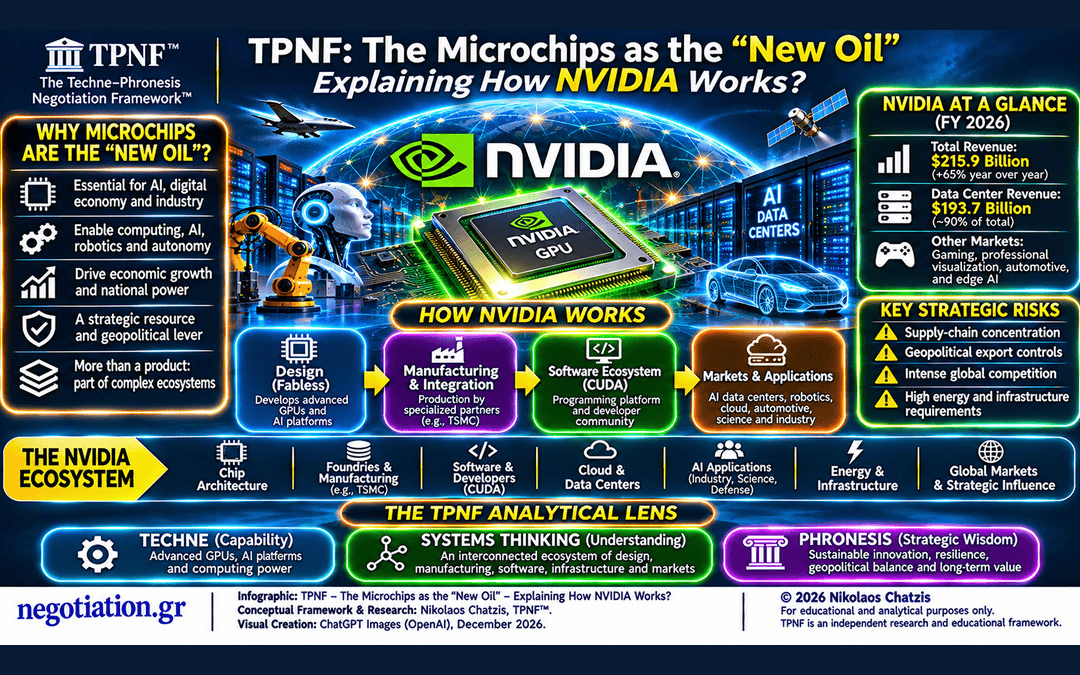
NVIDIA fiscal year 2026 · Year ended January 25, 2026
Total revenue
$215.9B
+65% year over year
Data Center revenue
$193.7B
Approximately 90% of total revenue
These figures demonstrate that NVIDIA’s commercial center of gravity has shifted decisively toward AI and data-center infrastructure.
6. The NVIDIA Technological Ecosystem
NVIDIA does not operate independently.
Its business depends on relationships among semiconductor foundries, memory manufacturers, advanced packaging providers, software developers, cloud operators, research institutions, and electricity suppliers.
The NVIDIA Value-Creation Ecosystem
Research and Chip Architecture
GPU design, AI algorithms, specialized software
Manufacturing and Integration
Foundries, memory, packaging, networking
AI Computing Platforms
GPUs, CUDA, data centers, integrated systems
Technological and Strategic Value
AI applications, scientific discovery, industrial productivity
TPNF conceptual interpretation of NVIDIA’s ecosystem.
The ecosystem also faces constraints: manufacturing concentration, electricity demand, capital expenditure, export restrictions, and competition from alternative computing architectures.
These dependencies reveal that even technologically powerful companies remain vulnerable to wider systemic conditions.
7. The Geopolitics of Semiconductor Power
Advanced semiconductors have become important instruments of geopolitical competition.
The United States seeks to maintain leadership in AI technologies and advanced chip design.
China invests heavily in domestic semiconductor capabilities to reduce dependence on foreign suppliers.
Taiwan occupies a particularly important position because of its advanced semiconductor manufacturing industry.
Export controls, industrial subsidies, technological restrictions, and supply-chain diversification consequently influence international strategic relationships.
For governments, access to advanced computing capabilities affects scientific competitiveness, industrial innovation, intelligence analysis, and national security.
Yet technological sovereignty cannot be achieved simply by purchasing chips.
It requires infrastructure, skilled personnel, energy resources, software capabilities, and resilient institutional partnerships.
8. NVIDIA Through the TPNF Analytical Lens
Techne — Capability
NVIDIA demonstrates how specialized technological knowledge can generate competitive advantages through GPU architectures, software platforms, and integrated computing systems.
Systems Thinking — Understanding
Its success depends on coordinating an extensive network of manufacturing partners, developers, cloud providers, customers, and infrastructure operators.
Phronesis — Strategic Wisdom
Long-term success requires balancing innovation with supply-chain resilience, geopolitical uncertainty, competition, energy efficiency, and responsible AI development.
The TPNF perspective therefore distinguishes technological leadership from sustainable strategic leadership.
The first concerns what a company can create.
The second concerns whether its capabilities can continue generating value under changing economic, technological, and geopolitical conditions.
9. Strategic Lessons for Leaders
-
Develop ecosystems, not isolated products. Complementary technologies can multiply the value of individual innovations.
-
Recognize software as strategic infrastructure. Developer communities and programming tools influence technological adoption.
-
Understand supply-chain dependencies. Advanced design capabilities do not eliminate manufacturing vulnerabilities.
-
Invest in human capital. Universities, engineers, and researchers sustain technological competitiveness.
-
Integrate energy and infrastructure planning. Computing growth requires reliable physical resources.
-
Preserve strategic flexibility. Technological leadership must adapt to competition and geopolitical change.
10. Conclusion: Beyond the New Oil
Microchips may be the new oil of the digital economy, but NVIDIA illustrates why the comparison is incomplete.
The strategic resource is not merely the semiconductor.
It is the combination of computational capability, software, manufacturing expertise, institutional cooperation, and continuous innovation.
NVIDIA’s development demonstrates how technological ecosystems can transform specialized engineering knowledge into economic influence and strategic power.
Within TPNF, the essential lesson is clear:
The future belongs not simply to those who possess advanced microchips, but to those who understand how to transform computational power into sustainable technological and human value.
Author’s Reflection
The evolution of NVIDIA raises a fundamental question about technological progress.
Are nations and companies competing primarily to possess more powerful technologies, or to develop the knowledge and institutions necessary to employ them effectively?
For TPNF, the answer lies in integrating Techne, Systems Thinking, and Phronesis.
Technological capability creates opportunities. Systemic understanding reveals their wider implications. Strategic wisdom determines whether those opportunities generate lasting value.
Nikolaos Chatzis
Selected Research Sources
Source: Open Sources Analysis, Relative Data Analysis by Nikos Chatzis
© Nikolaos Chatzis. All Rights Reserved.
The Techne–Phronesis Negotiation Framework™
An Integrative Theory of Strategic Negotiation, Complex Adaptive Systems and Practical Wisdom
Technology Creates Capability • Systems Thinking Creates Understanding • Strategic Wisdom Creates Lasting Value.
Negotiation.gr | Strategic Wisdom for the Technological Age