Negotiation.gr | Strategic Wisdom for the Technological Age
“Strategic resilience emerges when technical capability (techne) is
continuously guided by practical wisdom (phronesis) through adaptive
negotiation across interconnected systems.”
Central Idea (Thesis)
The November 19, 2026, trilateral summit between the United States, China, and Russia provides a compelling setting for applying Game Theory to contemporary international relations.
Although the summit produced limited substantive commitments, its diplomatic architecture reveals an important strategic reality: the ability to participate in negotiations may itself constitute a form of geopolitical power.
Within the Techne–Phronesis Negotiation Framework™ (TPNF), the European Union’s absence raises a fundamental question:
Can an economic superpower influence the international strategic environment when other powers determine the negotiating table, the agenda, and the rules of engagement?
1. Introduction: Three Powers at One Table
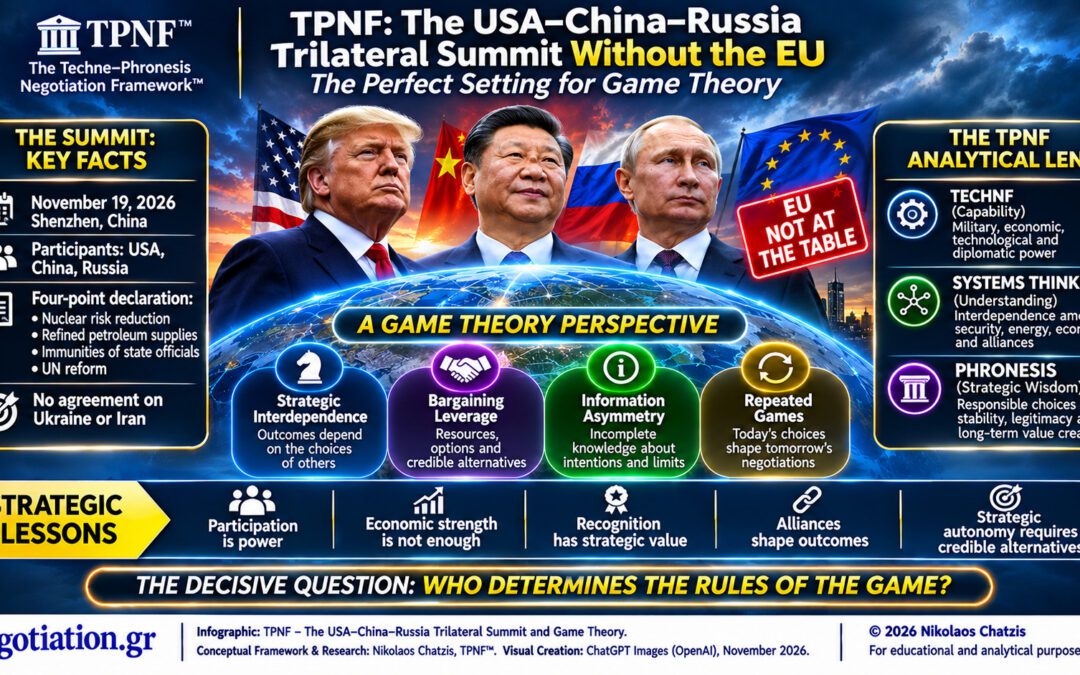
On November 19, 2026, Presidents Donald Trump, Xi Jinping, and Vladimir Putin met in Shenzhen, China, during the Asia-Pacific Economic Cooperation summit.
Their meeting generated considerable international attention because of the military, economic, nuclear, and technological influence exercised by the three countries.
The resulting declaration addressed four areas: increasing refined petroleum supplies, respecting the immunities of state officials in relation to international judicial institutions, reducing nuclear risks, and reforming the United Nations.
However, no concrete nuclear arms-control agreement emerged, and the declaration did not address the wars in Ukraine or Iran.
The summit therefore illustrates an important distinction between diplomatic visibility and negotiated outcomes.
It also raises a question of strategic representation: why was the European Union, a major economic and regulatory actor, absent from a gathering discussing matters with profound implications for European security?
2. Game Theory: Understanding Strategic Interdependence
Game Theory examines situations in which the outcomes available to one actor depend partly on decisions made by others.
International negotiations are particularly suitable for this analytical approach because states must consider not only their own preferences but also the incentives, capabilities, and likely responses of other governments.
Three concepts are especially relevant.
Strategic interdependence: No major power can pursue its objectives without considering the behavior of competitors and partners.
Bargaining leverage: Negotiating outcomes depend on credible alternatives, available resources, and the capacity to impose or absorb costs.
Information asymmetry: Participants rarely possess complete knowledge of their counterparts’ intentions, commitments, or acceptable concessions.
The Shenzhen summit demonstrates these dynamics because Washington, Beijing, and Moscow approached the negotiations with overlapping interests but fundamentally different strategic objectives.
3. The United States: Balancing Competition and Cooperation
The United States faces a complex strategic problem.
China represents a major economic and technological competitor, while Russia remains a nuclear power whose military actions directly affect European security.
Washington may benefit from engaging both simultaneously, particularly on nuclear risks and international stability.
However, closer engagement with Moscow could generate concerns among European allies, while excessive accommodation of Beijing could weaken American bargaining leverage in other strategic domains.
The American negotiating problem can therefore be expressed as:
How can Washington reduce the costs of confrontation without weakening its alliances or strengthening competing powers?
This is a repeated game, not a single diplomatic encounter.
Every concession, commitment, and public statement may influence future negotiations involving trade, technology, military security, and alliance cooperation.
4. China: The Strategic Advantages of Hosting
China’s position as summit host created an additional source of diplomatic influence.
Beijing could present itself as an indispensable participant in discussions concerning international stability.
China also benefits from maintaining economic relations with Western markets while preserving strategic cooperation with Russia.
However, its interests are not identical to Moscow’s.
Excessive alignment with Russia could increase economic and diplomatic tensions with Europe, while concessions to Washington might weaken Beijing’s wider bargaining position.
China’s strategic problem is therefore to maximize diplomatic influence while limiting the costs of great-power confrontation.
Hosting the summit offered reputational and agenda-setting advantages even without a major agreement.
5. Russia: Diplomatic Recognition as a Strategic Payoff
Russia entered the meeting under different conditions.
Its continuing war against Ukraine, international sanctions, and confrontation with European governments have constrained its diplomatic relationships.
Participation alongside the American and Chinese presidents offered Moscow an opportunity to project international relevance.
Atlantic Council analysts identified diplomatic legitimization and the possibility of influencing negotiations concerning Ukraine as important Russian objectives.
From a game-theoretical perspective, diplomatic recognition can constitute a payoff independently of formal concessions.
Russia could therefore benefit from the summit’s symbolism even if negotiations produced no major substantive agreement.
This demonstrates why the participants’ definitions of success may differ considerably.
6. The European Union: The Strategic Cost of Exclusion
The EU’s absence represents perhaps the most revealing dimension of the summit.
Europe possesses substantial economic, technological, regulatory, and diplomatic capabilities. Nevertheless, its fragmented defense structures and differences among member states can constrain its ability to act as a unified geopolitical player.
The exclusion is especially consequential because European interests are directly affected by the war in Ukraine, nuclear security, energy markets, and relations with China.
ECB Governing Council member Fabio Panetta publicly criticized the summit’s exclusion of the EU, highlighting concerns about major powers discussing the international order without European participation.
However, absence from one summit does not establish that Europe has lost all geopolitical influence.
The more important issue is whether Europe possesses credible alternatives when excluded from major negotiations.
In Game Theory, an actor with limited alternatives may have weaker bargaining leverage, even when its economic resources are considerable.
7. The Summit as a Four-Player Strategic Game
Although only three powers participated, the EU can be incorporated into the analytical model as an affected fourth actor.
The following matrix represents possible strategic preferences rather than empirically established government positions.
| Actor | Potential strategic payoff | Principal risk |
|---|---|---|
| United States | Reduced nuclear risks and diplomatic leverage | Alliance distrust |
| China | International recognition and agenda influence | Greater confrontation with Western partners |
| Russia | Diplomatic legitimacy and strategic influence | Limited substantive concessions |
| European Union | Stronger strategic autonomy and representation | Exclusion from agenda-setting |
The summit can be interpreted through several game-theoretical models.
Non-zero-sum bargaining: Cooperation on nuclear risks may benefit all three participating powers without requiring one to lose.
Prisoner’s Dilemma: Mutual suspicion may discourage cooperation even when all participants could benefit from greater stability.
Repeated games: Today’s diplomatic behavior affects tomorrow’s credibility, alliances, and negotiating opportunities.
Coalition formation: Temporary cooperation between two powers may alter the bargaining position of the third.
No single model fully explains the summit. The value of Game Theory lies in revealing competing incentives and possible strategic outcomes.
8. The TPNF Analytical Lens
The Techne–Phronesis Negotiation Framework™ provides a complementary approach by connecting capabilities, systemic understanding, and strategic judgment.
Techne — Capability
Military power, technological innovation, industrial capacity, economic resources, and diplomatic institutions determine what each actor can credibly offer or threaten.
Systems Thinking — Understanding
Leaders must recognize how nuclear deterrence, economic interdependence, alliances, supply chains, and regional conflicts influence one another.
Phronesis — Strategic Wisdom
Responsible leadership requires evaluating not merely immediate bargaining gains but also long-term stability, legitimacy, institutional trust, and the consequences for excluded stakeholders.
Game Theory helps explain how rational actors may behave under strategic interdependence.
TPNF extends the analysis toward a normative question: Which strategic choices create sustainable value rather than merely redistribute power?
9. A New Yalta or a Different International Order?
Comparisons with the 1945 Yalta Conference emerged before the Shenzhen summit.
Yet the historical analogy requires caution.
Yalta involved wartime negotiations concerning the postwar European settlement. Shenzhen produced a limited declaration without an equivalent agreement reorganizing territorial or political arrangements.
The resemblance lies primarily in the symbolism of major powers discussing international affairs without the direct participation of all affected parties.
A modern international order, however, is considerably more complex.
International institutions, global markets, technological ecosystems, and regional alliances create constraints that did not operate in the same manner in 1945.
The summit may therefore represent an attempt at selective great-power coordination rather than the establishment of a new geopolitical settlement.
10. Strategic Lessons for Leaders
-
Participation is strategic power. Influencing the negotiating agenda may matter as much as influencing the final agreement.
-
Economic strength does not automatically create geopolitical leverage. Capabilities must be coordinated and politically usable.
-
Symbolic recognition has strategic value. Diplomatic visibility can benefit participants without substantive concessions.
-
Alliances influence bargaining outcomes. Major powers must consider how bilateral or trilateral negotiations affect their partners.
-
Negotiations are repeated games. Short-term advantages can create long-term credibility costs.
-
Strategic autonomy requires credible alternatives. Actors must develop capabilities that reduce dependence on decisions made elsewhere.
-
Wise negotiation considers excluded stakeholders. Sustainable agreements require legitimacy and implementation capacity.
11. Conclusion: Who Determines the Rules of the Game?
The Shenzhen summit illustrates the continuing importance of great-power diplomacy in an increasingly interconnected international system.
Its immediate achievements were limited. Nevertheless, its strategic significance extends beyond the declaration.
The meeting demonstrated how agenda-setting, diplomatic recognition, bargaining leverage, and strategic exclusion interact.
For the European Union, the central lesson is not simply that it was absent.
It is that economic influence must be supported by political coordination, credible strategic capabilities, and the capacity to participate in decisions affecting European security.
The decisive question is not only who wins the geopolitical game, but who possesses the power to determine its rules.
Key Takeaways
The trilateral summit provides a valuable case for examining strategic interdependence, coalition formation, bargaining asymmetries, and diplomatic signaling.
The EU’s absence exposes potential weaknesses in European strategic coordination without proving that Europe lacks influence.
Game Theory explains the incentives of participating powers, while TPNF emphasizes the additional requirements of systemic understanding, responsible judgment, and long-term value creation.
Author’s Reflection
The history of international relations demonstrates that powerful states frequently seek to shape the international environment through selective negotiations.
Yet sustainable international order cannot depend exclusively on the immediate preferences of the strongest actors.
The challenge for Europe is to transform its considerable economic and technological resources into coherent strategic influence.
For TPNF, the summit illustrates an enduring principle: possessing capabilities is not equivalent to understanding how to employ them wisely.
Strategic wisdom requires recognizing that the legitimacy and durability of international arrangements depend on more than the bargaining power of those seated at the table.
Nikolaos Chatzis
Selected Research Sources
Source: Open Sources Analysis, Relative Data Analysis by Nikos Chatzis
© Nikolaos Chatzis. All Rights Reserved.
The Techne–Phronesis Negotiation Framework™
An Integrative Theory of Strategic Negotiation, Complex Adaptive Systems and Practical Wisdom
Technology Creates Capability • Systems Thinking Creates Understanding • Strategic Wisdom Creates Lasting Value.
Negotiation.gr | Strategic Wisdom for the Technological Age