Negotiation.gr | Strategic Wisdom for the Technological Age
“Strategic resilience emerges when technical capability (techne) is
continuously guided by practical wisdom (phronesis) through adaptive
negotiation across interconnected systems.”
TPNF Research Essay | Aviation Education, Technological Evolution, and Strategic Wisdom | 4 November 2026
Central Idea (Thesis)
Aviation education must evolve from teaching the safe operation of existing aircraft toward developing professionals who can understand, evaluate, and adapt to continuous technological change without compromising aviation safety.
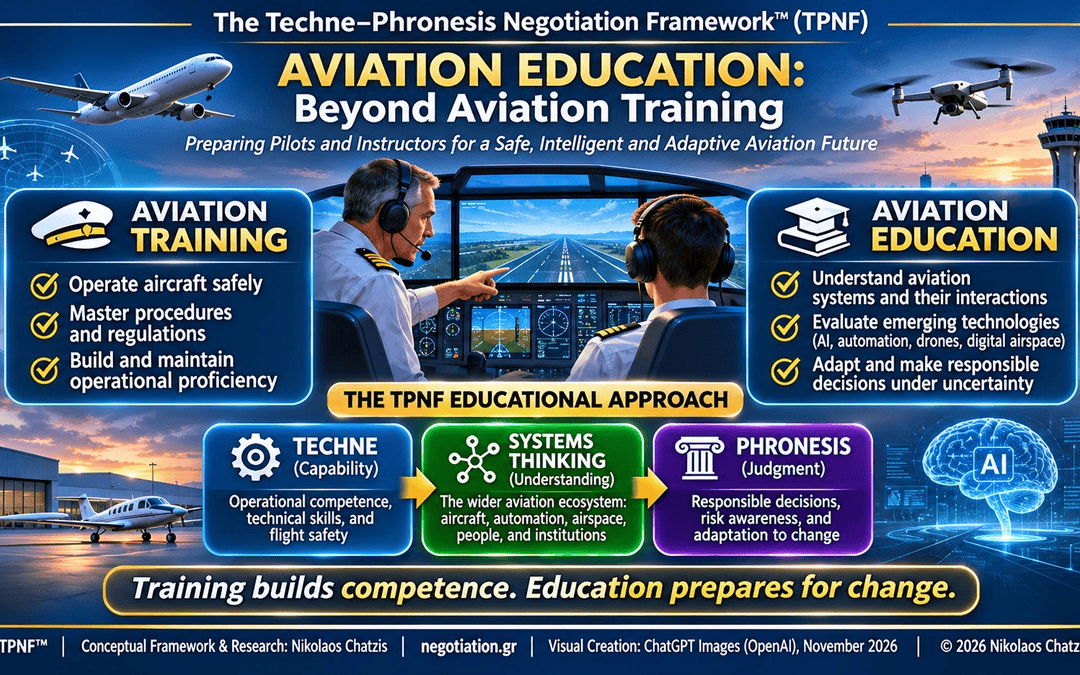
The Techne–Phronesis Negotiation Framework™ (TPNF) proposes that effective aviation education should integrate three complementary dimensions: Techne (operational capability), Systems Thinking (understanding technological and institutional interdependence), and Phronesis (responsible judgment).
The objective is not to replace established pilot training, but to strengthen its capacity to prepare aviation professionals for an uncertain technological future.
Purpose
This TPNF essay examines how aviation education can prepare pilots and instructors for developments in artificial intelligence, autonomous flight, unmanned aircraft, digital airspace management, and human–machine interaction.
It proposes a complementary educational approach connecting technical competence with technological understanding and strategic adaptability.
Abstract
Aviation is undergoing significant technological transformation.
Advanced automation, artificial intelligence, autonomous drones, and increasingly interconnected airspace systems are changing operational requirements.
Traditional flight training remains indispensable, particularly in aircraft handling, procedures, meteorology, navigation, and safety.
However, future aviation professionals must also understand technological limitations, system interactions, and emerging operational risks.
International developments in competency-based training provide an important foundation.
TPNF offers an additional educational perspective focused on technological evolution, systems understanding, and practical wisdom.
1. The Historical Foundations of Aviation Education
Aviation training developed around a fundamental objective: preparing pilots to operate aircraft safely.
Students learn aerodynamics, aircraft systems, meteorology, navigation, regulations, and emergency procedures.
Practical training transforms theoretical knowledge into operational competence.
Flight instructors play a decisive role by demonstrating procedures, evaluating performance, and developing aeronautical decision-making.
These foundations remain essential.
However, aviation technology has evolved considerably.
Modern aircraft increasingly incorporate digital avionics, automated flight controls, integrated navigation, and sophisticated decision-support systems.
Consequently, the educational challenge extends beyond mastering individual aircraft.
Pilots must understand how increasingly complex technologies influence operational decisions.
2. From Aircraft Operation to Technological Understanding
Operating an aircraft safely requires knowing how its systems function and recognizing their limitations.
Yet technological understanding involves an additional dimension.
Pilots should appreciate how technologies evolve, why new systems are introduced, and how innovations affect the broader aviation environment.
For example, satellite navigation improves operational efficiency but introduces dependence upon external signals.
Automation reduces certain workloads while potentially creating new monitoring challenges.
Artificial intelligence may support decision-making but introduces questions concerning reliability, transparency, and human oversight.
Understanding these developments helps aviation professionals distinguish technological advantages from emerging vulnerabilities.
TPNF principle: Operational competence explains how to use technology; technological understanding explains its capabilities, limitations, and wider consequences.
3. Techne: Preserving Operational Excellence
Within TPNF, Techne represents practical knowledge, technical capability, and professional competence.
For aviation education, this includes aircraft handling, systems management, navigation, communication, and emergency response.
Technological progress does not diminish these requirements.
Instead, it changes how certain competencies are exercised.
A pilot supervising automated flight must understand the aircraft’s behavior sufficiently to recognize unexpected performance.
Likewise, drone operators must understand navigation limitations, battery performance, meteorological risks, and emergency procedures.
The FAA’s risk-management guidance emphasizes the importance of balancing automation with manual proficiency.
Technology should support professional competence rather than substitute for it.
Therefore, future aviation education must preserve operational fundamentals while expanding technological literacy.
4. Systems Thinking: Aviation as an Interconnected Ecosystem
Modern aviation cannot be understood exclusively through the relationship between pilot and aircraft.
Every flight operates within a complex ecosystem.
This includes air traffic management, airports, communication networks, regulatory authorities, maintenance organizations, manufacturers, and environmental conditions.
Unmanned aviation adds digital traffic-management services, remote operators, and increasingly automated systems.
A technological change affecting one component may influence the performance of others.
For example, integrating autonomous drones into controlled airspace requires more than reliable onboard flight software.
It also demands airspace coordination, communications, appropriate procedures, and institutional accountability.
Systems Thinking enables aviation professionals to understand these relationships.
TPNF principle: Safe technological adaptation requires understanding how innovations affect the entire aviation ecosystem.
5. Phronesis: Strategic Wisdom and Human Judgment
Phronesis concerns practical wisdom: the ability to make responsible decisions under uncertainty.
In aviation, this means evaluating operational risks, recognizing technological limitations, and exercising appropriate judgment.
An automated system may perform reliably under normal conditions but behave unexpectedly during failures.
A technically feasible operation may nevertheless be unsafe because of weather, airspace restrictions, or inadequate preparation.
Phronesis therefore involves knowing when to use technology, when to question it, and when to discontinue an operation.
It also requires intellectual humility.
Neither advanced automation nor professional experience guarantees freedom from error.
The objective is to develop aviation professionals capable of combining technological knowledge with disciplined decision-making.
6. Artificial Intelligence and Human–Machine Cooperation
Artificial intelligence introduces new possibilities for aviation.
Potential applications include flight planning, predictive maintenance, traffic management, and decision support.
However, AI systems require appropriate validation, oversight, and operational limitations.
In June 2026, EASA released a proposed update to its Concept Paper on Artificial Intelligence, addressing human assistance, human–AI cooperation, and advanced automation.
These developments demonstrate the growing importance of human-centered technological governance.
Aviation education should therefore explain not only AI applications but also their limitations.
Pilots and instructors need to understand automation bias, inappropriate trust, unexpected system behavior, and the importance of independent verification.
The educational objective is responsible human–machine cooperation.
7. The Evolution of Competency-Based Aviation Training
International aviation education has increasingly emphasized Competency-Based Training and Assessment (CBTA).
ICAO and IATA guidance supports evaluating observable professional competencies rather than relying exclusively upon training hours or procedural repetition.
Competencies include communication, situational awareness, workload management, problem-solving, and flight-path management.
These approaches already provide important foundations for adaptive aviation education.
TPNF should therefore be understood as complementary rather than as a replacement.
Its potential contribution is to connect established operational competencies with broader technological and strategic understanding.
For example, a training scenario involving automation failure could examine immediate aircraft control, system dependencies, and the judgment required to select an appropriate response.
8. The Aviation Instructor as a Facilitator of Technological Adaptation
The instructor’s future role extends beyond demonstrating existing procedures.
Instructors must help participants understand technological change and evaluate unfamiliar operational situations.
This requires continuous professional development.
An instructor familiar with conventional aircraft may need additional knowledge concerning autonomous systems, digital airspace services, and AI-assisted operations.
Similarly, drone instructors should understand the wider aviation environment rather than treating unmanned aircraft as isolated technological platforms.
Effective teaching should encourage questioning, scenario analysis, and evidence-based reasoning.
The instructor becomes a facilitator of professional adaptability while maintaining responsibility for established safety standards.
9. A Complementary TPNF Educational Model
TPNF proposes three interconnected learning dimensions.
Techne — Operational Capability: Participants demonstrate aircraft knowledge, technical proficiency, procedural compliance, and safe operation.
Systems Thinking — Technological Understanding: Participants examine interactions among aircraft systems, airspace, institutions, automation, and emerging technologies.
Phronesis — Responsible Judgment: Participants evaluate uncertainty, operational consequences, technological limitations, and appropriate decisions.
These dimensions can be integrated into existing aviation courses without creating a separate licensing framework.
Scenario-based exercises could examine automation failures, drone integration, cybersecurity disruptions, or changing operational requirements.
The purpose is to develop transferable reasoning capabilities alongside practical competence.
10. The Strategic Value of Lifelong Aviation Education
Aviation careers may extend across decades, while technological systems evolve continuously.
Consequently, initial qualification cannot provide all the knowledge required throughout professional life.
Recurrent training, instructor development, simulation, and technological familiarization become increasingly important.
Educational institutions should establish mechanisms for updating curricula in response to operational evidence and technological developments.
However, adaptation should remain disciplined.
Not every innovation deserves immediate adoption.
New technologies must demonstrate operational relevance, acceptable safety performance, and educational value.
Lifelong learning therefore requires both openness to innovation and critical evaluation.
11. The TPNF Aviation Education Value Pathway
The proposed educational progression is:
Foundational Knowledge → Operational Competence → Technological Literacy → Systems Understanding → Scenario-Based Judgment → Professional Adaptability → Sustainable Aviation Safety
Each stage strengthens the next.
Foundational knowledge supports practical skills.
Technological literacy explains emerging capabilities.
Systems understanding reveals interdependencies.
Scenario-based judgment develops responsible decisions.
Professional adaptability enables continued competence as aviation evolves.
This pathway represents a conceptual TPNF educational proposal, not an established regulatory training standard.
Strategic Lessons for Aviation Leaders
Aviation education should preserve established flight-training fundamentals while incorporating emerging technological developments.
Training institutions should strengthen automation literacy, systems understanding, and risk-based decision-making.
Instructor development should receive particular attention because instructors influence successive generations of aviation professionals.
Regulators, universities, and training organizations can cooperate in developing evidence-based curricula.
Finally, educational innovation should be evaluated through measurable improvements in competence, adaptability, and safety.
The future of aviation education cannot be defined exclusively by the aircraft currently operating in our skies.
Artificial intelligence, autonomous systems, digital airspace infrastructure, and advanced automation will continue transforming aviation.
Yet technological progress does not eliminate the need for human expertise.
It increases the importance of understanding complex systems and exercising responsible judgment.
TPNF offers a complementary educational perspective connecting operational competence with technological evolution and strategic wisdom.
Aviation education should prepare professionals not only to operate today’s aircraft safely, but also to understand tomorrow’s technologies and adapt responsibly to their consequences.
Key Takeaways
- Traditional aviation competencies remain indispensable.
- Technological literacy should complement operational training.
- Systems Thinking helps explain increasingly interconnected aviation environments.
- Phronesis strengthens judgment under technological uncertainty.
- Instructor education must evolve alongside automation and autonomous systems.
- TPNF offers a complementary framework for lifelong professional adaptability.
Author’s Reflection
Aviation has always represented a remarkable relationship between human knowledge, technological achievement, and responsible judgment.
Every generation of pilots has encountered technologies that transformed the profession.
The challenge facing aviation education today is therefore not entirely new, but its complexity is increasing.
We must preserve the accumulated wisdom of traditional flight training while preparing professionals to understand technological developments that may fundamentally change aviation operations.
For TPNF, the educational objective is clear: develop aviation professionals who are technically competent, intellectually adaptable, and capable of exercising sound judgment throughout their careers.
The ultimate achievement of aviation education is not merely producing individuals who can operate an aircraft.
It is preparing professionals who can continue learning, understanding, and contributing safely as aviation evolves.
Nikolaos Chatzis
Primary Research References
-
ICAO — Competency-Based Training: The development of measurable competencies and training programs based on professional performance. ICAO official guidance.
icao.int
-
ICAO — Training Instructors Guide, Doc 10097: Instructor competencies, teaching effectiveness, and professional training standards. ICAO instructor guidance.
ICAO Store
-
EASA — Artificial Intelligence Roadmap 2.0: Human-centered aviation AI and the progressive development of safety guidance. EASA AI Roadmap.
EASA+1
-
FAA — Aviation Instructor’s Handbook: Teaching methodology, risk management, assessment, and professional instructor responsibilities. FAA official handbook.
Federal Aviation Administration
-
IATA — Competency-Based Training and Assessment: Performance-oriented pilot and instructor training across the aviation profession. IATA CBTA resources.
iata.org
Source: Open Sources Analysis, Relative Data Analysis by Nikos Chatzis
© Nikolaos Chatzis. All Rights Reserved.
The Techne–Phronesis Negotiation Framework™
An Integrative Theory of Strategic Negotiation, Complex Adaptive Systems and Practical Wisdom
Technology Creates Capability • Systems Thinking Creates Understanding • Strategic Wisdom Creates Lasting Value.
Negotiation.gr | Strategic Wisdom for the Technological Age