Negotiation.gr | Strategic Wisdom for the Technological Age
“Strategic resilience emerges when technical capability (techne) is
continuously guided by practical wisdom (phronesis) through adaptive
negotiation across interconnected systems.”
Central Idea (Thesis)
Periclean Athens cannot provide a blueprint for a twenty-first-century civilization confronting Artificial Superintelligence (SI), humanoid robotics and increasingly autonomous technological systems.
It can, however, provide something more useful: a raw historical model of capability integration.
During the age associated with Pericles, Athens combined political participation, maritime technology, infrastructure, architecture, philosophy, education, artistic creativity, commerce and military capability within an unusually dynamic societal ecosystem.
Through the Techne–Phronesis Negotiation Framework™ (TPNF), its enduring lesson is not that modern societies should imitate ancient Athens. Rather, Periclean Athens demonstrates that technological and material capability becomes civilizationally significant only when connected with institutions, knowledge, human participation and strategic purpose.
The age of Superintelligence and humanoid robotics confronts us with the same fundamental question at vastly greater technological scale: Can civilization develop wisdom as rapidly as it develops capability?
Purpose of the Essay
The purpose of this TPNF essay is to examine Periclean Athens from 461 to 429 BCE as a primitive but illuminating systems model for contemporary technological civilization.
It explores how Athens combined Techne, civic institutions, intellectual development, cultural production and strategic leadership, while also examining its serious limitations.
Using TPNF, the essay asks whether the central challenge facing an emerging civilization of AI, Superintelligence and humanoid robotics is not simply creating more advanced technologies, but integrating technological capability with Systems Thinking, human agency and Phronesis.
Abstract
The period associated with Pericles transformed Athens into one of history’s most influential political and cultural centers. Democracy expanded among citizens; maritime power supported an empire; architecture reshaped the Acropolis; and philosophy, drama and intellectual inquiry flourished.
Yet Periclean Athens also contained profound contradictions. Political participation excluded women, enslaved people and foreigners. Democratic Athens exercised coercive imperial power. Strategic confidence eventually encountered the realities of war, disease and systemic vulnerability.
TPNF therefore treats Periclean Athens neither as an ideal civilization nor as a historical curiosity. It can be interpreted as an early experiment in integrating multiple forms of capability.
The comparison with contemporary technological civilization suggests a fundamental principle: civilizations become resilient not by maximizing one capability, but by wisely integrating many capabilities into a sustainable human system.
Pericles and an Ecosystem of Capabilities
Pericles did not create Athenian democracy, nor did he rule Athens as a modern executive ruler.
His influence operated largely through persuasion, political leadership and repeated election as strategos.
Nevertheless, the period associated with his leadership witnessed an extraordinary concentration of capabilities.
Athens possessed formidable naval power.
Trade connected it with the wider Mediterranean.
Its democratic institutions enabled participating citizens to influence public decisions.
The Acropolis building program mobilized architecture, engineering, sculpture, finance and skilled labor.
Philosophers and intellectuals examined nature, politics and human existence.
Drama transformed collective experience into public reflection.
These were not isolated achievements.
Together they constituted an Athenian capability ecosystem.
That distinction is central to TPNF.
Techne: Capability Beyond Technology
The Greek concept of Techne extends beyond modern machines. It involves skilled making, practical knowledge and the capacity to produce.
The Parthenon illustrates this integration.
Its creation required geometry, architecture, materials, logistics, craftsmanship, finance, organization and artistic imagination.
Athenian maritime power likewise required ships, ports, trained crews, navigation, economic resources and institutional coordination.
Technology therefore generated capability, but capability emerged through relationships among people, knowledge, infrastructure and institutions.
Modern humanoid robotics demonstrates the same systems principle at a different level.
A humanoid robot is not merely a machine.
Its capability emerges from artificial intelligence, sensors, actuators, energy systems, materials, software, data, communications and human engineering.
Superintelligence—if it eventually emerges—would represent an even more profound expansion of capability.
But TPNF warns:
Increasing capability does not automatically increase wisdom.
Systems Thinking: Athens Was More Than Its Technologies
Imagine evaluating Periclean Athens only by examining its triremes.
We would completely misunderstand Athens.
The trireme mattered because it existed within a larger system involving citizens, finance, ports, trade, alliances, military strategy and political decisions.
The same analytical mistake can occur today.
Humanoid robots cannot be understood merely through mechanical performance.
AI cannot be understood merely through computational capability.
Superintelligence cannot be understood merely through intelligence benchmarks.
These technologies interact with employment, defense, education, economics, law, geopolitics, culture and human identity.
Systems Thinking therefore changes the question from:
What can this technology do?
to:
What happens to the wider system when this technology can do it?
That is a profoundly different strategic question.
Democracy, Participation and Human Agency
Periclean Athens also raises the issue of participation.
Measures associated with the period expanded the practical ability of poorer male citizens to participate in civic institutions, including through payment for public service. Yet Athenian democracy remained highly exclusive by modern standards.
This contradiction matters.
Technological civilization faces its own participation question.
If AI and robotics generate enormous productivity, who participates in the value created?
If algorithms increasingly influence decisions, who determines their objectives?
If Superintelligence eventually becomes possible, who possesses or governs it?
If humanoid robots replace significant categories of human labor, how will individuals maintain economic participation and social purpose?
The Periclean lesson is therefore not simply “democracy.”
It is agency.
A civilization remains human-centered only while human beings retain meaningful participation in determining its direction.
The Acropolis and Long-Term Value Creation
Pericles’ building program provides another useful analogy.
Its immediate functions belonged to fifth-century Athens, but some of its creations generated cultural value extending across millennia.
This distinction between immediate utility and enduring value is fundamental to TPNF.
Modern technological competition frequently rewards speed.
Who develops the most capable AI?
Who builds the best humanoid robot?
Who reaches Artificial General Intelligence first?
Who might eventually develop Superintelligence?
But technological leadership measured only through speed can become strategically incomplete.
Periclean Athens encourages a longer question:
What are we building that will remain valuable after the immediate competition has passed?
Strategic wisdom requires civilization to evaluate technological development not only through performance but through its contribution to lasting human value.
The Warning Inside the Golden Age
Periclean Athens must not be romanticized.
Its achievements coexisted with imperial coercion, restricted citizenship, slavery and growing geopolitical rivalry.
The transformation of the Delian League into an Athenian empire generated resentment. The Peloponnesian War exposed the vulnerability of Athenian power. Pericles himself died during the devastating plague in 429 BCE.
The Golden Age therefore contains its own strategic warning:
Exceptional capability can produce confidence faster than it produces resilience.
This is highly relevant to technological civilization.
A society possessing extraordinarily capable AI may still be institutionally fragile.
A state leading in robotics may still misunderstand social consequences.
A civilization capable of creating Superintelligence may still lack mechanisms capable of governing it.
TPNF identifies this as the Capability–Wisdom Gap.
The more rapidly capability expands, the more dangerous that gap may become.
Phronesis in the Age of Superintelligence
Phronesis becomes essential precisely where technical knowledge becomes insufficient.
An engineer can determine whether a humanoid robot can perform a task.
Strategic wisdom asks whether that task should be delegated.
AI may determine an efficient solution.
Wisdom must evaluate whether efficiency serves legitimate human purposes.
Superintelligence might someday generate strategies beyond ordinary human analytical capacity.
But even extraordinary intelligence would not automatically answer the fundamental civilizational question:
What kind of future should humanity choose?
That question involves values, responsibility, legitimacy and purpose.
It therefore cannot be reduced simply to technological optimization.
A Raw Model, Not a Blueprint
Periclean Athens can consequently be viewed as a raw model of integrated civilization, but never as a blueprint.
Its strength came from interaction among multiple capabilities:
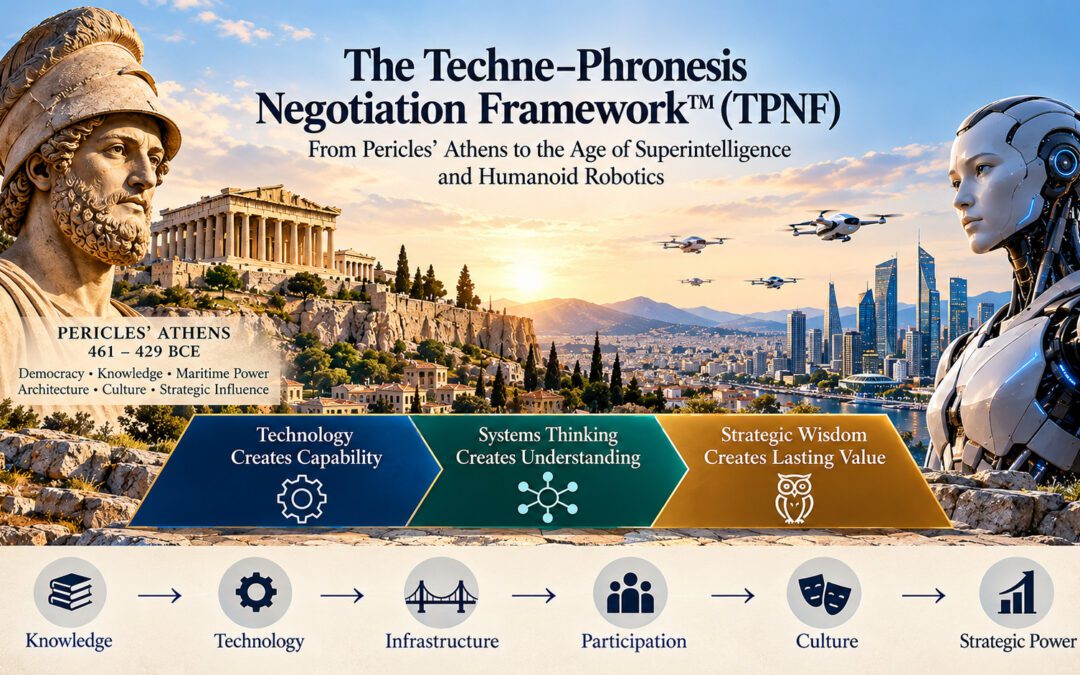
Knowledge → Technology → Infrastructure → Participation → Culture → Strategic Power
Its weaknesses emerged where that system became exclusionary, coercive or strategically overconfident.
The lesson for contemporary civilization is therefore dual.
Integration creates extraordinary capability.
But capability without sufficient wisdom can destabilize the ecosystem that produced it.
The TPNF Interpretation
TPNF condenses this historical comparison into its central triad:
Technology Creates Capability.
Superintelligence and humanoid robotics may dramatically expand what civilization can accomplish.
Systems Thinking Creates Understanding.
Their consequences must be understood across technological, economic, social, political and geopolitical ecosystems.
Strategic Wisdom Creates Lasting Value.
Humanity must determine how expanding technological capability can strengthen rather than diminish human agency and civilization.
Periclean Athens offers no instructions for governing Superintelligence.
It offers something more fundamental.
It demonstrates that a civilization reaches exceptional heights when different forms of human capability reinforce one another—and that even extraordinary civilizations remain vulnerable when power outruns judgement.
The strategic question of our technological age is therefore not whether humanity can create increasingly intelligent machines.
Evidence suggests that our capacity to create will continue expanding.
The deeper question is whether our institutions, societies and strategic wisdom can evolve alongside them.
Periclean Athens suggests a principle worth carrying into the age of humanoid robotics and Superintelligence:
A civilization should not be judged only by the power of what it creates, but by the wisdom with which it integrates that power into human life.
Key Takeaways
- Periclean Athens can be interpreted as an early ecosystem of interconnected capabilities rather than a model to imitate.
- Techne created material capability, but institutions, knowledge, culture and participation multiplied its value.
- Modern AI and humanoid robotics similarly acquire meaning through the systems surrounding them.
- Human agency should remain central as increasingly autonomous technologies enter society.
- The Golden Age also warns that capability can expand faster than resilience and strategic judgement.
- TPNF defines this danger through the Capability–Wisdom Gap.
- Superintelligence would magnify the requirement for Systems Thinking and Phronesis rather than eliminate it.
- Long-term technological civilization must optimize not merely intelligence or efficiency, but lasting human value.
Author’s Reflection
Pericles fascinates us not because fifth-century Athens possessed anything resembling today’s technology, but because his age demonstrates what happens when multiple forms of capability suddenly reinforce one another.
Our technological civilization may now be entering a transformation of incomparably greater magnitude.
Humanoid robotics gives artificial intelligence a physical presence. Future Superintelligence could give technological systems cognitive capabilities beyond anything previously created.
Yet the central strategic challenge remains human.
We must ensure that the civilization becoming technologically more intelligent also becomes strategically wiser.
That, ultimately, is why Periclean Athens still deserves our attention.
Nikolaos Chatzis
Source: Open Sources Analysis, Relative Data Analysis by Nikos Chatzis
© Nikolaos Chatzis. All Rights Reserved.
The Techne–Phronesis Negotiation Framework™
An Integrative Theory of Strategic Negotiation, Complex Adaptive Systems and Practical Wisdom
Technology Creates Capability • Systems Thinking Creates Understanding • Strategic Wisdom Creates Lasting Value.
Negotiation.gr | Strategic Wisdom for the Technological Age