Negotiation.gr | Strategic Wisdom for the Technological Age
“Strategic resilience emerges when technical capability (techne) is
continuously guided by practical wisdom (phronesis) through adaptive
negotiation across interconnected systems.”
Central Idea (Thesis)
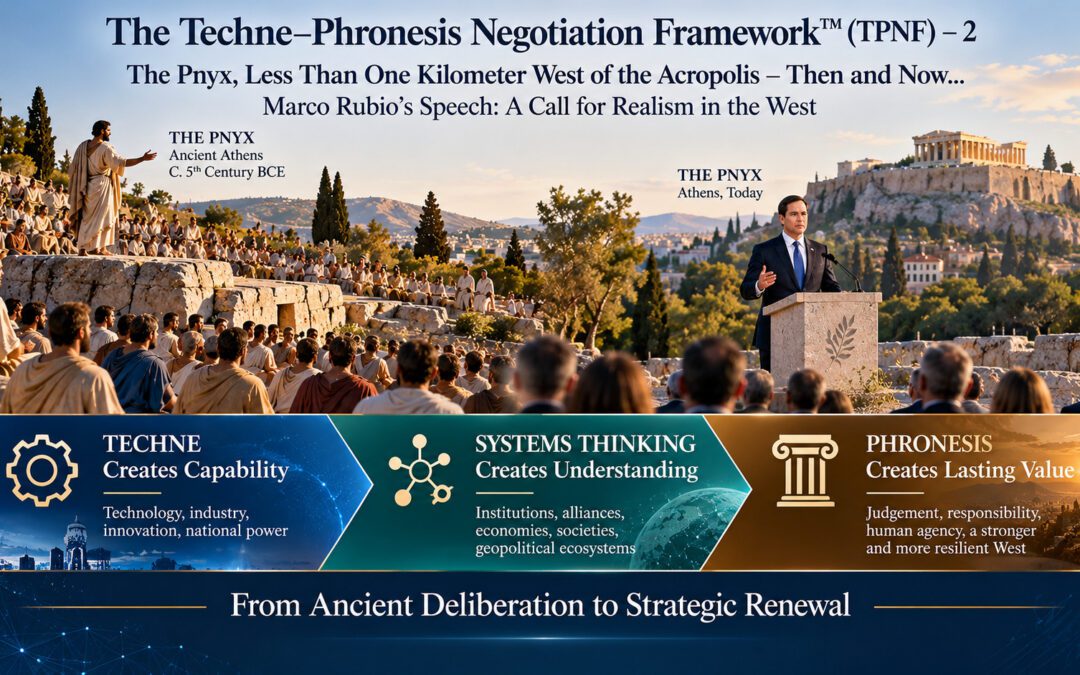
On October 7, 2026, U.S. Secretary of State Marco Rubio delivered a speech at the ancient Pnyx in Athens, calling for a renewal of Western confidence, national strength and civilizational purpose.
The location was historically significant. Less than one kilometer west of the Acropolis, the Pnyx once hosted the Athenian Assembly, where citizens debated war, alliances, public resources and the future of their city.
Through the Techne–Phronesis Negotiation Framework™ (TPNF), Rubio’s address raises a fundamental strategic question: Can the West transform its technological, economic and military capabilities into lasting civilizational strength without losing the wisdom and institutions that give those capabilities meaning?
The challenge is not simply recovering power. It is understanding how power, technology, institutions and strategic judgement must interact.
Purpose of the Essay
This TPNF essay examines Rubio’s Pnyx speech through TPNF, connecting ancient Athenian political experience with contemporary Western strategic challenges.
Its purpose is neither to endorse nor reject Rubio’s political agenda, but to evaluate his call for renewed Western power through three interconnected dimensions: technological capability, systemic understanding and strategic wisdom.
The central proposition is that national power becomes sustainable only when supported by resilient institutions, productive ecosystems and prudent strategic decision-making.
Abstract
Rubio’s October 7 address presented Western civilization as facing a decisive historical moment. He emphasized national sovereignty, industrial renewal, technological ambition, military strength and the need to rediscover qualities associated with ancient Greece.
His speech also referred to superintelligence as an American strategic ambition.
TPNF interprets these themes through the relationship between Techne, Systems Thinking and Phronesis.
The Pnyx provides an illuminating historical setting: ancient Athens demonstrated how political institutions, maritime capability, economic networks and strategic leadership could generate extraordinary influence, but also how power could become vulnerable through imperial rivalry, exclusion and strategic miscalculation.
The Pnyx: Where Power Encountered Deliberation
In classical Athens, the Pnyx was more than a meeting place.
It was an institutional environment where participating citizens exercised political authority through debate and collective decisions.
Questions of war, diplomacy, taxation and public policy were matters of civic deliberation.
Athenian democracy remained deeply exclusionary by modern standards. Women, enslaved people and resident foreigners lacked political participation.
Nevertheless, the Pnyx established an enduring principle: political power requires mechanisms through which collective choices can be debated, legitimized and implemented.
This distinction matters today.
Technological capability can expand a state’s options, but it cannot independently determine legitimate political objectives.
The Pnyx therefore symbolizes the continuing relationship between capability and judgement.
Rubio’s Message: The Return of Strategic Realism
Rubio’s speech emphasized that Western societies must recover confidence in their historical identity and pursue national interests without embarrassment.
He presented the coming decade as potentially decisive for the West’s position in the international system.
His argument reflected a national-power-centered interpretation of international politics: economic productivity, military strength, technological leadership and national cohesion remain essential foundations of geopolitical influence.
This perspective overlaps with classical strategic realism, although Rubio’s broader argument also incorporated civilizational identity and political values.
From a TPNF perspective, the important question is not whether power matters.
Power clearly matters.
The question is how power is created, coordinated, legitimized and sustained.
Military strength without economic resilience may become unsustainable.
Technological superiority without institutional adaptation may produce instability.
National ambition without effective alliances may reduce rather than expand strategic options.
Realism therefore requires more than recognizing competition. It requires understanding interdependence.
Techne: Rebuilding the Foundations of Capability
Rubio’s emphasis on industrial renewal and technological leadership corresponds to the first TPNF dimension:
Technology Creates Capability.
Modern national power increasingly depends upon advanced manufacturing, artificial intelligence, semiconductors, energy systems, cybersecurity, defense technologies and resilient supply chains.
These capabilities cannot be replaced by political declarations.
They require investment, education, research, infrastructure and productive institutions.
Rubio’s reference to superintelligence is particularly significant.
Artificial Superintelligence remains hypothetical, but its pursuit illustrates how technological leadership is becoming intertwined with national strategic ambition.
Yet TPNF introduces an important qualification:
The possession of advanced technology does not automatically guarantee strategic advantage.
A state may lead in AI research while remaining dependent on external manufacturing capacity, critical materials or energy infrastructure.
Technological power must therefore be understood within the systems supporting it.
Systems Thinking: The West as an Interconnected Ecosystem
The second TPNF dimension states:
Systems Thinking Creates Understanding.
Western power does not reside exclusively in Washington, Brussels or any individual European capital.
It emerges from interconnected economic, technological, institutional and security networks.
American innovation interacts with European industry, transatlantic investment, NATO defense cooperation, universities, financial systems and global trade.
The Western ecosystem also contains competing national interests, regulatory differences and political disagreements.
This complexity creates both strength and vulnerability.
Rubio’s emphasis on national sovereignty raises a legitimate strategic concern: governments must remain accountable to their citizens.
However, national sovereignty and international cooperation are not necessarily opposites.
Under TPNF, effective sovereignty may actually increase when states participate in resilient networks that expand their strategic options.
The central challenge is balancing national decision-making authority with the benefits of cooperation.
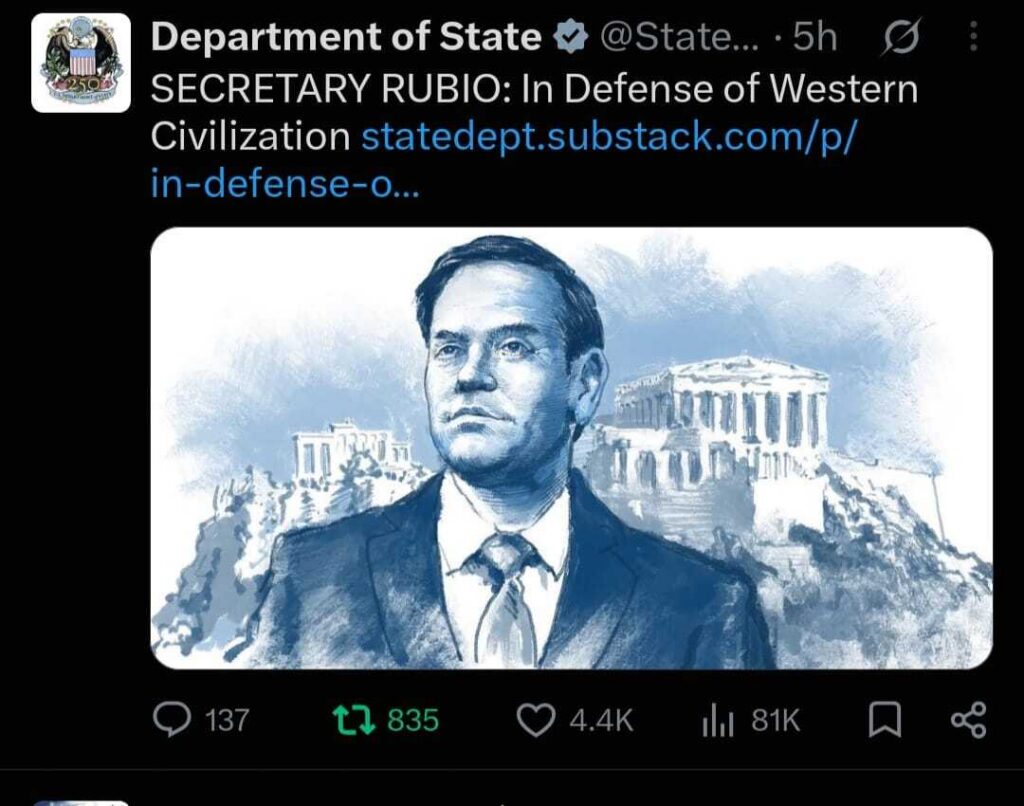
Marco Rubio in Akropolis, the US Dept of State
Ancient Athens: Capability and Its Limits
The historical comparison becomes especially instructive when examining Periclean Athens.
Athens possessed maritime superiority, commercial networks, political institutions, engineering capabilities and remarkable cultural creativity.
Its influence emerged from the interaction of these capabilities.
Yet Athens also developed an empire whose coercive relationships contributed to regional hostility.
Its achievements did not prevent strategic rivalry, war or institutional vulnerability.
The lesson is not that modern Western civilization will repeat Athenian history.
It is that exceptional capability does not eliminate systemic risk.
Indeed, growing power can encourage decision-makers to underestimate the consequences of their own choices.
This is the TPNF Capability–Wisdom Gap: the distance between expanding technological or material power and the capacity to govern its consequences wisely.
Phronesis: Beyond the Pursuit of Power
The third TPNF dimension states:
Strategic Wisdom Creates Lasting Value.
Rubio’s call for Western renewal invites an essential distinction between power as an instrument and power as an objective.
National strength can protect security, prosperity and political independence.
But maximizing power without clearly defined purposes can generate strategic overextension.
Phronesis requires decision-makers to evaluate consequences, competing interests, institutional limits and long-term outcomes.
It asks not merely whether the West can become more powerful, but what that power should accomplish.
Should technological leadership strengthen human productivity and education?
Should military capabilities support deterrence and stability?
Should industrial renewal reinforce social cohesion?
Should alliances multiply national capabilities while preserving legitimate political autonomy?
These questions transform strategic realism from an assertion of strength into a framework of responsible choice.
Greece and the Strategic Geography of Connectivity
Rubio’s visit also highlights Greece’s contemporary geopolitical position.
Greece connects European, Balkan, Mediterranean and transatlantic systems through shipping, energy infrastructure, defense cooperation and diplomatic relationships.
The Sixth U.S.–Greece Strategic Dialogue demonstrated the expanding scope of bilateral cooperation.
Its joint statement addressed defense, investment, critical infrastructure, energy, advanced technologies and superintelligence-related cooperation.
For TPNF, Greece’s opportunity extends beyond geographical advantage.
Geography creates strategic potential; connectivity transforms that potential into influence.
The country’s long-term value depends on its ability to connect capabilities, institutions and partnerships while protecting national interests.
Strategic Implications: What Western Renewal Requires
Rubio’s speech can be interpreted as a demand for strategic adaptation.
But a sustainable Western renewal requires three interconnected transformations.
First, technological and industrial capabilities must be strengthened.
Second, fragmented capabilities must be connected through resilient economic, political and security ecosystems.
Third, strategic decisions must reconcile national interests with the long-term stability of those ecosystems.
This produces a TPNF progression:
Capability Renewal → Ecosystem Integration → Strategic Coordination → Sustainable Influence → Lasting Value
Failure at any stage can undermine the entire process.
The West’s challenge is therefore not simply to recover historical greatness.
It is to create institutions and capabilities appropriate to an increasingly complex technological and geopolitical environment.
Rubio’s speech at the Pnyx connected ancient Athens with contemporary debates about Western power and identity.
Yet the deeper historical lesson extends beyond national ambition.
The ancient Athenians demonstrated that political institutions, technology, economic resources and strategic leadership could generate exceptional influence.
They also demonstrated that influence remained vulnerable to poor judgement and systemic instability.
TPNF therefore offers a broader interpretation of Western renewal.
Technology Creates Capability.
Systems Thinking Creates Understanding.
Strategic Wisdom Creates Lasting Value.
The future of Western civilization will depend not simply on how much power it possesses, but on how wisely that power is organized and employed.
The enduring lesson of the Pnyx is that the strength of civilization ultimately depends upon the quality of its strategic decisions.
Key Takeaways
- Rubio’s Pnyx speech emphasized national strength, sovereignty, industrial renewal and technological leadership.
- The ancient Pnyx symbolizes the relationship between political power and collective deliberation.
- Strategic realism must consider economic, technological and institutional interdependence.
- Superintelligence introduces new questions about technological competition and governance.
- Ancient Athens illustrates both the advantages and vulnerabilities of interconnected capabilities.
- TPNF identifies the Capability–Wisdom Gap as a central danger of expanding power.
- Greece’s strategic value increasingly depends on connectivity across regional ecosystems.
- Sustainable Western renewal requires capability, systemic understanding and practical wisdom.
Author’s Reflection
There is profound symbolism in an American Secretary of State addressing the future of Western civilization from the ancient Pnyx.
The technological environment has changed beyond recognition since the age of Pericles. Artificial intelligence, advanced robotics and the possibility of superintelligence introduce capabilities that ancient civilizations could never have imagined.
Yet the central question remains familiar.
How should political communities exercise power wisely?
Rubio’s speech calls attention to the necessity of national strength. TPNF adds that strength becomes strategically meaningful only when integrated with understanding, responsibility and long-term purpose.
Perhaps the greatest contribution of ancient Athens to contemporary civilization is not a particular political formula, but the recognition that power and wisdom must remain in continuous dialogue.
Nikolaos Chatzis
- https://www.state.gov/releases/office-of-the-spokesman/2026/10/secretary-of-state-marco-rubio-remarks/
Source: Open Sources Analysis, Relative Data Analysis by Nikos Chatzis
© Nikolaos Chatzis. All Rights Reserved.
The Techne–Phronesis Negotiation Framework™
An Integrative Theory of Strategic Negotiation, Complex Adaptive Systems and Practical Wisdom
Technology Creates Capability • Systems Thinking Creates Understanding • Strategic Wisdom Creates Lasting Value.
Negotiation.gr | Strategic Wisdom for the Technological Age