Negotiation.gr | Strategic Wisdom for the Technological Age
“Strategic resilience emerges when technical capability (techne) is
continuously guided by practical wisdom (phronesis) through adaptive
negotiation across interconnected systems.”
Central Idea — Thesis
The strategic significance of NASA’s Nancy Grace Roman Space Telescope lies not simply in the extraordinary scientific observations it may produce, but in its capacity to create cumulative knowledge, technological capability, scientific ecosystems and strategic options whose value can extend far beyond the original mission.
The Roman telescope therefore illustrates a fundamental principle of the Techne–Phronesis Negotiation Framework™ (TPNF):
The strategic value of advanced technology should not be measured only by what it accomplishes immediately, but by what it enables humanity to understand, create and accomplish next.
Roman represents Techne at extraordinary scale: advanced optics, sensors, spacecraft engineering, computing and data systems integrated into one scientific instrument.
But Phronesis asks the deeper strategic question:
How can such technological capability be transformed into Long-Term Space Value™ for science, institutions, technological ecosystems and humanity?
Purpose of the Essay
This essay examines the upcoming launch of the Nancy Grace Roman Space Telescope through the TPNF perspective of long-term value creation.
Rather than treating Roman exclusively as an astronomical instrument, it considers the observatory as part of a broader Space Knowledge Ecosystem™ connecting science, technology, data, institutions, industry, international cooperation and future generations of researchers.
The central strategic question is therefore not simply:
What will Roman discover?
It is:
What new capabilities and possibilities will Roman’s discoveries make possible?
Abstract
NASA and SpaceX are targeting August 30 for the launch of the approximately $4 billion Nancy Grace Roman Space Telescope aboard a Falcon Heavy rocket. Roman will travel to the Sun-Earth L2 region, approximately one million miles from Earth, and investigate some of astronomy’s greatest questions, including dark energy, dark matter, galaxy formation and exoplanets.
Its Wide Field Instrument will provide Hubble-like resolution while observing a field at least 100 times larger. NASA says Roman could measure light from a billion galaxies during its lifetime, while its enormous surveys will create extensive datasets available to the wider scientific community.
Through TPNF, Roman demonstrates how major scientific infrastructure can generate Cumulative Strategic Value™: one technological capability produces data; data produces knowledge; knowledge generates discoveries; discoveries enable technologies and future missions; and those capabilities create new strategic possibilities.
1. Roman: A New Window on the Universe
Roman belongs to the lineage of great space observatories.
Hubble transformed humanity’s visual understanding of the universe.
James Webb extended observation deeper into cosmic history.
Roman introduces another capability: scale.
NASA says Roman’s field of view will be at least 100 times larger than Hubble’s while maintaining comparable infrared resolution, allowing it to survey the sky dramatically faster.
This combination creates a different form of scientific capability.
Instead of examining relatively narrow regions in extraordinary detail, Roman can examine enormous cosmic populations.
Billions of galaxies.
Thousands of exoplanets.
Supernovae.
Black holes.
Dark-matter structures.
Large-scale cosmic evolution.
This changes astronomy from observing individual objects toward understanding populations and systems.
And that is immediately relevant to TPNF.
Greater scale creates greater systems understanding.
2. From Telescope to Knowledge Infrastructure
Calling Roman a telescope is technically correct.
Strategically, however, it is incomplete.
Roman is better understood as a knowledge infrastructure.
The spacecraft will generate enormous volumes of observational data. NASA’s technical specifications anticipate roughly 11 terabits of data per day.
Those observations will subsequently interact with:
universities;
research institutes;
supercomputers;
AI systems;
astronomers;
international partners;
other observatories;
future missions.
The telescope therefore becomes one node inside a much larger scientific ecosystem.
Its strategic value does not reside exclusively aboard the spacecraft.
It resides in the relationships connecting observation, data, researchers and discovery.
3. The TPNF Space Value Chain
Through TPNF, Roman’s value can be represented as:
Technology
↓
Observation
↓
Data
↓
Knowledge
↓
Scientific Discovery
↓
New Questions
↓
New Technologies and Missions
↓
Cumulative Space Capability
↓
Long-Term Strategic Value
This is fundamentally different from evaluating a mission according to immediate financial return.
Scientific infrastructure often produces value across decades.
Some discoveries cannot even be predicted when the instrument is designed.
That uncertainty is not necessarily a weakness.
It can be one of the mission’s greatest strategic strengths.
4. The Strategic Value of Unexpected Discovery
One of the most important lessons from previous observatories is that their greatest contributions are not always those originally anticipated.
Powerful scientific instruments create Discovery Optionality™.
They provide capabilities that allow researchers to investigate questions that may not yet exist.
Roman’s large datasets could reveal unusual phenomena that researchers were not explicitly searching for.
New theories could emerge.
AI techniques developed years from now may analyze Roman data differently.
Future observations from other telescopes may be compared against Roman’s historical measurements.
The mission therefore creates a scientific asset whose value can continue evolving.
This suggests a wider TPNF principle:
Strategic technologies create their greatest long-term value when they expand the range of future possibilities rather than merely accomplish predetermined tasks.
5. Dark Energy and the Value of Fundamental Knowledge
Roman will investigate one of modern cosmology’s greatest mysteries: why the expansion of the universe is accelerating.
Scientists use the term dark energy to describe the unknown phenomenon associated with that acceleration.
Roman will map enormous numbers of galaxies and cosmic structures, allowing researchers to test competing explanations and improve understanding of the universe’s evolution.
The immediate economic value of understanding dark energy may appear impossible to calculate.
But this illustrates an important distinction between economic value and civilizational value.
Fundamental science expands humanity’s understanding of reality.
Historically, discoveries initially considered purely theoretical have later generated transformative technologies.
Long-term strategy therefore requires the intellectual patience to invest in knowledge whose eventual applications cannot yet be predicted.
That is Phronesis operating across generations.
6. Exoplanets and Humanity’s Expanding Horizon
Roman will also conduct one of history’s most extensive searches for planets beyond our solar system.
Its microlensing observations are expected to discover thousands of exoplanets, while its Coronagraph Instrument will demonstrate technologies for directly imaging planets around other stars.
The scientific objective is extraordinary.
But the strategic consequence is broader.
Humanity is gradually constructing a statistical understanding of planetary systems across the galaxy.
Are planetary systems like ours common?
How frequently do Earth-like planets emerge?
What conditions produce potentially habitable worlds?
Each answer changes humanity’s understanding of its place within the universe.
Space exploration therefore produces not only technological capability.
It produces Civilizational Knowledge Value™.
7. Technology Creates Capability Beyond the Mission
Roman itself is also a technological ecosystem.
Its detectors.
Optics.
Spacecraft systems.
Data architecture.
Coronagraph.
Software.
Ground infrastructure.
Launch integration.
Each required years of engineering development.
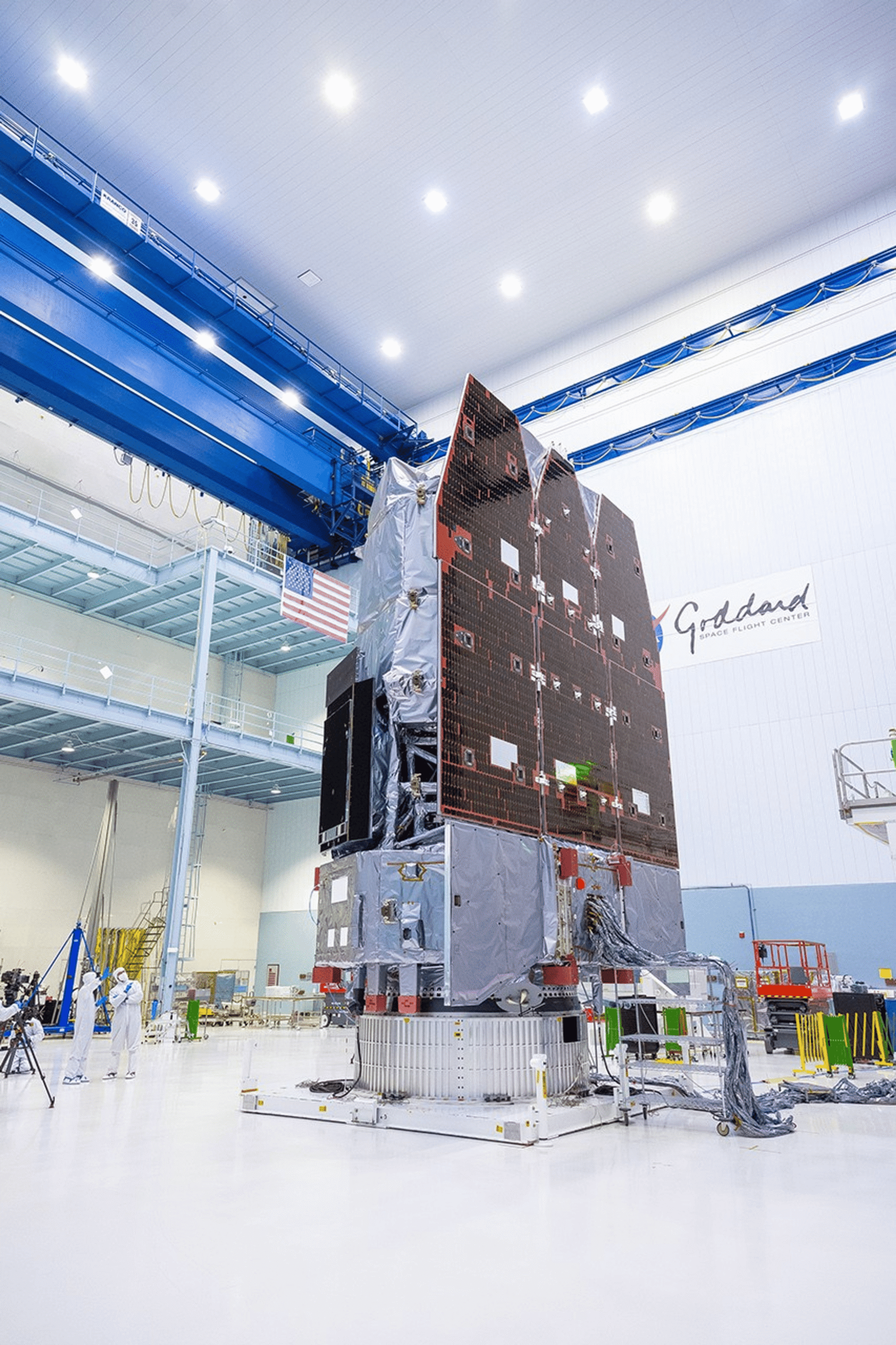
More than a thousand technicians and engineers participated in assembling the observatory from millions of individual components.
That expertise does not disappear after launch.
Engineers move to other projects.
Technologies evolve.
Industrial suppliers acquire experience.
Scientific institutions learn.
Future missions inherit knowledge.
Roman therefore creates what TPNF describes as Cumulative Capability™.
The strategic product is not only the spacecraft.
It is the strengthened ecosystem capable of building what comes next.
8. Space Science Is an Ecosystem
Modern space exploration increasingly demonstrates that no single organization creates value independently.
Roman is managed by NASA’s Goddard Space Flight Center, with participation from the Jet Propulsion Laboratory, Caltech/IPAC, the Space Telescope Science Institute, universities and industrial partners. Its ground-support architecture also includes facilities associated with ESA and JAXA.
Launch adds another actor: SpaceX and its Falcon Heavy.
Roman therefore represents:
Government + Science + Industry + Universities + International Cooperation + Infrastructure.
This is Ecosystem Orchestration™.
Complex scientific capability emerges not from one institution possessing everything, but from complementary capabilities being coordinated toward a common objective.
9. The Five-Year Mission and the Ten-Year Horizon
NASA currently plans Roman’s primary mission for approximately five years, with a goal of operating for as long as ten.
But its strategic life could be considerably longer.
The telescope produces observations.
Observations become datasets.
Datasets remain accessible.
Future researchers ask new questions.
Future computational methods reinterpret old observations.
Future missions compare their findings with Roman.
The physical spacecraft may eventually cease operating while its knowledge continues producing value.
This creates a fascinating form of strategic longevity.
A mission can end operationally while remaining productive intellectually.
10. The Strategic Challenge: Creating Value Across Time
This leads directly to the TPNF concept of Lasting Strategic Value™.
Long-term space value creation requires more than successful launch and operation.
It requires:
preserving scientific data;
maintaining open research ecosystems;
developing future generations of scientists;
integrating AI and new analytical tools;
supporting international cooperation;
transferring technological knowledge;
building successor missions;
and protecting institutional capacity for long-horizon scientific investment.
The strategic objective should therefore not be:
Launch → Mission → Completion.
It should become:
Mission → Knowledge → Learning → New Capability → New Mission → Cumulative Value.
Space exploration becomes a continuous civilizational learning process.
Strategic Implications
Roman illustrates several broader strategic principles.
First, scientific infrastructure should be evaluated across generational rather than exclusively political or budgetary time horizons.
Second, data itself becomes a long-term strategic asset.
Third, open scientific ecosystems can multiply the value generated by a single technological platform.
Fourth, international and public-private cooperation increasingly become essential components of advanced space capability.
Fifth, investment in fundamental science creates Strategic Optionality™ because its most important future applications cannot always be predicted.
When Falcon Heavy lifts the Nancy Grace Roman Space Telescope toward space, the most visible event will last only minutes.
The strategic consequences could last decades.
Roman will travel toward L2 carrying extraordinary technological capability.
But the telescope’s greatest product will not be the spacecraft itself.
It will be knowledge.
Knowledge about dark energy.
Knowledge about dark matter.
Knowledge about galaxies.
Knowledge about planetary systems.
Knowledge about the universe.
And knowledge has a distinctive strategic property:
It can compound.
One discovery creates another question.
One technological breakthrough enables another mission.
One dataset trains another generation of researchers.
One mission expands the frontier from which the next begins.
Through TPNF, Roman therefore represents something larger than space exploration.
It demonstrates how technological civilization can transform:
Techne → Capability → Knowledge → Learning → Cumulative Capability → Lasting Strategic Value.
The telescope will look billions of light-years into the past.
But its deepest strategic value may lie in what it makes possible for the future.
Key Takeaways
- Roman should be understood not simply as a telescope but as a long-term Space Knowledge Infrastructure™.
- Its wide-field capability can transform individual observations into systems-level understanding of the universe.
- Scientific missions create Discovery Optionality™ because future discoveries cannot be fully predicted when the technology is designed.
- Space missions generate Cumulative Capability™ across scientists, engineers, institutions and industrial ecosystems.
- Long-Term Space Value™ emerges when technological capability continues generating knowledge, learning and future strategic options long after the original mission.
Author’s Reflection
Perhaps space exploration offers one of the purest examples of long-term strategic thinking.
We build an extraordinarily complex machine.
We launch it a million miles from Earth.
We ask it questions whose answers may have no immediate commercial application.
And then we wait.
That can appear inefficient when measured against quarterly financial results or electoral cycles.
But civilization does not advance exclusively through immediate returns.
Some investments expand the horizon from which humanity understands what is possible.
The Nancy Grace Roman Space Telescope belongs to that category.
Its greatest discovery may be dark energy.
It may be thousands of new planets.
Or it may be something nobody designing the mission expected.
That uncertainty is precisely why the investment matters.
Techne gives humanity the ability to look deeper into the universe.
Phronesis gives humanity the wisdom to understand why looking matters.
And lasting strategic value emerges when what we discover today expands what humanity becomes capable of discovering tomorrow.
Nikos Chatzis
Source: Open Sources Analysis, Relative Data Analysis by Nikos Chatzis
© Nikolaos Chatzis. All Rights Reserved.
The Techne–Phronesis Negotiation Framework™
An Integrative Theory of Strategic Negotiation, Complex Adaptive Systems and Practical Wisdom
Technology Creates Capability • Systems Thinking Creates Understanding • Strategic Wisdom Creates Lasting Value.
Negotiation.gr | Strategic Wisdom for the Technological Age