Negotiation.gr | Strategic Wisdom for the Technological Age
“Strategic resilience emerges when technical capability (techne) is
continuously guided by practical wisdom (phronesis) through adaptive
negotiation across interconnected systems.”
Central Idea — Thesis
The fall in international oil prices as Washington prepares what the Trump administration calls an “Economic D-Day” against Iran reveals a central paradox of contemporary geopolitical power: markets respond not simply to escalation, but to their interpretation of how escalation changes the future balance of capability, risk and expected supply.
The United States is attempting to transform its enormous financial, commercial and sanctions capability into strategic leverage over Tehran. Iran, meanwhile, retains one of its strongest asymmetric instruments: its capacity to threaten energy flows through the Strait of Hormuz.
Through the Techne–Phronesis Negotiation Framework™ (TPNF), the confrontation illustrates how modern geopolitical power operates through interconnected ecosystems of military capability, finance, energy, shipping, alliances, markets and expectations.
The decisive question is therefore not merely whether sanctions hurt Iran.
It is whether Washington can convert economic pressure into a sustainable political outcome without triggering systemic consequences that undermine its own strategic objectives.
Purpose of the Essay
This essay examines the geopolitical significance of Washington’s threatened “Economic D-Day” against Iran and the simultaneous decline in international oil prices.
Using TPNF, it explores economic warfare, energy markets, the Strait of Hormuz, coercive diplomacy and the relationship between geopolitical events and market expectations.
Its broader purpose is to distinguish between possessing coercive capability and successfully converting that capability into strategic value.
Abstract
Nearly six months into the Iran war, the Trump administration is preparing another major escalation—not principally through additional military operations, but through economic pressure.
Washington has threatened countries, banks and businesses that continue providing economic support to Tehran and is preparing what U.S. Treasury Secretary Scott Bessent has described as exceptionally severe sanctions.
Iran has responded by threatening broader disruption of Gulf oil exports.
Yet oil prices fell on Monday.
The apparent contradiction demonstrates that energy markets do not simply price current conflict. They continuously price expectations concerning future supply, shipping access, escalation and political outcomes.
TPNF interprets the confrontation as a struggle over Strategic Conversion™: whether economic, military and geographic capabilities can actually be converted into favorable political outcomes.
1. From Military War to Economic War
The U.S.–Iran confrontation is increasingly operating across multiple strategic domains.
Military operations damaged Iranian nuclear, military and infrastructure capabilities.
Maritime confrontation shifted attention toward the Strait of Hormuz.
Diplomatic efforts attempted unsuccessfully to establish a sustainable settlement.
Washington is now escalating another instrument:
economic warfare.
The objective is straightforward in principle.
Iran requires external trade, petroleum revenues, financial transactions, shipping services and commercial relationships.
Washington possesses enormous influence over global financial networks and can threaten secondary sanctions against foreign actors maintaining those relationships.
The strategic architecture therefore becomes:
Financial Power → Economic Isolation → Domestic Pressure → Political Concession.
But each arrow represents an assumption.
And assumptions are where coercive strategies frequently fail.
2. Why Are Oil Prices Falling?
At first glance, the market reaction appears counterintuitive.
Washington threatens unprecedented economic sanctions.
Iran threatens Gulf energy exports.
The Strait of Hormuz remains strategically contested.
One might therefore expect oil prices to surge.
Instead, Brent and U.S. crude declined as markets waited for details of Washington’s measures.
This demonstrates an important characteristic of markets:
Markets price expectations rather than headlines alone.
If traders believe that Iran’s ability to disrupt shipping is weakening, additional sanctions may be interpreted as increasing pressure for eventual accommodation.
If more vessels successfully transit Hormuz, perceived supply risk declines.
If markets believe major producers can compensate for disruption, the geopolitical premium may fall.
The same event—stronger American pressure—can therefore produce two opposing interpretations.
Escalation → Greater Disruption → Higher Oil Prices
or:
Escalation → Greater Pressure on Iran → Earlier Resolution → Lower Oil Prices.
The price represents the market’s continuously changing judgment between those possibilities.
3. The Strait of Hormuz Remains Iran’s Strategic Counter-Leverage
Iran nevertheless possesses extraordinary geographic leverage.
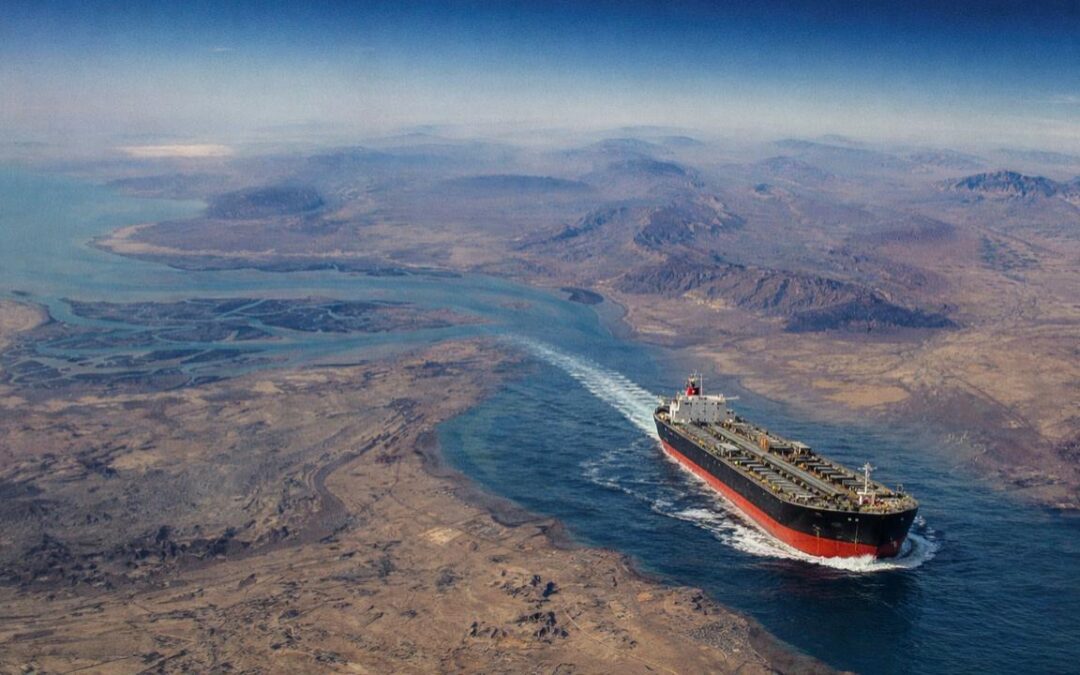
The Strait of Hormuz is one of the world’s most important energy chokepoints.
Roughly one-fifth of global oil and liquefied-natural-gas flows normally pass through the waterway, connecting Gulf producers with global markets.
This gives Tehran an asymmetric instrument against economically and militarily stronger adversaries.
Iran cannot match American global financial power.
It cannot match American conventional military capability.
But geography provides leverage.
This creates a strategic exchange:
Washington weaponizes financial connectivity.
Tehran weaponizes geographic connectivity.
Both strategies attempt to influence the same global ecosystem from different positions.
This is precisely why the confrontation cannot be understood solely as a bilateral conflict.
The battlefield extends through global markets.
4. The Weaponization of Interdependence
The confrontation demonstrates something fundamental about contemporary technological civilization.
Globalization created enormous efficiency by connecting economies.
But interconnectedness also created strategic vulnerabilities.
The dollar-based financial system enables global commerce.
It also provides Washington with sanctions leverage.
Global energy shipping enables efficient resource distribution.
It also creates dependence upon maritime chokepoints.
International insurance facilitates shipping.
It also becomes an instrument affecting whether vessels can operate.
Global banking creates liquidity.
It also provides mechanisms through which states can enforce financial isolation.
Interdependence therefore produces both:
Value Creation + Strategic Vulnerability.
TPNF interprets this as Network Power™.
The actor controlling critical nodes of a network may exercise influence far beyond its conventional physical capabilities.
5. America’s Financial Techne
The United States possesses extraordinary Techne in economic coercion.
The importance of the dollar, American financial institutions, sanctions enforcement, intelligence capabilities and access to U.S. markets gives Washington enormous capacity to influence global commercial behavior.
A foreign company may have little direct relationship with America politically.
But if losing access to U.S. financial markets threatens its business model, Washington possesses leverage.
This allows sanctions to extend beyond the immediate target.
The intended architecture of “Economic D-Day” therefore appears to be:
Iran → Trading Partners → Banks → Shipping → Petroleum Buyers → Global Financial Networks.
Instead of isolating only Iran, Washington attempts to make interaction with Iran increasingly costly for everybody else.
That is economic coercion through ecosystem pressure.
6. But Can Economic Pain Produce Political Compliance?
Here TPNF introduces the critical distinction between capability and conversion.
The United States clearly possesses enormous capacity to damage Iran economically.
That does not necessarily mean the pressure will produce the desired political behavior.
Iran has experienced American sanctions for decades.
Economic hardship may weaken the state.
But it may also strengthen hardliners.
External pressure may create domestic dissatisfaction.
But it can also generate nationalist mobilization.
Sanctions may reduce resources.
But they can simultaneously encourage alternative commercial networks.
This creates the Coercive Conversion Problem™:
Economic Damage ≠ Automatic Political Compliance.
Strategic effectiveness must therefore be measured by outcomes, not merely by the magnitude of pressure imposed.
7. China, India and the Wider Geoeconomic Battlefield
The effectiveness of Washington’s strategy also depends upon third parties.
Iran’s economic isolation cannot be understood without considering major energy consumers, regional trading partners, shipping networks and alternative financial mechanisms.
This transforms the conflict into a broader negotiation.
Washington is effectively negotiating—sometimes coercively—not merely with Tehran but with the global commercial ecosystem surrounding Tehran.
Companies and states must decide:
What is access to Iranian energy worth?
What is access to American finance worth?
How much sanctions risk can they tolerate?
Can alternative payment systems reduce dependence?
This creates Selective Strategic Connectivity™.
Actors increasingly decide which networks they can afford to remain connected to.
The geopolitical consequences could extend well beyond Iran if countries accelerate attempts to reduce exposure to American financial coercion.
8. Oil Prices as Strategic Intelligence
Oil prices themselves become a form of strategic information.
They aggregate millions of expectations about supply, demand, military escalation, shipping, inventories and diplomacy.
They should therefore not be interpreted simply as commodity prices.
They function partly as a continuously updating strategic sensor.
When prices rise sharply after threats to Hormuz, markets are signaling increased perceived systemic risk.
When prices fall despite escalating rhetoric, markets may be signaling that they believe supply disruption will be manageable—or that political pressure may produce a settlement.
Markets can, of course, be wrong.
But their reactions reveal how global actors collectively interpret geopolitical information.
For TPNF, this can be described as Market-Based Strategic Intelligence™.
9. The Risk of Strategic Overreach
Washington nevertheless faces a difficult balancing problem.
Economic pressure must be strong enough to change Tehran’s calculations.
But excessive pressure could encourage Iran to escalate against energy infrastructure or shipping.
That could increase oil prices dramatically.
Higher energy prices would affect Europe and Asia.
They could increase inflation.
They could damage American consumers.
They could complicate monetary policy.
And they could weaken international political support for Washington’s strategy.
This produces another paradox:
The more effectively Iran internationalizes the economic costs of its confrontation with Washington, the harder it becomes for Washington to maintain a unified coercive coalition.
Strategic power therefore depends not only upon inflicting costs on the adversary.
It depends upon controlling the distribution of costs across the wider ecosystem.
10. From Economic D-Day to Negotiation?
The ultimate purpose of coercion should be political.
Economic pressure without a credible negotiating pathway risks becoming punishment rather than strategy.
Iranian officials continue to signal interest in diplomacy while rejecting negotiations conducted under what they perceive as coercive conditions.
Washington therefore confronts the same problem repeatedly visible in strategic competition:
How does one transition from coercion to negotiation without appearing to surrender leverage?
TPNF suggests that coercion and negotiation should not be treated as opposites.
Properly designed, capability creates leverage.
Leverage creates negotiating space.
Negotiation converts leverage into arrangements.
And sustainable arrangements create long-term strategic value.
The progression should therefore be:
Capability → Leverage → Negotiation → Agreement → Sustainable Value.
Stopping at leverage is strategically incomplete.
Strategic Implications
The current confrontation produces several broader implications.
First, economic networks have become major instruments of geopolitical power.
Second, energy chokepoints allow geographically positioned states to exercise asymmetric influence over much stronger adversaries.
Third, oil markets increasingly function as real-time indicators of perceived geopolitical risk.
Fourth, secondary sanctions may accelerate efforts by other states to construct alternative financial and commercial networks.
Fifth, successful coercive diplomacy requires a credible mechanism for converting economic pressure into political settlement.
Most importantly, the U.S.–Iran confrontation demonstrates that modern strategic competition increasingly takes place within interconnected ecosystems rather than isolated battlefields.
The decline in international oil prices as Washington prepares an “Economic D-Day” against Iran is not necessarily contradictory.
It demonstrates how complex geopolitical systems operate.
Markets are evaluating not simply today’s threats but tomorrow’s probable consequences.
Washington is attempting to weaponize financial connectivity.
Iran is attempting to preserve and potentially weaponize geographic connectivity.
Energy markets continuously evaluate both.
Through TPNF, the decisive strategic question therefore becomes:
Which actor can convert its available capabilities into sustainable influence without generating systemic consequences that ultimately weaken its own position?
Economic power can impose extraordinary costs.
Geography can create extraordinary leverage.
Military power can destroy physical capability.
But none automatically produces strategic success.
That requires Phronesis: the wisdom to understand when pressure has created enough leverage—and when leverage must be converted into negotiation.
Key Takeaways
- Falling oil prices demonstrate that markets price expected geopolitical outcomes, not simply escalation headlines.
- Washington is weaponizing financial connectivity while Iran relies heavily upon geographic leverage surrounding Hormuz.
- Economic damage does not automatically translate into political compliance—the Coercive Conversion Problem™.
- Oil prices can function as Market-Based Strategic Intelligence™ about perceived geopolitical risk.
- The ultimate test of “Economic D-Day” is not how much damage it inflicts, but whether Washington can convert pressure into a sustainable political settlement.
Author’s Reflection
The most important strategic lesson may be hidden inside the apparently simple movement of an oil-price chart.
A geopolitical threat occurs.
Markets interpret it.
Ships change routes.
Governments calculate risks.
Companies reconsider transactions.
Consumers eventually experience the consequences.
What begins as a confrontation between Washington and Tehran therefore propagates through an enormous global system.
This is why contemporary geopolitics can no longer be understood exclusively through military capability.
Finance is power.
Energy is power.
Networks are power.
Geography is power.
Expectations themselves can become power.
But TPNF reminds us that the possession of power is only the beginning of strategy.
The decisive challenge is Strategic Conversion™—transforming capability into outcomes that remain valuable after the immediate confrontation ends.
“Economic D-Day” may demonstrate America’s extraordinary economic Techne.
Whether it produces a sustainable settlement with Iran will demonstrate something more difficult:
Phronesis.
Nikos Chatzis
Source: Open Sources Analysis, Relative Data Analysis by Nikos Chatzis
© Nikolaos Chatzis. All Rights Reserved.
The Techne–Phronesis Negotiation Framework™
An Integrative Theory of Strategic Negotiation, Complex Adaptive Systems and Practical Wisdom
Technology Creates Capability • Systems Thinking Creates Understanding • Strategic Wisdom Creates Lasting Value.
Negotiation.gr | Strategic Wisdom for the Technological Age