Negotiation.gr | Strategic Wisdom for the Technological Age
“Strategic resilience emerges when technical capability (techne) is
continuously guided by practical wisdom (phronesis) through adaptive
negotiation across interconnected systems.”
Central Idea — Thesis
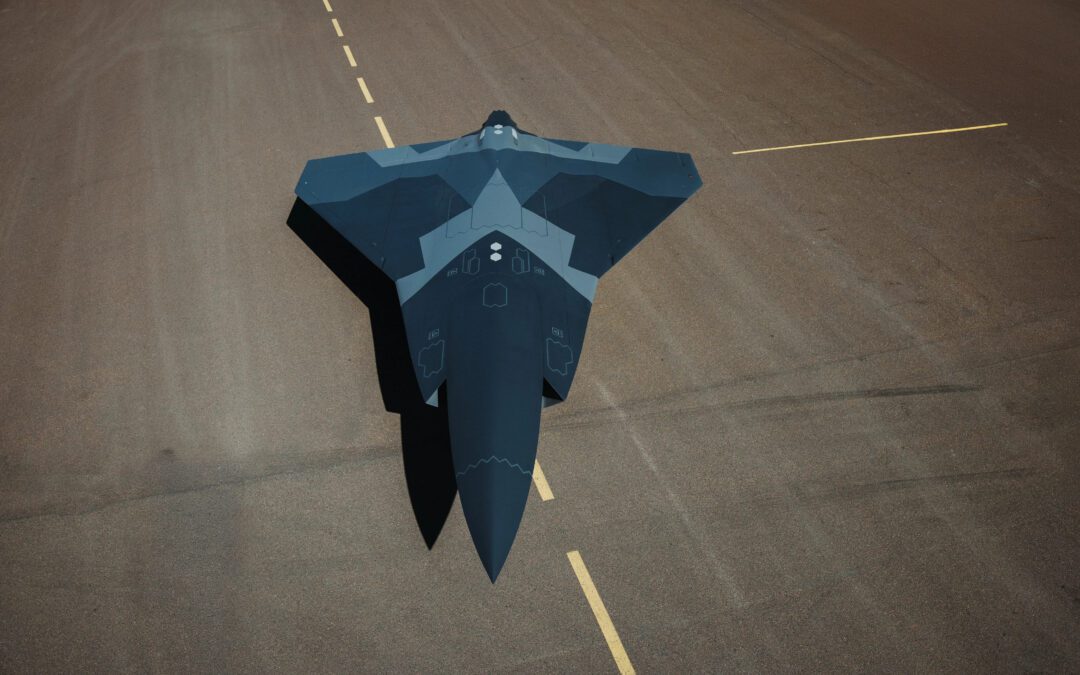
Saab’s A3-001 stealthy uncrewed combat-aircraft concept represents something strategically more important than the emergence of another advanced military drone. It illustrates the gradual transformation of air power from competition among individual fighter platforms toward competition among integrated combat ecosystems composed of crewed aircraft, autonomous systems, artificial intelligence, sensors, weapons and distributed information networks.
Through the Techne–Phronesis Negotiation Framework™ (TPNF), the decisive innovation is therefore not simply removing the pilot from a supersonic aircraft. It is redistributing capability, risk, sensing, decision-making and combat power across a network.
The future fighter may consequently no longer be best understood as an aircraft.
The future fighter is increasingly becoming an ecosystem.
Purpose of the Essay
This essay examines Saab’s A3-001 concept and its potential relationship with Gripen E through the TPNF lens. It explores how autonomous collaborative aircraft could transform air warfare, human–machine collaboration, survivability, force economics and European technological sovereignty.
The broader purpose is to demonstrate that next-generation air power will increasingly depend upon ecosystem orchestration rather than platform superiority alone.
Abstract
Saab has unveiled A3-001, a full-scale concept for a low-observable, highly autonomous uncrewed combat aircraft that could eventually complement Gripen and future Swedish crewed combat aircraft. The concept forms part of Sweden’s broader exploration of future fighter technologies and reflects growing international interest in collaborative combat aircraft.
Unlike lower-cost adjunct drones primarily designed to supplement fighters, Saab’s concept points toward a high-performance aircraft capable of operating in demanding contested environments.
TPNF interprets this development as part of a larger transformation: the migration from platform-centric air power toward distributed technological capability, where crewed fighters, autonomous aircraft, AI, electronic warfare, sensors and weapons function as interconnected elements of a combat ecosystem.
1. Saab’s A3-001: More Than a Loyal Wingman
The A3-001 concept was publicly displayed at Malmen Air Base in Linköping during the Swedish Armed Forces Air Show.
Saab describes the aircraft as a possible future uncrewed component of an integrated combat-air system.
Its envisioned characteristics are significant: low observability, substantial autonomy and the ability to undertake demanding missions including electronic warfare, suppression of enemy air defenses and precision strikes in heavily contested environments.
Industry reporting additionally describes Saab’s Autonomous Collaborative Platform concept as a stealthy, supersonic aircraft positioned toward the higher-performance end of the emerging collaborative-aircraft spectrum.
That distinction matters.
This is not simply an inexpensive drone accompanying a fighter.
It potentially represents a combat aircraft capable of assuming missions for which sending a crewed fighter would involve significant operational or human risk.
The relationship consequently evolves from:
Fighter + Supporting Drone
toward:
Crewed Capability + Autonomous Capability + Shared Combat Network.
2. Gripen E Becomes the Orchestrator
The Gripen E provides a particularly interesting foundation for this transition.
Saab already emphasizes the aircraft’s advanced electronic warfare, AESA radar, sensor fusion, networking, human–machine collaboration and adaptable avionics architecture.
More significantly, Saab has already demonstrated AI integration aboard Gripen E.
In 2025, Saab and Helsing integrated the Centaur AI agent into a Gripen E. During flight testing, the AI autonomously executed complex maneuvers in beyond-visual-range combat scenarios and provided firing cues to the pilot.
This suggests an important evolutionary pathway.
The Gripen pilot may increasingly cease to function exclusively as the operator of one aircraft.
Instead, the crewed fighter could become an orchestration node within a distributed combat network.
The pilot’s operational environment might therefore evolve from:
Pilot → Aircraft
to:
Human Commander → AI → Multiple Autonomous Platforms → Distributed Effects.
That represents a fundamental transformation in air combat.
3. From Platform Superiority to Ecosystem Superiority
Traditional fighter competition emphasizes platform characteristics.
Speed.
Range.
Radar performance.
Weapons.
Maneuverability.
Stealth.
Electronic warfare.
These remain important.
But collaborative combat introduces another competitive dimension: how effectively different capabilities interact.
Imagine a future Gripen-centered formation.
One autonomous aircraft penetrates contested airspace.
Another conducts electronic warfare.
Another extends sensing.
A Gripen E remains farther from the highest-threat area while integrating information.
GlobalEye contributes airborne surveillance.
Ground and space-based sensors provide additional intelligence.
AI helps interpret the resulting information environment.
Weapons may be launched from different nodes across the formation.
Combat effectiveness now emerges from the network.
This produces a central TPNF proposition:
The strongest platform does not necessarily create the strongest combat capability. The strongest integrated ecosystem may.
4. Distributed Capability Changes the Risk Equation
Uncrewed high-performance aircraft also transform operational risk.
Modern fighters are extraordinarily valuable assets.
But the most irreplaceable component remains the human pilot.
Highly contested airspace creates a strategic dilemma: commanders may possess aircraft capable of penetrating sophisticated defenses while remaining reluctant to expose scarce pilots to extreme danger.
Autonomous collaborative aircraft alter that calculation.
They can potentially perform the highest-risk missions:
SEAD → Electronic Warfare → Reconnaissance → Precision Strike → Forward Sensing.
The objective is not necessarily replacing the fighter pilot.
It is reallocating risk across the force.
TPNF can describe this as Distributed Strategic Risk™.
Instead of concentrating capability and human vulnerability inside the same platform, the combat ecosystem distributes functions across crewed and uncrewed nodes.
This can increase both survivability and strategic flexibility.
5. Autonomy Is More Important Than Uncrewed Flight
Aircraft have operated without onboard pilots for decades.
The revolutionary element is therefore not simply unmanned flight.
It is autonomous collaboration.
A remotely piloted aircraft still depends heavily upon continuous human control.
A genuinely collaborative autonomous platform must interpret information, navigate complex environments, respond to threats and coordinate with other actors while remaining aligned with command intent.
That requires AI.
But it also requires trust.
The crucial question becomes:
How much decision authority should be delegated to the machine?
This is precisely where Techne meets Phronesis.
Engineering can create autonomy.
Strategic wisdom must determine its boundaries.
Future combat-air superiority will therefore depend not simply upon artificial intelligence but upon Human–AI Strategic Collaboration™.
6. The Economics of Future Air Power
Collaborative aircraft also challenge traditional force economics.
Building increasingly sophisticated crewed fighters produces enormous capability but also enormous concentration of value.
Distributed forces provide another approach.
Instead of requiring every aircraft to perform every mission, specialized platforms can contribute different capabilities to a network.
One aircraft may prioritize electronic warfare.
Another weapons carriage.
Another sensing.
Another penetration.
The crewed fighter provides command, judgment and high-value capability.
This creates Distributed Technological Capability™.
Capability becomes modular across the force rather than concentrated entirely within individual aircraft.
For medium-sized European powers, this could be particularly attractive.
7. Sweden’s System-of-Systems Approach
The A3 concept should also be understood within Sweden’s broader future-fighter studies.
Saab’s work for Sweden has explicitly examined crewed and uncrewed solutions through a system-of-systems perspective, including technology development and demonstrations.
That phrase is strategically important.
A system-of-systems approach begins with the assumption that future combat effectiveness emerges through interaction among platforms.
Gripen.
GlobalEye.
Autonomous aircraft.
Sensors.
Weapons.
Data links.
Electronic warfare.
AI.
Command systems.
Each becomes a node within a larger adaptive architecture.
This mirrors a central TPNF idea:
Capability increasingly resides in relationships between systems rather than exclusively inside systems themselves.
8. European Technological Sovereignty
There is also a wider geopolitical dimension.
Future combat-air capability is becoming one of the most technologically demanding areas of strategic competition.
The United States, China and several European programs are exploring combinations of next-generation fighters, collaborative aircraft, AI and networked warfare.
Sweden’s continued investment in indigenous combat-air expertise therefore carries significance beyond procurement.
It preserves technological knowledge.
Engineering competence.
Software expertise.
AI integration.
Sensor development.
Electronic warfare capabilities.
Industrial supply chains.
And strategic freedom of action.
Saab’s A3 program should consequently also be interpreted as an instrument of Strategic Technological Sovereignty™.
A country able to design, integrate and continuously adapt advanced combat-air systems possesses options unavailable to one entirely dependent upon external technological ecosystems.
9. The TPNF Combat Ecosystem
Through the TPNF lens, Saab’s emerging architecture can be represented as:
Gripen E + Autonomous Collaborative Aircraft + GlobalEye + AI + Sensors + Electronic Warfare + Weapons + Networks
↓
Distributed Combat Capability
↓
Integrated Situational Understanding
↓
Adaptive Decision-Making
↓
Coordinated Effects
↓
Strategic Air-Power Advantage
This changes the fundamental unit of analysis.
Instead of asking:
Which fighter is better?
Strategists increasingly need to ask:
Which combat ecosystem learns, adapts and coordinates faster?
That is a much more consequential question.
Strategic Implications
Saab’s concept produces several strategic implications.
First, high-performance autonomous aircraft may increasingly assume missions considered excessively dangerous for crewed platforms.
Second, Gripen E’s role could evolve from individual combat aircraft toward an orchestration node connecting multiple autonomous capabilities.
Third, AI becomes essential not merely for flying aircraft but for managing increasingly complex information and decision environments.
Fourth, distributed capability may provide smaller and medium-sized air forces with new methods of generating combat mass without relying exclusively upon additional crewed fighters.
Fifth, indigenous development of autonomous combat-air technologies contributes directly to European technological sovereignty.
Most importantly, the future air-power competition may increasingly be determined by integration quality rather than platform quantity alone.
Saab’s A3-001 concept is visually striking because it resembles a futuristic stealth fighter without a pilot.
But concentrating on the aircraft’s appearance risks missing the strategic transformation.
The important development is not the drone.
It is the network around the drone.
Gripen E, autonomous platforms, AI, GlobalEye, sensors, electronic warfare and distributed weapons can increasingly operate as elements of one adaptive combat architecture.
Air power therefore progresses through a new sequence:
Platform → Network → Collaboration → Distributed Capability → Combat Ecosystem.
Through TPNF, the strategic lesson extends beyond aerospace.
Technology creates capability.
Connectivity multiplies capability.
Systems thinking reveals how capabilities interact.
But Phronesis remains necessary to determine how human judgment, autonomous decision-making and technological power should be orchestrated.
The future fighter may indeed fly without a pilot.
But the deeper revolution is that the fighter itself may no longer be the primary strategic unit of air power.
The ecosystem is becoming the weapon.
Key Takeaways
- Saab’s A3-001 represents movement from supporting drones toward high-end autonomous collaborative combat capability.
- Gripen E could increasingly become an orchestration node within a human–AI combat network.
- Future air superiority may depend more upon ecosystem integration than individual-platform superiority.
- Autonomous aircraft allow combat forces to distribute both capability and operational risk.
- Sweden’s development of autonomous combat-air technologies strengthens European Strategic Technological Sovereignty™.
Author’s Reflection
Perhaps the most revealing feature of Saab’s new concept is not that the aircraft has no pilot.
It is that no single aircraft needs to possess the entire capability of the force.
For more than a century, military aviation progressively concentrated technology, weapons, sensors and human skill inside increasingly sophisticated aircraft. Autonomous collaborative systems may begin reversing part of that logic.
Capability can now be distributed.
Nikolaos Chatzis
Source: Open Sources Analysis, Relative Data Analysis by Nikos Chatzis
© Nikolaos Chatzis. All Rights Reserved.
The Techne–Phronesis Negotiation Framework™
An Integrative Theory of Strategic Negotiation, Complex Adaptive Systems and Practical Wisdom
Technology Creates Capability • Systems Thinking Creates Understanding • Strategic Wisdom Creates Lasting Value.
Negotiation.gr | Strategic Wisdom for the Technological Age