Negotiation.gr | Strategic Wisdom for the Technological Age
“Strategic resilience emerges when technical capability (techne) is
continuously guided by practical wisdom (phronesis) through adaptive
negotiation across interconnected systems.”
Central Idea
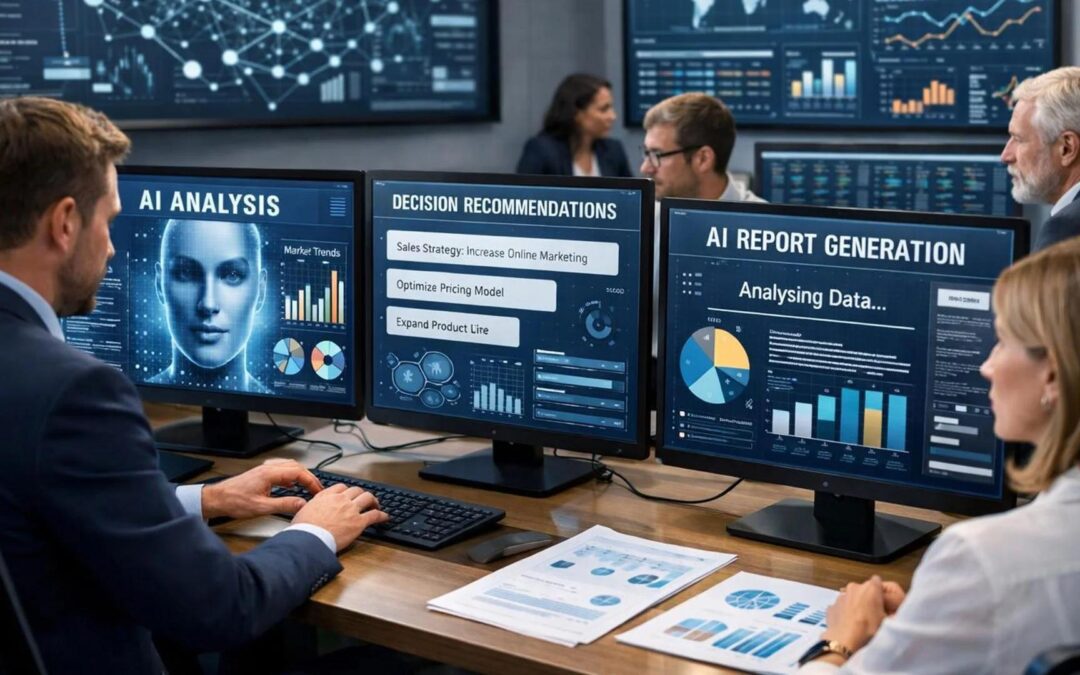
Artificial intelligence is transforming business decision-making from a predominantly human analytical process into an increasingly hybrid strategic system in which human judgment interacts continuously with machine-generated intelligence.
AI can process information, identify patterns, generate scenarios, detect emerging risks, accelerate forecasting, and support strategic choices at extraordinary speed. Yet greater analytical capability does not automatically produce better strategy.
Through the Techne–Phronesis Negotiation Framework™ (TPNF), the fundamental business challenge becomes clear:
AI expands the Techne of decision-making; Phronesis must determine how that capability should be strategically used.
The competitive advantage of the future may therefore belong not simply to companies possessing the most sophisticated AI, but to organizations capable of integrating AI capability, systems understanding, strategic leadership, institutional adaptation, and human practical wisdom into a coherent decision ecosystem.
Purpose of the Essay
This essay examines how AI is changing the role of business decision strategy in technological civilization.
Using TPNF, it argues that AI should not be understood merely as another productivity technology. It increasingly becomes part of the strategic decision architecture of the firm, influencing how organizations perceive markets, allocate resources, manage risk, negotiate, innovate, and create long-term value.
Introduction: From Business Intelligence to Decision Intelligence
Traditional business strategy has always depended upon information.
Executives collect market intelligence, examine competitors, analyze financial performance, evaluate risks, and choose among alternatives.
Artificial intelligence changes the scale and speed of this process.
Modern AI can analyze enormous quantities of structured and unstructured information, identify relationships difficult for humans to detect, simulate possible scenarios, summarize complex evidence, and generate strategic alternatives.
The transformation can be expressed simply:
Business Intelligence
↓
AI-Augmented Analysis
↓
Decision Intelligence
↓
Strategic Judgment
The first three stages can increasingly be technologically augmented.
The final stage remains fundamentally strategic.
1. AI Expands the Techne of Business Strategy
The first foundational proposition of TPNF states:
Technology Creates Capability.
AI dramatically expands corporate analytical capability.
Organizations can increasingly use AI to support:
- demand forecasting,
- competitive intelligence,
- supply-chain optimization,
- customer analysis,
- pricing decisions,
- financial modeling,
- scenario development,
- risk detection,
- product innovation,
- strategic planning.
This means managers can potentially understand their operating environment faster and with greater analytical depth.
But TPNF introduces an important distinction:
Analytical capability is not strategic wisdom.
AI may calculate which decision maximizes a particular variable.
Strategy must determine whether that variable should actually be maximized.
2. From Decision Support to Decision Ecosystems
The deeper transformation is therefore organizational.
AI is moving from being a tool used by individual employees toward becoming part of the wider Business Decision Ecosystem.
Imagine a corporation in which AI continuously monitors:
Markets + Customers + Competitors + Supply Chains + Technology + Regulation + Finance + Geopolitical Risk.
These information streams interact.
A geopolitical crisis may disrupt a supplier.
The disruption changes production costs.
Higher costs influence pricing.
Pricing affects demand.
Demand changes financial forecasts.
Management adjusts investment.
A single external event therefore propagates throughout the corporation.
This is why:
Systems Thinking Creates Understanding.
The strategic value of AI comes not simply from processing more information, but from helping decision-makers understand relationships among information.
3. AI Changes the Speed of Strategy
Traditional strategic planning often operated through annual or multi-year cycles.
Technological civilization increasingly makes such rhythms insufficient.
Markets evolve continuously.
Competitors introduce innovations rapidly.
Geopolitical shocks alter supply chains.
Consumer behavior changes.
AI enables organizations to observe these developments almost continuously.
Business strategy consequently becomes more adaptive:
Observe → Analyze → Decide → Act → Measure → Learn → Adapt
This produces what TPNF can describe as Continuous Strategic Adaptation™.
Strategy becomes less like a fixed document and increasingly like a continuously evolving organizational capability.
4. AI and Scenario-Based Decision Strategy
One particularly powerful AI application concerns scenarios.
Executives rarely possess certainty.
They make decisions under incomplete information.
AI can help organizations examine multiple possible futures simultaneously:
Scenario A: Market continues current trajectory.
Scenario B: Competitor introduces disruptive technology.
Scenario C: Supply chain experiences major disruption.
Scenario D: Regulation changes.
Scenario E: Geopolitical crisis transforms market conditions.
The objective is not to predict the future perfectly.
It is to increase Strategic Preparedness.
This distinction is central to TPNF.
Good strategy does not eliminate uncertainty.
It creates organizations capable of adapting when uncertainty becomes reality.
5. AI Changes Strategic Negotiation
AI will also influence business negotiation.
Companies can increasingly analyze:
- counterpart behavior,
- market alternatives,
- pricing structures,
- contractual risk,
- negotiation histories,
- scenario outcomes.
This potentially creates better-prepared negotiators.
But negotiation is not merely calculation.
Trust, reputation, emotion, organizational culture, political considerations, and long-term relationships remain important.
AI may therefore strengthen the Techne of negotiation, while human negotiators continue to provide essential Phronesis.
The future model becomes:
AI-Augmented Negotiation + Human Strategic Judgment.
6. The Capability–Dependency Paradox™
AI creates another strategic problem.
As companies become increasingly dependent upon AI, they may also become increasingly vulnerable to it.
This illustrates the TPNF:
Capability–Dependency Paradox™
AI creates capability.
But dependence upon AI may create new vulnerabilities involving:
- data quality,
- cybersecurity,
- model reliability,
- intellectual property,
- technological suppliers,
- infrastructure,
- human skill degradation.
Executives must therefore ask two questions whenever adopting AI:
What new capability does AI create?
and
What new dependency does that capability introduce?
Strategic leadership requires answering both.
7. The Danger of Automated Strategic Conformity
Another risk deserves attention.
If competing companies use similar models, similar datasets, and similar optimization methodologies, they may increasingly receive similar recommendations.
AI could therefore create an unexpected strategic paradox:
Better analysis but less strategic differentiation.
Competitive advantage often comes from seeing something competitors do not see.
Leadership therefore cannot simply ask AI:
What should we do?
It must also ask:
What assumptions is everyone else making?
What possibility is the model undervaluing?
Where can human imagination create strategic differentiation?
AI can expand strategic intelligence.
It should not eliminate strategic creativity.
8. Adaptive Governance Inside the Corporation
AI transformation is ultimately an institutional challenge.
Organizations must determine:
- which decisions AI may recommend,
- which decisions humans must approve,
- how AI outputs are verified,
- who accepts responsibility,
- how confidential information is protected,
- how employees develop new skills.
This requires Adaptive Governance.
Companies that acquire AI without redesigning their decision structures may possess advanced technology while maintaining outdated organizations.
That creates an Institutional Adaptation Gap.
The winners of AI transformation may therefore not necessarily be the earliest adopters.
They may be the organizations that adapt most coherently.
9. Human Leadership Becomes More Important
The rise of AI does not necessarily diminish leadership.
It changes what leadership must provide.
When machines increasingly provide analysis, human leaders must increasingly provide:
Purpose
Priorities
Judgment
Responsibility
Ethical boundaries
Strategic imagination
Meaning
This represents a transition:
From the Leader as Information Holder
to
The Leader as Strategic Orchestrator.
The executive of technological civilization increasingly coordinates humans, AI systems, institutions, networks, partners, and strategic ecosystems.
10. Phronesis and the Future of Business Decisions
The ultimate TPNF question remains:
What should we wisely choose to do?
AI may identify the most profitable decision.
But what if that decision damages long-term reputation?
AI may recommend workforce reductions.
But what happens to organizational knowledge?
AI may optimize supply chains.
But does maximum efficiency eliminate resilience?
AI may recommend aggressive pricing.
But what happens to long-term customer trust?
These are multidimensional strategic questions.
Phronesis therefore becomes increasingly valuable precisely because AI becomes increasingly capable.
The greater our technological decision capability becomes, the greater our need for strategic wisdom.
The TPNF AI–Business Decision Architecture
The emerging model can therefore be summarized:
AI / TECHNE
Creates Analytical Capability
↓
SYSTEMS THINKING
Connects Information
↓
SCENARIO ANALYSIS
Explores Possible Futures
↓
STRATEGIA
Defines Objectives and Choices
↓
STRATEGIC NEGOTIATION
Coordinates Interests
↓
ADAPTIVE GOVERNANCE
Integrates AI Institutionally
↓
PHRONESIS
Exercises Human Strategic Judgment
↓
MULTIDIMENSIONAL VALUE CREATION
This represents a possible architecture for business decision strategy in the technological age.
Strategic Implications
AI will increasingly become part of the strategic nervous system of modern organizations. Competitive advantage will therefore depend less upon simply possessing AI and increasingly upon how intelligently AI is integrated into the wider decision ecosystem.
Companies should avoid two extremes: rejecting AI because human judgment is considered sufficient, or surrendering strategic judgment because AI appears analytically superior.
The more powerful model is collaborative:
Machine Analytical Intelligence + Human Strategic Wisdom.
Organizations capable of combining both may become faster without becoming reckless, more analytical without becoming mechanistic, and more efficient without sacrificing resilience.
Artificial intelligence is transforming business decision strategy because it changes how organizations perceive, analyze, and respond to their environments.
But AI does not eliminate strategy.
It makes strategy more important.
Through TPNF, the transformation becomes clear:
Technology creates new analytical capability.
Systems Thinking converts information into understanding.
Strategia transforms understanding into purposeful action.
Adaptive Governance integrates AI into the organization.
Phronesis determines whether the resulting decisions create lasting value.
The strategic corporation of the future will therefore not simply be an AI-driven organization.
It should become an AI-augmented, human-guided strategic ecosystem.
And the decisive competitive question may eventually become not:
Which company has the most powerful AI?
but:
Which company possesses the wisdom to make the best strategic decisions with it?
Key Takeaways
- AI is transforming business intelligence into increasingly sophisticated decision intelligence.
- AI expands the Techne of strategy but does not automatically create strategic wisdom.
- Business strategy is becoming a process of Continuous Strategic Adaptation™.
- AI strengthens scenario analysis and strategic preparedness under uncertainty.
- Every AI capability can simultaneously create a new technological dependency.
- Overreliance on similar AI systems may create Automated Strategic Conformity.
- AI transformation requires Adaptive Governance, not merely technology acquisition.
- Human leadership increasingly shifts from information control toward strategic orchestration.
- Competitive advantage will come from integrating AI with human judgment.
- Phronesis becomes more—not less—important as AI capability increases.
Author’s Reflection
Artificial intelligence represents one of the most important expansions of organizational Techne in modern business history. Yet technological capability alone has never guaranteed strategic success.
The fundamental challenge for business leaders is therefore not merely how rapidly they adopt AI, but how wisely they integrate it into organizational decision-making.
The Techne–Phronesis Negotiation Framework™ (TPNF) suggests that the future of business strategy lies neither in exclusively human decision-making nor in autonomous machine decision-making.
It lies in their intelligent integration.
AI can expand analytical capability. Human beings must continue defining purpose, accepting responsibility, exercising judgment, and determining what constitutes lasting value.
The future competitive organization may therefore be distinguished not simply by artificial intelligence, but by its capacity to transform artificial intelligence into strategically wise action.
Nikos Chatzis
Source: Open Sources Analysis, Relative Data Analysis by Nikos Chatzis
© Nikolaos Chatzis. All Rights Reserved.
The Techne–Phronesis Negotiation Framework™
An Integrative Theory of Strategic Negotiation, Complex Adaptive Systems and Practical Wisdom
Technology Creates Capability • Systems Thinking Creates Understanding • Strategic Wisdom Creates Lasting Value.
Negotiation.gr | Strategic Wisdom for the Technological Age