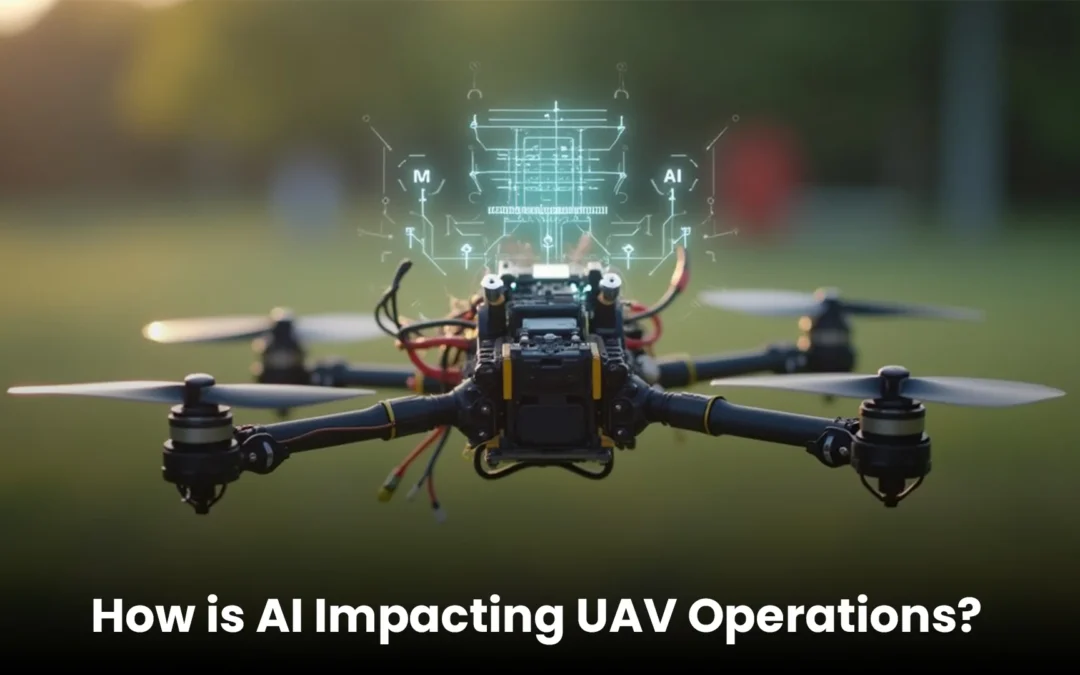
The drone industry is entering a new era of technological transformation. For more than two decades, innovation in Unmanned Aircraft Systems (UAS) focused primarily on improving hardware performance, including flight endurance, payload capacity, sensor integration, navigation systems, and communications capabilities. These advances enabled drones to become indispensable tools across a growing range of civilian and defense applications.
Today, however, the industry is approaching a new frontier. The future competitive advantage of drone technology will increasingly derive not from the aircraft itself but from the intelligence embedded within it. Artificial Intelligence (AI) is rapidly emerging as the key enabling technology that will transform drones from remotely operated platforms into autonomous systems capable of perception, learning, decision-making, and adaptive behavior.
Just as the combination of computers and the internet revolutionized the global economy, the convergence of Artificial Intelligence and drone technology is poised to redefine the future of aviation, geospatial intelligence, public safety, infrastructure management, logistics, and national defense.
From Flying Machines to Intelligent Systems
The first generation of drones functioned primarily as remotely piloted aircraft.
Human operators controlled:
- Navigation
- Flight paths
- Data collection
- Mission execution
While these systems offered significant operational advantages, they remained heavily dependent on human intervention.
Artificial Intelligence fundamentally changes this relationship.
Through machine learning, computer vision, sensor fusion, and real-time data processing, drones can increasingly understand their environment and respond dynamically to changing conditions.
The drone is no longer simply a flying platform.
It becomes an intelligent system.
This transformation represents one of the most important developments in the history of unmanned aviation.
Autonomous Navigation and Beyond Visual Line of Sight Operations
One of the most significant challenges facing the drone industry is the expansion of Beyond Visual Line of Sight (BVLOS) operations.
Current regulations often require operators to maintain visual contact with drones, limiting operational efficiency and scalability.
Artificial Intelligence provides a pathway toward safe autonomous navigation.
AI-enabled systems can:
- Detect obstacles
- Avoid collisions
- Recognize terrain features
- Adapt to changing weather conditions
- Optimize flight paths
By combining machine learning algorithms with advanced sensors, autonomous drones can operate safely in increasingly complex environments.
The widespread adoption of BVLOS capabilities will unlock new applications in:
- Logistics
- Infrastructure inspection
- Emergency response
- Environmental monitoring
- Long-range surveillance
The economic impact of this transition could be transformative.
Computer Vision and Situational Awareness
Computer vision is one of the most powerful applications of Artificial Intelligence within the drone ecosystem.
Advanced AI systems can analyze visual information in real time and identify:
- Vehicles
- Buildings
- Infrastructure defects
- Agricultural conditions
- Environmental changes
- Human activity
This capability significantly enhances situational awareness.
For example, infrastructure inspection drones can automatically identify cracks, corrosion, or structural anomalies.
Agricultural drones can detect crop diseases before they become visible to the human eye.
Emergency response drones can rapidly assess disaster zones and identify areas requiring immediate attention.
The ability to transform raw imagery into actionable intelligence dramatically increases the value of drone operations.
Geospatial Intelligence and Data Analytics
Modern drones generate enormous quantities of geospatial data.
However, collecting data is only the first step.
The true value lies in converting information into knowledge.
Artificial Intelligence enables:
- Automated image analysis
- Pattern recognition
- Predictive analytics
- Change detection
- Spatial modeling
As a result, drones are becoming critical components of geospatial intelligence ecosystems.
Governments, businesses, and research institutions increasingly rely on AI-powered geospatial intelligence to support:
- Urban planning
- Environmental management
- Infrastructure development
- Resource optimization
- Security operations
The future drone economy will be increasingly driven by data services and intelligent analytics rather than aircraft sales alone.
Swarm Intelligence and Collaborative Autonomy
One of the most fascinating developments in AI-enabled drone technology is swarm intelligence.
Inspired by biological systems such as bird flocks and insect colonies, swarm technologies allow multiple drones to operate collaboratively while sharing information and coordinating behavior.
Potential applications include:
- Search and rescue missions
- Environmental monitoring
- Agricultural management
- Infrastructure inspections
- Defense operations
Swarm systems offer significant advantages in terms of efficiency, resilience, and scalability.
Artificial Intelligence serves as the coordination mechanism that enables distributed autonomous behavior.
This represents a major step toward fully networked aerial ecosystems.
Artificial Intelligence in Defense Applications
The defense sector is increasingly investing in AI-enabled autonomous systems.
Modern military operations require:
- Real-time intelligence
- Persistent surveillance
- Rapid decision-making
- Adaptive mission planning
Artificial Intelligence enhances drone capabilities by enabling:
- Automated target recognition
- Threat detection
- Autonomous navigation
- Mission optimization
- Distributed operations
The integration of AI into defense drones is reshaping military doctrine and altering the strategic balance of power.
Recent conflicts have demonstrated the growing importance of intelligent unmanned systems in both tactical and strategic environments.
As a result, AI-powered drones are becoming central elements of national security planning worldwide.
Smart Cities and Digital Infrastructure
The future of urban development increasingly depends upon intelligent infrastructure.
AI-enabled drones can support smart city initiatives through:
- Traffic monitoring
- Infrastructure inspections
- Environmental assessments
- Public safety operations
- Emergency management
When integrated with digital twins, cloud platforms, and Internet of Things (IoT) networks, drones become mobile sensors within larger urban intelligence systems.
This integration allows cities to collect real-time information and improve decision-making across multiple domains.
Artificial Intelligence acts as the analytical engine that transforms data into actionable insights.
Human-Machine Collaboration
Despite rapid advances in autonomy, the future of drone technology is unlikely to eliminate human involvement.
Instead, AI will enhance human capabilities.
The emerging model is one of human-machine collaboration.
AI systems will perform:
- Data processing
- Pattern recognition
- Predictive analysis
- Routine operational tasks
Human operators will focus on:
- Strategic oversight
- Ethical judgment
- Mission objectives
- Policy decisions
This partnership allows organizations to combine computational efficiency with human creativity and accountability.
Innovation Ecosystems and Technology Leadership
The rise of Artificial Intelligence is also transforming the broader innovation ecosystem surrounding drones.
Future competitiveness will depend upon collaboration among:
- Universities
- Research centers
- Technology companies
- Governments
- Investors
- Regulators
AI development requires expertise in:
- Machine learning
- Robotics
- Cloud computing
- Data science
- Geospatial intelligence
Consequently, successful drone ecosystems must integrate diverse capabilities into collaborative innovation networks.
The countries and organizations that effectively combine AI and drone technologies will enjoy significant advantages in economic development, technological leadership, and strategic influence.
Artificial Intelligence represents the next major frontier in drone development because it fundamentally transforms the nature of unmanned aviation. It enables drones to evolve from remotely controlled aircraft into intelligent autonomous systems capable of perception, learning, adaptation, and collaboration.
Through applications such as autonomous navigation, computer vision, geospatial intelligence, swarm coordination, predictive analytics, and human-machine collaboration, AI is unlocking capabilities that were previously impossible.
The future of the drone industry will increasingly be defined by intelligent ecosystems rather than aircraft platforms alone. Economic value, societal impact, and strategic advantage will emerge from the ability to integrate Artificial Intelligence with geospatial intelligence, digital infrastructure, autonomous systems, and innovation networks.
In this new era, the most successful organizations will not merely build drones. They will build intelligent ecosystems in which drones serve as autonomous participants in a broader architecture of data, knowledge, and decision-making. Artificial Intelligence is therefore not simply another technological enhancement; it is the foundation upon which the next generation of the global drone economy will be built.
Source: Open Sources Analysis, Relative Data Analysis by Nikos Chatzis
© 2026 Nikolaos Chatzis – negotiation.gr. All Rights Reserved. No part of this publication may be reproduced, distributed, or transmitted without prior written permission, except for brief quotations with proper attribution.