Negotiation.gr | Strategic Wisdom for the Technological Age
“Strategic resilience emerges when technical capability (techne) is
continuously guided by practical wisdom (phronesis) through adaptive
negotiation across interconnected systems.”
From Reactive Problem-Solving to Adaptive Strategic Thinking
Central Idea (Thesis)
Adversity is an unavoidable dimension of human experience. Professional difficulties, technological failures, financial constraints, personal disappointments, and unexpected changes frequently challenge individuals’ ability to pursue their objectives.
Within the Techne–Phronesis Negotiation Framework™ (TPNF), adversity can become an opportunity for learning, strategic adaptation, and long-term value creation.
This transformation is neither automatic nor guaranteed. It requires the integration of Techne, Systems Thinking, and Phronesis to understand difficult circumstances, develop realistic alternatives, and make decisions that preserve future opportunities.
The strategic challenge is not simply overcoming adversity but developing the capacity to respond to it constructively.
Purpose of the Essay
This TPNF essay examines the practical application of TPNF in everyday life.
Its educational purpose is to help students, professionals, and individuals develop a structured approach to managing unexpected difficulties, limited resources, competing responsibilities, and uncertainty.
It also explores how everyday experiences can contribute to the gradual development of strategic intelligence, personal resilience, and practical wisdom.
Abstract
Strategic thinking is frequently associated with governments, corporations, military organizations, and international negotiations. However, individuals also operate within complex ecosystems characterized by uncertainty, competing priorities, resource limitations, and unexpected developments.
TPNF offers an integrated approach through which everyday adversity can become a foundation for learning, adaptation, improved decision-making, and sustainable personal development.
1. Adversity as a Dimension of Human Experience
Human life rarely develops according to predetermined plans.
A technological failure may interrupt professional activities. An unsuccessful examination may challenge educational ambitions. An unexpected financial expense may disrupt personal planning. Family responsibilities may require the postponement of professional objectives.
Such developments frequently generate disappointment, frustration, and uncertainty.
However, adversity does not necessarily invalidate the strategic objective. It may instead require a reconsideration of the pathway through which that objective is pursued.
This distinction is fundamental to TPNF.
An individual experiencing difficulties should distinguish between the temporary disruption of a plan and the permanent loss of an opportunity.
Strategic adaptation begins with understanding this difference.
2. From Emotional Reaction to Strategic Response
Human beings naturally respond emotionally to unexpected difficulties.
Frustration, anger, disappointment, and anxiety are understandable reactions when circumstances threaten important personal objectives.
Nevertheless, immediate emotional reactions may not provide the most appropriate foundation for consequential decisions.
TPNF encourages individuals to acknowledge their emotions while creating sufficient space for reflection and informed judgment.
Three questions become particularly important:
-
What has actually happened?
-
How does this development affect my wider objectives?
-
Which available response could preserve or create long-term value?
These questions facilitate the transition from reactive problem-solving toward constructive strategic thinking.
The objective is not emotional suppression but the integration of emotional awareness with practical reasoning.
3. The Aristotelian Foundation: Techne and Phronesis
In the Nicomachean Ethics, Aristotle distinguishes between Techne, associated with productive expertise, and Phronesis, associated with practical wisdom and responsible human action.
An individual may possess considerable technical knowledge without necessarily knowing how best to employ it under difficult circumstances.
Conversely, sound judgment may reveal the need to acquire additional knowledge, seek assistance, or reconsider an established objective.
TPNF incorporates Systems Thinking between these two dimensions, emphasizing the importance of understanding relationships, dependencies, and consequences.
This integration provides a contemporary interpretation of classical Greek philosophical thought within the complexity of everyday life.
4. The Individual as an Everyday Strategic Ecosystem
Every individual operates within an interconnected personal ecosystem.
Professional responsibilities, family relationships, education, technological resources, financial circumstances, physical health, and psychological well-being influence one another.
A disruption affecting one dimension can produce consequences elsewhere.
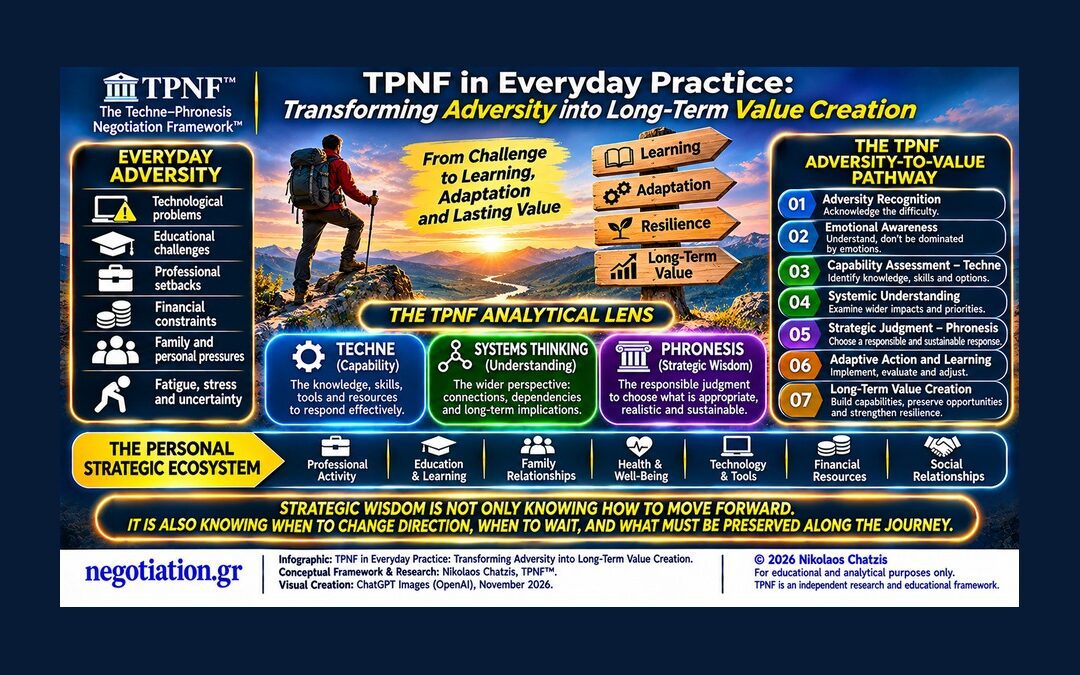
| Personal ecosystem dimension | Potential long-term value |
|---|---|
| Professional activity | Experience and professional development |
| Education | Knowledge and future opportunities |
| Family relationships | Trust, care, and emotional fulfillment |
| Technology | Productivity and access to information |
| Health and well-being | Sustainable personal capabilities |
| Social relationships | Cooperation and mutual support |
| Financial resources | Stability and freedom of choice |
Optimizing one dimension while neglecting the others may undermine the sustainability of the entire ecosystem.
Strategic success therefore requires balance rather than continuous maximization of productivity.
5. The TPNF Analytical Lens in Everyday Practice
Techne — Capability
Techne concerns the knowledge, skills, tools, and resources available to address a difficult situation.
When adversity emerges, individuals must evaluate their existing capabilities and identify additional expertise or assistance that may be required.
The fundamental question is:
What can I realistically do?
Systems Thinking — Understanding
Systems Thinking examines the wider implications of a problem.
An individual must recognize how a decision affects professional responsibilities, personal relationships, financial resources, available time, and future opportunities.
The fundamental question is:
How does this situation influence my wider personal ecosystem?
Phronesis — Strategic Wisdom
Phronesis determines which available response is appropriate, responsible, and sustainable.
Sometimes, the wisest decision involves persistence. At other times, it requires postponement, compromise, acceptance, or abandoning an unsuitable course of action.
The fundamental question is:
Which decision best serves my meaningful long-term objectives?
6. Three Practical Examples of Transforming Adversity
Example A: Technological Failure
An individual purchases technological equipment intended to improve professional productivity. Unexpected technical problems prevent its immediate use.
The initial experience generates disappointment and interrupts planned activities.
Through TPNF, however, the individual can investigate the problem, evaluate alternatives, exercise consumer rights, and reconsider future purchasing criteria.
Even if the original financial or operational loss cannot be fully recovered, the experience may contribute to improved technological knowledge and future decision-making.
Example B: Educational Constraints
A professional pursuing additional qualifications encounters difficulties allocating sufficient study time because of employment and family responsibilities.
Rather than abandoning the educational objective, the individual could redesign the learning schedule, prioritize essential knowledge, and adopt shorter, manageable study sessions.
Strategic adaptation preserves the long-term objective while respecting existing responsibilities.
Example C: Professional Exhaustion
An individual developing an ambitious intellectual or entrepreneurial project experiences fatigue following demanding professional commitments.
Continuing work regardless of exhaustion may undermine creativity, judgment, and well-being.
Temporarily postponing activities can protect the human capabilities on which future progress depends.
In this context, rest is not necessarily a departure from strategy. It can constitute an essential component of strategic sustainability.
7. The TPNF Adversity-to-Value Creation Pathway
From Adversity to Long-Term Value Creation
01
Adversity Recognition
Acknowledge the difficulty and its actual consequences.
02
Emotional Awareness
Recognize emotional reactions without allowing them to dominate decisions.
03
Capability Assessment — Techne
Identify available knowledge, resources and alternatives.
04
Systemic Understanding
Examine dependencies, consequences and competing priorities.
05
Strategic Judgment — Phronesis
Select a responsible and sustainable response.
06
Adaptive Action and Learning
Implement, evaluate and revise the response.
07
Long-Term Value Creation
Preserve opportunities, develop capabilities and strengthen resilience.
TPNF proposed conceptual model for everyday strategic adaptation.
This pathway is not necessarily linear. New information may require individuals to reconsider earlier assessments and modify their responses.
8. Negotiating with Ourselves
Negotiation is traditionally understood as a process involving two or more parties seeking to reconcile different interests.
However, everyday life frequently requires individuals to reconcile competing personal objectives.
Professional ambitions may conflict with family responsibilities. Educational development may compete with limited available time. Immediate satisfaction may undermine future opportunities.
TPNF introduces the possibility of understanding these circumstances as a form of internal strategic negotiation.
The objective is not to maximize every individual ambition simultaneously.
It is to establish a sustainable relationship among competing priorities without unnecessarily sacrificing meaningful long-term objectives.
Knowing when not to act can be as strategically important as knowing when to act.
9. Adversity, Resilience, and the Limits of Positive Thinking
Not every adverse experience can be transformed into a beneficial outcome.
Some difficulties involve irreversible losses, injustice, or circumstances beyond individual control.
TPNF should therefore avoid equating strategic thinking with unconditional optimism.
Constructive adaptation requires realistic assessments, acceptance of limitations, and recognition that external assistance may be necessary.
Resilience does not mean continuously enduring difficult circumstances. It may involve changing environments, requesting support, establishing boundaries, or withdrawing from unsustainable commitments.
Long-term value creation begins with protecting what genuinely matters.
10. Strategic Lessons for Everyday Life
-
Distinguish strategic objectives from temporary plans. Changing the pathway does not necessarily mean abandoning the destination.
-
Recognize emotions without allowing them to determine every decision.
-
Develop capabilities through continuous learning.
-
Evaluate difficulties within the wider personal ecosystem.
-
Protect health, relationships, and human sustainability.
-
Accept that postponement can constitute a rational strategic decision.
-
Measure progress through accumulated value rather than uninterrupted activity.
11. Conclusion: Transforming Experience into Strategic Wisdom
Adversity constitutes an unavoidable dimension of human life, but its consequences are not always predetermined.
The integration of technological and practical capabilities, systemic understanding, and strategic wisdom can help individuals respond constructively to uncertainty.
TPNF provides a conceptual pathway through which everyday difficulties may contribute to personal learning, professional development, stronger relationships, and sustainable decision-making.
The ultimate objective is not to eliminate adversity.
It is to develop the capacity to navigate complexity while preserving meaningful future opportunities.
Key Takeaways
Everyday life constitutes a complex strategic ecosystem. Adversity may become a foundation for learning when individuals combine realistic capability assessment, systemic understanding, and practical wisdom. Sustainable progress requires adaptability, responsible prioritization, and respect for human limitations.
Author’s Reflection
Strategic wisdom should not remain confined to academic institutions, corporate environments, or international negotiating tables.
Its deepest significance may emerge through the everyday decisions individuals make when confronted with uncertainty, disappointment, and competing responsibilities.
Human development is not measured exclusively through uninterrupted success. It can also be measured through the knowledge, understanding, and wisdom accumulated while navigating difficult circumstances.
Techne enables us to act. Systems Thinking helps us understand. Phronesis teaches us when, why, and how to act.
Adversity is not inherently a source of value. The wisdom with which we respond to it can become one.
Nikolaos Chatzis
Selected Research References
-
Aristotle, Nicomachean Ethics, Book VI — Intellectual Virtues, Techne and Phronesis.
-
Richard Kraut, Aristotle’s Ethics, Stanford Encyclopedia of Philosophy.
plato.stanford.edu+1 -
Aristotle, Nicomachean Ethics, translated and edited by Roger Crisp, Cambridge University Press.
beckassets.blob.core.windows.net -
Donella H. Meadows (2008), Thinking in Systems: A Primer, Chelsea Green Publishing.
-
Donald A. Schön (1983), The Reflective Practitioner: How Professionals Think in Action, Basic Books.
-
Roger Fisher, William Ury and Bruce Patton, Getting to Yes: Negotiating Agreement Without Giving In.
Source: Open Sources Analysis, Relative Data Analysis by Nikos Chatzis
© Nikolaos Chatzis. All Rights Reserved.
The Techne–Phronesis Negotiation Framework™
An Integrative Theory of Strategic Negotiation, Complex Adaptive Systems and Practical Wisdom
Technology Creates Capability • Systems Thinking Creates Understanding • Strategic Wisdom Creates Lasting Value.
Negotiation.gr | Strategic Wisdom for the Technological Age