Negotiation.gr | Strategic Wisdom for the Technological Age
“Strategic resilience emerges when technical capability (techne) is
continuously guided by practical wisdom (phronesis) through adaptive
negotiation across interconnected systems.”
Artificial Intelligence, Technological Adaptation, and the Transformation of Military Power
Central Idea (Thesis)
Russia’s full-scale invasion of Ukraine has demonstrated that numerical military superiority does not automatically translate into decisive strategic superiority.
Artificial intelligence, unmanned systems, satellite intelligence, electronic warfare, digital communications, and organizational adaptability are transforming the relationship between military resources and military effectiveness.
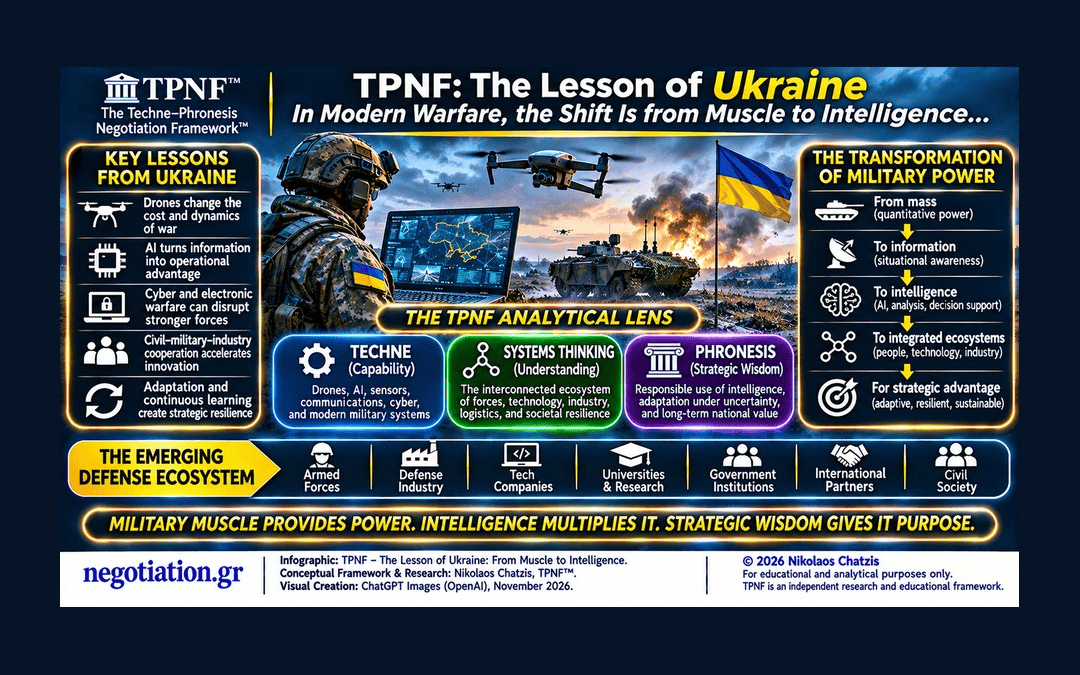
Within the Techne–Phronesis Negotiation Framework™ (TPNF), the emerging lesson is that strategic advantage increasingly depends on the intelligent integration of technological capabilities, human expertise, institutional learning, and adaptive decision-making.
Military muscle remains indispensable. However, intelligence increasingly determines its strategic value.
Purpose of the Essay
This TPNF essay examines how the war in Ukraine is transforming conventional perceptions of military power, emphasizing technological innovation, organizational intelligence, and the development of adaptive defense ecosystems.
Its educational purpose is to help students, policymakers, military professionals, and technology developers understand the distinction between possessing military capabilities and employing them effectively within complex operational environments.
It also explores the implications of this transformation for NATO, European defense modernization, and Greece.
Abstract
The war in Ukraine represents a major transformation in the character of contemporary warfare. Traditional military formations increasingly coexist with distributed intelligence networks, autonomous technologies, commercial innovation, and software-driven capabilities.
The TPNF analytical perspective examines this transformation as an evolving relationship between physical power, technological intelligence, systemic understanding, and strategic wisdom.
1. From Industrial Warfare to Intelligent Warfare
Throughout the twentieth century, military power was largely associated with the possession of substantial armed forces, armored formations, artillery, combat aircraft, and industrial production capacity.
These capabilities remain essential.
However, twenty-first-century warfare increasingly introduces another decisive dimension: the ability to collect, interpret, distribute, and intelligently utilize information.
A military organization may possess considerable physical resources while suffering from inadequate situational awareness, institutional rigidity, fragmented communications, or slow decision-making.
Conversely, a technologically adaptive organization may partially compensate for quantitative disadvantages through superior knowledge and organizational flexibility.
Ukraine illustrates this evolving relationship between material resources and strategic effectiveness.
The transformation is not from physical power to digital power alone. It is from relatively isolated military capabilities toward interconnected, intelligence-driven defense systems.
2. Ukraine: A Strategic Laboratory of Technological Adaptation
Since Russia’s full-scale invasion in February 2022, Ukraine has faced a larger adversary possessing significant military and industrial resources.
Ukraine responded partly by mobilizing its civilian technological sector, software engineers, volunteer organizations, private manufacturers, and international partnerships.
Commercial technologies acquired military significance at unprecedented speed.
Research published by the Center for Strategic and International Studies documents Ukraine’s transition toward a more decentralized defense innovation ecosystem, supported by private enterprise and revised procurement processes.
The strategic significance lies beyond individual technological inventions.
Ukraine demonstrates how institutional flexibility can accelerate the conversion of civilian knowledge into national defense capabilities.
Innovation consequently becomes a continuous organizational process rather than an occasional achievement of traditional military industry.
3. Unmanned Systems: Redefining the Economics of Military Power
Unmanned aerial, maritime, and ground systems have become prominent features of the conflict.
Their significance extends beyond their individual capabilities.
Relatively inexpensive technologies increasingly coexist with sophisticated military platforms, challenging traditional assumptions concerning procurement costs, operational endurance, and the concentration of military resources.
However, drones are not independent substitutes for conventional armed forces.
They depend on communications, energy, software, manufacturing capacity, trained personnel, maintenance, and institutional coordination.
Their effectiveness therefore illustrates a fundamental TPNF principle: the strategic value of a technology depends partly on the ecosystem supporting it.
Future military modernization must consider affordability, scalability, reliability, and technological integration alongside individual platform performance.
4. Artificial Intelligence: From Information to Understanding
Modern military organizations operate within increasingly information-intensive environments.
Satellites, sensors, unmanned systems, communications networks, and digital platforms generate enormous quantities of information.
Artificial intelligence can assist with data processing, pattern recognition, information classification, predictive maintenance, and decision support.
Nevertheless, information is not equivalent to understanding.
AI-generated assessments may contain errors, depend on incomplete data, or produce misleading conclusions.
Human judgment remains indispensable, particularly when decisions involve uncertainty, civilian protection, international humanitarian law, and potentially irreversible consequences.
Within TPNF, artificial intelligence represents an extension of Techne.
It strengthens human capabilities but cannot independently replace Phronesis.
5. The Invisible Dimension: Electronic and Cyber Warfare
Modern warfare increasingly encompasses environments that cannot be observed through conventional physical military indicators.
Electronic warfare, cybersecurity, communications integrity, and information security influence the reliability of contemporary defense systems.
Technological interconnectedness simultaneously creates capabilities and vulnerabilities.
Advanced military platforms may experience reduced effectiveness when their supporting digital infrastructure is disrupted.
Consequently, technological superiority is neither permanent nor absolute.
Both Russia and Ukraine have demonstrated continuing technological adaptation throughout the conflict.
Modern strategic advantage must therefore be understood as dynamic, contested, and potentially temporary.
The capacity to learn and adapt becomes as important as the original technological innovation.
6. The Emerging Defense Technological Ecosystem
Ukraine demonstrates the importance of cooperation among actors traditionally separated by institutional boundaries.
| Ecosystem participant | Strategic contribution |
|---|---|
| Armed forces | Operational experience and institutional requirements |
| Private technology companies | Software and technological innovation |
| Defense manufacturers | Industrial production and reliability |
| Universities | Research, engineering, and education |
| Government institutions | Funding, regulation, and coordination |
| International partners | Knowledge exchange and material support |
| Civil society | Technical expertise and national resilience |
The interaction of these participants creates an increasingly distributed defense technological ecosystem.
The effectiveness of such an ecosystem depends on institutional trust, communication, technological compatibility, and the capacity to translate knowledge into practical improvements.
National defense becomes a broader societal capability.
7. Intelligence Does Not Eliminate the Need for Military Muscle
One of the greatest analytical mistakes would be to conclude that artificial intelligence and unmanned systems have rendered conventional military capabilities obsolete.
The war continues to demonstrate the importance of personnel, artillery, air defense, logistics, industrial production, and sustained access to essential resources.
Russia’s continuing adaptation also demonstrates that technological innovation is not an exclusively Ukrainian advantage.
The emerging strategic model combines quantitative strength with qualitative intelligence.
European defense planning increasingly recognizes this requirement: sufficient military mass must coexist with technological agility and institutional adaptability.
The decisive question is how effectively these dimensions are integrated.
8. The TPNF Analytical Lens
Techne — Capability
Artificial intelligence, unmanned systems, advanced sensors, cybersecurity, communications networks, conventional military platforms, and industrial production provide the material and technological foundations of defense.
Systems Thinking — Understanding
Military effectiveness depends on recognizing the interdependencies among technology, personnel, logistics, industrial production, institutional structures, international partnerships, and societal resilience.
Phronesis — Strategic Wisdom
Responsible leadership requires evaluating technological limitations, human consequences, legal obligations, strategic objectives, and the long-term implications of military decisions.
TPNF therefore distinguishes technological sophistication from strategic intelligence.
Possessing advanced systems does not necessarily mean understanding how to govern them wisely.
9. Strategic Implications for NATO, Europe, and Greece
Ukraine’s experience offers important lessons for European defense modernization.
Greece, in particular, could complement its acquisition of advanced military platforms through investment in domestic technological development, aerospace education, cybersecurity, scientific research, and industrial cooperation.
The objective should not simply be the accumulation of sophisticated military equipment.
It should be the development of an adaptive national defense technological ecosystem capable of sustaining innovation across successive generations of technology.
Nevertheless, lessons from Ukraine must be evaluated against Greece’s distinctive geography, maritime environment, alliance commitments, economic resources, and national defense requirements.
Strategic adaptation requires contextual understanding rather than imitation.
10. Strategic Lessons for Leaders
-
Combine military mass with intelligence. Neither dimension independently guarantees strategic effectiveness.
-
Develop adaptive defense ecosystems. Connect research institutions, military organizations, and private industry.
-
Recognize information as a strategic resource. Its reliability and responsible interpretation are essential.
-
Invest in technological education. Human expertise remains central to military modernization.
-
Prioritize institutional learning. Technological advantages can rapidly diminish.
-
Preserve human responsibility. Artificial intelligence must operate within appropriate legal and ethical safeguards.
-
Evaluate long-term national value. Defense modernization should strengthen industrial, educational, technological, and institutional resilience.
11. Conclusion: From Military Muscle to Strategic Intelligence
Ukraine demonstrates that modern warfare increasingly depends on the relationship between physical resources, technological innovation, organizational adaptability, and intelligent decision-making.
Military strength remains necessary, but its strategic effectiveness cannot be evaluated independently of the wider ecosystem supporting it.
Within TPNF, the emerging transformation can be summarized through three interconnected requirements: technological capability, systemic understanding, and strategic wisdom.
The future of national defense will depend not merely on possessing more powerful military platforms, but on developing institutions capable of learning, adapting, and employing their resources responsibly.
Key Takeaways
Modern military power increasingly emerges from the integration of conventional strength, artificial intelligence, technological innovation, and human expertise. Ukraine illustrates the strategic importance of adaptive ecosystems without demonstrating that traditional military capabilities have become obsolete.
Author’s Reflection
Human history repeatedly demonstrates that possessing superior physical strength does not automatically guarantee superior strategic judgment.
From the strategic thought of ancient Greece to contemporary technological warfare, intelligence has remained a fundamental dimension of power.
Artificial intelligence expands humanity’s technological capabilities. However, the responsibility for determining their strategic purpose remains human.
The ultimate transformation may therefore be less about replacing military muscle with machines and more about developing the wisdom necessary to govern increasingly intelligent technologies.
Nikolaos Chatzis
Selected Research References
- Australian Army Research Centre, 2026: Drones in Modern Warfare (2024–2026): Lessons Learnt from the War in Ukraine.
- French Institute of International Relations (Ifri), February 2026: Mapping the MilTech War: Eight Lessons from Ukraine’s Battlefield.
- The Hague Centre for Strategic Studies, June 2026: Lessons That Transfer: Observations from the Russo-Ukraine War for European Land Forces.
- CSIS, May 2025: Lessons from the Ukraine Conflict: Modern Warfare in the Age of Autonomy, Information, and Resilience.
- CSIS, July 2025: Unleashing U.S. Military Drone Dominance: What the United States Can Learn from Ukraine.
- CSIS, November 2024: Understanding the Military AI Ecosystem of Ukraine.
- European Commission, 2025: Adapting to Modern Warfare: Lessons from Ukraine and Europe’s Evolving Defence Paradigm — COM(2025) 845.
Source: Open Sources Analysis, Relative Data Analysis by Nikos Chatzis
© Nikolaos Chatzis. All Rights Reserved.
The Techne–Phronesis Negotiation Framework™
An Integrative Theory of Strategic Negotiation, Complex Adaptive Systems and Practical Wisdom
Technology Creates Capability • Systems Thinking Creates Understanding • Strategic Wisdom Creates Lasting Value.
Negotiation.gr | Strategic Wisdom for the Technological Age