Negotiation.gr | Strategic Wisdom for the Technological Age
“Strategic resilience emerges when technical capability (techne) is
continuously guided by practical wisdom (phronesis) through adaptive
negotiation across interconnected systems.”
From Lunar Exploration to Sustainable Interplanetary Technological Ecosystems
Central Idea (Thesis)
America’s return to the Moon represents a fundamental transition from individual space exploration missions toward the development of a sustained extraterrestrial technological ecosystem.
Unlike the Apollo era, contemporary American space strategy seeks to establish infrastructure, cultivate commercial partnerships, develop human capital, and prepare the technological foundations for future crewed missions to Mars.
Within the Techne–Phronesis Negotiation Framework™ (TPNF), this transition illustrates how technological capability, systemic understanding, and strategic wisdom can transform ambitious exploration objectives into sustainable long-term value creation.
Purpose of the Essay
This TPNF essay examines the strategic significance of America’s return to the Moon, NASA’s evolving Artemis program, commercial space partnerships, and preparations for human exploration of Mars.
Its educational purpose is to help students and emerging professionals understand how technological ecosystems develop through cooperation among governments, private companies, universities, research institutions, and international partners.
The central objective is to distinguish the achievement of reaching a destination from the strategic capacity to establish and sustain a human presence there.
Abstract
NASA’s Moon-to-Mars strategy represents an increasingly integrated approach to human space exploration. Lunar infrastructure, advanced transportation systems, autonomous technologies, energy production, and international cooperation constitute essential components of this emerging ecosystem.
The TPNF analytical perspective examines how these interconnected capabilities could generate scientific, economic, technological, educational, and geopolitical value extending across generations.
1. From Apollo to Artemis: A Fundamental Strategic Transition
On July 20, 1969, Apollo 11 achieved humanity’s first crewed lunar landing.
The Apollo program demonstrated American technological superiority, scientific competence, industrial coordination, and geopolitical determination during the Cold War.
However, following Apollo 17 in December 1972, human exploration of the lunar surface ceased.
More than half a century later, America is pursuing a fundamentally different objective.
The Artemis program seeks to transform lunar exploration from a sequence of individual expeditions into an enduring human presence supported by progressively developed infrastructure.
NASA’s contemporary strategy therefore emphasizes continuity rather than simply repeating historical achievements.
Apollo demonstrated that humanity could reach the Moon. Artemis seeks to demonstrate that humanity can establish a sustainable presence beyond Earth.
2. November 2026: NASA’s Accelerating Lunar Strategy
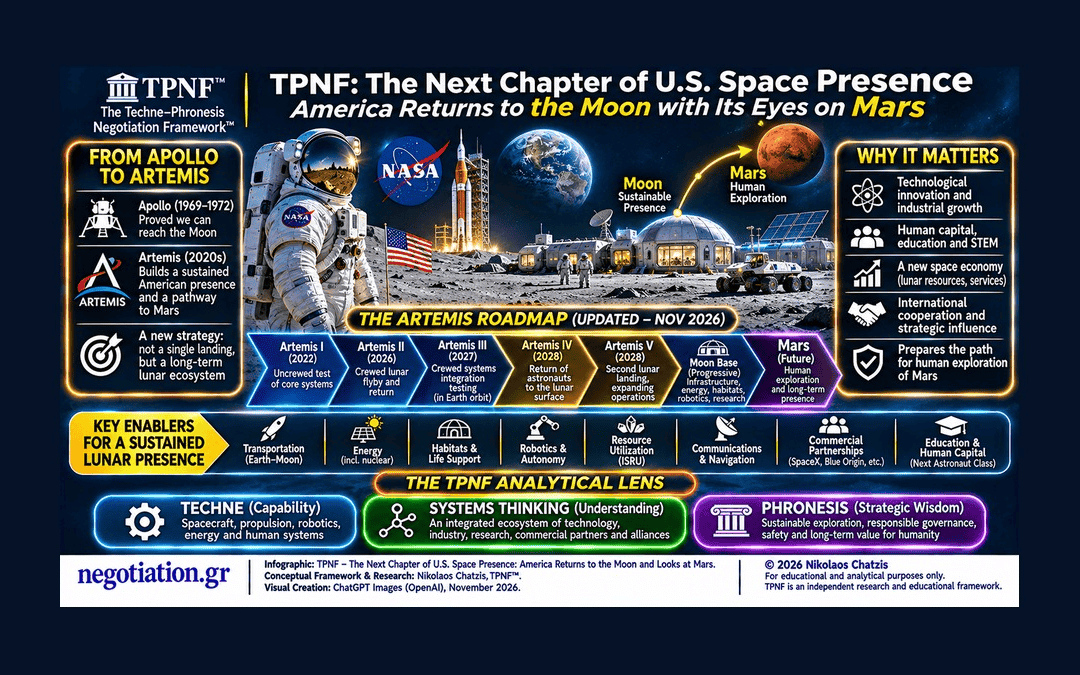
On November 4, 2026, NASA published an updated Artemis roadmap following a presentation by Administrator Jared Isaacman and other agency officials.
The revised architecture emphasizes accelerated mission development, operational testing, commercial partnerships, and reduced technological dependencies.
NASA
| Mission | Year | Strategic objective |
|---|---|---|
| Artemis I | 2022 | Uncrewed deep-space systems validation |
| Artemis II | 2026 | Crewed lunar flyby and safe return |
| Artemis III | 2027 | Earth-orbit testing of crewed and commercial spacecraft integration |
| Artemis IV | 2028 | Planned return of astronauts to the lunar surface |
| Artemis V | 2028 | Planned second lunar landing, supporting mission continuity |
| Moon Base | Progressive development | Sustained lunar exploration and infrastructure |
| Mars exploration | Future objective | Human interplanetary exploration |
Source: NASA’s updated Artemis program and November 2026 mission architecture. Future dates represent planning targets, not guaranteed achievements.
The architectural changes illustrate the importance of strategic adaptation when technological development encounters uncertainty.
3. The Moon Base: From Exploration to Infrastructure
On November 7, 2026, NASA announced additional investments supporting lunar transportation, robotic exploration, energy systems, and surface infrastructure.
These include the development of a nuclear-powered rover named PROMISE and expanded opportunities for commercial lunar cargo deliveries.
A sustainable lunar presence will require interconnected capabilities:
-
Reliable transportation between Earth and the Moon.
-
Habitats, radiation protection, and life-support systems.
-
Energy generation and storage.
-
Autonomous robotic construction and maintenance.
-
Communications and navigation infrastructure.
-
Scientific research and potential local resource utilization.
No individual technology can independently sustain human activity on the Moon.
The strategic value emerges through integration.
A lunar habitat without reliable energy, transportation, maintenance, or communications cannot constitute a sustainable operational environment.
This illustrates the difference between technological capability and technological ecosystem development.
4. The New Role of Commercial Space Companies
Unlike the Apollo program, contemporary American space exploration increasingly involves commercial companies as developers, infrastructure providers, and operational partners.
NASA is pursuing alternative lunar landing arrangements involving SpaceX and Blue Origin.
Both companies are developing capabilities intended to support a crewed lunar landing in 2028. NASA plans to test relevant spacecraft integration during Artemis III in Earth orbit in 2027.
Maintaining alternative technological approaches may reduce dependence on individual suppliers while encouraging innovation.
However, commercial participation also introduces contractual, financial, regulatory, and operational complexities.
NASA must preserve institutional expertise and mission accountability while benefiting from private-sector innovation.
Within TPNF, the emerging American space model represents a negotiated technological ecosystem in which public institutions and commercial actors contribute complementary capabilities.
5. Why the Moon Matters for Mars
Mars represents a substantially greater challenge than lunar exploration.
Its distance from Earth, communication delays, radiation exposure, atmospheric conditions, and extended mission durations introduce technological and human requirements that cannot be fully addressed through lunar experience alone.
Nevertheless, the Moon provides an accessible environment for developing and testing capabilities relevant to future Martian missions.
| Capability | Lunar development | Potential Mars application |
|---|---|---|
| Energy | Sustained surface power | Remote habitat operations |
| Life support | Extended habitation | Long-duration human survival |
| Robotics | Autonomous exploration | Operations with delayed communications |
| Construction | Extraterrestrial habitats | Sustainable surface infrastructure |
| Resource utilization | Local material experiments | Reduced dependence on Earth |
| Human performance | Isolated operational environments | Interplanetary mission readiness |
Mars remains NASA’s long-term human exploration objective. Its scientific importance includes investigating whether life previously existed beyond Earth.
6. The Geopolitics of a Sustained Space Presence
America’s lunar strategy also develops within an increasingly competitive international space environment.
China’s expanding space capabilities and its cooperation with Russia on lunar research demonstrate that extraterrestrial exploration is becoming an important dimension of geopolitical competition.
Strategic influence may increasingly depend on transportation networks, scientific knowledge, communications standards, industrial capacity, and international partnerships.
Nevertheless, competition need not inevitably produce confrontation.
The Artemis Accords, established in 2020, provide principles intended to support responsible international civil space exploration.
The long-term challenge involves balancing national competitiveness with scientific cooperation, transparency, international law, and peaceful exploration.
Space leadership requires more than reaching destinations before competitors. It requires building institutions capable of sustaining responsible activities beyond Earth.
7. Human Capital: Preparing the Next Generation
On November 7, 2026, NASA announced recruitment for its next astronaut class, explicitly connecting future astronaut training with lunar habitation and preparations for Mars.
Final candidate selection is expected in late 2027.
NASA also announced a $1 million Moon Base Challenge encouraging American students to develop solutions involving energy, construction, mobility, life support, communications, and astronaut safety.
These initiatives demonstrate that the future space economy depends on education as much as engineering.
Future astronauts, scientists, engineers, and strategic decision-makers must understand complex technological interdependencies, adapt to uncertainty, and cooperate across disciplinary boundaries.
8. The TPNF Analytical Lens
Techne — Capability
Advanced propulsion, spacecraft, autonomous robotics, artificial intelligence, surface energy systems, habitats, and human expertise enable extraterrestrial exploration.
Systems Thinking — Understanding
Recognizing the interdependencies among transportation, energy, human survival, industrial development, commercial partnerships, scientific research, and international governance.
Phronesis — Strategic Wisdom
Balancing exploration ambitions with astronaut safety, financial sustainability, responsible resource utilization, peaceful cooperation, and intergenerational value creation.
The integration of these three dimensions transforms space exploration into a multidimensional strategic development process.
9. The TPNF Interplanetary Value-Creation Pathway
From Earth-Based Innovation to Interplanetary Value
Earth-Based Technological Ecosystems
Research, education, industry and scientific innovation
Earth–Moon Transportation
Reliable access, spacecraft and logistics
Lunar Infrastructure Development
Energy, habitats, robotics and communications
Sustained Lunar Operations
Operational experience and scientific discovery
Interplanetary Capability Development
Advanced life support, autonomy and transportation
Human Exploration of Mars
Long-term scientific and technological opportunities
TPNF conceptual model — not an official NASA mission architecture.
Each stage potentially generates knowledge and capabilities that support subsequent development.
The objective is cumulative strategic learning rather than isolated technological achievement.
10. Strategic Lessons for Leaders
-
Build ecosystems rather than isolated missions.
-
Maintain alternative technological pathways to reduce dependency.
-
Integrate commercial innovation with institutional accountability.
-
Treat education and human capital as strategic infrastructure.
-
Balance geopolitical competition with international cooperation.
-
Prioritize safety, sustainability, and continuous operational learning.
11. Conclusion: Humanity’s Next Strategic Frontier
America’s return to the Moon represents an opportunity to redefine the strategic purpose of human space exploration.
The emerging lunar ecosystem could become a foundation for scientific discovery, economic innovation, educational development, and future interplanetary missions.
Nevertheless, reaching Mars will require considerably more than advanced spacecraft.
It will require technological integration, institutional resilience, sustained investment, international cooperation, and responsible strategic judgment.
Within TPNF, the ultimate achievement is not merely reaching another celestial body.
It is developing the sustainable technological ecosystems that allow humanity to continue exploring, learning, and creating value beyond Earth.
Key Takeaways
The Moon represents both a scientific destination and a developmental environment for future interplanetary capabilities. America’s long-term space leadership will depend on its ability to integrate technological innovation, institutional cooperation, commercial participation, and strategic wisdom.
Author’s Reflection
Humanity’s exploration of space represents one of the most extraordinary expressions of technological creativity and intellectual curiosity.
However, the ability to reach distant destinations should be accompanied by the wisdom to understand why we pursue them.
The return to the Moon offers humanity an opportunity to develop not only more advanced technologies but also more sophisticated approaches to cooperation, responsibility, and long-term strategic thinking.
Techne makes the journey possible. Systems Thinking connects its technological and institutional foundations. Phronesis gives the journey its enduring purpose.
Nikolaos Chatzis
Selected Research References
| Date | Primary source |
|---|---|
| November 4, 2026 | NASA — Plans to Accelerate Artemis and Return to the Moon |
| November 7, 2026 | NASA — Moon Base Transportation, Technology and Science Projects |
| November 7, 2026 | NASA — Recruitment of the Next Generation of Astronauts |
| November 8, 2026 | NASA — $1 Million Student Moon Base Challenge |
| Current architecture | NASA — Artemis Program |
| Long-term objectives | NASA — Humans to Mars |
Source: Open Sources Analysis, Relative Data Analysis by Nikos Chatzis
© Nikolaos Chatzis. All Rights Reserved.
The Techne–Phronesis Negotiation Framework™
An Integrative Theory of Strategic Negotiation, Complex Adaptive Systems and Practical Wisdom
Technology Creates Capability • Systems Thinking Creates Understanding • Strategic Wisdom Creates Lasting Value.
Negotiation.gr | Strategic Wisdom for the Technological Age