Negotiation.gr | Strategic Wisdom for the Technological Age
“Strategic resilience emerges when technical capability (techne) is
continuously guided by practical wisdom (phronesis) through adaptive
negotiation across interconnected systems.”
Defense Technology, Negotiated Strategic Autonomy, and National Aerospace Ecosystem Development
Central Idea (Thesis)
Israel’s ability to customize the American-built F-35 Lightning II represents an important example of negotiated technological autonomy within an international defense technological ecosystem.
The development of the F-35I Adir demonstrates that acquiring advanced military technology need not be limited to purchasing and operating a foreign weapons platform. Under negotiated conditions, procurement can also support domestic industrial development, scientific research, technological adaptation, and national aerospace expertise.
For Greece, the Israeli experience raises an important strategic question: could the acquisition of the F-35 become the foundation for a broader transformation of the Greek defense technological ecosystem?
Purpose of the Essay
This TPNF essay examines the strategic significance of Israel’s negotiated permission to customize the F-35, the relationship between American technological capabilities and Israeli industrial expertise, and the potential lessons for Greece.
Through the Techne–Phronesis Negotiation Framework™ (TPNF), it distinguishes military procurement from the development of sustainable national technological capabilities.
The educational objective is to help students, policymakers, and defense professionals understand how international defense negotiations can generate multidimensional, long-term strategic value.
Abstract
The F-35I Adir illustrates how technological adaptation, diplomatic influence, industrial capabilities, and strategic planning can interact within a sophisticated international defense program.
Israel’s experience provides Greece with a valuable comparative case, although differences in industrial capacity, bilateral relations, and American technology-transfer restrictions must be acknowledged.
1. The F-35I Adir: Beyond Conventional Military Procurement
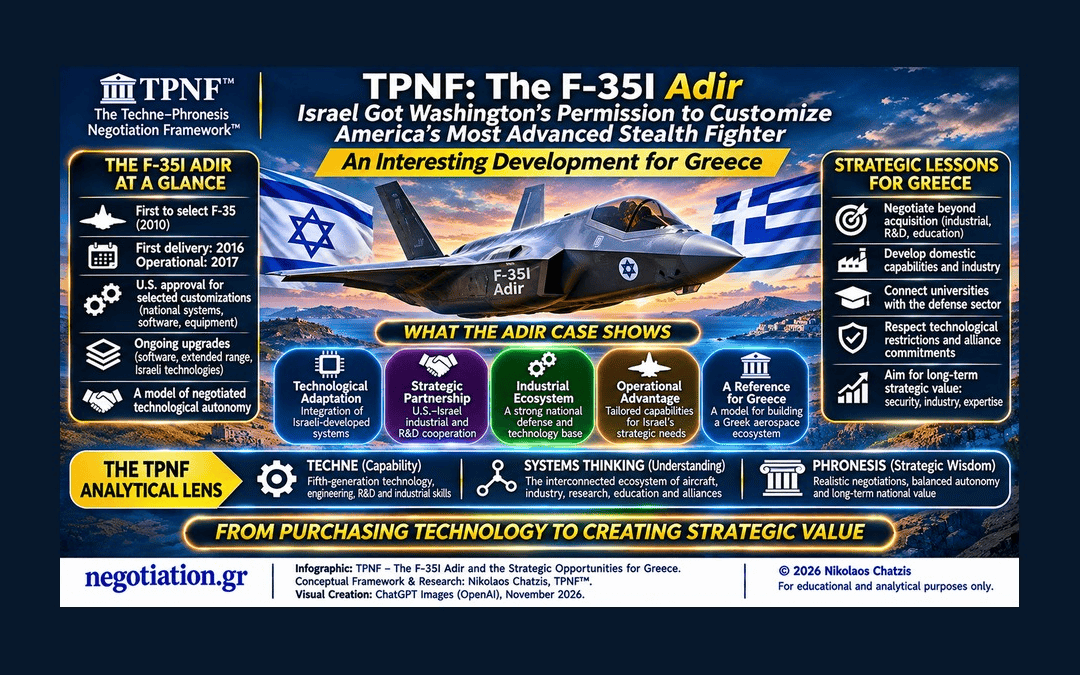
Israel became the first country to select the F-35 through the American Foreign Military Sales (FMS) process in October 2010. Its first aircraft was delivered in 2016, and initial operational capability followed in December 2017.
The aircraft received the Hebrew designation Adir, meaning “Mighty One.”
However, the distinguishing characteristic of the Israeli program is its negotiated customization framework.
Israel secured permission to incorporate selected national technologies into the American aircraft while respecting American restrictions concerning sensitive intellectual property and core software.
Consequently, the Adir represents more than an imported fifth-generation fighter. It illustrates the interaction between an international technological platform and an established national defense research and industrial ecosystem.
2. What Did Washington Actually Permit?
Israel’s customization privileges are longstanding arrangements rather than an entirely new authorization granted in November 2026.
The Congressional Research Service has documented Israeli access to selected development and integration opportunities, including nationally developed communications, electronic systems, and equipment.
Nevertheless, the United States and Lockheed Martin retain control over sensitive F-35 source code. Israel’s customization rights do not constitute unrestricted access to the aircraft’s technological architecture.
This distinction is strategically important.
Israel negotiated a degree of technological flexibility without acquiring complete technological independence.
The outcome represents a form of negotiated strategic autonomy within controlled technological interdependence.
3. The Continuing Evolution of the Adir in 2026
Three developments during 2026 illustrate the continuing evolution of the Israeli customization program.
| Date | Development |
|---|---|
| April 7, 2026 | An $11.4 million American contract supporting further Israeli-specific software modifications. |
| May 14, 2026 | An Israeli defense ministry contract exceeding $34 million for developing extended-range capabilities. |
| September 15, 2026 | Announcement of further integration of Israeli-developed equipment through cooperation between Rafael and Lockheed Martin. |
These developments demonstrate the continuing institutional relationship among the Israeli Ministry of Defense, American authorities, Lockheed Martin, and Israeli defense companies.
Importantly, announced development and integration contracts should not be confused with completed operational capabilities.
4. Israel’s Defense Technological Ecosystem
Israel’s negotiating position is supported by decades of investment in defense research, engineering, industrial development, and technological entrepreneurship.
Companies such as Israel Aerospace Industries (IAI), Elbit Systems, and Rafael participate in a broader ecosystem connecting military institutions, universities, researchers, software developers, and advanced manufacturers.
The ability to contribute nationally developed technologies strengthens Israel’s position as an industrial partner rather than exclusively a military customer.
From a TPNF perspective, technological capabilities become bargaining resources.
A country possessing valuable engineering expertise can potentially offer its international partners mutually beneficial industrial and technological cooperation.
This creates opportunities for negotiations extending beyond aircraft prices and delivery schedules.
5. Negotiation as a Source of Technological Value
Traditional military procurement negotiations often emphasize acquisition costs, aircraft numbers, delivery schedules, and maintenance arrangements.
The Israeli experience illustrates a broader negotiating agenda incorporating:
-
Domestic industrial participation.
-
Research and development cooperation.
-
Approved technological adaptation.
-
Sustainment capabilities and technical education.
-
Long-term institutional relationships.
Such negotiations can transform defense expenditure into an opportunity for technological development.
Nevertheless, successful outcomes depend on supplier consent, intellectual property protections, export regulations, and the purchasing country’s ability to make credible industrial contributions.
Negotiation cannot substitute for technological competence. It can, however, create opportunities to develop and employ it.
6. Why Is the Israeli Experience Important for Greece?
Greece’s acquisition of the F-35 represents a major modernization of the Hellenic Air Force.
However, its strategic significance could extend beyond the introduction of fifth-generation aircraft.
In January 2026, an Israeli military spokesperson publicly expressed willingness to share Israel’s F-35 experience with Greece, reflecting the broader development of bilateral defense cooperation.
This creates an interesting opportunity for institutional learning.
Greece could examine how Israeli experience might inform technical education, maintenance organization, research cooperation, and defense industrial development.
However, Israeli customization privileges cannot automatically be transferred to Greece.
Any comparable arrangement would require separate American authorization and negotiations reflecting Greek requirements, industrial capabilities, and alliance commitments.
7. From Aircraft Acquisition to Aerospace Ecosystem Development
Greece could consider a complementary national aerospace development strategy involving the Hellenic Air Force, Hellenic Aerospace Industry, universities, research institutions, and emerging technology companies.
A Proposed TPNF Greek Aerospace Value-Creation Pathway
01
F-35 Acquisition
Access to advanced aviation technology
02
Education and Human Capital
Pilots, engineers, researchers and technical personnel
03
International Industrial Cooperation
American, Israeli and Greek institutional partnerships
04
National Research and Development
Software, simulation, aerospace engineering and approved technologies
05
Industrial Integration
Certified manufacturing, maintenance and technological services
06
Long-Term Strategic Value
Industrial resilience, national expertise and sustainable aerospace development
TPNF conceptual development model — not an announced Greek government program.
The objective would not be to reproduce the Israeli aerospace ecosystem but to develop a sustainable model adapted to Greece’s resources and institutional environment.
8. The TPNF Analytical Lens
Techne — Capability
The acquisition of fifth-generation aviation technologies, alongside investment in engineering, software, scientific research, and industrial expertise.
Systems Thinking — Understanding
Recognition of the interdependencies connecting aircraft manufacturers, governments, universities, defense industries, human capital, international regulations, and technological infrastructure.
Phronesis — Strategic Wisdom
The responsible negotiation of realistic technological opportunities, balancing national autonomy, alliance commitments, affordability, security, and long-term industrial development.
The integration of these three dimensions allows defense procurement to become a potential instrument of national technological transformation.
9. Greece and Israel: Different Conditions, Shared Opportunities
Greece and Israel possess different geopolitical environments, industrial histories, research capabilities, and relationships with Washington.
The United States also maintains a specific legal commitment to preserving Israel’s qualitative military edge in the Middle East. This influences American decisions concerning sensitive defense technology transfers.
Greece should therefore regard Israel’s customization arrangements as an educational and negotiating reference rather than an automatically applicable precedent.
Potential cooperation should focus on mutually beneficial projects, authorized knowledge exchange, aerospace education, research partnerships, and institutional capacity building.
The strategic objective should be the gradual expansion of Greek capabilities through realistic, legally compliant, and economically sustainable arrangements.
10. Strategic Lessons for Leaders
-
Negotiate beyond acquisition: Include industrial development and education in long-term procurement planning.
-
Develop credible national capabilities: Technological expertise strengthens bargaining positions.
-
Connect universities with industry: Aerospace modernization requires sustainable human capital.
-
Respect technological restrictions: Strategic autonomy must coexist with international obligations.
-
Develop institutional continuity: Aerospace ecosystems require investment extending beyond individual procurement cycles.
-
Evaluate multidimensional value: Consider industrial, educational, technological, economic, and national security outcomes.
11. Conclusion: From Purchasing Technology to Creating Strategic Value
The F-35I Adir demonstrates that advanced military platforms can become foundations for broader technological ecosystem development when supported by industrial competence and successful international negotiations.
For Greece, the central question is not whether it can immediately obtain the same customization privileges as Israel.
It is whether Greece can develop a long-term national aerospace strategy that transforms its defense investments into opportunities for education, industrial modernization, research, and technological resilience.
Within TPNF, acquiring advanced technology constitutes only the beginning of strategic value creation.
The acquisition of technological capability should become the starting point for developing national technological competence.
Key Takeaways
Israel’s F-35I experience illustrates negotiated autonomy rather than complete technological independence. Greece can study this experience while developing an aerospace ecosystem appropriate to its own capabilities, international commitments, and national strategic objectives.
Author’s Reflection
The acquisition of a fifth-generation fighter represents an extraordinary technological opportunity.
However, the greater strategic challenge concerns what a nation can learn, develop, and sustain through its participation in an international defense technological ecosystem.
Greece should approach its aerospace modernization not exclusively as a military requirement but also as a potential opportunity for national technological advancement.
Techne provides the capabilities. Systems Thinking reveals the interconnected opportunities. Phronesis determines how these opportunities can generate lasting national value.
Nikolaos Chatzis
Selected Research References
Source: Open Sources Analysis, Relative Data Analysis by Nikos Chatzis
© Nikolaos Chatzis. All Rights Reserved.
The Techne–Phronesis Negotiation Framework™
An Integrative Theory of Strategic Negotiation, Complex Adaptive Systems and Practical Wisdom
Technology Creates Capability • Systems Thinking Creates Understanding • Strategic Wisdom Creates Lasting Value.
Negotiation.gr | Strategic Wisdom for the Technological Age