Negotiation.gr | Strategic Wisdom for the Technological Age
“Strategic resilience emerges when technical capability (techne) is
continuously guided by practical wisdom (phronesis) through adaptive
negotiation across interconnected systems.”
Cybersecurity, Strategic Trust, and the Challenge of Long-Term Value CreationC
Central Idea (Thesis)
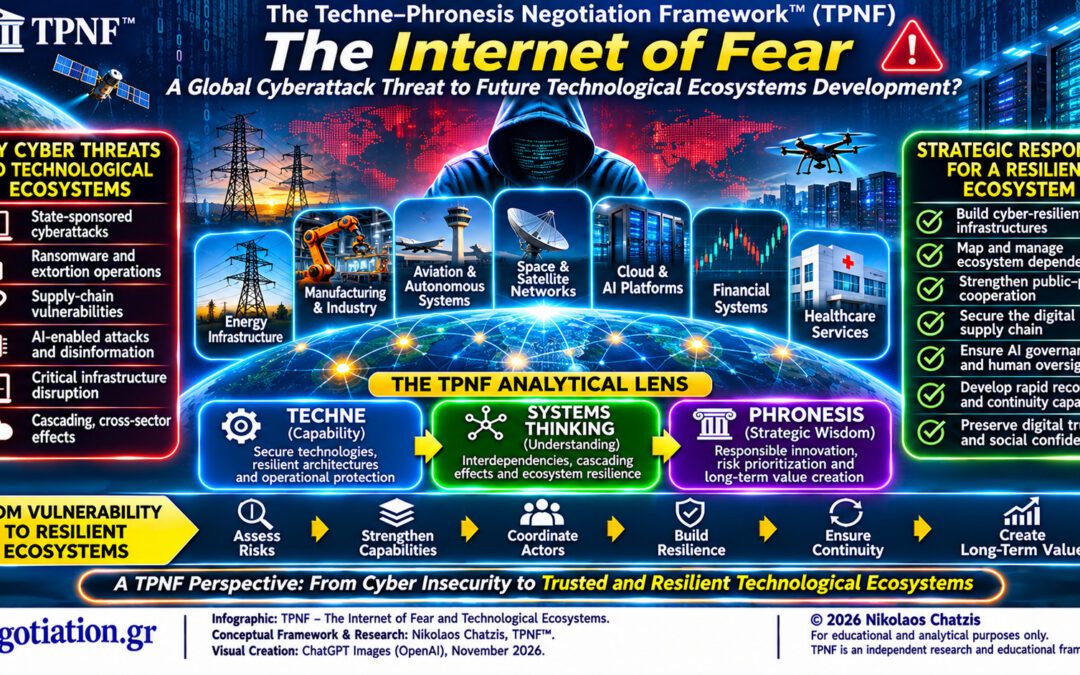
The growing interdependence of artificial intelligence, cloud computing, satellite networks, autonomous systems, digital infrastructure, and industrial platforms creates extraordinary opportunities for human development. Yet the same interconnectedness exposes technological ecosystems to cascading cyber disruptions.
Within the Techne–Phronesis Negotiation Framework™ (TPNF), the central strategic challenge is not simply preventing cyberattacks. It is preserving the institutional trust, operational resilience, and collective confidence necessary for technological innovation and sustainable long-term value creation.
The Internet of Fear emerges when insecurity becomes sufficiently widespread that technological interdependence is perceived primarily as vulnerability rather than opportunity.
1. Introduction: From the Internet of Things to the Internet of Fear
The Internet of Things connects physical devices, sensors, machines, and infrastructure through digital networks. Artificial intelligence extends this interconnectedness by enabling increasingly autonomous analysis and decision support.
However, technological integration also expands the potential consequences of cyberattacks.
A compromised software supplier may expose multiple customers. An attack against a cloud provider may interrupt numerous services. A disruption affecting digital infrastructure may cascade into transportation, healthcare, manufacturing, or financial systems.
The European Union Agency for Cybersecurity (ENISA), in its 2026 Threat Landscape, identifies cyber dependencies, ransomware, geopolitically influenced attacks, and emerging AI-enabled threats as important features of the European security environment.
ENISA+1
The strategic question becomes:
Can humanity continue expanding technological interdependence without simultaneously creating an increasingly fragile global digital ecosystem?
2. The Internet of Fear: A Proposed TPNF Concept
The Internet of Fear may be defined as:
An emerging condition of systemic technological insecurity in which actual or anticipated cyber threats undermine confidence, constrain cooperation, and reduce the capacity of interconnected technological ecosystems to generate sustainable value.
This concept has four interconnected dimensions:
-
Technological: Vulnerabilities in software, hardware, networks, and connected infrastructure.
-
Institutional: Declining confidence in governments, technology providers, and regulatory safeguards.
-
Economic: Investment uncertainty, operational disruption, and increasing security expenditure.
-
Psychological: Fear of dependence on systems whose security cannot be fully guaranteed.
The concept does not imply that the internet itself has become universally unsafe. Rather, it identifies a possible strategic consequence of insufficiently governed technological interdependence.
3. The Global Cyber Threat: Evidence and Strategic Implications
Cybersecurity has become a fundamental concern for governments, industries, and international institutions.
The World Economic Forum’s Global Cybersecurity Outlook 2026 reports that 94% of surveyed respondents expect artificial intelligence to be the most significant driver of cybersecurity change. Furthermore, 65% of large companies surveyed identify third-party and supply-chain vulnerabilities as their greatest challenge to cyber resilience.
World Economic Forum
These findings reveal two important developments.
First, cyber threats increasingly extend beyond individual organizations.
Second, technological innovation can create vulnerabilities faster than institutions develop the capabilities required to manage them.
The result is a strategic paradox: the technologies designed to improve efficiency, productivity, and connectivity may simultaneously increase systemic exposure.
4. Could a Global Cyberattack Disrupt Future Technological Ecosystems?
A coordinated cyber campaign against interconnected infrastructure could produce consequences across several sectors.
Potential disruption pathways
| Technological ecosystem | Possible consequences |
|---|---|
| AI and cloud computing | Interruption of digital services and decision-support systems |
| Energy infrastructure | Disruption of electricity distribution and dependent services |
| Satellite and communications networks | Reduced connectivity and operational coordination |
| Autonomous aviation and drones | Interference with supporting networks, data, or ground systems |
| Financial platforms | Transaction delays and loss of confidence |
| Advanced manufacturing | Production interruptions and supply-chain instability |
These are plausible risk scenarios, not predictions of a single imminent global attack.
A truly worldwide simultaneous disruption would require extensive capabilities and favorable conditions for attackers. Nevertheless, interconnected dependencies mean that even geographically limited incidents may have international consequences.
The distinction between a global cyber threat and a single global cyberattack is therefore essential.
5. Cyber Geopolitics: Technology as an Instrument of Strategic Competition
Cybersecurity increasingly intersects with international power competition.
State-linked espionage, criminal ransomware operations, politically motivated disruption, and information manipulation have different objectives but may exploit similar technological vulnerabilities.
ENISA’s 2026 assessment identifies public administration as the most frequently targeted European sector in its incident dataset, accounting for 32% of cases. It also highlights the continuing influence of geopolitical developments on cyber activity.
ENISA+1
Technological dependence therefore becomes a geopolitical consideration.
Governments must balance international technological cooperation with national security, digital sovereignty, and the protection of critical infrastructure.
Yet complete technological isolation is neither realistic nor necessarily desirable.
The strategic challenge is to establish trustworthy interdependence rather than pursue absolute technological independence.
6. Artificial Intelligence: A Dual-Use Cybersecurity Challenge
Artificial intelligence introduces a particularly important strategic dilemma.
AI can strengthen cybersecurity through anomaly detection, threat analysis, automated monitoring, and faster incident response.
However, malicious actors may exploit AI to increase the scale and sophistication of social engineering, reconnaissance, and deceptive communications.
The World Economic Forum reports that 87% of its surveyed respondents identified AI-related vulnerabilities as the fastest-growing cyber risk during 2025. This represents respondents’ assessment of risk, not a measured 87% increase in attacks.
World Economic Forum
The TPNF perspective emphasizes that technological sophistication alone cannot guarantee security.
Human judgment, organizational accountability, and institutional coordination remain indispensable.
7. The TPNF Analytical Lens
Techne — Technological Capability
Develop secure architectures, reliable authentication, network segmentation, threat detection, and recovery capabilities.
Systems Thinking — Understanding Interdependence
Identify critical dependencies, cascading vulnerabilities, supply-chain exposure, and cross-sector consequences.
Phronesis — Strategic Wisdom
Balance innovation, security, economic opportunity, civil liberties, and responsible international cooperation.
The interaction of these three dimensions transforms cybersecurity from an exclusively technical problem into a challenge of strategic governance.
8. From Cybersecurity to Ecosystem Resilience
Traditional cybersecurity often emphasizes protecting individual organizations and systems.
Technological ecosystem resilience requires a broader approach.
Governments, universities, manufacturers, software developers, cloud providers, and critical infrastructure operators must coordinate their security responsibilities.
The U.S. National Institute of Standards and Technology’s Cybersecurity Framework 2.0 provides a useful reference through six functions: Govern, Identify, Protect, Detect, Respond, and Recover.
Within TPNF, these functions support a wider strategic objective: preserving the capacity of interconnected ecosystems to operate, adapt, and create value despite disruption.
Resilience should therefore be evaluated not merely by whether an attack is prevented, but also by how effectively essential services continue and recover.
9. Strategic Lessons for Leaders
-
Treat cybersecurity as strategic infrastructure, not merely an information technology expense.
-
Map ecosystem dependencies before expanding technological integration.
-
Build resilience into innovation, rather than adding protection after deployment.
-
Strengthen public-private cooperation through information sharing and coordinated exercises.
-
Preserve human oversight when deploying AI-enabled security and autonomous systems.
-
Develop recovery capabilities alongside prevention and detection.
-
Protect digital trust, recognizing that confidence is essential to long-term technological investment.
10. Conclusion: Can the Internet of Fear Be Prevented?
The future of technological ecosystems will depend not only on increasingly advanced technologies, but also on society’s capacity to govern their interdependence.
Cyberattacks cannot be eliminated entirely. Nevertheless, their systemic consequences can be reduced through sound engineering, institutional cooperation, preparedness, and responsible strategic decision-making.
The Internet of Fear is not an inevitable destination.
It is a warning about what may happen when technological connectivity advances faster than collective security and governance.
Within TPNF, sustainable technological development requires an essential transition:
From technological connectivity to strategic trust; from isolated cybersecurity to ecosystem resilience; and from fear-driven technological dependence to responsible long-term value creation.
Key Takeaways
Cyber insecurity threatens technological development not only through direct disruption but also by undermining confidence and cooperation. The TPNF triad offers a way to connect technological protection, systemic understanding, and strategic judgment. Long-term value creation requires resilient ecosystems capable of adapting to threats without abandoning innovation.
Author’s Reflection
Technological progress has always expanded humanity’s capabilities while introducing new vulnerabilities.
Our challenge is not to retreat from technological interdependence, but to understand and govern it wisely.
The most important question may ultimately be whether humanity can develop institutional wisdom at a pace comparable to its accelerating technological capabilities.
The future should not become an Internet of Fear. It should become an ecosystem of technological opportunity, strategic responsibility, and sustainable human development.
Nikolaos Chatzis
Source: Open Sources Analysis, Relative Data Analysis by Nikos Chatzis
© Nikolaos Chatzis. All Rights Reserved.
The Techne–Phronesis Negotiation Framework™
An Integrative Theory of Strategic Negotiation, Complex Adaptive Systems and Practical Wisdom
Technology Creates Capability • Systems Thinking Creates Understanding • Strategic Wisdom Creates Lasting Value.
Negotiation.gr | Strategic Wisdom for the Technological Age