Negotiation.gr | Strategic Wisdom for the Technological Age
“Strategic resilience emerges when technical capability (techne) is
continuously guided by practical wisdom (phronesis) through adaptive
negotiation across interconnected systems.”
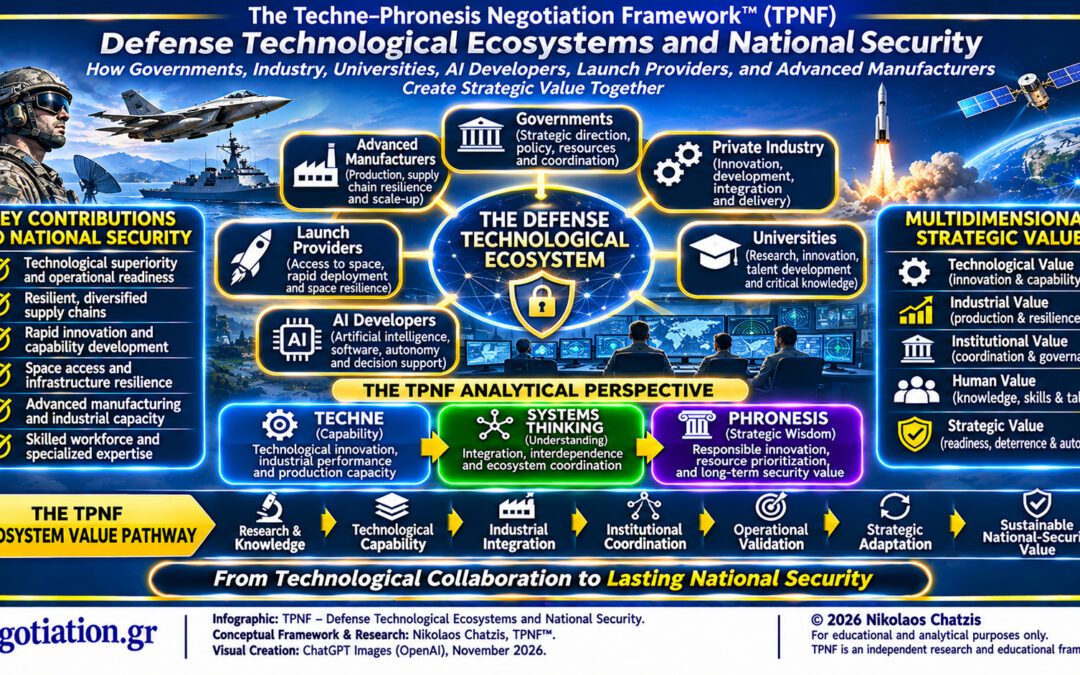
How Governments, Industry, Universities, AI Developers, Launch Providers, and Advanced Manufacturers Create Strategic Value Together
TPNF Research Essay | National Security, Technological Ecosystems and Multidimensional Value Creation | November 16, 2026
Central Idea (Thesis)
National security increasingly depends not only on military capabilities but also on the strength, adaptability, and coordination of the technological ecosystems that produce and sustain them.
Governments, private industry, universities, artificial intelligence developers, space launch providers, and advanced manufacturers contribute different but interconnected capabilities.
The Techne–Phronesis Negotiation Framework™ (TPNF) proposes that their collective strategic value emerges through three dimensions: Techne (Capability), Systems Thinking (Understanding), and Phronesis (Strategic Wisdom).
The central challenge is transforming distributed technological expertise into reliable national-security capabilities while preserving accountability, resilience, and responsible decision-making.
Purpose
This TPNF essay examines how defense technological ecosystems function, why their participants depend upon one another, and how coordinated innovation can create long-term national-security value.
It also considers the institutional and strategic challenges associated with technological interdependence.
Abstract
Modern defense capabilities emerge from networks connecting public institutions, commercial enterprises, research organizations, software developers, and industrial suppliers.
Advanced aircraft, autonomous systems, satellite networks, and artificial intelligence depend upon capabilities distributed across these networks.
The United States, NATO, and European Union have developed initiatives recognizing the importance of industrial resilience, technological innovation, and collaborative research.
TPNF offers a complementary analytical perspective for understanding how these relationships contribute to multidimensional strategic value.
1. From Defense Industries to Technological Ecosystems
Traditional defense-industrial analysis frequently emphasized weapons manufacturers and government procurement.
Modern technological development involves a broader range of participants.
Commercial software companies, universities, semiconductor manufacturers, telecommunications providers, and space enterprises increasingly influence national-security capabilities.
This transformation reflects the growing importance of dual-use technologies.
Artificial intelligence, advanced materials, robotics, and satellite communications may serve civilian and military applications.
Consequently, national-security innovation increasingly depends upon relationships extending beyond conventional defense contractors.
An ecosystem perspective helps explain these connections.
The strategic question is no longer simply which organization produces a particular system, but how multiple organizations collectively create, integrate, and sustain capabilities.
2. Governments: Strategic Direction and Institutional Coordination
Governments establish national-security priorities, allocate resources, define regulations, and determine procurement requirements.
They also support research, maintain critical infrastructure, and establish partnerships.
The United States’ 2024 National Defense Industrial Strategy identified four priorities: resilient supply chains, workforce readiness, flexible acquisition, and economic deterrence.
These priorities demonstrate that technological superiority depends upon broader industrial and institutional conditions.
However, governments cannot independently generate every necessary innovation.
They must establish effective relationships with private enterprises, universities, and specialized technology providers.
Within TPNF, government leadership requires aligning national objectives with technological capabilities and responsible institutional governance.
3. Private Industry: Innovation and Operational Delivery
Private industry transforms research and technological opportunities into products, infrastructure, and services.
Established defense companies contribute engineering expertise, integration capabilities, production capacity, and long-term maintenance.
Emerging companies may introduce new approaches to software development, autonomy, manufacturing, and operational experimentation.
Competition can stimulate innovation.
However, fragmented industrial activity may create compatibility problems, duplicated investment, or dependence upon vulnerable suppliers.
Effective ecosystems therefore require both competition and coordination.
The objective is not simply maximizing the number of technology providers.
It is developing industrial relationships capable of delivering reliable capabilities at appropriate cost and scale.
4. Universities: Knowledge and Human Capital
Universities contribute fundamental research, scientific expertise, engineering education, and professional development.
Their role extends beyond producing graduates.
Academic institutions investigate emerging technologies, develop experimental methods, and connect different disciplines.
Research involving artificial intelligence, aerospace engineering, cybersecurity, advanced materials, and robotics can generate knowledge relevant to national security.
Universities also cultivate critical thinking and technological adaptability.
Nevertheless, academic collaboration requires appropriate safeguards concerning research integrity, security, intellectual property, and academic freedom.
TPNF emphasizes that long-term technological strength depends upon developing people capable of understanding and improving complex systems.
5. AI Developers: Software as Strategic Capability
Artificial intelligence increasingly influences defense research, data analysis, maintenance, logistics, and autonomous systems.
AI developers contribute algorithms, software architectures, computational expertise, and methods for processing complex information.
Their technologies may improve decision support and operational efficiency.
However, military applications introduce demanding requirements involving reliability, cybersecurity, transparency, and human oversight.
Software performance in controlled environments does not automatically establish suitability for operational deployment.
AI capabilities must therefore undergo appropriate testing, integration, and governance.
Within TPNF, artificial intelligence represents Techne, while its integration and responsible employment require Systems Thinking and Phronesis.
6. Launch Providers: The Space Dimension of Security
Space infrastructure has become increasingly important to national security.
Satellites support communications, navigation, environmental observation, intelligence gathering, and other essential functions.
Commercial launch providers contribute transportation capabilities necessary to deploy and replenish orbital systems.
Reusable launch technologies may eventually improve launch flexibility and reduce certain costs.
However, national-security value depends upon more than access to rockets.
Satellite manufacturing, launch infrastructure, ground stations, cybersecurity, and orbital operations must function together.
The ecosystem must also address resilience against disruption.
Space launch providers therefore contribute to a wider infrastructure whose strategic importance depends upon reliable coordination.
7. Advanced Manufacturing: From Design to Production
Technological innovation becomes operationally meaningful when systems can be manufactured, maintained, and replaced.
Advanced manufacturing includes precision engineering, additive manufacturing, electronics production, specialized materials, and automated industrial processes.
These capabilities influence production speed, quality, and adaptability.
However, sophisticated designs may depend upon scarce materials or highly specialized suppliers.
A disruption affecting one critical component can delay an entire production program.
This creates a fundamental strategic distinction between possessing an advanced design and maintaining the industrial capacity to produce it reliably.
TPNF identifies manufacturing resilience as a necessary connection between technological capability and sustained national-security value.
8. Systems Thinking: Understanding Interdependence
Defense technological ecosystems contain numerous relationships and dependencies.
A satellite program may require university research, specialized components, manufacturing facilities, launch services, software integration, and government authorization.
Weakness in one component may affect the entire program.
Systems Thinking encourages decision-makers to examine these relationships before evaluating individual technologies.
It also helps identify bottlenecks, vulnerabilities, and opportunities for cooperation.
Within TPNF, national-security effectiveness emerges from coordinated capabilities rather than isolated technological achievements.
9. Phronesis: Responsible Strategic Judgment
Technological capability creates opportunities, but not every available technology should be deployed immediately.
Phronesis concerns responsible judgment under uncertainty.
Governments must balance national-security requirements with economic sustainability, public accountability, and legal obligations.
Companies must evaluate commercial incentives alongside security and reliability.
Universities must balance research openness with legitimate protection requirements.
AI developers must consider system limitations and potential misuse.
Strategic wisdom therefore involves recognizing trade-offs among innovation, security, transparency, and responsibility.
The objective is to strengthen national security without undermining the institutions and values that security is intended to protect.
10. NATO DIANA: An Ecosystem in Practice
NATO’s Defence Innovation Accelerator for the North Atlantic, DIANA, provides a practical example of collaborative technological development.
It connects innovators with accelerator facilities, test centers, investors, experts, and potential defense users.
Its activities focus upon emerging and dual-use technologies relevant to Allied security.
DIANA illustrates how governments can facilitate cooperation without independently developing every technological solution.
It also demonstrates the importance of testing, validation, and pathways toward adoption.
From a TPNF perspective, the initiative connects technical innovation with institutional coordination and practical strategic adaptation.
11. European Defense Cooperation
The European Defence Fund supports collaborative defense research and development among participating European industrial organizations.
Its approach recognizes that technological capabilities may benefit from cooperation across national boundaries.
Joint research can distribute costs, combine expertise, and strengthen industrial relationships.
However, multinational programs also encounter challenges involving procurement priorities, industrial competition, governance, and technological sovereignty.
TPNF emphasizes that cooperation creates value when participants establish workable arrangements for managing these differences.
12. Multidimensional National-Security Value
Defense technological ecosystems may generate several forms of value.
Technological value: Innovation and improved capabilities.
Industrial value: Production capacity and supply-chain resilience.
Institutional value: Coordination, accountability, and adaptability.
Human value: Scientific knowledge, professional skills, and employment.
Strategic value: Improved readiness, deterrence, and freedom of action.
These dimensions may reinforce one another, but they can also involve competing priorities.
Multidimensional value creation requires evaluating outcomes rather than assuming that every technological investment produces strategic benefits.
13. The TPNF Ecosystem Value Pathway
TPNF proposes the following analytical progression:
Research and Knowledge → Technological Capability → Industrial Integration → Institutional Coordination → Operational Validation → Strategic Adaptation → Sustainable National-Security Value
The pathway emphasizes the relationship between invention and implementation.
Research generates possibilities.
Industry develops capabilities.
Institutions coordinate resources.
Testing establishes reliability.
Adaptation incorporates evidence and changing requirements.
Long-term value emerges when the ecosystem can sustain and improve its capabilities.
Strategic Lessons for Leaders
- Treat national security as a technological and institutional ecosystem.
- Connect government priorities with commercial and academic innovation.
- Preserve resilient manufacturing and supply chains.
- Develop reliable AI governance and human oversight.
- Strengthen cooperation without creating excessive technological dependence.
- Evaluate success through operational outcomes and long-term adaptability.
Modern national security depends increasingly upon the collective capabilities of interconnected technological institutions.
Governments provide direction, industry develops systems, universities generate knowledge, AI developers contribute software, launch providers enable space infrastructure, and manufacturers deliver production capacity.
Yet these contributions create lasting strategic value only when integrated effectively.
TPNF proposes that Techne, Systems Thinking, and Phronesis provide a complementary perspective for understanding this challenge.
The ultimate objective is not merely technological superiority, but a resilient and responsible ecosystem capable of adapting to future security requirements.
Key Takeaways
National-security capabilities emerge from interconnected technological organizations.
Industrial resilience and human expertise are as important as innovation.
Systems integration determines how separate capabilities function together.
Responsible governance remains essential.
TPNF connects technological capability, ecosystem understanding, and strategic wisdom.
Author’s Reflection
The strength of a nation cannot be measured exclusively through the weapons systems it possesses.
Its deeper strategic capabilities reside within the institutions, people, technologies, and relationships that make innovation possible.
A university laboratory, an advanced manufacturing facility, an AI development team, and a space launch provider may contribute different capabilities to the same national-security objective.
For TPNF, their collective value depends upon understanding these relationships and guiding them responsibly.
The strategic challenge is transforming technological diversity into institutional coherence, practical adaptability, and lasting value.
Nikolaos Chatzis
Primary Research References
The essay draws on established institutional initiatives rather than assuming that the proposed TPNF relationships have already been empirically validated.
1. U.S. Department of Defense — National Defense Industrial Strategy (2024). Establishes supply-chain resilience, workforce readiness, flexible acquisition, and economic deterrence as strategic priorities.
defense.gov
Official U.S. defense strategy
2. U.S. Department of Defense — NDIS Implementation Plan (2024). Addresses industrial production, allied cooperation, supply-chain vulnerabilities, and the implementation of defense-industrial priorities.
defense.gov
3. NATO — Defence Innovation Accelerator for the North Atlantic (DIANA). Connects universities, entrepreneurs, companies, test centers, and defense users.
NATO Topic
4. European Commission — European Defence Fund. Supports multinational cooperative research and development of defense technologies and industrial capabilities.
European Commission
Source: Open Sources Analysis, Relative Data Analysis by Nikos Chatzis
© Nikolaos Chatzis. All Rights Reserved.
The Techne–Phronesis Negotiation Framework™
An Integrative Theory of Strategic Negotiation, Complex Adaptive Systems and Practical Wisdom
Technology Creates Capability • Systems Thinking Creates Understanding • Strategic Wisdom Creates Lasting Value.
Negotiation.gr | Strategic Wisdom for the Technological Age